

P0501 on 2005-2015 Nissan Frontier: Vehicle Speed Sensor Range & Performance Causes and Fixes
On a 2005-2015 Frontier, P0501 is most often caused by a faulty Output Vehicle Speed Sensor (VSS) on the transmission. It's a relatively easy and affordable fix, with the part costing between $40 and $100. However, if an ABS light is also on, the issue is more likely a faulty ABS wheel speed sensor, which provides a conflicting signal to the PCM.
- P0501 on a 2005-2015 Frontier most likely points to the Output Vehicle Speed Sensor on the transmission, not an ABS sensor.
- Before buying parts, scan for ABS codes ('C' codes). If you have one, that's your problem. If not, focus on the transmission sensor.
- If you own a 2005-2010 model, immediately check your transmission fluid for coolant contamination (pink, milky appearance) to rule out the catastrophic SMOD failure.
- Symptoms almost always include an erratic speedometer, poor shifting, and disabled cruise control.
- Replacing the transmission VSS is a beginner-friendly job, typically requiring only basic hand tools and about an hour of time.
What's Unique About the 2005-2015 Nissan Frontier
Unlike many vehicles that exclusively use ABS wheel sensors for vehicle speed, the D40 Frontier primarily relies on a dedicated Vehicle Speed Sensor (VSS) on the transmission for the speedometer and PCM. While a bad ABS sensor can trigger this code by providing conflicting data, the transmission VSS is the most common culprit. For 2005-2010 models, it's critical to know about the infamous "Strawberry Milkshake of Death" (SMOD), where an internal radiator failure contaminates the transmission fluid, which can destroy electronic sensors like the VSS and the entire transmission.
Generation note: This guide covers the second generation (D40) Nissan Frontier. The primary causes and fixes are consistent across this generation, but the 2005-2010 models have a specific radiator defect that can lead to this code as a secondary symptom of major transmission failure.
Symptoms You May Notice
- Erratic or non-functional speedometer
- Harsh, late, or incorrect automatic transmission shifting
- Cruise control will not engage or work properly
- Check Engine Light is on
- ABS or Traction Control light may be illuminated
- Engine may seem low on power due to incorrect shift strategy 🎬 Watch: A quick breakdown of P0501 engine code causes.
- Replacing an ABS wheel speed sensor when the fault is actually the transmission VSS (typically when no ABS light is on).
- Replacing the transmission's *input* speed sensor (which causes code P0717) instead of the *output* speed sensor (P0720/P0501).
- Replacing the transmission VSS when the actual cause is a faulty ABS wheel speed sensor that is setting a 'C' code in the ABS module.
Most Likely Causes
- Faulty Transmission Output Vehicle Speed Sensor (VSS) 🔴 High Probability This is the primary sensor used by the PCM for vehicle speed data on this platform. It is an electronic component that can fail with age, heat cycles, and vibration. It is the most cited fix in owner forums for a P0501 code without an accompanying ABS light.
How to confirm: With a scan tool, monitor the VSS data while driving. If the reading is erratic, jumps to zero, or doesn't match the actual speed, the sensor is likely bad. The sensor is located externally on the transmission housing (driver's side on 4WD models, passenger side on 2WD), usually held by a single 10mm bolt.
Typical fix: Replace the Output Vehicle Speed Sensor on the transmission. Ensure the o-ring is properly seated.
Est. part cost: $40-$100 - Faulty ABS Wheel Speed Sensor 🟡 Medium Probability The PCM compares the transmission VSS signal with individual wheel speed sensor signals. A discrepancy, often from a failed wheel sensor, can trigger P0501, usually accompanied by an ABS light. Front sensor wires are prone to damage from steering and suspension movement.
How to confirm: Scan the ABS control module for codes (e.g., C1101-C1108). A specific code will point directly to the faulty wheel sensor. Live data on a scan tool can also show the erratic or missing reading from one wheel compared to the others.
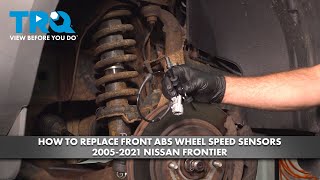
Typical fix: Replace the specific ABS wheel speed sensor indicated by the ABS code. 🎬 Watch: Step-by-step guide to replacing front ABS wheel speed sensors.
Est. part cost: $50-$120 - Damaged Wiring or Connectors ⚪ Low Probability Wiring to the transmission VSS can be damaged by road debris or heat from the nearby exhaust. Wiring to front ABS sensors can fray from constant flexing with suspension travel and steering.
How to confirm: Visually inspect the wiring harness and connector for the transmission VSS and all four ABS wheel speed sensors. Look for breaks, corrosion, melted sections, or chafing. Perform a continuity test on the signal wire if visual inspection is inconclusive.
Typical fix: Repair or replace the damaged section of the wiring harness or the connector.
Est. part cost: $10-$50
Rare But Worth Checking
- Transmission Fluid Contamination (SMOD on 2005-2010 models): On 2005-2010 models, a breach in the internal radiator cooler can mix coolant with transmission fluid. This 'strawberry milkshake' mixture destroys electronic components, including speed sensors. If you have one of these years, check the transmission fluid condition immediately. If it's pink and milky, the sensor failure is a symptom of a much larger problem requiring a new radiator and transmission flush or replacement.
- Faulty Instrument Cluster: In rare cases, the instrument cluster itself can fail, causing an incorrect speedometer reading that conflicts with the PCM's data, triggering the code. This is uncommon but possible if the speedometer behaves erratically while scan tool data from the VSS appears stable.
- Failing Intelligent Power Distribution Module (IPDM): The IPDM, located in the engine bay, contains relays that power many vehicle systems. A failing IPDM can cause a host of strange, intermittent electrical issues, including power loss to sensors or modules, potentially triggering a P0501 code. This is often accompanied by other seemingly unrelated electrical problems.
- Faulty Powertrain Control Module (PCM): This is extremely rare. All other possibilities, including sensors, wiring, and the IPDM, should be exhausted before considering PCM failure.
Diagnosis Steps
- Scan for Codes: Use an OBD-II scanner to check for all codes in the PCM and, crucially, the ABS module. If any 'C' codes (e.g., C1101-C1108) are present, diagnose them first as they will often pinpoint a faulty wheel speed sensor.
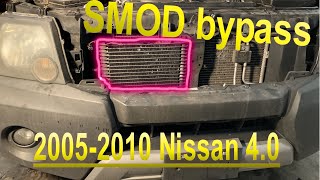
- Check Transmission Fluid (2005-2010 Models): Before proceeding, pull the transmission fluid dipstick. If the fluid is pink, milky, or looks like a strawberry milkshake, you have the SMOD issue. Stop diagnosis and address the radiator and transmission immediately. 🎬 See how to perform the SMOD bypass to protect your transmission.
- Inspect Transmission VSS and Wiring: If no ABS codes are present, locate the Output VSS on the exterior of the transmission housing. Visually inspect its connector and wiring for any obvious damage, corrosion, or looseness. Pay close attention to where the harness may rub against the frame or exhaust components.
- Monitor Live Data: Use a scan tool that can display live data. Observe the 'Vehicle Speed' reading from the PCM while driving. Compare it to your phone's GPS speed and the readings from the individual wheel speed sensors. If the main VSS reading is erratic, drops to zero, or is inconsistent while the wheel speed sensors read smoothly, the transmission VSS is the likely culprit.
- Test the Sensor and Circuit: If you have a multimeter, disconnect the sensor. Check for proper voltage (usually 5V or 12V reference) and ground at the connector. You can also test the resistance of the sensor itself, though values vary by manufacturer. Given the low part cost, replacement is often the most efficient step if live data points to a failure.
- Inspect VSS Drive Gear: When removing the transmission VSS, inspect the plastic gear on its tip. Though less common, this gear can become worn or stripped, causing it to lose contact with the drive gear inside the transmission, leading to an erratic signal.
- Replace the Suspect Part: Based on your findings, replace either the transmission Output VSS or the specific ABS wheel speed sensor that is faulting.
Parts You'll Likely Need
- Transmission Output Vehicle Speed Sensor (VSS)
(OEM #31935-1XJ0A (supersedes 31935-8E006, 31935-8E007))— This is the most common failure point for code P0501 on the 2005-2015 Frontier, especially when no ABS codes are present.
Trusted brands: Hitachi (OEM supplier), NGK/NTK, Nissan Genuine
OEM price range: $90-$150
Aftermarket price range: $40-$80 - ABS Wheel Speed Sensor (Front)
(OEM #47910-EA025)— This is the second most likely cause, especially if an ABS code is also present. The front sensors are more prone to wire damage than the rears.
Trusted brands: Bosch, Standard Motor Products (SMP), Duralast
OEM price range: $100-$180
Aftermarket price range: $50-$120
Related Codes That Often Appear With This One
- C1101-C1108 — These are Nissan-specific ABS codes that indicate a fault with a particular wheel speed sensor. If one of these is present with P0501, the cause is almost certainly the indicated wheel speed sensor or its circuit.
- P0720 — This code is for 'Output Speed Sensor Circuit Malfunction.' It is very similar to P0501 and often points to the same faulty transmission-mounted VSS, indicating a circuit problem rather than just a performance range issue.
- U1000 / U1001 — These are CAN communication codes. If present, they can indicate a broader network issue, possibly related to a failing IPDM or a wiring problem affecting multiple modules, which could be the root cause of the P0501.
Technical Service Bulletins (TSBs) & Recalls
- NTB12-051k: While not directly for P0501, this TSB addresses reprogramming the ECM for a false P0101 (MAF Sensor) code on 2011-2012 Frontiers, showing that ECM logic updates are sometimes required to fix erroneous codes on this platform.
- NTB10-061: Addresses a buzzing/whining noise from the timing chain area on 2005-2010 models, which is a separate major issue but relevant platform context.
Platform-Specific Known Issues
- For 2005-2010 models, a known defect in the radiator can cause coolant to leak into the transmission cooler lines, contaminating the automatic transmission fluid. This condition, known as SMOD ('Strawberry Milkshake of Death'), will destroy the transmission and its electronic components, including the speed sensors.
Mechanic-Grade Diagnostic Values
- Passive ABS Wheel Speed Sensor Resistance — expected: 800 - 2,000 Ohms (varies by manufacturer, but this is a common range). Failure: A reading of OL (Open Loop/Circuit) or near 0 Ohms (Short Circuit) indicates a failed sensor.
- Passive ABS Wheel Speed Sensor AC Voltage Output — expected: At least 100-200 millivolts (0.1-0.2V AC) when spinning the wheel by hand.. Failure: No voltage or very low voltage while the wheel is spinning indicates the sensor is not generating a signal.
Scan Tool Commands That Help
- Nissan CONSULT or advanced professional scanner: IPDM E/R Auto-Active Test — If P0501 is accompanied by other strange electrical faults (lights, wipers, etc.), this test can be used to verify the functionality of the IPDM. It commands various relays and outputs to cycle on and off, helping to confirm if the IPDM itself is faulty.
Wiring & Ground Locations
- IPDM E/R (Intelligent Power Distribution Module Engine Room) — Located in the engine compartment, on the passenger side, near the firewall. It is a black box containing fuses and relays.. A failing IPDM can cause intermittent power loss to various modules and sensors, including the TCM and ABS module, which process speed signals. Corrosion on the internal board or failing relays can be a root cause for P0501 and other U-codes.
- ECM and TCM Harness Connectors — The ECM is typically on the right rear of the engine compartment, while the TCM is often located under the dash or near the transmission itself.. When diagnosing wiring faults, it's necessary to test continuity from the sensor connector back to the control module. Knowing the location of connectors like E119, E126, and the main module connectors is critical for pin-to-pin testing.
- Instrument Cluster Connector — Behind the instrument cluster, accessible after removing the dash trim.. In rare cases, a poor connection at the main cluster harness can cause erratic gauge behavior that may be mistaken for a sensor issue. Reseating this connector can sometimes resolve intermittent problems.
Real Owner Repair Stories
- Reddit user post (Nissan Frontier (year not specified, but D40 generation)) — All gauges on the instrument cluster were not working, no turn signal sound, and some dash lights were out. Externally, all lights worked correctly.
❌ Tried (didn't work) Checked all fuses in the in-cab fuse box., Checked all fuses in the engine bay fuse box (IPDM).
✅ What actually fixed it The owner removed the entire instrument cluster, visually inspected the circuit board (found nothing wrong), and then simply plugged it back in. Upon reconnection, all functions returned to normal, suggesting the root cause was a poor connection at the main cluster harness.
OEM Part Supersession History
31935-8E006, 31935-8E007→31935-1XJ0A— Part consolidation and potential design updates over the vehicle's long production run.31935-1XJ0A→31935-1XJ0C, 31935-1XJ0D— Continued minor revisions to the sensor design or manufacturing process.
Heads up: These parts are generally backward-compatible for the 2005-2015 range. Always verify with the parts supplier for your specific VIN.
Model Year Variations Within This Range
- 2005-2008: These early D40 models were most prone to transmission issues (SMOD) and had numerous complaints. They also had a specific IPDM with a white case that was subject to an ECM relay service bulletin.
- 2009-2019: The 2009 model year received a facelift with a new dashboard and interior styling. While mechanically similar regarding this code, wiring harness routing and connector access may differ slightly from earlier models. Reliability is generally considered better for 2009+ models.
- 2020-2021: While outside the primary range, it's notable that these last two years of the D40 generation received the new 3.8L V6 and 9-speed automatic transmission, which would carry over to the next-generation D41. This completely changes the VSS system and related diagnostics.
Diagnostic Flowchart
Other Known Issues on This Vehicle
Issues unrelated to this code that are worth knowing about as an owner of this generation:
- Radiator Failure / Transmission Contamination (SMOD) 🔴 High — Common on 2005-2010 models with automatic transmissions, typically occurring between 80,000 and 120,000 miles.
- Timing Chain Tensioner & Guide Wear 🔴 High — Common on the 4.0L V6 (VQ40DE) engine, especially in 2005-2010 models. Often presents as a high-pitched whining noise that increases with RPM. Failure can cause catastrophic engine damage. (Ref: NTB10-061; Subject of class-action lawsuits (e.g., Duncan v. Nissan).)
- Fuel Level Sending Unit Failure 🟠 Medium — Very common across all years. Causes an inaccurate or completely empty fuel gauge reading, often triggering codes like P0463. (Ref: Nissan extended the warranty on this part for some model years but it was not a full recall.)
- IPDM-ER Relay Failure 🟠 Medium — Common on earlier models (approx. 2005-2012), causing intermittent crank-no-start conditions or stalling at low speeds. (Ref: NHTSA Campaign 10V517000 was a recall for the ECM relay within the IPDM on some 2005-2006 models.)
- Rear Axle Seal Leaks 🟠 Medium — Affects second-generation Frontiers, leading to differential fluid leaking onto the rear brakes and wheel. If not addressed, can lead to differential failure.
Used vs. New Parts: Buying Guide for This Vehicle
When a used part is the smart pick: For this repair, using a used part is generally not recommended for the sensors themselves due to their low cost new and the difficulty in verifying their remaining lifespan. However, a used IPDM or Instrument Cluster from a reputable salvage yard can be a cost-effective alternative to a new dealership part, which can be very expensive.
Donor-vehicle mileage cap: roughly under 100000 miles for the part to have meaningful remaining life.
What to inspect on the donor part:
- For an IPDM: Inspect the donor vehicle for signs of water leaks in the cowl area. Open the IPDM if possible and look for any white or green powder/corrosion on the circuit board. Avoid any with signs of moisture.
- For an Instrument Cluster: Check the donor vehicle's mileage if possible. Ensure the plastic lens is not cracked or heavily scratched. Verify it comes from a vehicle with the same transmission type (A/T vs M/T).
- For any part: Choose a donor vehicle from a dry climate to minimize corrosion risk. Look for vehicles with front-end damage rather than ones that were junked for electrical or engine problems.
OEM-only on this vehicle (don't cheap out):
- IPDM (Intelligent Power Distribution Module): While a used OEM part is an option, aftermarket IPDMs are not widely available or trusted. A new or used genuine Nissan part is the safest bet.
Aftermarket brands forum-validated for this vehicle:
- Hitachi (often the OEM supplier for the VSS)
- Bosch (for ABS sensors)
- NGK/NTK (for VSS and ABS sensors)
- Standard Motor Products (SMP)
Brands owners have reported issues with on this vehicle:
- Unnamed, no-brand sensors from online marketplaces. These often have high failure rates, incorrect signal outputs, and can cause more diagnostic confusion. Given the relatively low cost of a quality aftermarket part, it's not worth the risk.
Real Owner Stories
Aggregated from forums and TSBs cited above. Mileages and costs reflect what owners reported in those sources.
2005 Nissan Frontier
Symptoms: The speedometer was erratic and the truck threw codes P0501 and P0720.
What fixed it: Replacing the vehicle speed sensor on the transmission.
Source hint: ClubFrontier.org thread titled 'Speedometer not working, P0501, P0720'
Nissan Xterra (platform-mate)
Symptoms: Check Engine Light with code P0501 and the ABS light was also on.
What fixed it: The problem was traced to a faulty rear ABS wheel speed sensor after scanning the ABS module.
Source hint: TheNewX.org thread titled 'P0501 Code, No Speedometer, ABS light on'
2008 Nissan Frontier — ~95000 miles
Symptoms: After experiencing harsh shifting and a P0501 code, the transmission fluid was checked and found to be pink and milky, a condition known as the 'Strawberry Milkshake of Death' (SMOD).
What fixed it: The root cause was a failed radiator allowing coolant to mix with transmission fluid. The radiator and transmission had to be addressed to fix the vehicle.
Source hint: Known Issue: Radiator Failure / Transmission Contamination (SMOD) on 2005-2010 models
Related OBD-II Codes
Frequently Asked Questions
My 2005-2010 Frontier has a P0501 code. What is the very first thing I should check?
My Check Engine Light is on for P0501, but my ABS light is also on. What does this mean for my Frontier?
If I only have a P0501 code and NO ABS light, what is the most common cause?
Where is the main Vehicle Speed Sensor (VSS) located on my Nissan Frontier?
I have a Suzuki Equator with code P0501. Does this Nissan Frontier guide apply?
My Frontier has a high-pitched whining noise and a P0501 code. Are these two problems related?
Helpful Videos

Used OEM Parts in Stock


New Aftermarket Parts Available


The information in this article is provided for general reference and educational purposes only. Vehicle specifications, procedures, and part compatibility can vary by production date, trim level, and region. Always consult your vehicle's factory service manual and verify part numbers before purchasing or performing repairs. Safety-critical components such as airbags, seat belts, and braking systems should be installed by a qualified professional.
- Nissan Frontier:
- 🎬 Helpful Videos
- 🛍️ Shop This Part
- What's Unique About the 2005-2015 Nissan Frontier
- Symptoms You May Notice
- Most Likely Causes
- Rare But Worth Checking
- Diagnosis Steps
- Parts You'll Likely Need
- Related Codes That Often Appear With This One
- Technical Service Bulletins (TSBs) & Recalls
- Platform-Specific Known Issues
- Mechanic-Grade Diagnostic Values
- Scan Tool Commands That Help
- Wiring & Ground Locations
- Real Owner Repair Stories
- OEM Part Supersession History
- Model Year Variations Within This Range
- Diagnostic Flowchart
- Other Known Issues on This Vehicle
- Used vs. New Parts: Buying Guide for This Vehicle
- Real Owner Stories
- 2005 Nissan Frontier
- Nissan Xterra (platform-mate)
- 2008 Nissan Frontier — ~95000 miles
- Related OBD-II Codes
- Frequently Asked Questions
- 🎟️ Get 5% Off