

Ultimate Guide to OBD-II Code C1102: ABS Circuit Failure
The Most Comprehensive Guide to Diagnosing and Fixing C1102 for Technicians and DIYers
- Code C1102 disables your ABS and traction control systems, increasing your risk of skidding and losing steering control during emergency stops.
- Never blindly replace parts; C1102 means 'Wheel Sensor' on a Nissan, 'G-Force Sensor' on a Ford, and 'Low Battery Voltage' (under 9.5V) on a Hyundai.
- Use an advanced OBD-II scanner to monitor live wheel speed data at 15 mph to instantly identify which of the 4 sensors is failing.
- Check your battery and alternator output first, as a voltage drop below 12.4V triggers this exact code on 2009-2018 Hyundai and Kia models.
- Expect to pay between $140 and $350 to replace a single faulty wheel speed sensor, which resolves this code in over 60% of cases.
What Does C1102 Mean?

OBD-II code C1102 signifies that the Anti-lock Brake System (ABS) control module detected a fault within its circuitry. While the generic definition is "ABS Acceleration or Wheel Speed Sensor Circuit Failure," its precise meaning varies by manufacturer. It indicates a problem with a specific wheel speed sensor, the wiring harness, the ABS module, a G-force sensor, or low system voltage.
Technical definition: The SAE J2012 standard defines C1102 as "ABS Acceleration Switch Circuit Failure." However, manufacturers apply this code to various specific issues. It triggers when the ABS control module detects an electrical anomaly—such as an open circuit, a short to ground, a short to power, or an abnormal voltage reading. On a Nissan, it points to a rear wheel speed sensor circuit; on a Ford, a frame-mounted G-force sensor; and on a Hyundai, system voltage dropping below 9.5 volts.
Can I Drive With C1102?
yes_but_not_recommended. Yes, but standard hydraulic brakes are your only stopping method. The Anti-lock Braking System (ABS), Traction Control (TCS), and Electronic Stability Control (ESC) are disabled. During a panic stop, your wheels will lock up, causing you to skid and lose steering control. On wet or icy surfaces, this dramatically increases the risk of an accident. Limit driving to reaching a repair shop.
Common Causes

- Faulty ABS Wheel Speed Sensor (Very Common) — This is the most frequent culprit. The sensor, which measures the rotational speed of a wheel, fails internally due to age, heat, or contamination from road grime and metallic debris.
- Damaged or Corroded Wiring/Connectors (Common) — The wiring harness leading to a wheel speed sensor is exposed to harsh conditions. Wires fray, break, or get chewed by rodents. Connectors fill with moisture and corrode, causing a poor signal or a complete open/short circuit that triggers the code instantly.
- Low Battery Voltage or Charging System Fault (Common) — On many Hyundai, Kia, and some other makes, C1102 is specifically a low voltage code. A weak battery, failing alternator, or poor battery/ground connections causes the ABS module's supply voltage to drop below its operational threshold (often ~9.5V), disabling the system.
- Damaged Tone Ring or Failed Wheel Bearing (Less Common) — The tone ring (which the sensor reads) is often integrated into the wheel bearing. If the bearing fails, develops excessive play, or the ring becomes cracked and rusted, it generates an erratic signal that triggers C1102.
- Faulty ABS Control Module (Less Common) — The electronic module that controls the ABS system fails internally. This is common on certain BMW, VW, and Mercedes models where engine compartment heat cracks internal solder joints over time, leading to communication failures.
- Faulty G-Switch / Acceleration Sensor (Rare) — On specific vehicles, notably older Ford trucks and SUVs, C1102 points to a separate "Acceleration Switch" or G-force sensor mounted on the frame rail. This sensor provides lateral acceleration data to the ABS module.
- Low Brake Fluid (Rare) — A very low brake fluid level triggers a general ABS system fault and illuminates the warning light on some vehicles as a safety precaution.
Symptoms
- ABS Warning Light On — The ABS indicator on the instrument cluster illuminates immediately upon detecting the fault.
- Traction/Stability Control Light On — Because the traction control (TCS) and stability control (ESC/VSC) systems rely on the same wheel speed sensors, their warning lights illuminate alongside the ABS light.
- Wheels Locking Up During Hard Braking — In a panic stop, you feel the wheels lock and the vehicle skids, instead of the characteristic pulsation of the brake pedal associated with a functioning ABS.
- Engine Enters Limp Mode — On certain Nissan and Mercedes-Benz models, a critical ABS fault causes the Powertrain Control Module (PCM) to enter a 'fail-safe' mode, severely restricting engine power and vehicle speed.
- Change in Brake Pedal Feel — The brake pedal feels spongy, stiff, or unresponsive if the fault affects the hydraulic unit or disables the brake assist system.
- Erratic Wheel Speed Sensor Data (scan-tool only — no driver-felt sign) — When viewing live data on a scan tool, the faulty sensor reports a speed of 0 MPH while the vehicle is moving, or its reading jumps erratically compared to the other sensors.
Diagnostic Flowchart
Tap your situation to follow the diagnostic path that matches what you're seeing on this code.
Common Fixes & Costs
- Replace a Faulty ABS Wheel Speed Sensor — Parts: $40-$150, Labor: $100-$200, ~1.5 hr book time (DIY)
- Repair or Replace Damaged Wiring/Connector — Parts: $10-$50, Labor: $150-$450, ~2.5 hr book time (Intermediate)
- Replace Battery or Repair Charging System — Parts: $150-$400, Labor: $100-$300, ~1.5 hr book time (DIY)
- Replace Wheel Hub Bearing Assembly — Parts: $150-$400, Labor: $200-$400, ~2.5 hr book time (Intermediate)
- Repair ABS Control Module — Parts: $150-$400, Labor: $150-$300, ~2.0 hr book time (Professional)
- Replace ABS Control Module/HCU Assembly — Parts: $800-$2000, Labor: $200-$400, ~2.5 hr book time (Professional)
DIY vs Professional
- Replace a Faulty ABS Wheel Speed Sensor — Beginner:
Tools: Jack, jack stands, socket set, torque wrench, flashlight. - Repair or Replace Damaged Wiring/Connector — Beginner:
Tools: Multimeter, wire cutters/strippers, soldering iron or quality crimp tool, heat shrink tubing, wiring diagrams. - Replace Battery or Repair Charging System — Beginner:
Tools: Socket set, multimeter, battery terminal cleaner. - Replace Wheel Hub Bearing Assembly — Beginner:
Tools: Jack, jack stands, large socket/breaker bar for axle nut, torque wrench, slide hammer or hydraulic press. - Repair or Replace ABS Control Module — Beginner:
Tools: Socket set, line wrenches, scan tool with ABS bleeding and programming functions.
Used vs. New Parts: Buying Guide
When a used part is worth it: For an ABS wheel speed sensor, buying used is never recommended. The part is exposed to harsh elements and has a high failure rate. The small cost savings are not worth the risk of premature failure.
Donor-vehicle mileage cap: roughly under 20000 miles for the part to have meaningful remaining life.
Donor quality checklist:
- If considering used, only take from a very low-mileage vehicle that was wrecked.
- Match the part number exactly; connectors and wire lengths are specific.
- Avoid parts from the 'rust belt' as corrosion is a primary cause of failure.
Decision logic:
- If The part is an electronic sensor like a wheel speed sensor. → Buy new. Choose a quality aftermarket brand (e.g., Bosch, Delphi, NTK) or OEM.
- If The part is a complete ABS module/HCU assembly and new is prohibitively expensive ($1500+). → A professional mail-in repair of your original module is the most reliable choice. A used unit from a guaranteed low-mileage donor is a secondary option.
- If Budget is the primary concern. → A new aftermarket sensor is still preferable to a used one and costs only slightly more.
Warranty tradeoff: Used parts: Typically 30-90 day warranty, covers part only. Aftermarket new: 1-year to limited lifetime warranty. OEM new: 12-month/12,000-mile warranty typical.
Worst-case if a used part fails: $150-$300 if a used or cheap aftermarket sensor fails quickly, requiring repeat labor for diagnosis and replacement.
What Happens If You Wait — Timeline
- Immediate: ABS, Traction Control, and Stability Control warning lights illuminate. The safety systems are disabled. The vehicle's standard hydraulic brakes remain functional. (MPG impact: 0%% · Added cost: $0 (Safety risk is the primary cost))
- 1-3 months: If the root cause is a failing wheel bearing, a humming or grinding noise develops and worsens. Continued driving accelerates wear on the hub and potentially the axle spindle. (MPG impact: 0-1%% · Added cost: $350-$600 (Cost to replace the failing wheel bearing before it causes more damage).)
- 3-6+ months: Catastrophic failure of the ignored wheel bearing occurs. This causes the wheel to wobble severely or separate from the vehicle, leading to a complete loss of control. (MPG impact: N/A% · Added cost: $1,500-$3,000+ (Cost to repair the hub, suspension, and brake components after a catastrophic bearing failure).)
- Special Case (Hyundai/Kia): If the ABS light is related to a recalled, faulty HECU/ABS module, an internal short occurs at any time, even when the car is parked and off. This leads to an engine compartment fire. (MPG impact: N/A% · Added cost: $20,000+ (Potential total loss of the vehicle due to fire).)
Cost of Not Fixing It
- Immediate: Loss of Anti-lock Braking (ABS), Traction Control (TCS), and Electronic Stability Control (ESC). This results in a significantly increased risk of skidding and losing control during emergency braking or on slippery surfaces. (Added cost: $0 (Safety risk))
- 0-6 months: If the initial fault is a symptom of a failing wheel bearing, ignoring the noisy bearing leads to catastrophic failure of the wheel hub assembly. (Added cost: $1000-$2500 (If a failed bearing damages the spindle, knuckle, or axle.))
- 6+ months: Continued driving without ABS normalizes unsafe braking behavior. The driver forgets the system is disabled and fails to react properly in an emergency. (Added cost: Potentially total loss of vehicle or severe accident.)
Diagnosis Steps
- Retrieve All Fault Codes
Use a professional-grade OBD-II scanner capable of accessing the ABS module. A basic engine code reader will not see 'C' codes. Document C1102 and any other codes (e.g., C1155, C1230) to provide critical context for the location and nature of the fault.
Tools: OBD-II Scanner with ABS/Chassis function (Beginner) - Check Battery and Charging System Voltage
Perform this crucial step before diving into sensors, especially for Hyundai/Kia. With a multimeter, check the battery voltage with the car off (must be >12.4V). Start the engine and check charging voltage (must be ~13.5V-14.8V). If voltage is low, diagnose the battery or alternator first.
Tools: Multimeter (Beginner) - Analyze Live Data with a Scan Tool
Access the ABS live data stream on your scanner. While driving slowly (or with the wheels raised and spinning by hand), monitor the speed reading from all four wheels. The sensor reading 0 MPH or showing an erratic signal is the source of the problem.
Tools: Advanced OBD-II Scanner (Intermediate) - Visual Inspection of Wiring and Components
Raise the vehicle safely. At the wheel identified in Step 3, visually inspect the wheel speed sensor, its connector, and the wiring harness. Look for broken wires, green corrosion in the connector, or physical damage. Inspect the tone ring for cracks or missing teeth.
Tools: Flashlight, Jack, Jack Stands (Beginner) - Test Active Sensor Circuit at the Connector
Unplug the suspect sensor. With the key ON, use a multimeter to test the harness-side connector. One pin must have a reference voltage (typically 5V or 12V) and another must have a good ground (<100mV). If either is missing, the problem is in the wiring harness or the ABS module.
Tools: Multimeter, Wiring Diagram (Advanced) - Check for Faulty Grounds and Fuses
Consult the service manual to locate the main ground point for the ABS control module. A corroded ground is a common cause of electrical faults on older trucks. Check all fuses related to the ABS system in both the interior and under-hood fuse boxes.
Tools: Owner's Manual, Basic Hand Tools (Beginner) - Test Passive Sensor Resistance
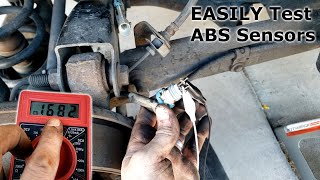
For older, 2-wire passive sensors, disconnect the sensor and set a multimeter to Ohms (Ω). A healthy passive sensor typically has a resistance between 800 and 2,000 Ohms. A reading of OL (Open Loop) or 0 Ohms indicates a failed sensor. 🎬 Watch: How to test ABS sensors for resistance and AC voltage Do not perform this test on active sensors.
Tools: Multimeter, Service Manual (Advanced) - Test Passive Sensor AC Voltage Output
With the passive sensor disconnected, set the multimeter to AC Volts. Connect the probes to the sensor's pins and spin the wheel by hand (one revolution per second). A good sensor generates a small AC voltage, typically above 100mV. No voltage indicates a failed sensor or tone ring.
Tools: Multimeter, Jack, Jack Stands (Advanced) - Pro Tip: Perform a Voltage Drop Test
To find high resistance in the circuit, perform a voltage drop test. With the sensor and ABS module connected, back-probe the signal and ground wires at the sensor connector. With the key on, the ground wire must read less than 100mV (0.1V). A higher reading indicates a bad ground connection.
Tools: Multimeter with back-probes (Advanced) - Pro Tip: Analyze the Sensor Signal with an Oscilloscope
Connect an oscilloscope to the sensor's signal wire. A healthy active sensor produces a clean square wave that increases in frequency as the wheel spins. A damaged tone ring shows a 'dropout' or gap in the pattern. A failing sensor produces a noisy or distorted waveform.
Tools: Oscilloscope (Advanced)
When This Code Triggers (Freeze-Frame Conditions)
- Vehicle Speed: 15-55 mph (The code sets once the vehicle starts moving and the ABS module expects a signal from all sensors but doesn't receive one from the faulty circuit.)
- System Voltage: 11.5-14.5V (Normal operating voltage. For Hyundai/Kia, this parameter is critical, as the code sets if voltage drops below ~9.5V.)
- Fault Status: Present/Active (For a hard circuit fault (like a broken wire), the code is active as soon as the key is turned on, even with 0 mph vehicle speed.)
- Time Since Code Set: 0 minutes (Freeze frame captures the exact moment the fault was detected by the ABS module.)
Related Codes
- C1101, C1103 (Nissan) — Sister codes to C1102 on Nissan vehicles, pointing to sensor circuit issues. C1102 might be the rear left, while C1101 is the rear right. Using live data is crucial to avoid replacing the wrong sensor.
- C1230 (Ford) — On Ford trucks, C1230 means 'Rear Speed Sensor Circuit Fault.' Seeing C1230 alongside C1102 confirms two separate issues: one with the rear differential sensor and one with the frame-mounted G-force sensor.
- C1145, C1155, C1165, C1175 — Specific wheel speed sensor circuit fault codes (e.g., C1155 is 'Front Left'). If present with the generic C1102, it confirms the problem is isolated to that specific wheel's sensor or wiring.
- U-Series Codes (e.g., U0121) — Communication codes like U0121 (Lost Communication With ABS Control Module) alongside C1102 point toward a failed ABS module, a CAN bus wiring issue, or a module ground failure.
Climate & Environmental Factors
- Road Salt / High Humidity: Areas using road salt see a much higher incidence of C1102. Salt and moisture accelerate corrosion of wiring harnesses, connectors, and ABS module ground points on the frame.
- Extreme Heat: High ambient temperatures combined with engine heat cause under-hood ABS control modules to fail. Repeated heat cycles crack internal solder joints on the circuit board.
- Extreme Cold: Wiring harnesses become brittle in cold weather and are susceptible to breaking. Low temperatures also expose a weak battery, the primary trigger for C1102 on Hyundai and Kia vehicles.
- Off-Roading / Debris: Driving on unpaved roads increases the risk of damage to exposed sensor wiring from rocks. Mud and metallic debris accumulate on the sensor tip, disrupting the signal.
How to Talk to a Mechanic About This Code
Say this: "I have an ABS light on and a C1102 code in my [Vehicle Year/Make/Model]. I've researched that for my car, this code often points to [the rear wheel speed sensor circuit/the frame-mounted G-force sensor/low battery voltage]. I'd like to book a diagnostic appointment. Can you please start by [checking the live wheel speed data/testing the battery and charging system/inspecting the ABS module ground] before recommending any part replacements?"
This signals to the mechanic that you are an informed customer. It directs them toward the most likely cause for your specific vehicle, saving diagnostic time and preventing them from replacing the wrong parts.
Avoid saying:
- 'My ABS light is on, can you fix it?' (This is too vague and invites a shop to start replacing parts without proper diagnosis).
- 'Just do whatever it takes to turn the light off.'
- 'A friend told me it's probably the sensor, so just change it.'
Questions to ask before authorizing the repair:
- Can you show me the live data from the scanner that indicates which wheel sensor is failing?
- If you are recommending an ABS module replacement, did you verify good power and ground at the module connector first?
- For my Hyundai/Kia, what were the specific voltage readings from the battery and alternator test?
- Can you show me the damaged wiring or corroded connector that you found?
- What is the warranty on the recommended parts and labor?
Where to Take It: Dealer vs Independent vs Chain
- Dealer:
Best for: Vehicles under warranty., Complex diagnostics involving module programming, especially on German makes (BMW, VW, Mercedes-Benz)., Checking for and performing safety recalls, which is critical for Hyundai/Kia models with ABS module fire risk.
Downsides: Highest labor rates, often 1.5-2x more than independent shops., May recommend replacing an entire expensive assembly when a simpler repair or cleaning a ground connection would suffice. (Typical cost: +50% vs. baseline) - Independent Shop:
Best overall fit. A reputable independent shop provides the best balance of expertise and value for most C1102 repairs. They are well-equipped to handle the most common causes like sensors, wiring, and bearings.
Best for: Out-of-warranty vehicles where cost is a factor., Common C1102 causes like wheel speed sensor replacement, wiring repairs, and wheel bearing jobs., Shops that specialize in your vehicle's make and have ASE-certified technicians.
Downsides: Quality and diagnostic capabilities vary widely; vet shops based on reviews and certifications., May lack expensive, factory-specific programming tools for newer vehicle modules. (Typical cost: +0% vs. baseline) - Chain Shop:
AVOID for diagnosis. Only use a chain shop if you have already diagnosed the problem yourself and it's a simple part swap. Do not rely on them to accurately troubleshoot a C1102 code.
Best for: Simple, pre-diagnosed part replacement (e.g., 'Please replace the front right ABS sensor').
Downsides: High potential for misdiagnosis due to the code's complexity and manufacturer-specific meanings., Technician skill varies dramatically; they may lack the advanced diagnostic tools or experience for electrical troubleshooting., Business model can pressure technicians to upsell unnecessary services. (Typical cost: -10% vs. baseline)
When to Walk Away From the Repair
If the estimated repair cost for the C1102 fault exceeds 40-50% of your car's private-party value, you should seriously consider selling the car instead of repairing it.
- Car worth $3000, fix is $1800: Walk away. The repair cost is 60% of the car's value. It's not financially sensible to invest this much into an older, lower-value car for an ABS module.
- Car worth $12000, fix is $450: Fix it. A $450 repair for a wheel speed sensor is well below the threshold and restores a critical safety system.
- Car worth $5000, fix is $2200: Borderline. At 44% of the car's value for a complex module/wiring issue, get a second opinion. If the rest of the car is in excellent condition, it might be worth it, but weigh the cost against finding a replacement vehicle.
What Scan Tool You Need for This Code

Minimum: A scanner that can read and clear Anti-lock Braking System (ABS) fault codes and view live data from the wheel speed sensors. A basic engine-only code reader will NOT work.
A standard $20-$30 code reader only communicates with the engine control module (ECU). It cannot see chassis ('C') codes like C1102. To diagnose this code, you must be able to read the ABS module and watch the live speed data from each wheel to see which one is failing.
Budget: Autel ML629 / BlueDriver Bluetooth Pro (~$99) — Both read and clear ABS codes and display live data streams. The BlueDriver pairs with a smartphone app that provides repair suggestions, while the Autel is a standalone handheld tool. This is sufficient for a DIYer to identify a faulty wheel speed sensor.
Mid-range: Innova 5610 / Launch X431 CRP919E BT (~$350) — These tools offer bi-directional controls, crucial for advanced ABS diagnostics. They command the ABS pump and solenoids to test them and perform an automated ABS brake bleed after replacing a hydraulic control unit.
Professional: Autel MaxiCOM MK808Z (~$450) — Provides full, dealership-level capabilities. It has extensive bi-directional controls, advanced service functions like module programming and calibration, and a fast, tablet-based interface. Essential for diagnosing complex module failures or programming a new module.
Rent vs buy: Many auto parts stores scan codes for free, but their basic tools often cannot read ABS codes. Call ahead to confirm if their loaner tool supports ABS diagnostics. If you plan to do your own repairs, buying a budget pick like the BlueDriver is a worthwhile investment.
How to Clear the Code After You Fix It
- Perform the necessary mechanical or electrical repair.
- Reconnect any disconnected components, including the battery.
- Use an ABS-capable OBD-II scan tool to erase the C1102 fault code from the ABS module.
- Perform the ABS drive cycle to verify the repair.
Drive cycle (~10 minutes): After clearing the code, start the vehicle. Drive forward and accelerate to a speed above 15 mph (25 km/h). This allows the ABS module to perform a self-test and verify it is receiving valid signals from all four wheel speed sensors. Drive for several minutes, including some turns. If the light does not return, the repair is successful.
Readiness monitors affected: This is a chassis ('C') code and does not directly affect engine emissions readiness monitors (like Catalyst, O2, EVAP).
Watch out for:
- Using a basic engine code reader that cannot access or clear ABS codes.
- Forgetting to clear the code after the repair; the light stays on even if the fault is fixed.
- The code returning immediately, indicating the root cause (often a wiring issue) was not fixed.
Will This Fail Emissions / State Inspection?
Yes — this code typically fails an OBD-II emissions inspection.
- California: An ABS light alone will not fail the smog check. However, if the Check Engine Light is also on, it is an automatic failure.
- New York: An illuminated ABS warning light is grounds for failure of the annual safety inspection. The official rule requires the system to be functional.
- Texas: During the state safety inspection, the ABS light must come on during the bulb check and then go out. If the light stays on, the vehicle fails the inspection.
Most Commonly Affected Vehicles

- Nissan Versa, Titan, Pathfinder, Maxima, Navara (2005-2015) — C1102 frequently points to a failure of a rear wheel speed sensor or its wiring. For the 2005-2012 Pathfinder, the left and right rear sensors are sold as a single harness assembly.
- Hyundai/Kia Sorento, Santa Fe, Picanto, Elantra (2009-2018) — C1102 is almost always defined as 'Battery Voltage Low'. The ABS module sets this code when system voltage drops below 9.5V. Test the battery and alternator before suspecting ABS parts.
- Ford Ranger, F-150, Explorer (1998-2012) — Ford defines this code as 'ABS Acceleration Switch Circuit Failure'. This is a separate G-force sensor on the frame rail, not a wheel sensor.
- Chevrolet / GMC Silverado, Suburban, Tahoe, Sierra (2000-2014) — Commonly caused by corrosion at the main ABS module electrical connector or a poor module ground connection located on the frame rail below the driver's door.
- BMW 3 Series (E46), 5 Series (E39), X3 (E83), X5 (E53) (1998-2008) — This code is a symptom of a failed ABS control module, triggering the 'trifecta' of lights (ABS, DSC, Brake). The Bosch 5.7 unit is prone to internal failure from heat cycles.
- Volkswagen Passat, Golf, Jetta, Touareg (1999-2009) — VWs of this era are known for ABS control module failures. The module is susceptible to internal electronic failure, preventing scan tool communication and setting circuit codes.
- Mercedes-Benz C-Class (W203), E-Class (W211), ML-Class (W163) (2000-2008) — Points to a faulty wheel speed sensor or issues within the ABS/ESP control unit. On the W203 C-Class, a C1102 code for the rear left wheel speed sensor is a common trigger.
- Subaru / Mazda Forester, Outback, Impreza / Mazda3, Mazda6 (2005-2015) — C1102 is a standard manufacturer-specific code pointing to a fault in a wheel speed sensor circuit, requiring the same diagnostic process as Nissan models.
Manufacturer-Specific Notes

- Nissan/Infiniti: C1102 almost always refers to a rear wheel speed sensor circuit. A common failure point is the harness connector behind the wheel well liner. On some Pathfinders and Titans, the two rear sensors are integrated into a single harness.
- Hyundai/Kia: The code means 'Battery Voltage Low'. The ABS module disables itself if the supply voltage drops below 9.5V. Always diagnose the battery and charging system first; the fault will not clear if the voltage issue persists.
- Ford: Ford's definition is 'ABS Acceleration Switch Circuit Failure'. This is a G-force sensor mounted on the vehicle's frame, typically under the driver's side. Do not confuse it with a wheel speed sensor.
- BMW/VW: On E39/E46 BMWs and B5 Passats, this code is a classic symptom of a failing ABS control module, not the sensor. The fault is intermittent, often appearing when the engine bay gets hot.
Real Owner Stories
2011 Nissan Versa with C1102
ABS light came on. Scan showed C1102 for the left rear speed sensor circuit. The code reappeared instantly after clearing, without driving the vehicle.
Outcome: The problem was ultimately a faulty ABS control module. Even though tests on the module's pins gave similar readings for the left and right rear sensors, the internal circuit for the left rear sensor had failed.
Lesson: When a circuit code returns instantly after replacing a sensor, the fault is almost certainly in the wiring or the control module itself. Don't assume the module is good just because basic resistance tests seem okay.
2008 Hyundai Elantra at 162k miles with C1102 & C1213
EPS (Electronic Power Steering) light came on, and a grinding noise was present during braking from the front right side. A scan revealed C1102 (EPS Battery Voltage Low) and C1213 (Wheel Speed Frequency Error).
Outcome: The combination of a wheel speed error (C1213) and a low voltage code (C1102) on a Hyundai pointed to a failing battery or charging system. The grinding noise was a separate issue caused by a worn-out front right wheel bearing, which damaged the integrated tone ring.
Lesson: On a Hyundai/Kia, C1102 almost always means 'Battery Voltage Low'. Always test the battery and alternator first. A grinding noise combined with an ABS code indicates a failing wheel bearing is the root cause.
2004 Chevy Silverado with ABS light and U1041/C0265
ABS and Brake warning lights came on intermittently while driving, accompanied by a constant beeping chime. The code was for loss of communication with the EBCM (Electronic Brake Control Module).
Outcome: Cleaning the corroded ground connection resolved the communication code and extinguished the warning lights. The constant chiming stopped.
Lesson: On GM trucks from the 'rust belt,' intermittent ABS communication codes are very commonly caused by a corroded main ground for the ABS module. This simple fix should be the first step before considering a module replacement.
BMW E46 with 'Trifecta' of Lights (ABS, DSC, Brake)
The ABS, DSC, and Brake warning lights all illuminated on the dashboard. The issue was intermittent, appearing after the car had been running for a while and the engine bay was hot.
Outcome: The owner removed the ABS control module and sent it to a mail-in repair service. The service cost around $200 to rebuild the internal circuits. After reinstalling the repaired module, all warning lights extinguished.
Lesson: On many 1998-2008 BMW and VW models, ABS circuit codes are classic symptoms of a heat-induced failure inside the ABS control module itself. Mail-in repair services are a highly cost-effective solution.
How to Prevent This Code From Triggering
- Flush Brake Fluid per Manufacturer's Schedule (Every 2-3 years) — Brake fluid absorbs moisture over time. This moisture corrodes the sensitive internal components of the ABS hydraulic control unit and module, leading to expensive failures.
- Apply Dielectric Grease to Connectors (During any brake or wheel-end work) — Applying a non-conductive dielectric grease to the wheel speed sensor connectors creates a waterproof seal. This prevents moisture intrusion and corrosion, a primary cause of circuit faults.
- Clean and Inspect ABS Module Grounds (Every 3-5 years, especially in the 'Rust Belt') — The main ground for the ABS module is often bolted directly to the vehicle's frame. Over time, this connection rusts, causing high resistance and intermittent communication faults.
- Clean Wheel Speed Sensors and Tone Rings (During every brake pad replacement) — The magnetic tip of the sensor and the teeth of the tone ring become covered in metallic brake dust and road grime. This buildup weakens the signal and causes erratic readings.
- Maintain a Healthy Battery and Charging System (Ongoing) — On Hyundai and Kia vehicles, a weak battery or failing alternator is a primary trigger for code C1102. Replacing an aging battery ensures the ABS module receives stable voltage.
Frequently Asked Questions
Can I fix code C1102 myself?
Yes, if the problem is a faulty wheel speed sensor, it is often a straightforward DIY repair. However, blindly replacing parts is a mistake. Proper diagnosis with a multimeter and an ABS-capable scanner is essential to confirm the cause.
My mechanic replaced the sensor, but the C1102 code came back instantly. What's next?
An instant return of the code without even driving the vehicle points to a hard electrical fault. This means the problem is not the sensor but the wiring harness between the sensor and the ABS module. It can also indicate a failed circuit inside the ABS module itself.
What is the most common misdiagnosis for C1102?
Replacing the wrong wheel speed sensor is the most common error. Scan tools sometimes mislabel sensor locations. Use the scanner's live data, spin each wheel by hand, and verify which sensor reads 0 MPH.
What happens if I ignore code C1102?
Ignoring the code means driving without ABS, traction control, and stability control. Your ability to control the car in a panic stop is severely compromised, increasing collision risks on wet or icy roads. In some vehicles, it also triggers a restrictive 'limp mode'.
Will clearing the C1102 code turn off the ABS light?
You can clear the code with a scanner, but it returns immediately if the underlying electrical fault remains. For a signal-related fault, the light stays off until you drive and the module fails to receive a sensor signal.
Can a bad alignment or tires cause a C1102 code?
A bad alignment or mismatched tire sizes will not directly cause a C1102 circuit code. However, a severely worn wheel bearing damages the integrated ABS tone ring. This leads to a signal fault that triggers this code.
Why did my ABS, Traction Control, and Brake lights all come on at once?
These systems are all integrated and rely on the wheel speed sensors to function. When the main ABS module detects a critical fault like C1102, it shuts down all related systems as a fail-safe. This causes the ABS, TCS, and ESC warning lights to illuminate simultaneously.
Key Takeaways
- Code C1102 disables your ABS and traction control systems, increasing your risk of skidding and losing steering control during emergency stops.
- Never blindly replace parts; C1102 means 'Wheel Sensor' on a Nissan, 'G-Force Sensor' on a Ford, and 'Low Battery Voltage' (under 9.5V) on a Hyundai.
- Use an advanced OBD-II scanner to monitor live wheel speed data at 15 mph to instantly identify which of the 4 sensors is failing.
- Check your battery and alternator output first, as a voltage drop below 12.4V triggers this exact code on 2009-2018 Hyundai and Kia models.
- Expect to pay between $140 and $350 to replace a single faulty wheel speed sensor, which resolves this code in over 60% of cases.
Helpful Videos
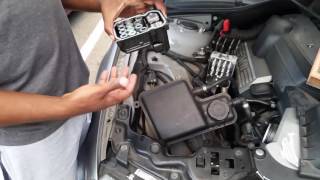

The information in this article is provided for general reference and educational purposes only. Vehicle specifications, procedures, and part compatibility can vary by production date, trim level, and region. Always consult your vehicle's factory service manual and verify part numbers before purchasing or performing repairs. Safety-critical components such as airbags, seat belts, and braking systems should be installed by a qualified professional.
- 🎬 Helpful Videos
- What Does C1102 Mean?
- Can I Drive With C1102?
- Common Causes
- Symptoms
- Diagnostic Flowchart
- Common Fixes & Costs
- DIY vs Professional
- Used vs. New Parts: Buying Guide
- What Happens If You Wait — Timeline
- Cost of Not Fixing It
- Diagnosis Steps
- When This Code Triggers (Freeze-Frame Conditions)
- Related Codes
- Climate & Environmental Factors
- How to Talk to a Mechanic About This Code
- Where to Take It: Dealer vs Independent vs Chain
- When to Walk Away From the Repair
- What Scan Tool You Need for This Code
- How to Clear the Code After You Fix It
- Will This Fail Emissions / State Inspection?
- Most Commonly Affected Vehicles
- Manufacturer-Specific Notes
- Real Owner Stories
- 2011 Nissan Versa with C1102
- 2008 Hyundai Elantra at 162k miles with C1102 & C1213
- 2004 Chevy Silverado with ABS light and U1041/C0265
- BMW E46 with 'Trifecta' of Lights (ABS, DSC, Brake)
- How to Prevent This Code From Triggering
- Frequently Asked Questions
- Can I fix code C1102 myself?
- My mechanic replaced the sensor, but the C1102 code came back instantly. What's next?
- What is the most common misdiagnosis for C1102?
- What happens if I ignore code C1102?
- Will clearing the C1102 code turn off the ABS light?
- Can a bad alignment or tires cause a C1102 code?
- Why did my ABS, Traction Control, and Brake lights all come on at once?
- Key Takeaways
- 🎟️ Get 5% Off