

OBD-II Code P0463: Fuel Level Sensor 'A' Circuit High Input
The Ultimate Guide to Diagnosing and Fixing P0463
- P0463 indicates an open circuit in the fuel level sensor, causing the fuel gauge to permanently stick on 'Full'.
- Track your mileage with the trip odometer and refuel every 200-250 miles to prevent running the tank dry and destroying the $400-$1,000 electric fuel pump.
- Test the fuel tank ground circuit with a multimeter first; a reading above 1 Ohm confirms a bad ground, which costs under $15 to fix.
- Never replace the entire fuel pump assembly without checking if the $30-$100 fuel level sensor is sold separately, as this saves hundreds in parts costs.
What Does P0463 Mean?

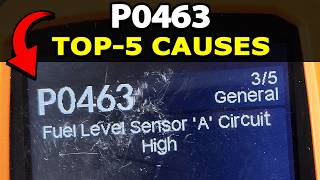
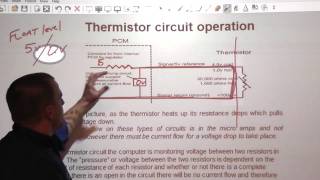
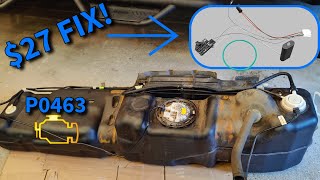
Your car's Powertrain Control Module (PCM) is receiving a voltage signal from the fuel level sensor that is higher than the maximum expected value. The sensor is essentially 'shouting' that the tank is overfilled, which the PCM interprets as a fault. 🎬 Watch: A quick overview of P0463 causes and fixes. This causes the fuel gauge to permanently stick on 'Full,' regardless of the actual fuel level.
Technical definition: The SAE/OBD-II definition is "Fuel Level Sensor 'A' Circuit High Input." The PCM has detected the fuel level sensor voltage exceeding the calibrated upper limit (typically over 4.8V on a 5V reference system) for a specified duration. This high voltage state indicates an open circuit, a loss of ground, or an internal sensor failure.
Can I Drive With P0463?

Yes, But With Caution. Yes, you can drive, but your fuel gauge is completely unreliable, creating a high risk of running out of gas. Running the tank dry causes the electric fuel pump to overheat from lack of lubrication, leading to premature failure. This adds a $400-$1,000 fuel pump replacement to your repair bill. To avoid this, use your trip odometer to track mileage and refuel every 200-250 miles.
Common Causes

- Faulty Fuel Level Sensor (Sending Unit) (Very Common) — The mechanical float and variable resistor inside the fuel tank wear out. The resistor card develops open spots from physical wear or corrosion, sending a maximum 5V signal to the PCM.
- Damaged Wiring or Corroded Connectors (Common) — Road debris, rodents, or improper repairs damage the wiring from the fuel tank to the PCM. The main connector on top of the fuel pump assembly frequently fails when pins corrode from road salt, creating an open circuit.
- Bad or Corroded Ground Connection (Common) — The fuel level sensor requires a solid ground path to the chassis. If the ground strap rusts or breaks, circuit resistance increases dramatically, which the PCM reads as a high voltage signal.
- Bent or Stuck Float Arm (Less Common) — The float arm gets physically stuck in the 'up' position. This happens if the fuel tank is dented from an impact or if the arm was bent during a fuel pump replacement.
- Aftermarket Fuel Pump Assembly Issues (Less Common) — Low-quality aftermarket fuel pump assemblies often include incompatible or poorly manufactured fuel level sensors. This triggers a P0463 code immediately after installation.
- Fuel Contamination (Sulfur, Water, Debris) (Less Common) — High sulfur content in fuel creates a resistive film over the sensor's contacts, leading to an artificially high resistance reading. Water in the tank accelerates corrosion.
- Faulty Instrument Cluster (Rare) — The instrument cluster fails due to cold solder joints or faulty internal processors. It misinterprets a correct signal from the PCM, causing an incorrect gauge reading.
- Faulty Powertrain Control Module (PCM) (Very Rare) — A failure within the PCM's internal circuits causes it to misinterpret the fuel level signal. Consider this only after exhaustively testing the sensor, wiring, grounds, and cluster.
Symptoms
- Fuel Gauge is Stuck on Full — The hallmark symptom of P0463. The PCM receives a maximum voltage signal and commands the gauge to read 100% full, regardless of actual fuel level.
- Running Out of Gas Unexpectedly — Relying on a gauge that indicates a full tank leads to running out of fuel and getting stranded.
- Fuel Gauge is Erratic or Reads Empty — An intermittent open in the circuit causes the gauge to fluctuate wildly or drop to empty as the connection is lost and regained.
- Low Fuel Light Stays On — Some vehicle systems default to a low fuel warning when receiving an illogical signal from the sensor as a fail-safe.
- Remote Start Disabled — Modern vehicles disable the remote start feature when the PCM detects a fuel level fault as a safety precaution.
- Check Engine Light is On (also visible on scanner) — The PCM illuminates the Malfunction Indicator Lamp (MIL) once the high voltage fault persists for a set period.
Diagnostic Flowchart
Tap your situation to follow the diagnostic path that matches what you're seeing on this code.
Common Fixes & Costs
- Replace Fuel Level Sensor (Sending Unit) Only — Parts: $30-$250, Labor: $250-$400, ~2.5 hr book time (Professional)
- Replace Complete Fuel Pump Module Assembly — Parts: $200-$800, Labor: $300-$650, ~3 hr book time (Professional)
- Clean or Repair Fuel Tank Ground Connection — Parts: $1-$15, Labor: $60-$120, ~0.8 hr book time (DIY)
- Repair Damaged Wiring or Connector — Parts: $10-$60, Labor: $120-$250, ~1.5 hr book time (Intermediate)
- Fuel System Decontamination/Cleaning — Parts: $15-$30, Labor: $0, ~0.1 hr book time (DIY)
Used vs. New Parts: Buying Guide
When a used part is worth it: A used OEM fuel pump assembly from a low-mileage donor vehicle is a cost-effective option for older cars where budget is the primary concern. It carries higher risk than buying new.
Donor-vehicle mileage cap: roughly under 70000 miles for the part to have meaningful remaining life.
Donor quality checklist:
- Verify the donor vehicle's mileage and ensure it was not scrapped for a fuel system or electrical issue.
- Match the part number exactly; variations in connectors or sensor resistance are common even within the same model.
- Avoid parts from regions with heavy road salt use, as the electrical connector on top is prone to severe corrosion.
Decision logic:
- If The fuel level sensor is available separately from the pump (e.g., many Nissan, Ram models) → Buy a new sensor from an OEM or reputable aftermarket brand (e.g., Bosch, Denso). This is the most cost-effective and reliable repair.
- If The vehicle is less than 10 years old and the complete fuel pump module must be replaced → Buy a new OEM or top-tier aftermarket assembly. The savings from a used part do not justify the risk of repeat labor costs.
- If The vehicle is over 10 years old, budget is tight, and the part is over $500 new → A used assembly from a low-mileage donor is a reasonable gamble, but expect a shorter lifespan.
Warranty tradeoff: Used parts typically come with a 30-90 day warranty, which rarely covers labor. New aftermarket parts offer 1-year to limited lifetime warranties. New OEM parts usually have a 1-year warranty.
Worst-case if a used part fails: 400-800 if a used part fails after the warranty period, as you pay for the part and the 2-4 hours of labor a second time.
What Happens If You Wait — Timeline
- 0-2 weeks: Check Engine Light illuminates with P0463. Fuel gauge becomes unreliable, often stuck on 'Full'. No direct impact on engine performance. (MPG impact: 0%% · Added cost: $0 (but high risk of being stranded))
- 1-3 months: By relying on an inaccurate gauge, you inadvertently run the fuel tank completely dry. This starves the fuel pump of cooling and lubrication, causing it to overheat. (MPG impact: 0%% · Added cost: $0-50 in inconvenience (needing gas brought to you))
- 3-6 months: The fuel pump, weakened by repeated overheating, begins to fail. It becomes noisy (a high-pitched whine) or provides inconsistent fuel pressure, leading to hesitation. (MPG impact: 1-5%% · Added cost: $400-1200 (The cost of the now-inevitable fuel pump replacement))
- 6+ months: Complete failure of the fuel pump. The vehicle stalls while driving and will not restart, requiring a tow. (MPG impact: 100% (vehicle will not run)% · Added cost: $550-1500 (Cost of tow + full fuel pump module replacement))
Cost of Not Fixing It
- Immediate: High risk of running out of fuel unexpectedly, leaving you stranded in dangerous traffic conditions. (Added cost: 0)
- 1-3 Months: Repeatedly running the fuel tank completely dry starves the in-tank electric fuel pump of cooling and lubrication, causing it to overheat and wear out prematurely. (Added cost: 0)
- 3+ Months: Complete failure of the electric fuel pump due to overheating. The vehicle stalls and will not restart, requiring a tow and a full fuel pump module replacement. (Added cost: 400-1200)
Diagnosis Steps

- Verify Code and Review Live Data
Connect an OBD-II scanner. Confirm P0463 is active. Navigate to 'Live Data' and observe 'Fuel Level Sensor A Voltage'. A voltage stuck high (>4.8V) and fuel level at 100% confirms the fault.
Tools: OBD-II Scanner with Live Data (Beginner) - Inspect Wiring Harness and Ground Strap
Visually inspect the wiring harness running to the fuel tank for chafing or rodent damage. Check the main connector on the fuel pump module for green or white corrosion. Ensure the chassis ground strap is clean and tight.
Tools: Flashlight, Trim Removal Tools (Beginner) - Test the Ground Circuit Integrity
Set a digital multimeter (DMM) to Ohms. Disconnect the fuel pump harness. Probe the ground pin and a clean chassis point. A reading over 1 Ohm confirms a bad ground path requiring repair.
Tools: Digital Multimeter, Vehicle Wiring Diagram (Intermediate) - Test the Fuel Level Sensor's Resistance
Set the DMM to Ohms. Measure resistance between the two sensor pins on the fuel pump assembly. Gently rock the vehicle; the reading must fluctuate. An 'OL' reading confirms internal sensor failure.
Tools: Digital Multimeter (Intermediate) - Perform an Instrument Cluster Self-Test
Activate the instrument cluster diagnostic mode (often by holding the trip reset button while starting). If the fuel gauge sweeps correctly from empty to full, the cluster is functional.
Tools: None (Vehicle specific procedure) (Beginner) - Check for a Short to Power
Turn the ignition 'ON'. Set the DMM to DC Volts. Probe the signal wire terminal on the disconnected harness. It must read 0 volts. A 5V or 12V reading indicates a short to power.
Tools: Digital Multimeter, Vehicle Wiring Diagram (Advanced) - Bench Test the Fuel Level Sensor
Remove the fuel pump assembly. Connect the DMM to the sensor pins. Manually move the float arm. Resistance must change smoothly. Dead spots or 'OL' readings confirm a bad sensor.
Tools: Digital Multimeter, Hand Tools (Advanced) - [ADVANCED] Verify Sensor Resistance Against OEM Specs
Compare sensor resistance to the service manual. Common ranges (Empty-Full): GM 1998+ (40-250 Ohms), Ford 1987+ (16-158 Ohms), Universal (240-33 Ohms). Infinite resistance indicates an open circuit.
Tools: Digital Multimeter, Service Manual (Advanced) - [PRO TIP] Check Signal Wire with an Oscilloscope
Back-probe the signal wire at the PCM. A good sensor shows a stable DC voltage that changes smoothly. A flat line at ~5V or sudden dropouts indicates a failing sensor or wiring issue.
Tools: Automotive Oscilloscope, Back-probe Pins (Advanced)
When This Code Triggers (Freeze-Frame Conditions)
- Engine Coolant Temp: 170-210°F (The engine is at full operating temperature.)
- RPM: 1500-2500 (The code sets during steady-state cruise conditions, not during heavy acceleration or deceleration.)
- Vehicle Speed: 40-65 mph (The fault registers during continuous driving, such as on a highway.)
- Engine Run Time: > 2 minutes (The PCM continuously monitors the circuit, and the code sets after the fault condition persists for a short duration while the engine is running.)
Related Codes
- P0462 — The direct opposite: 'Fuel Level Sensor Circuit Low Input.' This indicates a short to ground, causing the gauge to read empty. P0463 shows >4.8V on a scanner; P0462 shows <0.2V.
- P0461 — 'Fuel Level Sensor Circuit Range/Performance.' Sets when the signal is erratic or doesn't change logically with fuel consumption. P0463 is a 'hard fault' stuck high, while P0461 is an illogical signal.
- P0464 — 'Fuel Level Sensor Circuit Intermittent.' The high voltage signal is not constant. The gauge works correctly for a while and then suddenly sticks on full.
- P0460 — A general 'Fuel Level Sensor Circuit Malfunction.' The PCM sets this when it detects a problem but can't isolate it as high, low, or intermittent.
Climate & Environmental Factors
- Road Salt / Cold Climates: Accelerates corrosion on the fuel pump electrical connector, chassis ground points, and exposed wiring. This corrosion creates high resistance or open circuits, triggering P0463.
- High Humidity: Promotes moisture intrusion into electrical connectors with failing seals. This moisture corrodes the delicate pins and contacts for the fuel level sensor.
How to Talk to a Mechanic About This Code
Say this: "I have a P0463 code and my fuel gauge is stuck on full. I'd like to schedule a diagnostic. Can you please test the fuel level sensor circuit, including the ground and wiring, before recommending a full fuel pump replacement? I'd also like to know if the sensor is available as a separate part for my vehicle."
This signals that you are an informed customer. It directs the mechanic to perform a thorough electrical diagnosis rather than jumping to the most expensive conclusion. It proactively asks about the most cost-effective repair path.
Avoid saying:
- 'My check engine light is on, can you just fix it?'
- 'My gas gauge is broken, I probably need a new fuel pump.'
- 'Just do whatever you think is best.'
Questions to ask before authorizing the repair:
- Did you test the ground wire for the fuel tank? What was the resistance reading?
- Did you test the sensor's resistance and see if it was open or out of spec?
- Is the problem the sensor itself, or the wiring to it?
- If the sensor failed, can it be replaced by itself, or do I have to buy the complete fuel pump module?
- What is the warranty on the recommended parts and labor?
Where to Take It: Dealer vs Independent vs Chain
- Dealer:
A good choice if your vehicle is under warranty or has a known TSB. For out-of-warranty repairs, be prepared for higher costs.
Best for: Vehicles still under warranty., Complex, vehicle-specific electrical issues or known TSBs (like on certain Nissan models)., When you want an OEM part and a manufacturer-backed warranty.
Downsides: Highest labor rates, often $150-$250+ per hour., Defaults to replacing the entire fuel pump assembly for simplicity, even if not strictly necessary. (Typical cost: +50% vs. baseline) - Independent Shop:
Best fit for most out-of-warranty vehicles. A reputable independent shop with good electrical diagnostic skills accurately diagnoses and repairs P0463 cost-effectively.
Best for: Out-of-warranty vehicles where cost is a major factor., Getting a thorough, component-level diagnosis instead of just replacing a whole assembly., Building a long-term relationship with a trusted mechanic.
Downsides: Quality and diagnostic capabilities vary widely; vetting the shop's reputation and ASE certifications is crucial., Lacks experience with very new or model-specific electrical quirks. (Typical cost: +0% vs. baseline) - Chain Shop:
Use with caution. While they replace fuel pumps, they rarely perform the detailed circuit diagnosis needed to find a cheaper wiring or ground fault.
Best for: Simple, routine maintenance like oil changes or tires.
Downsides: Technician skill is inconsistent., Business model encourages upselling (e.g., recommending a full fuel pump assembly when only a wiring fix is needed)., Lacks advanced diagnostic tools or experience for tricky electrical faults. (Typical cost: -10% vs. baseline)
When to Walk Away From the Repair
If the estimated repair cost for the P0463 fault exceeds 50% of your car's private-party value, sell or trade it in.
- Car worth $4000, fix is $1100: Fix it. The repair cost is significant but well below the 50% threshold. This assumes the rest of the car is in good condition.
- Car worth $8000, fix is $1200: Fix it. This is a reasonable cost relative to the vehicle's value.
- Car worth $2500, fix is $1300: Walk away. The repair cost is over 50% of the car's value. It's not a sound financial decision unless the car has significant sentimental value.
What Scan Tool You Need for This Code
Minimum: A scanner that reads and displays live data PIDs (Parameter IDs), specifically 'Fuel Level Sensor Voltage'.
A basic $20 code reader only shows the P0463 code. It cannot display the live voltage from the sensor, which is the most critical piece of data for diagnosis. Seeing the voltage stuck high (>4.8V) instantly confirms the fault.
Budget: BlueDriver Pro (~$99) — This Bluetooth scanner connects to your smartphone and provides detailed code descriptions, freeze-frame data, and customizable live data graphing. You watch the fuel level voltage in real-time to confirm it's stuck high.
Mid-range: Innova 5610 (~$320) — Offers robust live data with recording and graphing capabilities. Its key advantage is bidirectional controls, which on compatible GM vehicles allows you to command an instrument cluster gauge sweep to test if the gauge itself is faulty.
Professional: Autel MaxiCOM MK808 / Topdon ArtiDiag Pro (~$300-500) — These tablet-style scanners provide full bidirectional controls, allowing you to actively test components. They offer OEM-level diagnostics, crucial for accessing manufacturer-specific codes and testing the instrument cluster directly.
Rent vs buy: If this is a one-time fix, auto parts stores like AutoZone let you use a scanner for free. However, their loaner tools rarely support live data. Buying a budget pick like the BlueDriver is a worthwhile investment.
How to Clear the Code After You Fix It
- Use an OBD-II scan tool to clear the P0463 code.
- Ensure the fuel tank is between 15% and 85% full, as this is required for EVAP system monitors to run.
- Perform a complete OBD-II drive cycle to allow all readiness monitors to run and confirm the fix.
Drive cycle (~30 minutes): A general drive cycle includes: 1) A cold start (engine off for 8+ hours). 2) 2-3 minutes of idling. 3) 15 minutes of mixed city/highway driving, including steady cruising between 45-60 mph. 4) At least four 30-second idle periods. 5) Let the vehicle coast (decelerate without brakes) where possible.
Readiness monitors affected: Evaporative System (EVAP) Monitor, Comprehensive Component Monitor
Before emissions retest: drive at least 100 miles to fully set monitors.
Watch out for:
- Disconnecting the battery does not clear the code from all modules and resets all readiness monitors to 'incomplete'.
- The EVAP monitor will not run if the fuel level is too high or too low, preventing the vehicle from passing an emissions test.
- The code returns immediately if the underlying electrical fault (bad sensor, wiring, or ground) remains unaddressed.
Will This Fail Emissions / State Inspection?
Yes — this code typically fails an OBD-II emissions inspection.
- California: An active Check Engine Light for P0463 is an automatic test failure. The EVAP readiness monitor is also blocked from running due to the invalid fuel level input, causing a secondary failure.
- New York: The NYS DMV inspection includes an OBD-II scan. Any fault code that illuminates the Check Engine Light, including P0463, results in an automatic failure.
- Texas: In counties requiring emissions testing, a vehicle with an active P0463 code fails the OBD-II portion of the inspection.
Manufacturer-Specific Notes
- Nissan: Per TSB NTB22-026, technicians are explicitly instructed to replace only the fuel level sensor for a P0463 code, not the whole fuel pump assembly. The bulletin warns that warranty claims for the entire assembly will be charged back.
- Ford: For many 2004-2008 trucks (TSB 08-2-9), sulfur buildup from fuel is the primary cause. Adding a bottle of Chevron Techron Concentrate Plus to a full tank of gas cleans the sender contacts and resolves the issue.
- GM (Chevrolet/GMC): On 2000-2007 trucks and SUVs, a fuel gauge stuck on full is often caused by a failed stepper motor inside the instrument cluster, not the fuel level sensor. A gauge sweep test is crucial.
- Subaru: Saddle-style fuel tanks use two sensors. A P0463 code points to the primary 'A' sensor. When it fails, the gauge reads accurately from full to half, then drops to empty or fluctuates.
Real Owner Stories
2007 Chevy Silverado 1500 with intermittent gauge
The check engine light came on with code P0463. The fuel gauge worked most of the time but occasionally dropped to empty and bounced back.
Outcome: Forum advice confirmed the fuel level sender was the culprit and could be replaced separately from the main fuel pump assembly, saving significant cost.
Lesson: On many GM trucks, the fuel level sensor is a separate, serviceable part. Never assume you need to replace the entire expensive fuel pump module without confirming a 'sensor only' fix.
2017 Nissan Rogue with gauge stuck on full
The check engine light came on, and the fuel gauge stuck on full. A shop quoted over $1,000 for a full fuel pump assembly replacement.
Outcome: The TSB explicitly states to replace only the fuel level sensor, not the entire pump assembly. Armed with this information, the owner insisted on the correct, cheaper repair.
Lesson: Always search for Technical Service Bulletins (TSBs) related to your specific vehicle. For Nissan, TSB NTB22-026 prevents paying for an unnecessary full pump replacement.
2008 Corvette with P0463 after DIY fuel pump replacement
A P0463 code appeared immediately after the owner replaced the driver's side fuel pump. Clearing the code did not help.
Outcome: Since the new sensor was good, the problem was an open circuit in the wiring between the connector and the PCM. The owner ran a new wire to bypass the break in the factory harness.
Lesson: If a code appears immediately after a repair, the cause is almost always related to the repair itself. Systematically testing the new component's circuit isolates the issue.
2006 Nissan Xterra misdiagnosed with a bad catalytic converter
The vehicle had a P0463 code, the fuel gauge read empty with a half tank of gas, and the 'Distance to Empty' was zero.
Outcome: The owner correctly identified that P0463 has no correlation with the catalytic converter. The actual issue was the fuel level sending unit.
Lesson: Trust your gut and do your own research. A mechanic suggesting an unrelated, expensive repair like a catalytic converter for a fuel level code is a major red flag.
How to Prevent This Code From Triggering
- Keep the fuel tank at least 1/4 full (Ongoing habit) — Gasoline acts as a coolant and lubricant for the electric fuel pump. Consistently running the tank near empty causes the pump to overheat and fail prematurely.
- Use high-quality, Top Tier gasoline (Every fill-up) — Top Tier gasoline contains higher levels of detergents that keep the delicate contacts on the fuel level sensor clean from deposits and sulfur contamination.
- Apply dielectric grease to connectors (During any related service) — Applying a thin layer of dielectric grease creates a barrier that repels moisture and prevents pins from corroding, a primary cause of P0463.
- Perform regular underbody washes in winter climates (Monthly during winter) — Washing away road salt buildup from the vehicle's undercarriage prevents accelerated corrosion that destroys electrical ground points.
Frequently Asked Questions
Can I keep driving with a P0463 code?
Yes, the engine runs normally. However, you have no reliable way of knowing your fuel level, creating a high risk of getting stranded. Fix it promptly to avoid destroying your fuel pump by running it dry.
Will a fuel additive or cleaner fix a P0463 code?
Only in specific cases, like older Ford trucks with sulfur contamination, where a PEA-based cleaner dissolves deposits. For most vehicles with an internal electronic failure, additives are useless and replacement is mandatory.
Why did P0463 appear right after I replaced my fuel pump?
First, the new aftermarket assembly includes a defective or incompatible sensor. Second, the float arm was bent during installation. Third, the main electrical connector on top of the tank is not seated properly.
My mechanic says I need to replace the whole fuel pump. Is that true?
Not always, as it depends on the vehicle model. For many brands like Nissan and Ram, the sensor is sold separately and is the correct, cheaper repair. Always ask your shop if a 'sensor only' replacement is possible.
Can a P0463 code cause my car not to start?
Not directly, as the code is purely informational. However, relying on a stuck gauge causes you to run out of fuel, resulting in a no-start. In rare cases, a shared blown fuse causes both the code and a stall.
What is the most common misdiagnosis for P0463?
The most costly mistake is replacing the entire $800 fuel pump assembly when only the $50 fuel level sensor failed. The second is replacing the sensor when the actual problem is a corroded $15 ground wire.
How can I avoid running out of gas with this code?
Use your trip odometer as a manual fuel gauge. Reset it to zero every time you fill the tank completely. Refuel every 200-250 miles to guarantee you never run dry.
Key Takeaways
- P0463 indicates an open circuit in the fuel level sensor, causing the fuel gauge to permanently stick on 'Full'.
- Track your mileage with the trip odometer and refuel every 200-250 miles to prevent running the tank dry and destroying the $400-$1,000 electric fuel pump.
- Test the fuel tank ground circuit with a multimeter first; a reading above 1 Ohm confirms a bad ground, which costs under $15 to fix.
- Never replace the entire fuel pump assembly without checking if the $30-$100 fuel level sensor is sold separately, as this saves hundreds in parts costs.
Helpful Videos



The information in this article is provided for general reference and educational purposes only. Vehicle specifications, procedures, and part compatibility can vary by production date, trim level, and region. Always consult your vehicle's factory service manual and verify part numbers before purchasing or performing repairs. Safety-critical components such as airbags, seat belts, and braking systems should be installed by a qualified professional.
- 🎬 Helpful Videos
- What Does P0463 Mean?
- Can I Drive With P0463?
- Common Causes
- Symptoms
- Diagnostic Flowchart
- Common Fixes & Costs
- Used vs. New Parts: Buying Guide
- What Happens If You Wait — Timeline
- Cost of Not Fixing It
- Diagnosis Steps
- When This Code Triggers (Freeze-Frame Conditions)
- Related Codes
- Climate & Environmental Factors
- How to Talk to a Mechanic About This Code
- Where to Take It: Dealer vs Independent vs Chain
- When to Walk Away From the Repair
- What Scan Tool You Need for This Code
- How to Clear the Code After You Fix It
- Will This Fail Emissions / State Inspection?
- Manufacturer-Specific Notes
- Real Owner Stories
- 2007 Chevy Silverado 1500 with intermittent gauge
- 2017 Nissan Rogue with gauge stuck on full
- 2008 Corvette with P0463 after DIY fuel pump replacement
- 2006 Nissan Xterra misdiagnosed with a bad catalytic converter
- How to Prevent This Code From Triggering
- Frequently Asked Questions
- Can I keep driving with a P0463 code?
- Will a fuel additive or cleaner fix a P0463 code?
- Why did P0463 appear right after I replaced my fuel pump?
- My mechanic says I need to replace the whole fuel pump. Is that true?
- Can a P0463 code cause my car not to start?
- What is the most common misdiagnosis for P0463?
- How can I avoid running out of gas with this code?
- Key Takeaways
- 🎟️ Get 5% Off