

P0846 on 2015-2026 Ford Transit: Transmission Pressure Sensor Fault Causes & Fixes
For 2015-2019 Transits with the 6R80 transmission, P0846 is almost always caused by a failed internal transmission lead frame. Expect to pay $500-$1200 for a shop to replace it. For 2020+ models with the 10R80, causes are more varied and may involve the valve body or an internal CDF clutch drum failure.
- The cause of P0846 on a Ford Transit heavily depends on the model year and which transmission it has (6-speed vs. 10-speed).
- For 2015-2019 models with the 6R80 transmission, a faulty internal molded lead frame is the most probable cause.
- For 2020+ models with the 10R80, the issue is more likely related to the valve body or other internal components.
- This is not a DIY-friendly repair. It requires dropping the transmission pan and valve body.
- Always use the specified transmission fluid (Mercon LV for 6R80, ULV for 10R80) to prevent further issues.
What's Unique About the 2015-2026 Ford Transit
The Ford Transit in this year range uses two different transmissions, and the cause of P0846 is very different for each. Models from 2015-2019 are typically equipped with the 6R80 6-speed automatic, which has a well-documented history of failures of the internal molded lead frame. This single component houses the sensors and control electronics, and is the most common cause of this code. Newer models from 2020 onward use the 10R80 10-speed, where this code is more likely related to valve body issues or internal hydraulic leaks rather than a single, common-failure part.
Generation note: This guide covers two key generations of Ford Transit transmissions: - 2015-2019: Primarily uses the 6-speed 6R80 automatic transmission. The most common cause for P0846 is a faulty molded lead frame inside the transmission. - 2020-2026: Primarily uses the 10-speed 10R80 automatic transmission. P0846 on these models is more likely caused by issues with the valve body, solenoids, or internal clutch pack problems like a failing CDF drum. TSB 22-2428 addresses related shifting issues.
Symptoms You May Notice
- Check Engine Light and/or Wrench Light illuminated
- Harsh, erratic, or delayed gear shifts
- Transmission getting stuck in a single gear (limp mode)
- Sudden, unexpected downshifts while driving
- Difficulty or inability to select gears
- Decreased fuel economy
- Transmission overheating
- Replacing only a single pressure sensor when the entire lead frame (on 6R80 models) is the actual point of failure.
- Assuming a major internal mechanical failure without first investigating the more common electronic causes like the lead frame or fluid condition.
- Replacing the PCM/TCM before thoroughly testing the wiring harness and connectors for faults.
Most Likely Causes
- Faulty Molded Lead Frame (2015-2019 6R80 Models) 🔴 High Probability The 6R80 transmission has a known design flaw with the internal lead frame, which contains the output speed sensor, turbine speed sensor, and transmission range sensor. The internal circuitry is prone to failure from heat and vibration, causing erratic signals. Ford issued Customer Satisfaction Program 19N01, extending the warranty to 10 years/150,000 miles for this part on other vehicles like the F-150, highlighting the widespread nature of the defect.
How to confirm: A professional technician will confirm by scanning for related codes (P0720 and P0722 for the output speed sensor are very common companions) and observing live data from the transmission sensors. If sensor data for OSS or TSS is erratic or drops out, the lead frame is the confirmed cause. The TFPS voltage PID may be stuck at 0V or 5V.
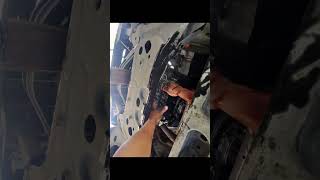
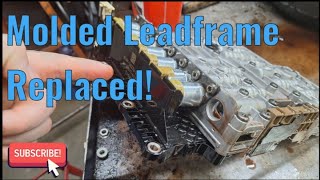
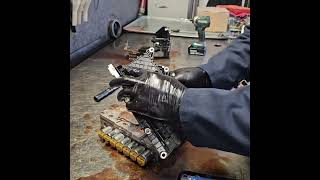
Typical fix: Replace the entire molded lead frame assembly, along with the transmission filter, pan gasket, and bulkhead sleeve connector. The transmission pan and valve body must be removed to access the part. 🎬 Watch: Step-by-step Ford Transit 6R80 lead frame replacement guide.
Est. part cost: $150-$450 - Low or Contaminated Transmission Fluid 🟡 Medium Probability High-mileage and commercial use can accelerate fluid breakdown. A dirty or clogged filter can also restrict flow, causing pressure-related codes.
How to confirm: Check the transmission fluid level and condition. The fluid should be at the correct level and reddish-pink in color. If it is dark brown, black, or smells burnt, it is contaminated. Note: Many modern Transits do not have a traditional dipstick and require a specific procedure to check the fluid level when the transmission is at operating temperature.
Typical fix: Perform a transmission fluid drain and fill or a full fluid exchange with the correct type of fluid (Mercon LV for 6R80, Mercon ULV for 10R80). Replace the transmission filter.
Est. part cost: $100-$250 - Faulty Valve Body or Solenoid (2020+ 10R80 Models) 🟡 Medium Probability The 10R80 transmission's complexity can lead to issues with sticking solenoids or internal cross-leaks in the valve body. Ford TSB 22-2428 addresses harsh/delayed shifting issues that can be related to valve body problems, although it doesn't specifically mention P0846.
How to confirm: This requires advanced diagnostics with a scan tool capable of commanding individual solenoids and monitoring pressure response. A technician may inspect the valve body for debris or wear during a service.
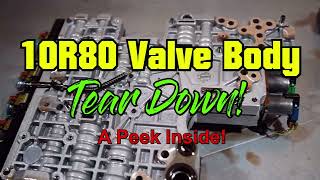
Typical fix: Replacement of the specific faulty solenoid or the entire valve body assembly, followed by a PCM reflash and adaptive learning drive cycle as per TSB 22-2428. 🎬 See this 10R80 valve body teardown for a closer look inside.
Est. part cost: $300-$1000 - Damaged Wiring or Connectors ⚪ Low Probability
How to confirm: Visually inspect the transmission wiring harness and the main connector at the transmission case for any signs of damage, corrosion, or fluid intrusion from a leaking bulkhead sleeve. Perform a continuity test on the wiring between the connector and the TCM.
Typical fix: Repair the damaged section of the wiring harness or clean/replace the corroded connector. The bulkhead connector sleeve is often replaced as preventative maintenance during lead frame service.
Est. part cost: $20-$150
Rare But Worth Checking
- Faulty Powertrain/Transmission Control Module (PCM/TCM): This is extremely rare and should only be considered after all other possibilities, including the entire lead frame on 6R80 models, have been exhausted and wiring has been verified as good.
- Internal Hydraulic Leak from CDF Clutch Drum (2020+ 10R80 Models): A known issue on 10R80 transmissions where a sleeve within the 'Clutch F' drum can move out of place, damaging a seal and causing a significant hydraulic pressure leak. This can lead to a variety of shifting symptoms and may trigger pressure sensor codes like P0846. This requires a full transmission teardown to repair and is covered by TSB 22-2428.
Diagnosis Steps
- Check and verify the transmission fluid level and condition. Ensure the correct fluid type is being used (Mercon LV for 6R80, ULV for 10R80).
- Use an OBD-II scanner to confirm P0846 and check for any other related transmission codes, especially P0720 and P0722 on 6R80 models.
- Record freeze frame data to understand the conditions when the fault occurred.
- Visually inspect the external transmission wiring harness and the main bulkhead connector for damage, corrosion, or loose connections.
- For 2015-2019 (6R80) models: Given the high failure rate, the next logical step is to suspect the molded lead frame. A professional diagnosis will confirm this by monitoring live data for the Output Shaft Speed (OSS) and Turbine Shaft Speed (TSS) PIDs. 🎬 Watch: How to diagnose and replace a faulty 6R80 lead frame. Dropouts or erratic readings confirm a bad lead frame.
- For 2020+ (10R80) models: Use an advanced scan tool to monitor live pressure data and command solenoids to isolate the fault within the valve body or clutch packs. Consult TSB 22-2428 for related diagnostic procedures.
- If the lead frame or valve body is replaced, clear the codes and perform a transmission adaptive learning procedure.
Parts You'll Likely Need
- Molded Lead Frame (Conductor Plate)
(OEM #AL3Z-7G276-D)— This is the most common point of failure for P0846 on 2015-2019 Ford Transits with the 6R80 transmission. It contains the pressure sensors and control electronics. The 'D' suffix indicates the latest revised part, superseding 'A' and 'B' versions.
Trusted brands: Motorcraft, Dorman (926-149), Circuit Board Medics (Remanufactured OEM)
OEM price range: $200-$350
Aftermarket price range: $150-$250 - Transmission Pan Gasket
(OEM #BL3Z-7A191-A (6R80))— Must be replaced anytime the transmission pan is removed for service. Many modern gaskets are reusable, but replacement is best practice.
Trusted brands: Motorcraft, Fel-Pro
OEM price range: $30-$50
Aftermarket price range: $15-$30 - Transmission Filter
(OEM #BR3Z-7A098-A (6R80))— Should be replaced as part of the service when replacing the lead frame or changing the fluid.
Trusted brands: Motorcraft, Wix
OEM price range: $20-$40
Aftermarket price range: $15-$30 - Transmission Case Connector Sleeve (Bulkhead Sleeve)
(OEM #AL3Z-7G276-A (often packaged with lead frame kits))— This seal is known to leak and should be replaced when the valve body is serviced to prevent future leaks and connection issues.
Trusted brands: Motorcraft, Dorman
OEM price range: $15-$30
Aftermarket price range: $10-$20
Related Codes That Often Appear With This One
- P0720 — Output Speed Sensor circuit failure. This sensor is part of the 6R80 lead frame assembly and is a primary indicator of its failure.
- P0722 — Output Speed Sensor circuit no signal. This sensor is also part of the 6R80 lead frame assembly and strongly points to its failure.
- P0847 — Transmission Fluid Pressure Sensor/Switch 'B' Circuit Low. This is a related code indicating a specific type of electrical fault in the same circuit.
- P0848 — Transmission Fluid Pressure Sensor/Switch 'B' Circuit High. This is a related code indicating a specific type of electrical fault in the same circuit.
Technical Service Bulletins (TSBs) & Recalls
- TSB 21-2315: Addresses harsh shifting and delayed engagement on 10R80 transmissions, potentially related to P0846 causes.
- Customer Satisfaction Program 19N01: Extended warranty coverage for the 6R80 molded lead frame on F-150s and Expeditions, which share the same part and failure mode.
- Recall 19S38: Pertains to the failure of the driveshaft flexible coupling on 2015-2017 Transits, a separate but critical platform issue.
Platform-Specific Known Issues
- On 6R80-equipped models (2015-2019), Ford issued Customer Satisfaction Program 19N01 for other vehicles like the F-150, extending the warranty on the lead frame to 10 years/150,000 miles due to these known issues. While the Transit was not explicitly named in all documents, it uses the same problematic component.
Mechanic-Grade Diagnostic Values
- Transmission Fluid Pressure Sensor (TFPS) 'B' Signal Voltage — expected: 0.5V to 4.5V, fluctuating with gear changes and engine load.. Failure: Voltage is stuck at 0V (short to ground) or 5V (open circuit/short to power).
- TFPS Reference Voltage at sensor connector (harness side) — expected: ~5.0V with key on, engine off.. Failure: No voltage or significantly lower voltage indicates a wiring or PCM/TCM issue.
- TFPS Ground Circuit Resistance at sensor connector (harness side) — expected: Less than 0.1 volts or very low resistance to a known good chassis ground.. Failure: High resistance indicates a poor ground connection, which can cause erratic sensor readings.
Scan Tool Commands That Help
- Ford IDS, FORScan, Snap-on, or other advanced scanner: Clear Transmission Adaptive Tables / Reset KAM — This is a mandatory step after replacing the lead frame, valve body, or entire transmission. It erases the old shift strategy learned with the faulty parts, allowing the TCM to relearn with the new components.
- Ford IDS or equivalent: Adaptive Learning Drive Cycle — After clearing the adaptive tables, a specific drive cycle must be performed to allow the transmission to relearn shift points and clutch pressures correctly. This involves a series of light accelerations, stops, and gear selections.
- Advanced Scan Tool: TFPS Voltage/Pressure PID Monitoring — During initial diagnosis, watching the live data PID for the 'B' pressure sensor while driving can confirm if the sensor is providing erratic, stuck, or illogical readings compared to commanded pressures and other sensor data.
Wiring & Ground Locations
- Transmission Bulkhead Connector (C175T on some models) — On the exterior of the transmission case, passenger side, where the main vehicle harness connects to the transmission's internal wiring.. This is the primary connector for all transmission sensor and solenoid signals, including the pressure sensor. It's a common point for corrosion, fluid intrusion from a failed internal sleeve seal, or pin damage.
- Chassis Ground Points (e.g., G203, G35) — Various locations on the frame and body. Common spots on a Transit include behind the passenger side kick panel, and on the B and D pillars.. A poor ground connection for the PCM/TCM or the sensor circuit can cause erratic voltage readings and trigger range/performance codes. The transmission case itself also serves as a major ground path.
Real Owner Repair Stories
- F150online Forums User (2019 F-150 3.5L EcoBoost (10R80 Transmission) at 65,400 miles) — Wrench light came on while towing. Transmission was over-revving on 1-3 and 7-8 shifts. Fluid was found to be burnt with friction material.
❌ Tried (didn't work) Initially, no diagnostic codes were present, which delayed diagnosis.
✅ What actually fixed it A complete transmission overhaul including a new valve body. The final cost was $4,583, though most was covered by an extended warranty. The out-of-pocket cost was $705. - Ford F150 Forum User (2012 F-150 FX4 (6R80 Transmission)) — Lead frame failure symptoms (limp mode, shifting issues).
❌ Tried (didn't work) Getting an OEM part from the dealer, who quoted $3,000 and a potential 6-month wait.
✅ What actually fixed it The owner self-installed a Dorman-branded lead frame, new filter, and a new pan with a drain plug. The total cost for parts and tools was under $750, and the repair took 3 days. The Dorman part performed like OEM with no issues. - Ford Truck Enthusiasts Forum User (2013 Expedition (6R80 Transmission)) — Vehicle was not drivable due to lead frame codes.
❌ Tried (didn't work) Could not find an OEM lead frame from Ford.
✅ What actually fixed it Installed a Dorman lead frame, which fixed the issue. Noted that after letting the transmission drain for 3 days, it required 9+ quarts of fluid to refill, as the torque converter had likely drained back.
OEM Part Supersession History
AL3Z-7G276-A, AL3Z-7G276-B→AL3Z-7G276-D— Revisions to improve reliability and address the common failure of the internal sensors and circuitry.
Heads up: The 'D' revision is the latest and most reliable version and should be used for all repairs. While older versions may physically fit, they are prone to the original failure mode.
Model Year Variations Within This Range
- 2020-2022: Ford TSB 22-2428, which addresses harsh shifts and internal issues like the CDF drum failure, specifically applies to Transit models built on or before December 23, 2022, suggesting a possible production change after this date.
Diagnostic Flowchart
Other Known Issues on This Vehicle
Issues unrelated to this code that are worth knowing about as an owner of this generation:
- Driveshaft Flexible Coupling Failure 🔴 High — Common on 2015-2017 models, leading to multiple recalls. The coupling can crack, causing vibrations and potential driveshaft separation. (Ref: Recall 17V-408, superseded by 19S38.)
- 3.5L EcoBoost Timing Chain Stretch (Gen 1) 🔴 High — Prevalent in first-generation 3.5L EcoBoost engines (approx. 2015-2016). Caused by a long single-chain design and soot contamination from direct injection, often manifesting as a startup rattle.
- 3.5L EcoBoost VCT Phaser Rattle (Gen 2) 🟠 Medium — Common on second-generation 3.5L EcoBoost engines (approx. 2017-2020). A brief rattle (2-5 seconds) on cold starts points to worn VCT units. (Ref: TSB 20-2315)
- Sliding Door Wiring Harness Failure 🟠 Medium — Frequent issue where the wiring harness for the sliding door fatigues and breaks from repeated opening and closing, causing issues with door locks and interior lights.
- Premature Brake and Tire Wear 🟡 Low — High vehicle weight, especially when loaded, leads to accelerated wear of brake pads, rotors, and tires. Front tire edge wear is common without regular alignment.
Used vs. New Parts: Buying Guide for This Vehicle
When a used part is the smart pick: For this specific repair, using a used part is strongly discouraged. A used lead frame or valve body from a salvage yard has an unknown history and may have the same internal faults or be close to failing.
What to inspect on the donor part:
- Not applicable, as used electronic/hydraulic transmission components are not recommended for this repair.
OEM-only on this vehicle (don't cheap out):
- Molded Lead Frame (Motorcraft is highly preferred)
- Valve Body Assembly
Aftermarket brands forum-validated for this vehicle:
- Dorman: Widely reported by owners as a viable alternative for the 6R80 lead frame when the OEM Motorcraft part is on backorder or unavailable.
- Circuit Board Medics: Offers remanufactured OEM lead frames which can be a reliable option.
Brands owners have reported issues with on this vehicle:
- Unnamed, no-brand parts from online marketplaces should be avoided due to high failure rates and lack of quality control.
Real Owner Stories
Aggregated from forums and TSBs cited above. Mileages and costs reflect what owners reported in those sources.
2015 Ford F-150 (6R80) — ~155000 miles
Symptoms: Sudden, unexpected downshifts while driving and harsh, erratic shifting, eventually causing the wrench light to illuminate. The transmission would sometimes get stuck in a single gear.
What fixed it: Replacement of the molded lead frame assembly, as the vehicle was outside the 10 year/150,000 mile window of the Customer Satisfaction Program.
Source hint: Reddit discussion on the expired Customer Satisfaction Program 19N01
2020 Ford Transit (10R80)
Symptoms: Owner reported harsh engagement when shifting into gear, along with harsh and delayed shifts while driving.
What fixed it: The fix followed procedures related to TSB 22-2428, which involves diagnosing and potentially replacing the valve body assembly, followed by a PCM reflash and adaptive learning drive cycle.
Source hint: F-150 owner discussion on TSB 21-2315 for the 10R80 transmission
2016 Ford Transit (6R80)
Symptoms: The transmission suddenly went into 'limp mode' and was stuck in a single gear. The Check Engine and Wrench lights were on, and shifts had been harsh leading up to the failure.
What fixed it: Discussions pointed to the common failure, which was resolved by replacing the entire molded lead frame assembly inside the transmission.
Source hint: https://www.fordtransitusaforum.com/ - discussions on lead frame replacement
Related OBD-II Codes
Frequently Asked Questions
My 2017 Transit is showing P0846 and shifting erratically. Is this the known molded lead frame issue?
Ford issued Customer Satisfaction Program 19N01 for the lead frame on F-150s. Does this warranty extension cover my Transit?
What other OBD-II codes commonly appear with P0846 on a 2015-2019 Transit?
I have a newer 2021 Transit with the 10R80 transmission. Is the lead frame still the likely cause for P0846?
My mechanic is replacing the molded lead frame. What other parts should be replaced at the same time?
How can a technician definitively confirm that the lead frame is the problem?
Helpful Videos
We Have This Part in Stock



The information in this article is provided for general reference and educational purposes only. Vehicle specifications, procedures, and part compatibility can vary by production date, trim level, and region. Always consult your vehicle's factory service manual and verify part numbers before purchasing or performing repairs. Safety-critical components such as airbags, seat belts, and braking systems should be installed by a qualified professional.
- Ford Transit:
- 🎬 Helpful Videos
- 🛍️ Shop This Part
- What's Unique About the 2015-2026 Ford Transit
- Symptoms You May Notice
- Most Likely Causes
- Rare But Worth Checking
- Diagnosis Steps
- Parts You'll Likely Need
- Related Codes That Often Appear With This One
- Technical Service Bulletins (TSBs) & Recalls
- Platform-Specific Known Issues
- Mechanic-Grade Diagnostic Values
- Scan Tool Commands That Help
- Wiring & Ground Locations
- Real Owner Repair Stories
- OEM Part Supersession History
- Model Year Variations Within This Range
- Diagnostic Flowchart
- Other Known Issues on This Vehicle
- Used vs. New Parts: Buying Guide for This Vehicle
- Real Owner Stories
- 2015 Ford F-150 (6R80) — ~155000 miles
- 2020 Ford Transit (10R80)
- 2016 Ford Transit (6R80)
- Related OBD-II Codes
- Frequently Asked Questions
- 🎟️ Get 5% Off