

P0700 on 2010-2017 Chevrolet Equinox: Transmission Control System Fault Causes and Fixes
P0700 means your Equinox's transmission computer (TCM) has detected a fault. It's a general alert, not a specific problem. The most crucial first step is to scan the TCM for more specific codes, which often point to a faulty shift solenoid or torque converter clutch solenoid, a repair that can cost between $400 and $900 at a shop. On V6 models, this can also be an early warning for a failing 3-5-R wave plate.
- P0700 is not the real problem; it's a general alarm. You MUST scan the Transmission Control Module (TCM) with a proper scan tool to find the specific, actionable codes.
- The most common fixes involve replacing a faulty solenoid (like the TCC or a shift solenoid) located inside the transmission oil pan.
- Do not ignore this code. A simple solenoid issue can lead to more severe transmission damage if left unaddressed.
- Regularly changing your transmission fluid with DEXRON-VI is the best preventative maintenance you can do to avoid this code.
What's Unique About the 2010-2017 Chevrolet Equinox

The second-generation Equinox uses GM's 6-speed automatic transmissions: the 6T40/6T45 for 4-cylinder models and the heavier-duty 6T70 for V6 models. While P0700 is a generic code, on this platform it frequently precedes codes related to failed torque converter clutch (TCC) solenoids or specific shift solenoids. A more severe, though well-documented, issue on the 6T70 transmission is the failure of the 3-5-R wave plate, which leads to a loss of 3rd, 5th, and Reverse gears and often requires a complete transmission rebuild. A critical design aspect is that the TCM is integrated with the valve body and solenoids into a single unit called the Transmission Electro-Hydraulic Control Module (TEHCM), located inside the transmission pan. This exposes the electronics to failure from heat and contaminated fluid.
Symptoms You May Notice
- Check Engine Light is on
- Harsh, erratic, or delayed shifting
- Vehicle gets stuck in one gear (limp mode)
- Slipping between gears
- Inability to select certain gears (e.g., loss of Reverse)
- Vehicle hesitates or is slow to respond when accelerating
- Reduced fuel economy
- Flashing gear indicator (P, R, N, D) on the instrument cluster
- A rattling or whining noise from the transmission area
- Replacing the entire transmission without first diagnosing the specific codes. Many P0700 issues are caused by relatively inexpensive solenoids or the TEHCM assembly.
- Clearing the codes and hoping the problem goes away. The P0700 code indicates a real fault that will almost certainly return and could cause more damage if ignored.
- Replacing individual solenoids when the root cause is a failing TCM/TEHCM. If multiple, unrelated solenoid codes appear, the control unit itself is more likely the culprit.
Most Likely Causes

- Faulty Torque Converter Clutch (TCC) Solenoid 🔴 High Probability The TCC solenoid is a very common failure point in the 6T40/6T45/6T70 family of transmissions, often leading to code P0741 alongside P0700. Debris in old fluid can cause the solenoid to stick.
How to confirm: Scan the TCM for code P0741 (TCC Performance or Stuck Off). A mechanic can command the solenoid on and off with a scan tool to test its function and monitor TCC slip speed, which should be near zero when commanded on.
Typical fix: Replace the TCC solenoid. This requires removing the transmission oil pan and the valve body/TEHCM assembly to access the solenoid. It is often recommended to replace all solenoids as a set while the valve body is out.
Est. part cost: $50-$150 - Failed Shift Solenoid 🔴 High Probability
How to confirm: Scan the TCM for specific solenoid codes (e.g., P0751, P0752, P2723). These codes point directly to the malfunctioning solenoid circuit. Resistance for a good solenoid is typically between 16-40 ohms. NHTSA ODI #10888569 describes a case where codes P0700 and P0776 were present, resulting in a vehicle that could only drive forward and eventually stopped going in reverse. Similarly, NHTSA ODI #10979593 notes that P0700 and P0776 appeared together, causing the engine to push 7000 RPMs while in park.
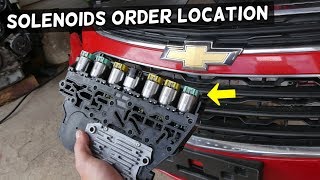
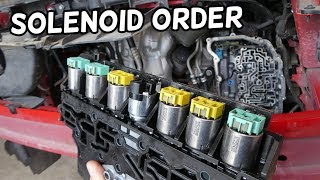
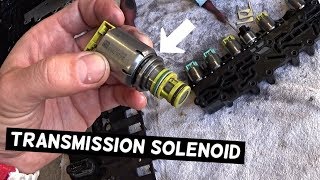
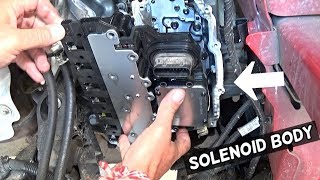
Typical fix: Replace the specific failed solenoid. 🎬 See this walkthrough on how to remove and replace shift solenoids. Like the TCC solenoid, this part is located on the valve body inside the transmission pan. Solenoids are often sold in a complete kit.
Est. part cost: $40-$100 per solenoid, or $150-$250 for a full kit - Low or Degraded Transmission Fluid 🟡 Medium Probability Many of these vehicles were marketed with 'lifetime' fluid, leading owners to neglect fluid changes. Old, burnt, or low fluid causes overheating, varnish buildup, and poor hydraulic pressure, leading to solenoid failure and shudder.
How to confirm: Check the transmission fluid level and condition. On the 2.4L Equinox, there is often no dipstick, requiring a level check plug on the side of the transmission case. 🎬 Watch: How to check and fill transmission fluid on the 2.4L. The fluid should be bright red and not smell burnt. Dark brown or black fluid with metal particles indicates a serious internal problem.
Typical fix: Perform a transmission fluid drain-and-fill or a full fluid exchange. Use only the specified fluid, typically DEXRON-VI. A simple drain-and-fill is often safer on high-mileage transmissions where a full flush could dislodge debris and cause more issues.
Est. part cost: $60-$120 for fluid - Failed Transmission Control Module (TCM/TEHCM) 🟡 Medium Probability The TCM is integrated into the TEHCM inside the transmission, where it is exposed to constant heat and potentially contaminated fluid, which can lead to electronic failure over time.
How to confirm: This is often a diagnosis of exclusion. If specific solenoid/sensor codes are present but the components and wiring test good, the TEHCM is suspect. A code like P0601 (Internal Control Module Memory Check Sum Error) alongside P0700 strongly points to a bad TCM. Inability to communicate with the TCM with a scan tool is another key indicator. NHTSA ODI #11462104 reports a diagnostic reading including P0700 and U0101, explicitly noting a loss of communication with the transmission control module.
Typical fix: Replace the entire TEHCM assembly (TCM, valve body, and solenoids). The new module must be programmed to the vehicle's VIN.
Est. part cost: $300-$700 for a remanufactured unit, higher for new OEM.
Rare But Worth Checking
- Broken 3-5-R Wave Plate: This is a catastrophic internal failure specific to the 6T70/6T75 transmission used in V6 Equinox models. It causes a sudden loss of 3rd, 5th, and Reverse gears. 🎬 Watch: Diagnosing major transmission slipping and reverse gear failure. The broken metal pieces contaminate the entire transmission, necessitating a complete rebuild or replacement. TSB 14404B was issued for earlier models (up to 2009) extending warranty coverage, but the faulty part design can still affect later models. The updated wave plate part is ACDelco 24254103.
- Damaged Internal Wiring Harness: The wiring harness inside the transmission can become brittle and fail from constant exposure to heat and fluid, causing intermittent shorts or open circuits that can trigger various solenoid codes. Sometimes the main external connector to the transmission can also be damaged or have poor contact, causing communication loss. NHTSA ODI #11244385 describes a vehicle throwing codes P0700, U0073, and U1000, where the car would buck and lose engine power while the Stabilitrak light illuminated.
- Faulty Transmission Range Sensor (Neutral Safety Switch): This sensor, also called the Internal Mode Switch (IMS), tells the TCM which gear is selected (P, R, N, D). If it fails, it can send incorrect data, causing erratic shifting, a flashing gear indicator, and triggering a P0700 code. This may also be accompanied by codes like P1825 or P1915.
Diagnosis Steps
- Connect an OBD-II scanner capable of reading transmission codes to the vehicle's diagnostic port.
- Retrieve all codes from both the ECM (Engine Control Module) and TCM (Transmission Control Module). Do not clear them. Document the P0700 code and, more importantly, any other P07xx, P08xx, or Uxxxx codes stored in the TCM. NHTSA ODI #10733263 notes a case where P0700 appeared alongside P069E, U0073, and U0100, which persisted even after the battery was replaced twice.
- Check the transmission fluid level and condition. On models without a dipstick, this requires safely raising the vehicle and opening a check plug. Look for fluid that is dark, burnt-smelling, or contains metallic particles, which indicate severe internal wear.
- If a specific solenoid code (e.g., P0741, P0752) is present, focus diagnosis on that circuit. This involves testing the solenoid's resistance (typically 16-40 ohms) and checking the wiring between the TCM and the solenoid for continuity and shorts.
- If there are no other codes besides P0700 (which is rare), or if multiple, seemingly unrelated codes are present, suspect a failing TEHCM or a wiring harness issue. Check for a P0601 code, which confirms an internal module fault.
- If symptoms include a sudden loss of 3rd, 5th, and Reverse gears (especially on V6 models), suspect an internal mechanical failure like the 3-5-R wave plate and inspect the fluid for excessive metal debris.
- If communication with the TCM is not possible with a capable scan tool, check the power and ground connections to the module and the integrity of the CAN bus wiring.
Parts You'll Likely Need

- Transmission Electro-Hydraulic Control Module (TEHCM)
(OEM #24256523 (This is a common Gen 1 part number, verify with VIN))— This integrated unit contains the TCM, valve body, and all solenoids. It's a common failure point due to heat and is often replaced as a complete assembly to resolve complex electronic issues or multiple solenoid failures.
Trusted brands: ACDelco (GM Genuine), Dorman (Remanufactured)
OEM price range: $500-$800
Aftermarket price range: $300-$600 - Torque Converter Clutch (TCC) Solenoid — A very common failure point on these transmissions that triggers code P0741, which in turn triggers P0700.
Trusted brands: ACDelco, Rostra
OEM price range: $80-$150
Aftermarket price range: $50-$100 - Shift Solenoid Kit — Individual shift solenoids can stick or fail electronically, causing specific shifting problems and codes. Often replaced as a full set when the valve body is removed.
Trusted brands: ACDelco, Bosch, Rostra
OEM price range: $200-$350 (for a set)
Aftermarket price range: $150-$250 (for a set) - 3-5-R Clutch Wave Plate
(OEM #24254103)— The specific part that fractures in the 6T70 transmission, leading to loss of 3rd, 5th, and Reverse gears. This is only needed for a full transmission rebuild.
Trusted brands: ACDelco
OEM price range: $15-$30
Aftermarket price range: $10-$20
Related Codes That Often Appear With This One
- P0741 — This code for 'Torque Converter Clutch Circuit Performance or Stuck Off' is one of the most common specific faults that triggers a P0700 on this platform, pointing directly to the TCC solenoid or its circuit.
- P0750-P0799 range — This range of codes relates to specific shift solenoid and pressure switch faults. Finding one of these (e.g., P0751, P0752) is key to diagnosing the P0700 and identifying which solenoid has failed.
- P0601 — This code indicates an internal memory error in a control module. When seen with P0700, it strongly suggests the Transmission Control Module (TCM) itself has failed and the entire TEHCM needs replacement.
- P0716 / P0717 — These codes point to a fault with the Input Speed Sensor. A failed sensor can cause erratic shifting and trigger a P0700, but some owners have reported that even after replacing the sensor, the issue persisted, pointing to a deeper problem in the TCM or wiring.
Technical Service Bulletins (TSBs) & Recalls
- 14404B - Special Coverage for cracked 3-5-R wave plate leading to loss of 3rd, 5th, and Reverse gears.
Platform-Specific Known Issues

- P0700 and P0601 Combination: Several owners on forums for the Equinox and its platform mates report getting P0700 in combination with P0601 (Internal Control Module Memory Check Sum Error). This combination almost always indicates a failed TCM/TEHCM that needs to be replaced and programmed, rather than a fault with an individual solenoid or sensor.
- Extreme Cold Triggering P0700: One owner on ChevroletForum.com reported that the P0700 code appeared during single-digit temperatures after starting the car and driving off quickly without a warm-up period. The car seemed to be held back and revving high. This could indicate that cold, thick fluid caused a temporary hydraulic pressure issue that the TCM flagged as a fault.
- Wave Plate Failure on V6 Models: While the TSB (14404B) officially covered earlier model years, the 6T70 transmission in 2010+ V6 Equinox models still contains the 3-5-R wave plate design. Owners report a sudden loss of reverse, 3rd, and 5th gears, often preceded by erratic shifting. The fix is a complete transmission rebuild to replace the plate and clean out all the metal debris.
Mechanic-Grade Diagnostic Values
- Shift Solenoid Resistance (On/Off type) — expected: 16-20 ohms at 70°F (21°C). Failure: Reading outside this range indicates a faulty solenoid coil.
- Pressure Control Solenoid (PCS) Resistance (Variable Bleed Type) — expected: 3-5 ohms at 70°F (21°C). Failure: Reading outside this range indicates a faulty solenoid coil.
- PWM VBS Solenoid Resistance — expected: 4-7 ohms. Failure: A reading outside this range suggests a solenoid electrical fault.
- Pressure Switch (Gen 1 TEHCM) State — expected: Normally closed, reading 0.5 to 10 ohms with no pressure applied.. Failure: An open circuit (O.L.) reading with no pressure, or a closed reading when pressure is applied, indicates a failed switch.
Scan Tool Commands That Help
- GM GDS2 / Tech2Win: Solenoid Cleaning Process — Use this automated procedure when a solenoid performance code is set. The scan tool commands the TCM to cycle the solenoids while the system is pressurized, which can clear debris from a sticky solenoid without disassembly. This should be performed before more invasive diagnostics.
- GM GDS2 / Tech2Win: Solenoid Command Status Test — To manually test an individual solenoid's function. A technician can command a specific solenoid ON or OFF to verify its operation. This is useful for isolating a single faulty solenoid when a specific code (e.g., P0752) is present.
- GM GDS2 / Tech2Win: Fast Learn / Reset Adapts — This procedure is required after replacing the TEHCM or performing major transmission service. It erases old adaptive learning values and allows the TCM to quickly relearn shift points and clutch apply pressures with the new components, ensuring smooth operation.
- GM GDS2 / Tech2Win: SPS2 (Service Programming System 2) or Techline Connect — Required to program a new or remanufactured TEHCM. This process downloads the correct software and VIN information to the module, marrying it to the vehicle. Failure to program the TEHCM will result in a no-start condition or immediate fault codes.
Wiring & Ground Locations
- G107 — At the right side of the engine compartment.. This is a primary ground point for various engine and transmission components. A corroded or loose connection at G107 can cause intermittent electrical issues, including loss of communication with the TCM or erratic sensor readings, potentially triggering a P0700.
- Transmission Case Connector (23-way) — External connector on the transmission case that links the vehicle harness to the internal TEHCM.. This is the main communication and power gateway to the TCM. Damage, corrosion, or poor pin contact in this connector can cause a complete loss of communication with the TCM, setting a P0700 and various U-codes. Specific pins for CAN bus (Serial Data +/-) are critical for TCM function.
- TCM Power/Ground Pins — Within the main transmission connector.. Verifying battery voltage and a solid ground at the appropriate pins of the transmission connector is a crucial first step when diagnosing a no-communication issue with the TCM. Without proper power, the module cannot operate or set any codes other than the generic P0700 in the ECM.
Real Owner Repair Stories
- Chevy Tahoe Forum user (Similar GM 6-speed transmission (6L80)) — P0700 and P0741 codes, harsh shifts, harsh engagement into reverse, delayed 3rd gear engagement.
❌ Tried (didn't work) Initial diagnosis pointed towards multiple potential failures.
✅ What actually fixed it The root cause was identified as wear in the TCC regulator valve bore within the valve body, preventing proper torque converter lockup. The ultimate fix for these combined symptoms often involves a transmission rebuild or a remanufactured unit that includes an updated valve body, TEHCM, and torque converter. The user noted that a GM remanufactured transmission often comes with the TEHCM factory-programmed. - NHTSA ODI #11462104 reporter — An owner reported the check engine and brake lights coming on and off. Diagnostic codes included P0700 and U0101, indicating a loss of communication with the transmission control module.
✅ What actually fixed it The diagnostic recommendation was to replace the transmission control module. - NHTSA ODI #10888569 reporter — An owner reported that the vehicle stopped going in reverse and could only drive forward. The error codes were P0700 and P0776.
❌ Tried (didn't work) Returning the vehicle to the dealership five times within two months did not resolve the issue.
OEM Part Supersession History
24256797, 24256525→24287420, 24287421— Internal hardware and software updates to improve reliability and address common failure modes.
Heads up: TEHCMs are generation-specific. A Gen 1 TEHCM (identified by a number as the 8th digit on the barcode) has pressure switches, while a Gen 2 (identified by a letter) does not. They are not interchangeable. Installing the wrong generation TEHCM will cause immediate faults or a no-start condition.
Model Year Variations Within This Range
- 2010-2012 vs 2013-2017: The optional V6 engine changed from a 3.0L (LFW) to a more powerful 3.6L (LFX) in 2013. While both use the 6T70 transmission, diagnostics related to engine-specific parameters may differ.
- Approx. 2010-2012 vs 2013-2017: The 6T40/45 transmissions transitioned from Generation 1 to Generation 2 around 2012-2013. Gen 1 TEHCMs have five pressure switches which were eliminated in Gen 2. The solenoids also changed locations on the valve body between generations. This is a critical distinction when ordering a replacement TEHCM.
Diagnostic Flowchart
Used vs. New Parts: Buying Guide for This Vehicle
When a used part is the smart pick: A used TEHCM from a reputable salvage yard can be a cost-effective option, BUT ONLY if you can verify the donor vehicle's year and transmission type (Gen 1 vs. Gen 2) to ensure compatibility. It is a high-risk purchase due to the electronic failure rate and the absolute requirement for professional reprogramming.
Donor-vehicle mileage cap: roughly under 80000 miles for the part to have meaningful remaining life.
What to inspect on the donor part:
- Match the 8th digit of the barcode on the TEHCM (number for Gen 1, letter for Gen 2) to your original part.
- Obtain the VIN of the donor vehicle to help with reprogramming.
- Look for a donor vehicle with a documented history of regular maintenance, if possible.
- Avoid parts from vehicles that show signs of a major collision or flood damage.
OEM-only on this vehicle (don't cheap out):
- Transmission Electro-Hydraulic Control Module (TEHCM): While aftermarket options like Dorman exist, ACDelco (GM's OEM brand) is strongly recommended for reliability. Many forum discussions detail premature failures of aftermarket units. A new or professionally remanufactured OEM unit is the safest bet.
Aftermarket brands forum-validated for this vehicle:
- Sonnax: For valve body repair kits and individual components to address specific wear issues, often considered an upgrade over stock.
Brands owners have reported issues with on this vehicle:
- Dorman (for TEHCM): While Dorman offers a TEHCM that comes with a programming tool, owner reviews are mixed, with some reporting premature failure within months. It may be a viable option if budget is the primary concern and the warranty is good, but OEM is generally preferred for this critical part.
Real Owner Stories
Aggregated from forums and TSBs cited above. Mileages and costs reflect what owners reported in those sources.
2012 Chevrolet Equinox
Symptoms: The owner experienced slow acceleration and hard shifting, accompanied by codes P0700 and P0601.
What fixed it: The combination of codes pointed directly to a likely Transmission Control Module (TCM) failure requiring replacement.
Source hint: ChevroletForum.com thread titled 'check engine p0700 p0601'
2013 Chevrolet Equinox
Symptoms: The car failed while driving on the highway, displaying codes P0700 and P0601.
What fixed it: A transmission shop suspected the root cause was an electrical or computer issue (the TCM/TEHCM) rather than a purely mechanical transmission failure.
Source hint: ChevroletForum.com thread titled '2013 Equinox P0700 P0601 code car failed interstate'
Chevrolet Equinox (V6 model)
Symptoms: A sudden loss of reverse, 3rd, and 5th gears, often preceded by erratic shifting.
What fixed it: The issue was a broken 3-5-R wave plate, which required a complete transmission rebuild to replace the plate and clean out the resulting metal debris.
Source hint: Vehicle-specific issue 'Wave Plate Failure on V6 Models' citing TSB 14404B
GMC Terrain (Equinox platform mate)
Symptoms: The vehicle had a P0700 code and a loss of communication with the transmission module.
What fixed it: The problem was traced to a damaged main wiring connector at the transmission, which was repaired to restore communication and clear the code.
Source hint: YouTube video repair on a GMC Terrain
Documented NHTSA Reports

NHTSA ODI #11462104
Symptoms: An owner reported the check engine and brake lights coming on and off. Diagnostic codes included P0575, P0700, U0101 (loss of communication with transmission control module), and a transmission input shaft speed sensor fault.
NHTSA ODI #10733263
Symptoms: A vehicle displayed codes P069E, P0700, U0073, and U0100. The owner noted that the battery had been replaced twice and the vehicle required towing to the dealership.
NHTSA ODI #11244385
Symptoms: An owner reported codes P0700, U0073, and U1000. The vehicle experienced a loss of engine power, the Stabilitrak light illuminated, and the car would buck.
NHTSA ODI #10979593
Symptoms: While talking to OnStar, an owner was given codes P0776 and P0700. The engine was pushing 7000 RPMs while the vehicle was in park.
NHTSA ODI #10888569
Symptoms: An owner reported that the car stopped going in reverse and could only drive forward. Error codes P0700 and P0776 were present.
Related OBD-II Codes
Frequently Asked Questions
What does it mean if my Equinox shows codes P0700 and P0601 at the same time?
My V6 Equinox suddenly lost Reverse, 3rd, and 5th gears. Is this a common problem?
How do I check the transmission fluid on my 2.4L Equinox if there's no dipstick?
Is a full transmission flush safe for my high-mileage Equinox?
Why is the Transmission Control Module (TCM) a common failure point on this vehicle?
My Check Engine Light with code P0700 only came on during a very cold morning. What could be the cause?
Helpful Videos

Used OEM Parts in Stock


New Aftermarket Parts Available





The information in this article is provided for general reference and educational purposes only. Vehicle specifications, procedures, and part compatibility can vary by production date, trim level, and region. Always consult your vehicle's factory service manual and verify part numbers before purchasing or performing repairs. Safety-critical components such as airbags, seat belts, and braking systems should be installed by a qualified professional.
- Chevrolet Equinox:
- 🎬 Helpful Videos
- 🛍️ Shop This Part
- What's Unique About the 2010-2017 Chevrolet Equinox
- Symptoms You May Notice
- Most Likely Causes
- Rare But Worth Checking
- Diagnosis Steps
- Parts You'll Likely Need
- Related Codes That Often Appear With This One
- Technical Service Bulletins (TSBs) & Recalls
- Platform-Specific Known Issues
- Mechanic-Grade Diagnostic Values
- Scan Tool Commands That Help
- Wiring & Ground Locations
- Real Owner Repair Stories
- OEM Part Supersession History
- Model Year Variations Within This Range
- Diagnostic Flowchart
- Used vs. New Parts: Buying Guide for This Vehicle
- Real Owner Stories
- 2012 Chevrolet Equinox
- 2013 Chevrolet Equinox
- Chevrolet Equinox (V6 model)
- GMC Terrain (Equinox platform mate)
- Documented NHTSA Reports
- NHTSA ODI #11462104
- NHTSA ODI #10733263
- NHTSA ODI #11244385
- NHTSA ODI #10979593
- NHTSA ODI #10888569
- Related OBD-II Codes
- Frequently Asked Questions
- 🎟️ Get 5% Off