

OBD-II Code P0751: Shift Solenoid 'A' Performance / Stuck Off
The Ultimate Guide to What P0751 Means, Why It Triggers, and How to Fix It for Good
- Address code P0751 immediately; driving in 'limp mode' causes severe transmission overheating and turns a $300 solenoid repair into a $4,000 rebuild.
- Check your transmission fluid level and color first, as dirty or low fluid causes over 40% of P0751 codes by clogging the solenoid's internal passages.
- Test the solenoid's electrical resistance (typically 10-30 ohms) with a multimeter before replacing it to rule out a simple $50 wiring or ground issue.
- Expect repair costs between $3,500 and $8,500 if you own a 2017-2023 Ford F-150 or GM truck, as P0751 frequently indicates a catastrophic clutch drum or torque converter failure.
What Does P0751 Mean?

P0751 means the Powertrain Control Module (PCM) commanded a gear shift, but Shift Solenoid 'A' failed to execute it. This solenoid is a computer-controlled valve that directs hydraulic fluid to change gears. The computer monitors engine RPM and transmission output speed to verify the shift. When the gear ratio remains incorrect after commanding solenoid 'A', the PCM flags the solenoid as 'stuck off' and illuminates the check engine light.
Technical definition: The SAE/OBD-II definition is "Shift Solenoid 'A' Performance or Stuck Off". The Powertrain Control Module (PCM) or Transmission Control Module (TCM) detects a discrepancy between the commanded gear state and the actual gear ratio. The fault sets when the TCM does not see the expected change in the relationship between the transmission's input and output speed sensors within a specific time frame (typically 50-200 milliseconds) after activating the 'A' shift solenoid circuit.
Can I Drive With P0751?

Yes, But With Caution. You can drive short distances to reach a repair shop, but continued driving is highly discouraged. The transmission locks into a single gear ('limp mode'), causing poor acceleration and harsh shifting. Driving in limp mode causes severe overheating and excessive wear on internal components, quickly turning a $300 solenoid issue into a $4,000 transmission rebuild. On Ford models with the 10R80 transmission, this fault triggers violent downshifts to 1st gear at highway speeds, creating a major safety hazard.
🎬 Watch: Why some Ford models slam into gear with this code.Common Causes

- Low or Dirty Transmission Fluid (Very Common) — Low fluid drops hydraulic pressure, while contaminated fluid clogs the tiny passages inside the solenoid and valve body, forcing it to stick.
- Failed Shift Solenoid 'A' (Common) — The solenoid fails electrically (broken internal coil) or mechanically (stuck valve). This is a primary failure point in vehicles over 100,000 miles.
- Sticking Valve Body or Internal Mechanical Failure (Common) — Debris or wear causes internal valves to stick. On specific Ford and GM models, this points to catastrophic mechanical failure like a torn clutch drum or disintegrating torque converter shedding metal.
- Clogged Transmission Filter (Common) — A clogged filter restricts fluid flow, starving the solenoids of the hydraulic pressure required to operate and triggering the code.
- Damaged Wiring or Connectors (Less Common) — Heat, vibration, or chafing damages transmission wiring. Corroded connectors cause an intermittent or total loss of signal to the solenoid.
- Poor Ground Connection (Uncommon) — A corroded engine or TCM ground strap causes erratic voltage and phantom codes. The TCM misinterprets unstable signals as a solenoid failure.
- Incorrect Aftermarket Parts (Uncommon) — Cheap aftermarket filters release debris that clogs the valve body. Non-OEM solenoids also cause performance mismatches, prompting GM to issue TSB PIP5100A.
- Faulty Transmission Control Module (TCM) (Rare) — The TCM's internal driver circuit burns out, preventing it from sending the correct signal. Suspect this only after ruling out wiring and solenoids.
Symptoms

- Transmission Stuck in Gear (Limp Mode) — The vehicle locks into a single gear (often 2nd or 3rd) to prevent further damage, resulting in sluggish acceleration and high highway RPMs.
- Harsh or Delayed Shifting — The transmission slams into gear or pauses for 1-2 seconds before shifting, especially between 1st and 2nd.
- Transmission Slipping — The engine revs up without the vehicle accelerating, indicating the gear failed to fully engage.
- Check Engine Light is On — The PCM activates the Malfunction Indicator Lamp (MIL) after detecting the fault over two consecutive drive cycles.
- Abnormal Noises from Transmission — Whining, clunking, or buzzing sounds emerge from the transmission pan during shift attempts, indicating hydraulic distress.
- Transmission Overheating (also visible on scanner) — Slipping creates excess friction, pushing transmission fluid temperatures above the normal 175-225°F range and triggering a dashboard warning.
- Decreased Fuel Economy (also visible on scanner) — Running at higher RPMs in limp mode consumes 10-15% more fuel.
Diagnostic Flowchart
Tap your situation to follow the diagnostic path that matches what you're seeing on this code.
Common Fixes & Costs
- Transmission Fluid and Filter Change — Parts: $70-$150, Labor: $100-$250, ~1.5 hr book time (Intermediate)
- Replace Shift Solenoid 'A'
— Parts: $50-$200, Labor: $200-$400, ~2.5 hr book time
(Advanced)
: OEM
: OEM
: OEM - Repair Wiring Harness or Connectors
— Parts: $20-$100, Labor: $150-$400, ~2 hr book time
(Intermediate)
: OEM - Replace Shift Solenoid Pack/Valve Body Assembly
— Parts: $300-$800, Labor: $400-$900, ~3.5 hr book time
(Professional)
: OEM
: OEM - Major Internal Repair or Transmission Replacement — Parts: $2,500-$6,000, Labor: $1,000-$2,500, ~12 hr book time (Professional)
Used vs. New Parts: Buying Guide
When a used part is worth it: For a simple shift solenoid on an older, high-mileage vehicle, a tested used part from a reputable salvage yard is cost-effective. Avoid used parts for complex, sealed solenoid packs or modern valve bodies requiring programming.
Donor-vehicle mileage cap: roughly under 100000 miles for the part to have meaningful remaining life.
Donor quality checklist:
- Verify the exact part number on the component itself.
- Ensure the donor vehicle was not scrapped due to transmission failure.
- Demand a 30-90 day functional warranty.
Decision logic:
- If The part is a complete valve body or TEHCM for a vehicle less than 10 years old → Buy new or professionally remanufactured. Used units carry a high risk of pre-existing wear and programming conflicts.
- If The vehicle is over 150K miles and the fix is a single, accessible solenoid → A tested used part is a reasonable budget repair, but its lifespan is unknown.
- If The part is a known high-failure item (e.g., Dodge solenoid pack, Ford 10R80 valve body) → Buy new OEM or updated aftermarket designs, as a used part likely has the same inherent flaws.
Warranty tradeoff: Used parts typically have a 30-90 day warranty. Aftermarket new parts offer 1-year to limited-lifetime warranties. New OEM parts carry a 12-month/12,000-mile warranty.
Worst-case if a used part fails: 600-1200 if a used valve body fails after installation, requiring repeat labor costs.
What Happens If You Wait — Timeline
- 0-4 weeks: Check Engine Light illuminates. Occasional harsh or delayed 1-2 or 2-3 shifts occur. No other major symptoms are noticeable. (MPG impact: 0-5%% · Added cost: $0-$50 in wasted fuel)
- 1-3 months: Shifting becomes consistently harsh. The transmission enters 'limp mode' intermittently. Slipping occurs, where engine RPMs flare up without acceleration. (MPG impact: 10-15%% · Added cost: $100-$300 in wasted fuel and increased stress on engine/transmission mounts.)
- 3-6 months: Constant operation in limp mode generates extreme heat, burning the transmission fluid. This heat damages internal seals and causes other solenoids to fail. (MPG impact: 15-25%% · Added cost: $500-$1,500 as burnt fluid and damaged seals turn a single-part fix into a valve body repair.)
- 6+ months: Catastrophic failure. Burnt clutch material and metal debris circulate throughout the transmission, destroying the torque converter and planetary gear sets. The vehicle stops moving entirely. (MPG impact: N/A (Vehicle likely undrivable)% · Added cost: $3,500-$8,500+ for a complete transmission rebuild or replacement.)
Cost of Not Fixing It
- Short-Term (Weeks): Vehicle stuck in 'limp mode' with harsh shifting. Fuel economy drops by 10-15%. Increased stress on transmission mounts. (Added cost: 50-150)
- Medium-Term (1-6 Months): Continued slipping generates excessive heat, burning the transmission fluid and overheating internal clutch packs. This damages seals and other solenoids. (Added cost: 500-1500)
- Long-Term (6+ Months): Catastrophic internal failure. Burnt clutches and shed debris contaminate the entire hydraulic system, destroying the valve body and torque converter. (Added cost: 3500-8500)
Diagnosis Steps
- Check Transmission Fluid Level and Condition
Check the fluid level with the engine warm and running. Bright red fluid is healthy; dark, brown, or burnt-smelling fluid indicates internal damage. For sealed transmissions, follow the manufacturer's specific leveling procedure.
Tools: Rag or paper towel, fluid pump (for sealed units) (Beginner) - Scan for Codes and Review Live Data
Confirm P0751 and review freeze-frame data. Monitor live data for Transmission Input Speed (ISS), Output Speed (OSS), and 'Shift Solenoid A Status'. A healthy shift shows a clear ISS/OSS ratio change when the solenoid toggles. No change indicates a slip.
Tools: Advanced OBD-II Scanner (Beginner) - Inspect External Wiring, Connectors, and Grounds
Inspect the transmission wiring harness for chafing, melting, or corrosion. Unplug the main connector to check for bent pins, and verify engine/transmission ground straps are tight and rust-free.
Tools: Flashlight, socket set (Intermediate) - Test the Solenoid's Resistance
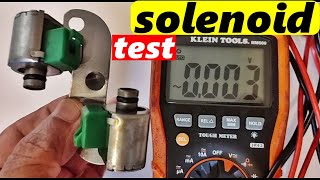
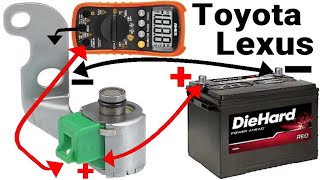
Measure the resistance between the power and ground pins for Shift Solenoid 'A' using a multimeter. Expect 10-30 ohms (verify OEM spec). Infinite resistance (OL) means an open circuit; near-zero means a short.
Tools: Multimeter, vehicle-specific wiring diagram (Intermediate) - Perform a Voltage Drop Test (Pro Tip)
Back-probe the solenoid ground pin at the TCM and connect the other lead to the negative battery terminal with the key on. A reading above 0.2V indicates ground circuit corrosion. Repeat on the power side; a drop >0.5V flags high resistance.
Tools: Multimeter with back-probe pins (Advanced) - Test Solenoid Voltage and Command Operation
Test for power at the solenoid's connector with the key on (expect ~12V). Use an advanced scanner to command the solenoid on and off; you should hear a faint click. If it clicks but the code returns, suspect a hydraulic blockage.
Tools: Multimeter, advanced OBD-II scanner (Advanced) - Drop the Transmission Pan and Inspect Internals
Drain the fluid and remove the transmission oil pan. Inspect the pan magnet for excessive metal shavings or clutch material (fine grey dust is normal). Locate the solenoid on the valve body.
Tools: Socket set, torque wrench, drain pan, jack and jack stands (Advanced) - Perform a Hydraulic Pressure Test (Pro Tip)
Connect a pressure gauge to the transmission's line pressure test port. While monitoring the gauge, command the solenoid on and off. A significant drop or failure to build pressure indicates a major leak (e.g., failed clutch drum seal), ruling out a simple solenoid issue.
Tools: Transmission pressure gauge set, vehicle-specific service manual (Professional) - Analyze Solenoid Current Signature (Pro Tip)
Use a low-amp current probe and an oscilloscope to graph the electrical current flowing through the solenoid. A missing 'hump' in the waveform proves the solenoid is mechanically stuck, even if resistance is correct.
Tools: Oscilloscope, low-amp current probe (Professional)
When This Code Triggers (Freeze-Frame Conditions)
- Engine Coolant Temp: 175-210°F (Sets when the engine and transmission reach full operating temperature.)
- Engine RPM: 1500-3000 RPM (Occurs during light to moderate acceleration when a gear change is expected.)
- Vehicle Speed: 25-55 mph (Triggers during normal city or highway upshifts (e.g., 1-2, 2-3, or 3-4).)
- Commanded Gear: 2, 3, or 4 (Logged when the PCM commands a new gear but speed sensors report the shift failed to complete.)
Related Codes
- P0700 — A general transmission fault code indicating the TCM stored a code. It always appears with P0751 to alert the main computer but offers no independent diagnostic value.
- P0753 — Indicates a purely electrical fault (short or open circuit) in the Shift Solenoid 'A' circuit. If resistance is normal but P0751 persists, the problem is a mechanical blockage, not electrical failure.
- P0756 — Shift Solenoid 'B' Performance. Seeing P0751 and P0756 together strongly suggests a systemic problem like contaminated fluid, low system voltage, or a failing valve body affecting multiple solenoids.
- P0741 — Torque Converter Clutch (TCC) solenoid performance. On GM 6L80 transmissions, a failing torque converter sheds metallic debris that clogs all solenoids, causing P0751. Seeing them together confirms torque converter failure.
- P2700-P2708 — Relates to transmission clutch application timing. Frequently listed alongside P0751 in Ford TSBs for the 10R80 transmission, confirming a loss of clutch engagement pressure due to CDF drum failure.
Climate & Environmental Factors
- Cold Weather: In cold climates, old or incorrect transmission fluid becomes too thick for the solenoid to actuate properly within the TCM's allotted time, setting a performance code on cold starts.
- High Operating Temperature: Extreme heat causes wire insulation to become brittle and crack, leading to intermittent shorts or open circuits that trigger P0751.
How to Talk to a Mechanic About This Code
Say this: "I have a P0751 shift solenoid performance code. Please start by checking the transmission fluid condition and inspecting the external wiring and ground connections before quoting any internal part replacements."
This signals you understand the code is often caused by simple issues, not just a bad solenoid. It directs the technician to follow a logical diagnostic path and prevents immediate upsells.
Avoid saying:
- 'My car is shifting funny.'
- 'My check engine light is on, can you just fix it?'
- 'I think I need a new shift solenoid.'
Questions to ask before authorizing the repair:
- What was the condition of the transmission fluid? Was it dark, burnt, or full of debris?
- Did you perform a resistance test on the solenoid and a voltage drop test on the wiring? What were the readings?
- If you are recommending a solenoid replacement, what tests did you run to rule out a simpler wiring or fluid issue?
- What is the warranty on both the parts and the labor for this repair?
Where to Take It: Dealer vs Independent vs Chain
- Dealer:
Necessary for specific TSB-related repairs or warranty coverage. Otherwise, the most expensive option.
Best for: Vehicles under warranty., Specific models with known TSBs (e.g., Ford 10R80, GM 6L80) where the dealer has access to the latest parts and software., Complex repairs requiring programming of a new valve body or TCM.
Downsides: Highest labor rates., Defaults to replacing entire expensive assemblies instead of smaller components. (Typical cost: +50% vs. baseline) - Chain Shop:
Avoid for P0751 diagnosis and repair. The risk of an incorrect and costly repair is too high.
Best for: Potentially a fluid exchange service, but proceed with caution.
Downsides: High risk of upsell and misdiagnosis. Technicians lack deep expertise for complex transmission codes., Uses aggressive flushing machines that dislodge debris and worsen the problem. (Typical cost: -20% vs. baseline)
When to Walk Away From the Repair
If the estimated repair cost for the P0751 code exceeds 50% of your car's private-party value, seriously consider selling it as-is or trading it in.
- Car worth $15000, fix is $1200: Fix it. The repair cost is only 8% of the vehicle's value.
- Car worth $6000, fix is $3500: Walk away. The repair cost is nearly 60% of the car's value. Use this money as a down payment on a reliable vehicle.
- Car worth $3000, fix is $800: Borderline. The repair is ~27% of the car's value. If the rest of the car is in excellent shape, fix it. If other major repairs are needed, let it go.
What Scan Tool You Need for This Code
Minimum: A scanner that reads transmission-specific live data, including Transmission Fluid Temperature (TFT), commanded gear, and solenoid status.
A basic $20 code reader only shows the P0751 code. It cannot display the live data required to diagnose *why* the code set. Without seeing solenoid command status or fluid temperature, you are guessing.
Budget: BlueDriver Pro or XTOOL A30M (~$100) — Connects to your smartphone and displays critical live transmission data PIDs like fluid temperature and solenoid command status for initial diagnosis.
Mid-range: Foxwell NT510 Elite or Launch CRP129X (~$170) — Provides manufacturer-specific diagnostics and bidirectional control, allowing you to manually command Shift Solenoid 'A' on and off to test its mechanical function.
Professional: Autel MaxiCOM MK808S/MK808Z (~$500) — Offers full bidirectional control and advanced functions. Critical for performing a 'transmission adaptive relearn' procedure after a repair, which is required by many manufacturers.
Rent vs buy: Auto parts stores scan codes for free, but their tools lack the live data needed for a real diagnosis. If you plan to DIY the diagnosis, you must buy a scanner with live data capabilities.
How to Clear the Code After You Fix It
- Use an OBD-II scan tool to clear the P0751 and related fault codes.
- Perform a transmission adaptive pressure relearn procedure if specified by the manufacturer (requires an advanced scan tool).
- Conduct a specific drive cycle to allow the TCM to verify the repair and reset readiness monitors.
Drive cycle (~20 minutes): Idle for 2-3 minutes. Accelerate to 45-55 mph at a moderate, steady throttle. Hold this speed for 5-7 minutes. Safely come to a complete stop and idle in Drive for 1 minute. Repeat the process to allow the transmission to shift smoothly through all gears multiple times.
Readiness monitors affected: Comprehensive Component Monitor (CCM), Transmission
Before emissions retest: drive at least 50 miles to fully set monitors.
Watch out for:
- Clearing the code without a proper test drive results in the code returning immediately.
- Disconnecting the battery clears the code but erases all adaptive memory, causing initial poor shifting and requiring a longer drive to reset emissions monitors.
- If the root cause remains unfixed, the code returns as soon as the fault conditions are met.
Will This Fail Emissions / State Inspection?
Yes — this code typically fails an OBD-II emissions inspection.
- California: An active P0751 code causes an automatic smog check failure. The Check Engine Light must be off and all monitors set to 'Ready'.
- New York: The NYS DMV inspection includes an OBD-II scan. Any active diagnostic trouble code illuminating the check engine light results in failure.
- Texas: In the 17 Texas counties requiring emissions testing, an illuminated Check Engine Light due to P0751 fails the OBD inspection.
Most Commonly Affected Vehicles
- Ford F-150, Expedition, Ranger, Mustang, Transit (2017-2023) — On models with the 10R80 10-speed transmission, this code indicates a major internal failure of the CDF clutch drum or main valve body. This requires a major transmission repair per TSBs 23-2123 and 24-2254.
- Chevrolet / GMC Silverado, Sierra, Express, Suburban (2010-2019) — Common on trucks with 4L60-E, 6L80, and 8L90 transmissions. The cause is often a sticking solenoid due to contaminated fluid, debris from a failing torque converter, or a faulty TEHCM assembly. Addressed in TSB 18-NA-355.
- Dodge / Ram 1500, 2500, Durango, Grand Caravan (2004-2018) — Common in vehicles with 45RFE, 545RFE, and 68RFE transmissions. The issue lies within the solenoid pack bolted to the valve body. Replacing the entire solenoid pack is the standard repair.
- Nissan Altima, Sentra, Maxima, Murano (2005-2016) — On CVT models, P0751 indicates internal valve body wear or a failing solenoid, exacerbated by poor fluid condition.
- Hyundai / Kia Sonata, Elantra, Optima, Sorento (2011-2018) — Susceptible to P0751 due to internal solenoid failure or valve body blockages. The solution involves replacing the solenoid pack and performing a thorough fluid flush.
- Toyota Camry, Corolla, RAV4, Highlander (2004-2013) — Often points to an aging shift solenoid that failed electrically or is mechanically stuck. A straightforward solenoid replacement usually resolves the issue.
- Honda Accord, Civic, Odyssey (2008-2017) — Honda transmissions are highly sensitive to fluid type. Using non-genuine Honda ATF is a primary cause of solenoid performance codes.
- Chevrolet Equinox, Malibu, Cobalt (2006-2015) — Frequently experience P0751 due to failed shift solenoids or valve body issues related to fluid degradation in 6T40/6T45 transmissions.
Manufacturer-Specific Notes
- General Motors (Chevrolet/GMC): On trucks with 6L80/6L90 transmissions, a failing torque converter sheds debris that contaminates the entire valve body and TEHCM, causing P0751. A simple solenoid replacement is not a long-term fix. TSB 18-NA-355 addresses this.
- Ford: On modern F-150s with the 10R80 10-speed transmission, P0751 indicates a slipped bushing in the CDF clutch drum or a faulty main control valve body. This requires a major transmission repair per TSB 24-2254.
- Honda: Honda transmissions are notoriously sensitive to fluid type. Using non-genuine Honda ATF or degraded fluid is a primary trigger for solenoid performance codes like P0751. Always use Honda ATF-DW1.
- Dodge / Ram / Chrysler: In RFE-series transmissions (45RFE, 545RFE, 68RFE), shift solenoids are integrated into a single 'solenoid pack'. When one solenoid triggers P0751, the entire pack must be replaced as a unit.
Real Owner Stories
2018 Ford F-150 with 10R80 Transmission at 75,000 miles
Vehicle experienced a violent slam when shifting and entered limp mode. The check engine light came on with code P0751.
What they tried:
- Owner suspected a simple solenoid issue. A local shop quoted a full transmission replacement for $7,000.
- Dealer diagnosis confirmed the common 10R80 issue: a failed CDF clutch drum, not just the solenoid.
Outcome: The transmission required a complete teardown to replace the faulty CDF drum with an updated part (JL3Z-7H351-B), costing $4,200 at an independent shop.
Lesson: On a Ford 10R80 transmission, P0751 strongly indicates major internal failure. Do not accept a simple solenoid replacement or software reset. Reference Ford TSB 24-2254.
2000 Jeep Cherokee XJ at 130,000 miles
Check engine light appeared with code P0751. The transmission shifted normally, but the owner was concerned about damage.
What they tried:
- The owner performed three separate drain-and-refills of the transmission fluid over a few weeks to replace the old fluid.
Outcome: After the fluid changes, the check engine light turned off permanently. The fresh fluid freed the mechanically sticky solenoid.
Lesson: For high-mileage vehicles with unknown service history, a fluid and filter change is a low-cost, highly effective first step that resolves many performance-related codes.
2019 Chevy Volt at 80,000 miles
Car exhibited strange shifting behavior and threw P0700 and P0751 codes. It eventually entered a 'propulsion error' state and would not shift out of neutral.
What they tried:
- The first dealership misdiagnosed the issue and recommended a full transmission replacement for $7,200.
- The owner sought a second opinion.
Outcome: The second dealer correctly identified a failure in the solenoid valve assembly. They replaced the entire assembly for $2,700, resolving the issue.
Lesson: Always get a second opinion for major repairs. P0751 often points to a faulty solenoid pack or valve body—a significant but much cheaper repair than a full transmission replacement.
How to Prevent This Code From Triggering
- Change transmission fluid and filter. (Every 30,000 to 60,000 miles, or per manufacturer spec.) — Removes contaminants that clog solenoid passages. Fresh fluid restores lubrication and heat dissipation, preventing solenoid overheating and mechanical sticking.
- Use only OEM-specified transmission fluid. (Every fluid change.) — Manufacturer-specific fluids contain precise friction modifiers. Wrong fluid degrades seals and forces solenoids to perform outside designed parameters.
- Install an external in-line magnetic filter (for older vehicles). (Once, with filter changes every 10,000-20,000 miles.) — Captures fine metallic particles the internal filter misses, protecting solenoids and the valve body from abrasive debris.
- Check for TCM software updates. (During routine dealer service visits.) — Manufacturers release updates adjusting shift logic or widening acceptable performance parameters, preventing erroneous codes from setting.
- Maintain the engine's cooling system. (Per manufacturer schedule (e.g., coolant flush every 5 years/100k miles).) — The radiator cools transmission fluid. An overheating engine spikes transmission temperatures, accelerating fluid breakdown and solenoid failure.
Frequently Asked Questions
How much does it cost to fix code P0751?
Costs range from $170-$400 for a fluid change to $250-$600 for a single solenoid replacement. Replacing a valve body costs $700-$1,700. Major internal repairs on specific Ford/GM trucks often exceed $3,500.
What is the most common misdiagnosis for P0751?
The most common mistake is immediately replacing Shift Solenoid 'A' without checking fluid condition or wiring. Low fluid, a clogged passage, or a bad ground wire frequently trigger this code. Always test the circuit and fluid before replacing parts to avoid repeat failures.
Can a bad battery or alternator cause P0751?
Yes, the Transmission Control Module (TCM) and solenoids require stable voltage to function. A failing battery, bad alternator, or corroded ground connection causes voltage drops that the TCM misinterprets as a solenoid failure. Ensure the charging system and grounds are healthy before opening the transmission.
Why did the P0751 code come back after I replaced the solenoid?
This happens when the solenoid was not the root cause of the failure. Contaminated fluid, a blocked valve body passage, or a persistent wiring issue will immediately trigger the code again. It also indicates deeper mechanical failures, like a disintegrating torque converter shedding debris into the new solenoid.
Will a transmission flush fix a P0751 code?
A flush sometimes clears minor blockages caused by dirty fluid, but it is not a guaranteed fix. If the solenoid is electrically dead or mechanically damaged, a flush does nothing. Furthermore, aggressive flushing on high-mileage transmissions dislodges trapped debris, creating new clogs and worsening the problem.
What is the difference between P0751 and P0752?
Both codes relate to Shift Solenoid 'A', but indicate opposite mechanical failures. P0751 means the solenoid is 'Stuck Off' and fails to activate when commanded. P0752 means the solenoid is 'Stuck On' and fails to deactivate.
Where is Shift Solenoid A located?
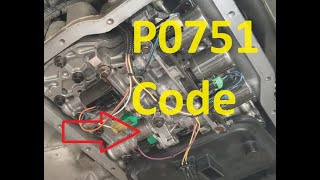
Shift Solenoid 'A' is located inside the automatic transmission, mounted directly to the valve body. It is not accessible from the outside of the vehicle. You must drain the transmission fluid and remove the oil pan to reach it.
Key Takeaways
- Address code P0751 immediately; driving in 'limp mode' causes severe transmission overheating and turns a $300 solenoid repair into a $4,000 rebuild.
- Check your transmission fluid level and color first, as dirty or low fluid causes over 40% of P0751 codes by clogging the solenoid's internal passages.
- Test the solenoid's electrical resistance (typically 10-30 ohms) with a multimeter before replacing it to rule out a simple $50 wiring or ground issue.
- Expect repair costs between $3,500 and $8,500 if you own a 2017-2023 Ford F-150 or GM truck, as P0751 frequently indicates a catastrophic clutch drum or torque converter failure.
Helpful Videos



The information in this article is provided for general reference and educational purposes only. Vehicle specifications, procedures, and part compatibility can vary by production date, trim level, and region. Always consult your vehicle's factory service manual and verify part numbers before purchasing or performing repairs. Safety-critical components such as airbags, seat belts, and braking systems should be installed by a qualified professional.
- 🎬 Helpful Videos
- What Does P0751 Mean?
- Can I Drive With P0751?
- Common Causes
- Symptoms
- Diagnostic Flowchart
- Common Fixes & Costs
- Used vs. New Parts: Buying Guide
- What Happens If You Wait — Timeline
- Cost of Not Fixing It
- Diagnosis Steps
- When This Code Triggers (Freeze-Frame Conditions)
- Related Codes
- Climate & Environmental Factors
- How to Talk to a Mechanic About This Code
- Where to Take It: Dealer vs Independent vs Chain
- When to Walk Away From the Repair
- What Scan Tool You Need for This Code
- How to Clear the Code After You Fix It
- Will This Fail Emissions / State Inspection?
- Most Commonly Affected Vehicles
- Manufacturer-Specific Notes
- Real Owner Stories
- 2018 Ford F-150 with 10R80 Transmission at 75,000 miles
- 2000 Jeep Cherokee XJ at 130,000 miles
- 2019 Chevy Volt at 80,000 miles
- How to Prevent This Code From Triggering
- Frequently Asked Questions
- How much does it cost to fix code P0751?
- What is the most common misdiagnosis for P0751?
- Can a bad battery or alternator cause P0751?
- Why did the P0751 code come back after I replaced the solenoid?
- Will a transmission flush fix a P0751 code?
- What is the difference between P0751 and P0752?
- Where is Shift Solenoid A located?
- Key Takeaways
- 🎟️ Get 5% Off