

OBD-II Code P0741: Torque Converter Clutch Circuit Performance / Stuck Off
The Most Comprehensive Guide to Understanding, Diagnosing, and Fixing P0741
- Check your transmission fluid level and condition first; replacing degraded fluid resolves P0741 in roughly 20% of cases for under $300.
- Stop driving at highway speeds immediately; continuous torque converter slip raises fluid temperatures by 50-100°F, turning a $300 solenoid fix into a $4,000 transmission rebuild.
- Test the TCC solenoid's electrical resistance (typically 10-30 Ohms) before authorizing major repairs, as a failed $50 solenoid perfectly mimics a destroyed transmission.
- Search for manufacturer Technical Service Bulletins (TSBs) before replacing parts; known defects on 2017-2019 Hondas and Fords often qualify for free dealership repairs or software updates.
What Does P0741 Mean?

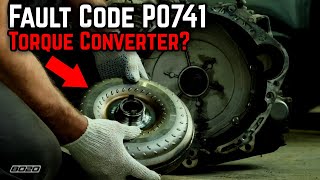
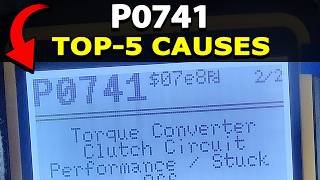
P0741 means your vehicle's Powertrain Control Module (PCM) detects a performance problem with the torque converter clutch (TCC). At highway speeds (above 40-45 mph), this clutch locks to create a solid 1-to-1 mechanical link between the engine and transmission, eliminating slippage, reducing heat, and improving fuel economy. 🎬 Watch: A quick overview of P0741 causes and fixes. The PCM sets this code when it commands the TCC to engage, but detects the clutch is not applying or is slipping excessively.
Technical definition: The official SAE/OBD-II definition is "Torque Converter Clutch (TCC) Circuit Performance or Stuck Off." The PCM triggers the code when it commands TCC lock-up but detects a persistent difference of more than 200 RPM between the engine speed and the transmission input shaft speed. When locked, these two speeds should be nearly identical (less than 50 RPM slip).
Can I Drive With P0741?
yes_but_not_recommended. You can drive for short, low-speed distances, but long-distance or high-speed driving is strongly discouraged. Continued operation with the clutch slipping generates excessive heat (an increase of 50-100°F), which cooks the transmission fluid, warps internal components, and turns a $300 solenoid fix into a $4,000 transmission rebuild. Ignoring the code leads to catastrophic transmission failure, leaving you stranded.
Common Causes


- Low, Dirty, or Incorrect Transmission Fluid (Very Common) — This is the leading cause. Old, degraded fluid loses its hydraulic properties and friction modifiers. Low fluid levels reduce the hydraulic pressure required to engage the TCC. Using the wrong fluid type also causes this issue.
- Faulty Torque Converter Clutch (TCC) Solenoid (Very Common) — This electro-hydraulic valve controls fluid flow to the TCC. It fails electrically (open/short circuit), mechanically (gets stuck), or becomes clogged with debris from contaminated fluid, preventing clutch engagement.
- TCM/PCM Software Glitch (Common) — On specific models (e.g., Kia Telluride, Hyundai Santa Fe), faulty logic in the Transmission Control Module (TCM) erroneously triggers the code. A dealership software update (reflash) is the only fix.
- Worn or Damaged Torque Converter (Common) — The internal clutch's friction material wears out completely, or internal seals and pistons fail (a known issue in some Honda and BMW models), preventing lock-up even with a functional solenoid.
- Faulty Transmission Valve Body (Less Common) — The valve body is the transmission's hydraulic brain. Bores within the valve body wear out, or valves stick due to debris, preventing proper hydraulic pressure from reaching the TCC circuit.
- Damaged Wiring or Connectors (Less Common) — The wiring harness to the TCC solenoid or the main transmission connector corrodes, frays, or shorts. This is common on older vehicles or those in harsh climates with road salt.
- Internal Hydraulic Leak / Worn Pump (Rare) — Worn seals on the transmission's input shaft or a failing front pump cause a loss of hydraulic pressure throughout the system, preventing the TCC from having enough force to engage.
- Faulty Engine Coolant Temperature (ECT) Sensor (Rare) — The TCM relies on engine temperature to determine when it is safe to engage the TCC (it inhibits lock-up when cold). An inaccurate ECT sensor prevents the TCM from ever commanding lock-up.
- Faulty Transmission Control Module (TCM) or Powertrain Control Module (PCM) (Very Rare) — In rare instances, the control module itself fails. Consider this only after exhaustively testing all wiring, solenoids, and mechanical components.
Symptoms

- Check Engine Light is On — This is the most common initial symptom. On many Honda and Acura models, a flashing 'D' or 'OD' (Overdrive) light appears alongside the Check Engine Light.
- Reduced Fuel Economy — Without TCC lock-up, the engine must maintain higher RPMs at cruising speeds, leading to a noticeable 10-15% drop in gas mileage.
- Engine RPMs Higher Than Usual at Highway Speed — When driving at a steady 60 mph, the tachometer shows higher RPMs than normal, as if the transmission hasn't shifted into its final gear.
- Shuddering or Vibration — The vehicle shudders or vibrates, feeling like driving over rumble strips, especially under light acceleration between 40-60 mph as the TCC attempts to engage.
- Transmission Overheating — Constant slippage generates significant excess heat, triggering a transmission temperature warning light and causing a burning smell from the fluid.
- Harsh or Delayed Shifts — The underlying issues causing P0741, such as dirty fluid or low pressure, also lead to rough or delayed gear changes.
Diagnostic Flowchart
Tap your situation to follow the diagnostic path that matches what you're seeing on this code.
Common Fixes & Costs
- Transmission Fluid and Filter Change — Parts: $80-$150, Labor: $150-$300, ~1.5 hr book time (DIY)
- Replace Torque Converter Clutch (TCC) Solenoid — Parts: $50-$250, Labor: $250-$600, ~3.5 hr book time (Advanced)
- TCM Software Update — Parts: $0, Labor: $150-$300, ~1 hr book time (Professional)
- Replace Transmission Valve Body — Parts: $300-$800, Labor: $400-$1000, ~4.5 hr book time (Professional)
- Replace Torque Converter — Parts: $200-$700, Labor: $800-$2200, ~8 hr book time (Professional)
DIY vs Professional
- Transmission Fluid and Filter Change — Beginner:
Tools: Socket set, drain pan, funnel, torque wrench, new fluid, new filter/gasket. - Replace TCC Solenoid — Beginner:
Tools: Full socket set, torque wrench, inch-pound torque wrench, service manual. - Replace Valve Body — Beginner:
Tools: Professional tool set, transmission-specific tools, service manual, torque wrenches. - Replace Torque Converter — Beginner:
Tools: Engine hoist, transmission jack, full professional tool set, vehicle lift.
Used vs. New Parts: Buying Guide
When a used part is worth it: For a complete transmission assembly or a valve body, a low-mileage used part from a reputable salvage yard is a cost-effective option for older vehicles. Never buy a used, standalone torque converter or solenoid due to the high risk of contamination.
Donor-vehicle mileage cap: roughly under 60000 miles for the part to have meaningful remaining life.
Donor quality checklist:
- Verify the donor vehicle's mileage and reason for salvage (accident damage is preferable to mechanical failure).
- For valve bodies and solenoids, ensure the part number is an exact match.
- Favor remanufactured torque converters over used ones, as they are fully disassembled and cleaned.
Decision logic:
- If The failed part is a TCC solenoid → Buy new OEM or high-quality aftermarket. The part is inexpensive and critical for function; used is not worth the risk.
- If The failed part is the torque converter → Buy a quality remanufactured unit. It offers a balance of cost and reliability with a warranty.
- If The vehicle is over 10 years old and the entire transmission needs replacement → A low-mileage used assembly is a viable, budget-friendly option.
Warranty tradeoff: Used parts typically have a 30-90 day warranty covering the part only. Remanufactured components carry a 1-3 year warranty that includes limited labor coverage. New OEM parts have the best warranty.
Worst-case if a used part fails: 500-2500 if a used transmission part fails. This includes the repeat labor cost to remove and replace the component.
What Happens If You Wait — Timeline
- 0-1 month: Check Engine Light is on. TCC fails to lock, causing engine RPM to be 200-400 RPM higher at highway speeds. No other major symptoms are perceived. (MPG impact: 5-10%% · Added cost: $20-75 in wasted fuel)
- 1-4 months: Constant slippage generates excess heat, raising average transmission fluid temperature by 50-100°F. The fluid loses lubricating properties and acquires a burnt smell. Occasional shudder is felt. (MPG impact: 10-15%% · Added cost: $150-400 (wasted fuel + potential cost of a TCC solenoid damaged by heat/debris))
- 4-9 months: Sustained high temperatures (exceeding 240°F) cause internal seals to harden and crack. The torque converter's internal friction lining is destroyed. Other clutch packs begin to slip. (MPG impact: 15-20%% · Added cost: $1,500-2,500 (Torque converter replacement is mandatory; valve body damage is likely))
- 9+ months: Catastrophic failure. Extreme heat warps the valve body or transmission case. All clutch packs are glazed and burned. The vehicle stops moving altogether. (MPG impact: 20%+% · Added cost: $3,500-6,000+ (Full transmission rebuild or replacement cost))
Cost of Not Fixing It
- 0-1 month: Noticeable drop in fuel economy (5-15%). Transmission fluid temperature runs consistently higher, beginning the process of fluid degradation. (Added cost: 50-150)
- 1-6 months: Accelerated transmission fluid breakdown, leading to burnt smell and loss of hydraulic properties. Internal seals harden. Damage to the TCC solenoid from debris and heat occurs. (Added cost: 300-800)
- 6+ months: Catastrophic transmission failure. Extreme heat from constant slippage warps internal components, glazes clutch packs, and destroys the torque converter. (Added cost: 3000-5000+)
Diagnosis Steps
- Verify Code and Review Freeze Frame Data
Use an OBD-II scanner to confirm P0741 is active and check for other codes. Review Freeze Frame data to see the vehicle's state (speed, RPM, temp) when the code was set, providing critical clues about the failure conditions.
Tools: OBD-II Scanner (Beginner) - Check Transmission Fluid Level and Condition
Following the manufacturer's specific procedure, check the fluid level. Healthy fluid is bright red/pink with a neutral odor. Dark brown/black fluid that smells burnt indicates severe contamination and internal damage.
Tools: Rag, Gloves (Beginner) - Monitor Live Data with an Advanced Scanner
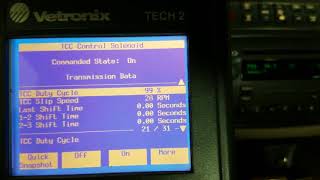
Use a scan tool to monitor TCC slip speed. During a test drive at highway speeds, observe this PID. When the PCM commands lock-up, the slip RPM should drop below 50 RPM. If the slip remains high (over 200 RPM), the mechanical failure is confirmed.
Tools: Advanced Bi-Directional Scan Tool (Intermediate) - Pro Tip: Test Solenoid Resistance at the Connector
Disconnect the main transmission harness connector and use a multimeter set to Ohms (Ω). Identify the two pins for the TCC solenoid using a wiring diagram. Measure the resistance. Most TCC solenoids read between 10-30 Ω. A reading of infinity (O.L.) or near zero confirms a bad solenoid.
Tools: Digital Multimeter, Vehicle-Specific Wiring Diagram (Advanced) - Pro Tip: Command the Solenoid and Perform a 'Click Test'
Use a bidirectional scanner to command the TCC solenoid on and off while stationary. Listen underneath the vehicle near the transmission pan. You should hear a distinct 'click'. No click confirms a stuck solenoid or a wiring issue.
Tools: Advanced Bi-Directional Scan Tool, Mechanic's Stethoscope (optional) (Advanced) - Inspect Wiring Harness and Connectors
Perform a visual inspection of the transmission's main electrical connector and wiring. Look for green/white corrosion, pushed-out pins, fluid intrusion, or chafed wires.
Tools: Flashlight, Mirror (Intermediate) - Advanced: Test ECT Sensor Resistance
If lock-up is inhibited, test the Engine Coolant Temperature (ECT) sensor. Disconnect the sensor and measure its resistance with a multimeter. Compare the reading to a temperature vs. resistance chart. An incorrect reading falsely tells the TCM the engine is cold.
Tools: Digital Multimeter, Temperature vs. Resistance Chart (Advanced) - Professional: Perform a Transmission Pressure Test
If electrical tests pass, connect a transmission pressure gauge to the line pressure port. Check the pressure at idle and during a stall test. Low line pressure indicates a failing pump, clogged filter, or internal leak preventing TCC engagement.
Tools: Transmission Pressure Gauge Kit, Service Manual (Professional) - Inspect Internal Components (Valve Body & Torque Converter)
Remove the transmission pan. Inspect the magnet for excessive metal shavings. Remove the valve body and inspect for stuck valves. If the valve body is clean, the torque converter has failed internally and requires replacement.
Tools: Full Mechanic's Tool Set, Transmission Jack, Gaskets, New Fluid (Professional)
When This Code Triggers (Freeze-Frame Conditions)
- Engine Coolant Temp: 175-210°F (Engine at full operating temperature.)
- RPM: 1500-2500 (Steady cruising speed, light throttle.)
- Engine Load: 20-50% (Maintaining speed on a flat road or slight incline.)
- Vehicle Speed: 45-65 mph (Highway driving in the top gear.)
Related Codes
- P0740 — P0740 indicates a purely electrical fault (open or short) in the TCC solenoid's circuit. P0741 is a 'performance' code, meaning the circuit is electrically intact, but the mechanical lock-up is failing.
- P0742 — This is the opposite of P0741, indicating the TCC is 'Stuck On'. This causes the engine to shudder violently and stall when coming to a stop.
- P0743 — Similar to P0740, this code points to an electrical failure specifically in the TCC solenoid's electrical circuit.
- P2757 — This code for 'Torque Converter Clutch Pressure Control Solenoid' often appears with P0741 on Toyota models. It indicates a problem with the solenoid controlling hydraulic pressure, directly causing P0741.
- P0700 — This is a generic fault code indicating the TCM requested the Check Engine Light. When P0700 is present, a specific code like P0741 is stored in the TCM.
Climate & Environmental Factors
- Cold Weather: Cold temperatures mask symptoms. The TCM inhibits TCC lock-up until the transmission fluid reaches a minimum operating temperature (e.g., >120°F). The problem only becomes apparent after the vehicle fully warms up.
- Harsh Climates (Road Salt): In regions using road salt, the external wiring harness and connectors are highly susceptible to corrosion. This increases resistance or causes short circuits in the TCC solenoid circuit.
How to Talk to a Mechanic About This Code
Say this: "I have a P0741 code and I'd like to schedule a diagnostic. I'd like you to start by checking the transmission fluid level and condition, and then use a scan tool to monitor the live TCC slip RPM data during a test drive. Please provide a quote for this initial diagnosis before proceeding with any teardown."
This signals you are an informed customer. It directs the shop to perform specific, low-cost checks first and prevents them from immediately quoting an expensive transmission rebuild without proper evidence.
Avoid saying:
- 'My transmission is acting funny, can you fix it?'
- 'Just do whatever it takes to get the light off.'
- 'A guy online said I need a new transmission.'
- Giving vague descriptions without mentioning the code invites a shop to start with the most expensive possibilities.
Questions to ask before authorizing the repair:
- What was the condition of the transmission fluid?
- What was the TCC slip RPM when lock-up was commanded on the scanner?
- If you are recommending a solenoid replacement, what was its resistance reading?
- If you are recommending a torque converter or rebuild, what tests ruled out a bad solenoid, wiring, or valve body?
- What is the warranty on the recommended repair, and does it cover both parts and labor?
- Can I have the old parts back?
Where to Take It: Dealer vs Independent vs Chain
- Dealer:
Necessary for warranty work or software flashes. For out-of-warranty repairs, get a second opinion from a specialist before approving a major repair.
Best for: Vehicles under powertrain warranty., Models with known TSBs or software updates for P0741 (e.g., Honda, Ford, Kia, Hyundai)., Complex, late-model vehicles where specialized factory tools are required.
Downsides: Highest labor rates., Prefers to replace larger assemblies (entire valve body, full transmission) rather than smaller components. (Typical cost: +50% vs. baseline) - Chain Shop:
Not recommended for diagnosing a P0741 code. The risk of an expensive misdiagnosis is high.
Best for: Basic fluid services (use with caution).
Downsides: High risk of being upsold to an unnecessary and expensive rebuild., Technician skill and experience with complex diagnostics is inconsistent., Often use scare tactics or offer vague phone estimates. (Typical cost: -10% vs. baseline)
When to Walk Away From the Repair
If the estimated repair cost exceeds 50% of the car's private-party value, replace the vehicle instead of repairing it. For cars over 10 years old or with more than 150,000 miles, lower this threshold to 40%.
- Car worth $8000, fix is $750: Fix it. A solenoid or valve body repair is well below the threshold and significantly cheaper than a new car payment.
- Car worth $4000, fix is $3500: Walk away. The repair cost is nearly 90% of the car's value. It is not a sound financial decision.
- Car worth $5000, fix is $2200: Borderline. The cost is 44% of the car's value. Before proceeding, consider the car's overall condition, recent repairs, and expected remaining lifespan. Getting a second opinion is highly recommended.
What Scan Tool You Need for This Code
Minimum: A scanner that reads manufacturer-specific transmission codes and displays live data, specifically 'Torque Converter Slip Speed' or 'TCC Slip RPM'.
A basic $20 code reader only confirms the P0741 code exists. It cannot show live slip data, which is essential to determine if the failure is real-time and hydraulic/mechanical. Without this data, you are guessing.
Budget: FOXWELL NT604 Elite / Motopower MP69033 (~$90) — Reads engine, transmission, ABS, and SRS codes. It provides a live data stream to monitor PIDs like transmission fluid temperature and TCC slip RPM. This is the minimum required to intelligently diagnose P0741.
Mid-range: Autel MaxiCOM MK808 / BlueDriver Pro (~$100-350) — Includes full live data graphing and adds bidirectional control. This allows you to command the TCC solenoid on and off yourself (a 'click test') to see if it is mechanically stuck or electrically sound, saving hundreds in diagnostic fees.
Professional: Autel MaxiSys MS906 / Launch X431 Series (~$600-1500) — Provides full, OEM-level diagnostics, including advanced bidirectional functions, module coding, and access to all manufacturer-specific PIDs. This is professional-grade equipment used by top-tier independent shops.
Rent vs buy: Most auto parts stores offer a 'loan-a-tool' program for basic scanners, but these lack the live data and bidirectional features needed for a proper P0741 diagnosis. For this code, you need to own or borrow at least a mid-range scanner.
How to Clear the Code After You Fix It
- Use an OBD-II scan tool to clear the code.
- Perform a complete transmission drive cycle to verify the repair.
- Do NOT simply disconnect the battery, as this clears important adaptive memory.
Drive cycle (~30 minutes): From a cold start, drive the vehicle under various conditions. Start with 5 minutes of city driving. Proceed to a highway and maintain a steady speed between 45-60 mph for at least 10-15 minutes to allow the TCC to attempt lock-up. Safely perform several light accelerations and decelerations. Allow the vehicle to cool down completely and repeat.
Readiness monitors affected: Comprehensive Component Monitor, Catalyst Monitor, Evaporative System Monitor
Before emissions retest: drive at least 50 miles to fully set monitors.
Watch out for:
- Clearing the code without performing a drive cycle results in the code returning immediately.
- Disconnecting the battery resets all readiness monitors to 'Not Ready', guaranteeing an emissions test failure.
- If the underlying mechanical issue is not fixed, the code returns as soon as the PCM runs the TCC monitor again.
Will This Fail Emissions / State Inspection?
Yes — this code typically fails an OBD-II emissions inspection.
- California: A vehicle with an illuminated Check Engine Light for P0741 automatically fails the smog inspection. All readiness monitors must be 'Ready' before a re-test.
- New York: An active P0741 code is an automatic failure of the emissions portion of the NYS inspection. The issue must be repaired and a drive cycle completed before it passes.
- Texas: In the 17 counties requiring emissions testing, a P0741 code causes the vehicle to fail the OBD-II portion of the inspection.
Most Commonly Affected Vehicles

- Honda Accord, Odyssey, Pilot, Ridgeline (2002-2019) — Extremely common. For 2017-2019 models with the 6-speed automatic, TSBs A23-077 and A23-078 extend the warranty due to a cracked lock-up piston inside the torque converter.
- Toyota Camry, Corolla, Matrix, RAV4 (2003-2015) — Linked to high mileage and worn fluid. TSB TC008-04 was issued for 2004-2005 Corollas. On the U760E transmission in 2012+ Camrys, it appears with P2757.
- Ford F-150, Escape, Mustang, Expedition (2004-2020) — For 2017-2018 F-150s/Mustangs with the 10R80 transmission, TSB 20-2117 points to a sticking TCC valve. For 2013-2015 Escapes (1.6L), TSB 19-2100 points to internal torque converter failure.
- Chevrolet / GM Silverado, Colorado, Tahoe, Suburban, Impala (2005-2019) — TSB 19-NA-153 states: on vehicles <7k miles, suspect a damaged turbine shaft bushing; on vehicles >30k miles, suspect worn torque converter clutch material.
- Hyundai Santa Fe, Sonata, Elantra (2008-2020) — TSB 23-AT-005H provides a TCU software update for 2019-2020 Santa Fe models (2.4L) to fix faulty P0741 logic.
- Kia Sorento, Telluride, Optima (2011-2020) — For the 2020 Telluride, TSB TRA089 requires a TCM software update to correct false P0741 codes. On Sorento models, it is often a faulty TCC solenoid.
- BMW 3-Series (E46, E90), 5-Series (E39, E60) (2001-2013) — On models with ZF automatic transmissions, this code is frequently caused by a failed internal seal inside the torque converter, requiring complete replacement.
- Subaru Forester, Legacy, Outback, Impreza (2003-2014) — Frequently appears with the generic P0700 code. The cause is often a failing TCC solenoid (lock-up duty solenoid) or degraded fluid.
Manufacturer-Specific Notes
- Honda / Acura: A blinking 'D' light is the primary indicator. TSBs A23-077 and A23-078 confirm a manufacturing defect and provide a warranty extension to 8 years/150,000 miles for the torque converter on many 2017-2019 6-speed models.
- Ford: On 2017-2018 models with the 10R80 transmission, the issue is a sticking valve in the main control valve body (TSB 20-2117). On 2013-2015 Escapes (1.6L), it is a failed torque converter (TSB 19-2100).
- General Motors (GM): TSB 19-NA-153 for 2014-2019 trucks gives mileage-based diagnostic paths: under 7,000 miles is a damaged turbine shaft front bushing; over 30,000 miles is worn friction material inside the torque converter.
- Kia / Hyundai: Before suspecting mechanical failure on 2019-2020 models, check for a software update. TSBs TRA089 (Kia) and 23-AT-005H (Hyundai) correct faulty TCM logic with a simple dealership reflash.
- Toyota: TSB TC008-04 for 2004-2005 Corollas points to an obscure cause related to the speedometer drive gear, which must be investigated before replacing major components.
Real Owner Stories
2014 Honda Odyssey at 45K miles
Check Engine Light and flashing 'D' light appeared. Transmission fluid level was fine.
What they tried:
- Initially suspected a major transmission failure based on forum posts.
Outcome: Replaced the externally accessible torque converter clutch solenoid. The repair took less than an hour, and the code was resolved.
Lesson: On many Honda models, the TCC solenoid is a common failure point and is externally accessible. Investigate this inexpensive fix before assuming catastrophic internal failure.
2018 Ford F-150 with 10R80 Transmission
Check Engine Light came on with codes P0741 and P1744. No major symptoms were noticed.
What they tried:
- A shop quoted a potential transmission rebuild.
Outcome: Owner found Ford TSB 20-2117 identifying a sticking TCC valve in the main control valve body. The fix was replacing the valve body under warranty, not the entire transmission.
Lesson: Always search for Technical Service Bulletins (TSBs). A known manufacturing defect turns a $4,000 rebuild quote into a targeted, warranty-covered repair.
2020 Kia Telluride
P0741 code appeared intermittently with no noticeable driving issues.
What they tried:
- The dealership initially considered diagnosing the torque converter.
Outcome: The dealership found Kia TSB TRA089 indicating a software logic error in the TCM falsely triggered P0741. A TCM software update permanently resolved the code.
Lesson: For newer vehicles, a software glitch is often the root cause. Insist the dealer checks for TCM software updates before authorizing mechanical repairs.
2008 Honda Odyssey at 160K miles
P0741 code appeared. A transmission shop immediately quoted a full rebuild citing high mileage.
What they tried:
- The owner tried a transmission fluid change first.
Outcome: Three drain-and-fills with Honda genuine DW-1 ATF resolved the code and symptoms. The old fluid was too degraded to provide necessary hydraulic pressure.
Lesson: Never underestimate fresh, correct-spec fluid. The cheapest and simplest fix is often the most logical first step and highly effective.
How to Prevent This Code From Triggering
- Perform regular transmission fluid and filter changes (Every 30,000-60,000 miles, or per manufacturer's 'severe' schedule.) — Fresh fluid maintains the correct hydraulic pressure, friction properties, and heat dissipation needed for the TCC to operate. It prevents sludge buildup that clogs solenoids.
- Use ONLY the manufacturer-specified transmission fluid (OEM) (Every fluid change.) — Modern transmissions are highly sensitive to specific fluid chemistry. Generic fluids lack correct friction modifiers, leading to TCC shudder, slippage, and P0741 codes.
- Install an external transmission cooler (One-time install, especially for vehicles used for towing or in hot climates.) — Heat is the number one enemy of transmissions. An external cooler significantly reduces fluid temperature, protecting the torque converter and internal clutches from heat damage.
- Ensure the engine's cooling system is in perfect condition (During regular vehicle maintenance.) — The transmission relies on a cooler inside the engine's radiator. A faulty thermostat or clogged radiator causes transmission fluid overheating, accelerating degradation.
Frequently Asked Questions
Can I fix P0741 myself?
A transmission fluid and filter change is a manageable DIY task. Diagnosing and replacing internal components like the TCC solenoid requires advanced skills and tools. Replacing the torque converter is a professional-level job requiring complete transmission removal.
Will changing the transmission fluid fix a P0741 code?
Yes, if the code is caused by low, dirty, or incorrect fluid. It is the least expensive and most logical starting point for repair.
What happens if I ignore a P0741 code?
Ignoring P0741 leads to continuously high transmission temperatures due to clutch slippage. This heat degrades the fluid, damages seals, warps metal components, and causes complete transmission failure costing over $3,000.
My P0741 code appeared right after a transmission fluid change. What happened?
You likely used the wrong type of transmission fluid or filled it to the incorrect level. Alternatively, on high-mileage transmissions, the detergents in new fluid dislodge built-up sludge, which then clogs a solenoid or valve passage.
What is the most common misdiagnosis for P0741?
The most common mistake is immediately condemning the entire transmission and quoting a full rebuild. A thorough diagnosis must rule out simpler causes first: fluid condition, a faulty TCC solenoid, a software glitch, or a wiring problem.
What does a torque converter clutch shudder feel like?
It feels like a brief vibration or a series of rapid bumps, similar to driving over rumble strips. This shudder is most apparent at highway speeds (40-60 mph) under light throttle as the system attempts to engage the clutch.
Is it worth fixing a P0741 code on an old car?
If the fix is a fluid change, software update, or an accessible solenoid (totaling $200-$800), it is almost always worth it. If the diagnosis requires a torque converter replacement or transmission rebuild ($1,500-$4,000+), weigh that cost against the vehicle's overall value.
Key Takeaways
- Check your transmission fluid level and condition first; replacing degraded fluid resolves P0741 in roughly 20% of cases for under $300.
- Stop driving at highway speeds immediately; continuous torque converter slip raises fluid temperatures by 50-100°F, turning a $300 solenoid fix into a $4,000 transmission rebuild.
- Test the TCC solenoid's electrical resistance (typically 10-30 Ohms) before authorizing major repairs, as a failed $50 solenoid perfectly mimics a destroyed transmission.
- Search for manufacturer Technical Service Bulletins (TSBs) before replacing parts; known defects on 2017-2019 Hondas and Fords often qualify for free dealership repairs or software updates.
Helpful Videos



The information in this article is provided for general reference and educational purposes only. Vehicle specifications, procedures, and part compatibility can vary by production date, trim level, and region. Always consult your vehicle's factory service manual and verify part numbers before purchasing or performing repairs. Safety-critical components such as airbags, seat belts, and braking systems should be installed by a qualified professional.
- 🎬 Helpful Videos
- What Does P0741 Mean?
- Can I Drive With P0741?
- Common Causes
- Symptoms
- Diagnostic Flowchart
- Common Fixes & Costs
- DIY vs Professional
- Used vs. New Parts: Buying Guide
- What Happens If You Wait — Timeline
- Cost of Not Fixing It
- Diagnosis Steps
- When This Code Triggers (Freeze-Frame Conditions)
- Related Codes
- Climate & Environmental Factors
- How to Talk to a Mechanic About This Code
- Where to Take It: Dealer vs Independent vs Chain
- When to Walk Away From the Repair
- What Scan Tool You Need for This Code
- How to Clear the Code After You Fix It
- Will This Fail Emissions / State Inspection?
- Most Commonly Affected Vehicles
- Manufacturer-Specific Notes
- Real Owner Stories
- 2014 Honda Odyssey at 45K miles
- 2018 Ford F-150 with 10R80 Transmission
- 2020 Kia Telluride
- 2008 Honda Odyssey at 160K miles
- How to Prevent This Code From Triggering
- Frequently Asked Questions
- Can I fix P0741 myself?
- Will changing the transmission fluid fix a P0741 code?
- What happens if I ignore a P0741 code?
- My P0741 code appeared right after a transmission fluid change. What happened?
- What is the most common misdiagnosis for P0741?
- What does a torque converter clutch shudder feel like?
- Is it worth fixing a P0741 code on an old car?
- Key Takeaways
- 🎟️ Get 5% Off