

P0521 on 2005-2023 Chrysler 300: Oil Pressure Sensor Causes and Fixes
For a Chrysler 300, code P0521 most often points to a failed oil pressure sensor (Mopar P/N 5149062AA or its successor). On 3.6L Pentastar engines, it's frequently caused by a leaking oil filter/cooler housing (a common failure is Mopar P/N 68105583AF) where the sensor is located. On 5.7L HEMI engines, the sensor itself is the common failure point, though using a non-OEM oil filter is also a known trigger. Expect to pay $20-$60 for a sensor and $150-$250 for a Pentastar oil filter housing assemb
- P0521 on a Chrysler 300 almost always points to a problem with the oil pressure sensor's reading, not necessarily the actual oil pressure.
- Before any repair, check the oil level and confirm the correct viscosity oil and a quality filter are being used.
- The most important diagnostic step is to verify actual oil pressure with a mechanical gauge to rule out a serious internal engine problem.
- On 3.6L Pentastar engines, the cause is very often a cracked/leaking oil filter housing assembly, which is a more involved repair than just the sensor.
- On 5.7L HEMI engines, the sensor itself is the most likely culprit, but its location can be difficult to access on some model years.
What's Unique About the 2005-2023 Chrysler 300
The Chrysler 300 used two main engine families in this period, and the cause of P0521 is often different for each. On the second-generation (2011+) 3.6L Pentastar V6, the oil pressure sensor is integrated into the plastic oil filter/cooler housing assembly, which sits in the 'V' of the engine. This entire assembly is a known failure point, often developing cracks or leaks that cause this code and can even mimic a rear main seal leak. For the 5.7L HEMI V8, the issue is more commonly the oil pressure sensor itself failing (located near the alternator or above the oil filter depending on the year), though using the wrong type of oil filter is a well-documented cause of this code.
Generation note: The 2005-2023 range covers two generations of the Chrysler 300. The first generation (2005-2010) used engines like the 2.7L V6, 3.5L V6, and 5.7L/6.1L HEMI V8s. The second generation (2011-2023) primarily used the 3.6L Pentastar V6 and 5.7L/6.4L HEMI V8s. The most significant difference regarding this code is the introduction of the 3.6L Pentastar engine with its unique oil filter housing design, which is a very common cause of P0521 on those models.
Symptoms You May Notice
- Check Engine Light illuminated
- Oil pressure warning light on the dashboard, which may flicker
- Oil pressure gauge reading erratically, or showing zero or maximum pressure
- A "Low Oil Pressure" message on the instrument cluster
- Engine noise (ticking, clattering) if actual oil pressure is low
- Engine may stall or run rough if VVT system is disabled due to the code
- Replacing the oil pump when the issue is just a faulty sensor or incorrect oil filter.
- On 3.6L engines, replacing only the sensor when the entire oil filter housing is cracked and leaking.
- On 3.6L engines, misdiagnosing a leaking oil filter housing as a rear main seal leak due to the location of the oil drip.
Most Likely Causes
- Faulty Engine Oil Pressure Sensor 🔴 High Probability The oil pressure sensor is a very common failure item on both Pentastar and HEMI engines. It is exposed to heat and pressure cycles which cause it to fail electronically or leak internally over time. Chrysler has superseded the part number (e.g., 5149062AA to 5149062AB) suggesting revisions to improve reliability.
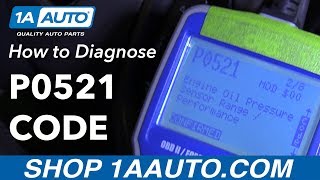
How to confirm: Using a scan tool, observe the oil pressure reading. If it is erratic, stuck at one value (e.g., 99 psi or 0 psi), or clearly incorrect for the engine's state, the sensor is likely bad. The ultimate confirmation is to check the actual oil pressure with a mechanical gauge; if the mechanical pressure is normal but the sensor reading is not, the sensor is faulty. 🎬 Watch: How to diagnose a failed oil pressure sender code.
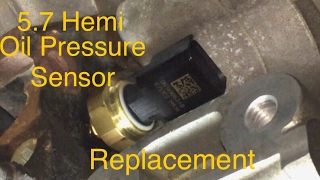
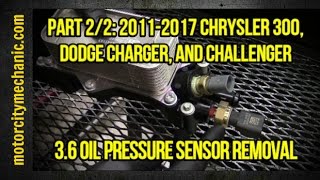
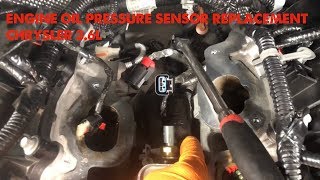
Typical fix: Replace the oil pressure sensor. On the 5.7L HEMI, it's typically located near the oil filter or under the alternator. 🎬 See how to replace the oil pressure sensor on a HEMI. On the 3.6L, it's on the oil filter housing assembly in the engine valley.
Est. part cost: $20-$60 - Leaking/Cracked Oil Filter Housing Assembly (3.6L Pentastar only) 🔴 High Probability The oil filter housing on the 3.6L Pentastar engine is made of plastic and sits in the hot valley between the cylinder heads. Repeated heat cycles cause the plastic to become brittle and crack, or the seals to degrade. This causes both external oil leaks and internal pressure problems that trigger P0521.
How to confirm: Visually inspect the area in the 'V' of the engine, underneath the intake manifold, for signs of oil leakage or pooling. A long dowel or inspection camera can help. TSB 09-008-15 details this inspection method. A significant leak here is a clear indicator.
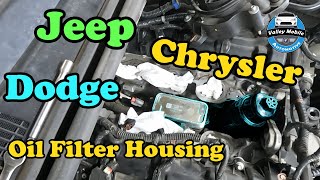
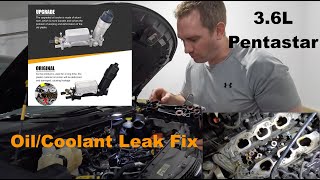
Typical fix: Replace the entire oil filter and cooler housing assembly. This is a labor-intensive job as it requires removing the upper and lower intake manifolds. 🎬 Watch this step-by-step walkthrough of the Pentastar oil cooler replacement. Upgraded aluminum versions are available from aftermarket suppliers like Dorman.
Est. part cost: $150-$250 - Incorrect Oil Viscosity or Clogged/Restrictive Oil Filter 🟡 Medium Probability Using oil that is thicker than the manufacturer's recommendation (e.g., 10W-40 instead of 5W-20 in a HEMI) can cause pressure readings outside the expected range. Similarly, a low-quality or overly restrictive oil filter (often from quick-lube shops) can impede flow and affect pressure readings, a known issue on HEMI engines.
How to confirm: Verify the oil viscosity used during the last oil change against the manufacturer's specification in the owner's manual. Inspect the oil filter part number. If it's not an OEM or reputable brand (like Mopar, Wix), it's a prime suspect.
Typical fix: Perform an oil and filter change using the correct viscosity oil (e.g., SAE 5W-20 for many 5.7L HEMI models) and a quality OEM Mopar or equivalent filter.
Est. part cost: $50-$100 - Low Engine Oil Level 🟡 Medium Probability
How to confirm: Check the engine oil level using the dipstick. This should always be the first step in diagnosing any oil pressure-related code.
Typical fix: Add the correct type of engine oil to bring the level to the 'Full' mark.
Est. part cost: $10-$20
Rare But Worth Checking
- Failing Oil Pump or Internal Engine Wear: This is the worst-case scenario. If a mechanical gauge confirms that the oil pressure is genuinely low, it points to a serious internal problem like a failing dual-stage oil pump (on newer models) or worn engine bearings. This is a true low-pressure condition that can quickly destroy the engine.
- Wiring Harness or Connector Issue: The wiring to the oil pressure sensor can become damaged from heat or contaminated with oil, leading to a poor connection and erratic signal. On the 3.6L, oil leaking from the filter housing often saturates the connector. This should be inspected before replacing the sensor.
Diagnosis Steps
- Check the engine oil level and condition. Top up if necessary.
- Using an OBD-II scanner, confirm the P0521 code is present and check for any other related codes.
- Observe the live oil pressure data from the scanner with the engine running. Note any erratic behavior, such as jumping to max/min or not changing with engine RPM.
- Verify the vehicle has the correct oil viscosity and a quality oil filter (Mopar is recommended). If in doubt, perform an oil change.
- The most crucial step: connect a mechanical oil pressure gauge to the engine. Compare the mechanical reading to the scanner's reading.
- If mechanical pressure is good and the scanner reading is bad, the problem is in the sensor or its wiring. Inspect the sensor's connector for oil contamination or damage.
- If the wiring looks good, replace the oil pressure sensor.
- On 3.6L engines, carefully inspect the entire oil filter housing for cracks or leaks before and after replacing the sensor. Consider replacing the whole assembly if any doubt exists.
- If mechanical pressure is genuinely low, the engine has a serious internal problem (e.g., oil pump, worn bearings) and requires professional diagnosis.
Parts You'll Likely Need
- Engine Oil Pressure Sensor (Switch)
(OEM #5149062AA, 5149062AB (superseded), 68295556AA (newer 3.6L))— This is the most common failure point for both the 5.7L HEMI and 3.6L Pentastar engines, causing erratic or incorrect pressure readings.
Trusted brands: Mopar, Standard Motor Products (SMP), Delphi
OEM price range: $40-$70
Aftermarket price range: $20-$45 - Engine Oil Filter and Cooler Housing Assembly (3.6L Pentastar)
(OEM #68105583AE, 68105583AF, 68105583AG, 68596317AB (latest))— This entire plastic assembly is a common failure point on the 3.6L engine. It cracks from heat and vibration, causing oil leaks and pressure issues that trigger P0521. The sensor is part of this assembly.
Trusted brands: Mopar (OEM), Dorman (926-876, Plastic), Dorman OE FIX (926-959, Upgraded Aluminum)
OEM price range: $200-$300
Aftermarket price range: $120-$250 (Plastic), $180-$350 (Aluminum)
Related Codes That Often Appear With This One
- P0520 — This code indicates a general fault in the oil pressure sensor circuit. It often appears with P0521 as the PCM tries to make sense of the faulty signals. TSBs often reference this code for sensor replacement.
- P1524 — On some models, this code for 'Oil Pressure Out of Range - Camshaft Advance/Retard Disabled' can be set. The variable valve timing (VVT) system uses oil pressure to function, so if the PCM can't trust the oil pressure reading, it will disable VVT as a precaution.
- P06DE / P06DD — On newer Pentastar engines, these codes relate to the dual-stage oil pump being stuck in high or low pressure mode. A faulty oil pressure sensor reading can lead the PCM to set these codes incorrectly, as the PCM uses the sensor's input to verify pump operation.
Technical Service Bulletins (TSBs) & Recalls
- TSB 09-008-15: Addresses oil loss or pooling in the engine valley of 2014 model year 3.6L engines. It instructs technicians to check for pooled oil under the intake, which can hold nearly a quart, before performing other diagnostics. If significant oil is found, the oil filter housing is the likely cause.
- TSB 18-034-14 REV. A: While specifically for code P0520 on some 2013-2014 models, it is highly relevant as it acknowledges a high failure rate of the original oil pressure sensor and recommends replacement with an updated part (P/N 05149062AB). This faulty sensor is a primary cause of P0521 as well.
Platform-Specific Known Issues
- 3.6L Pentastar Oil Leak Mimicking Rear Main Seal: When the plastic oil filter housing cracks on the 3.6L V6, oil pools in the engine valley under the intake manifold. Once this valley fills up, the oil runs down the back of the engine and drips from the bellhousing area. This is very commonly misdiagnosed as a failed rear main seal, which is a much more expensive and labor-intensive repair. TSB 09-008-15 specifically advises checking the valley for pooled oil as a first step.
- 5.7L HEMI Sensitivity to Aftermarket Oil Filters: Multiple owner forums report that the 5.7L HEMI engine can be particularly sensitive to the brand and quality of the oil filter. Using cheap, restrictive, or incorrect aftermarket filters (especially from quick-lube services) has been shown to cause P0521 by altering the oil pressure outside of the PCM's expected range. In many cases, simply performing an oil change with a quality Mopar or Wix filter resolves the code.
Mechanic-Grade Diagnostic Values
- 3.6L Pentastar Mechanical Oil Pressure (Warm Engine) — expected: Minimum 5 PSI at curb idle. 30-139 PSI between 1,200-3,500 RPM. For dual-stage pumps (2014+), expect ~30 PSI below 3,000 RPM and 60-75 PSI above 3,000 RPM.. Failure: Pressure below 5 PSI at idle, or pressure that does not increase with RPM. On dual-stage pumps, failure to switch to the higher pressure stage above ~3,000 RPM.
- 5.7L HEMI Mechanical Oil Pressure (Warm Engine) — expected: Typically 25-37 PSI at idle. Rises to 50-60 PSI during highway driving or higher RPMs.. Failure: Pressure significantly below 20 PSI at warm idle, or pressure that does not respond to changes in engine RPM.
- Oil Pressure Sensor Signal Voltage — expected: The sensor is a 3-wire design (5V reference, signal, ground). The signal wire should read approximately 0.5V at low pressure and rise towards 4.5V at high pressure.. Failure: Voltage stuck at 0V, 5V, or a fixed value that doesn't change with engine RPM. A reading that doesn't correlate with a mechanical gauge reading.
Scan Tool Commands That Help
- wiTECH (or equivalent high-level scanner): Dual-Stage Oil Pump Solenoid Actuation — On 2014+ 3.6L engines, if codes P06DD or P06DE are present with P0521, this command can be used to manually toggle the oil pump between its low and high-pressure stages while monitoring a mechanical gauge. This directly tests the pump's solenoid and its ability to change pressure, isolating it from the sensor.
Wiring & Ground Locations
- Oil Pressure Sensor Connector — On the oil pressure sensor itself. On the 3.6L, it's on the oil filter housing in the engine valley. On the 5.7L, it's typically near the oil filter or behind the alternator.. This 3-pin connector provides the sensor with a 5V reference, a ground, and sends the signal back to the PCM. Oil contamination (especially on the 3.6L from a leaking housing), corrosion, or a loose connection will cause an erratic or out-of-range signal, directly triggering P0521.
- Ground G102 — Located at the right side of the engine compartment on some models (e.g., 2007).. This is a primary engine ground point. A loose or corroded ground here can affect multiple sensors, including the oil pressure sensor, by creating an unstable ground reference and causing incorrect readings.
- Engine Management Fuses — In the front fuse box (Power Distribution Center) and potentially the trunk fuse box on later models.. The oil pressure sensor circuit is powered by fuses that also supply other engine management components. Specifically for some later models, fuses F31, F34, F35, F37 and relays R14, R29, R63 (ASD) should be checked. A blown fuse will kill power to the sensor, setting a circuit code.
Real Owner Repair Stories
- Reddit user in r/ChevyTrucks (describing a HEMI issue) (Dodge Charger with HEMI engine) — Persistent P0521 code.
❌ Tried (didn't work) Replacing the oil pressure sensor with a part from a local auto parts store.
✅ What actually fixed it Replacing the sensor a second time, but using an OEM Mopar sensor, resolved the code. - RamForum.com user (2014 Ram 1500 5.7L HEMI) — Oil pressure gauge was seemingly stuck at 49 PSI at all times (idle, driving, cold, warm).
❌ Tried (didn't work) Initial concern was a faulty, stuck sensor.
✅ What actually fixed it Performing a standard oil and filter change (with Pennzoil 5W-20 and a Mopar MO-339 filter) caused the gauge to begin reading dynamically as it should (30 PSI at idle, 50+ PSI while driving). The theory was that old oil or a clogged filter caused the sensor to report a fixed value. - BobIsTheOilGuy.com forum user (2015 Jeep with 3.6L Pentastar, 110k miles) — Oil light continued to come on after multiple repairs.
❌ Tried (didn't work) Replaced oil filter housing and oil pressure sensor., Replaced the 2-stage oil pump., Verified wiring integrity.
✅ What actually fixed it The root cause was never fully resolved in the thread, but a critical diagnostic finding was made: a mechanical gauge revealed that when the oil pump solenoid commanded a pressure change, the actual pressure would momentarily drop to near zero before recovering. This split-second pressure loss was enough to set the code but was missed by standard checks. This pointed to a deeper, intermittent mechanical failure within the lubrication system.
"I Checked Everything" — The Actual Cause
- The diagnostic equivalent for P0521 is when a mechanical gauge shows good pressure and a new sensor is installed, but the code persists. In one documented case involving a similar GM engine, the final fix was changing to a specific high-quality aftermarket oil filter (Mobil 1 M1-113A). This suggests the PCM's expected pressure range is so specific that the flow characteristics of certain filters can cause a deviation sufficient to set the code, even if overall pressure seems acceptable.
OEM Part Supersession History
68105583AF (and earlier revisions)→68105583AG, 68596317AB (latest known)— Revisions to the 3.6L oil filter housing assembly to improve durability and prevent cracking/leaking that is common with earlier plastic versions.
Heads up: While physically interchangeable, using an older revision part is not recommended due to the high failure rate. The Dorman 926-959 aluminum housing is a popular aftermarket upgrade to prevent future failures.5149062AA→5149062AB— Internal revisions to the oil pressure sensor to improve reliability and accuracy.
Heads up: Forum reports strongly indicate that using non-Mopar sensors, even if they cross-reference, often fails to fix the P0521 code on Chrysler products. Sticking to the latest Mopar revision is critical.
Model Year Variations Within This Range
- 2011-2013 (3.6L Pentastar): These early Pentastar engines used a single-stage oil pump and have a specific oil filter housing and cap design.
- 2014-2023 (3.6L Pentastar): Starting around 2014, the Pentastar was updated with a dual-stage oil pump for better efficiency. This adds diagnostic complexity, as a failure of the pump to switch stages can cause P0521 and related codes like P06DD. The oil filter housing was also updated.
- 2005-2010 vs 2011+ (5.7L HEMI): The location of the oil pressure sensor can vary. On many earlier models, it is more difficult to access, located behind the alternator, often requiring the alternator's removal to replace. On some other models or years, it is located in a more accessible position near the oil filter housing.
Diagnostic Flowchart
Used vs. New Parts: Buying Guide for This Vehicle
When a used part is the smart pick: For this repair, used parts are generally not recommended for the core components. However, obtaining used 'hard parts' that must be removed for access, such as the upper and lower intake manifolds for the 3.6L engine, can be a cost-effective choice as they have no wear components.
Donor-vehicle mileage cap: roughly under 75000 miles for the part to have meaningful remaining life.
What to inspect on the donor part:
- For a used intake manifold, ensure all threaded inserts are intact and there are no visible cracks.
- Avoid any parts from an engine that shows signs of heavy oil sludge or coolant contamination ('milkshake').
- If considering a used oil pump (high risk), inspect for any scoring or visible wear on the gears and housing.
OEM-only on this vehicle (don't cheap out):
- Engine Oil Pressure Sensor: Multiple owner reports confirm that aftermarket sensors frequently do not work correctly or fail prematurely, causing the P0521 code to return. Always use a genuine Mopar sensor.
- Oil Pump (especially dual-stage): This is a critical engine component where OEM reliability is paramount. The risk of a used or cheap aftermarket pump failing is too high.
Aftermarket brands forum-validated for this vehicle:
- Dorman OE FIX (Aluminum Oil Filter Housing, P/N 926-959): A widely-accepted upgrade for the failure-prone OEM plastic housing on the 3.6L Pentastar.
- Wix / NAPA Gold (Oil Filters): Consistently regarded as a high-quality alternative to Mopar oil filters.
Brands owners have reported issues with on this vehicle:
- No-name / generic brand oil pressure sensors.
- Low-cost 'white box' oil filters often used by quick-lube shops, which are a known cause of oil pressure issues on HEMI engines.
Real Owner Stories
Aggregated from forums and TSBs cited above. Mileages and costs reflect what owners reported in those sources.
5.7L HEMI
Symptoms: Check engine light with codes P1524 and P0521.
What fixed it: The owner resolved both codes by performing an oil change and replacing a restrictive, off-brand 'Prompto' oil filter with a quality one.
Source hint: RamForum.com - 'Codes P1524 and P0521 - Oil Pressure Low'
2020 Dodge Challenger Scat Pack (HEMI)
Symptoms: The vehicle threw a P0521 oil pressure code.
What fixed it: The code was resolved by replacing the oil pressure sensor, which was located under the alternator.
Source hint: Reddit r/Challenger - 'P0521 Oil Pressure code'
2014 RAM 1500 (5.7L HEMI)
Symptoms: The P0521 code persisted even after initial repairs.
What fixed it: Replacing the sensor with a genuine Mopar part and performing an oil change did not fix the problem, indicating a more complex issue like wiring or a PCM problem.
Source hint: Reddit r/MechanicAdvice - 'Still getting P0521 after replacing oil pressure sensor on 2014 RAM 1500'
2008 Chrysler Aspen (5.7L HEMI)
Symptoms: The P0521 code returned after replacing the sensor and changing the oil with the correct viscosity.
What fixed it: The issue was not the sensor; it was a genuine mechanical problem causing a real oil pressure drop when the engine reached full operating temperature.
Source hint: Chrysler Forum - '2008 Aspen P0521 code suggestions?'
Related OBD-II Codes
Frequently Asked Questions
My 3.6L V6 Chrysler 300 is leaking oil from the back of the engine. Is it a failed rear main seal?
I have a 5.7L HEMI. Does the brand of oil filter really matter for a P0521 code?
Is there an updated part for the oil pressure sensor on my Chrysler 300?
Where is the oil pressure sensor located on the 3.6L and 5.7L engines?
What is the most common cause for P0521 on the 3.6L Pentastar engine?
What is the first thing I should check if I get a P0521 code?
Helpful Videos
We Have This Part in Stock



The information in this article is provided for general reference and educational purposes only. Vehicle specifications, procedures, and part compatibility can vary by production date, trim level, and region. Always consult your vehicle's factory service manual and verify part numbers before purchasing or performing repairs. Safety-critical components such as airbags, seat belts, and braking systems should be installed by a qualified professional.
- Chrysler 300:
- 🎬 Helpful Videos
- 🛍️ Shop This Part
- What's Unique About the 2005-2023 Chrysler 300
- Symptoms You May Notice
- Most Likely Causes
- Rare But Worth Checking
- Diagnosis Steps
- Parts You'll Likely Need
- Related Codes That Often Appear With This One
- Technical Service Bulletins (TSBs) & Recalls
- Platform-Specific Known Issues
- Mechanic-Grade Diagnostic Values
- Scan Tool Commands That Help
- Wiring & Ground Locations
- Real Owner Repair Stories
- "I Checked Everything" — The Actual Cause
- OEM Part Supersession History
- Model Year Variations Within This Range
- Diagnostic Flowchart
- Used vs. New Parts: Buying Guide for This Vehicle
- Real Owner Stories
- 5.7L HEMI
- 2020 Dodge Challenger Scat Pack (HEMI)
- 2014 RAM 1500 (5.7L HEMI)
- 2008 Chrysler Aspen (5.7L HEMI)
- Related OBD-II Codes
- Frequently Asked Questions
- 🎟️ Get 5% Off