

OBD-II Code P0520: Engine Oil Pressure Sensor/Switch Circuit
The Definitive Guide to What P0520 Means, Why It Triggers, and How to Fix It for Good
- P0520 indicates an electrical fault in the oil pressure sensor circuit, not necessarily a mechanical drop in actual oil pressure.
- Chrysler, Dodge, Jeep, and Ram 3.6L models from 2013-2014 have a notorious failure rate for this sensor, addressed by TSB #18-034-14 REV. A.
- Verify actual mechanical oil pressure with a gauge before replacing parts; a reading of 20-25 PSI at hot idle confirms the engine is mechanically healthy.
- Stop driving immediately when P0520 triggers; operating without a working oil pressure monitor risks catastrophic engine failure costing upwards of $4,000.
- Always install an OEM or premium aftermarket sensor, as budget sensors frequently fail out of the box and cause the P0520 code to return.
What Does P0520 Mean?

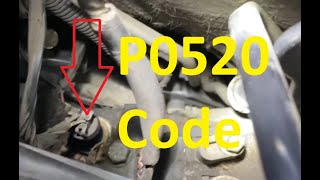
P0520 indicates the Powertrain Control Module (PCM) detects an electrical circuit malfunction in the primary engine oil pressure sensor. The computer is receiving an illogical voltage signal—too high, too low, intermittent, or completely absent. This code points directly to a failure in the sensor or its wiring 🎬 Watch: A quick overview of P0520 causes and fixes, not necessarily a drop in actual engine oil pressure.
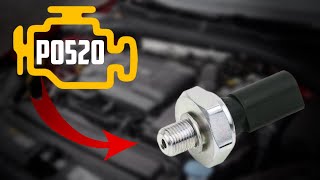
Technical definition: The SAE/ISO definition for P0520 is "Engine Oil Pressure Sensor/Switch 'A' Circuit Malfunction." The PCM flags this when the voltage from the primary oil pressure sensor falls outside its pre-programmed acceptable range for a specific duration. The sensor is a three-wire device receiving a 5-volt reference from the PCM, utilizing a ground wire, and returning a variable voltage signal (typically 0.5V to 4.5V) corresponding to measured pressure.
Can I Drive With P0520?
Yes, But With Caution. Do not drive the vehicle. P0520 disables your oil pressure monitoring system, leaving you blind to genuine, engine-destroying low oil pressure events. Driving with this code is a gamble that risks catastrophic engine failure costing $3,000 to $10,000+ for a replacement. Tow the vehicle or diagnose the issue immediately.
Common Causes

- Faulty Engine Oil Pressure Sensor (Very Common) — The sensor itself is the primary culprit. Operating in intense heat and vibration, internal diaphragms fail and leak oil into the electrical connector. This is a notorious, TSB-addressed issue on Chrysler, Dodge, Jeep, and Ram 3.6L engines. Note: Cheap aftermarket replacement sensors frequently fail out of the box, causing immediate code recurrence.
- Damaged Wiring or Corroded Connector (Common) — The wiring harness becomes brittle and cracks from engine heat cycles. Oil leaks or rodent damage also compromise the wires. Corrosion on the connector pins adds resistance, corrupting the 5V signal to the PCM.
- Cracked Oil Filter Housing / Adapter (Common) — On Chrysler 3.6L Pentastar engines, the plastic oil filter housing assembly that holds the sensor develops hairline cracks. This causes oil leaks, erratic pressure readings, and triggers P0520. Upgrading to an aluminum housing is the permanent fix.
- Incorrect or Poor-Quality Oil Filter (Common) — Low-quality aftermarket oil filters use poorly designed anti-drainback valves or restrictive filter media. This impedes proper oil flow, creating pressure anomalies the PCM interprets as a circuit fault.
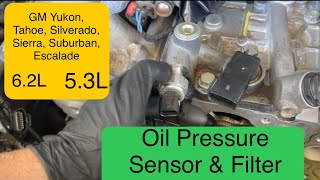
- Clogged Oil Passages or Sensor Screen (Less Common) — Engine sludge from neglected oil changes clogs the port leading to the sensor. On GM V8s, a small filter screen located in the block directly below the sensor clogs with debris, starving the sensor of accurate pressure. 🎬 Watch: DIY oil pressure sensor and screen replacement for GM V8s
- Low Engine Oil Level or Incorrect Oil Viscosity (Less Common) — While P0520 is an electrical code, severely low oil levels cause erratic pressure readings that trigger it. Using oil significantly thicker or thinner than OEM specifications also creates pressure anomalies.
- Failing Oil Pump (Rare) — Mechanical failure of the oil pump causes an actual pressure drop that the sensor correctly reports. This severe mechanical issue is always accompanied by loud engine knocking or whining noises.
- Faulty Powertrain Control Module (PCM) (Very Rare) — The vehicle's main computer fails and cannot read the signal from a known-good sensor. Consider this only after exhaustively ruling out the sensor, wiring, and mechanical pressure.
Symptoms

- Check Engine Light is On — The primary and often only symptom noticed by the driver.
- Incorrect Oil Pressure Gauge Reading — The gauge sticks at zero, maxes out (e.g., 99 PSI on Chrysler vehicles), or fluctuates erratically.
- Oil Pressure Warning Light is On — A red or yellow oil pressure warning light illuminates or flickers on the dashboard.
- Engine Enters 'Limp Mode' — The PCM forces the vehicle into a reduced-power mode, limiting RPM and speed to prevent damage.
- Engine Knocking or Ticking Noises — A critical symptom indicating actual oil starvation. Stop the engine immediately if you hear knocking, ticking, or whining.
Diagnostic Flowchart
Tap your situation to follow the diagnostic path that matches what you're seeing on this code.
Common Fixes & Costs
- Replace Engine Oil Pressure Sensor — Parts: $25-$110, Labor: $85-$600 (Varies dramatically by engine layout), ~0.8 hr book time (Intermediate)
- Replace Oil Filter Housing Assembly (3.6L Pentastar) — Parts: $120-$300, Labor: $300-$600, ~4.5 hr book time (Professional)
- Repair or Replace Damaged Wiring/Connector — Parts: $15-$50, Labor: $100-$200, ~1.5 hr book time (Intermediate)
- Change Engine Oil and Filter — Parts: $40-$90, Labor: $25-$60, ~0.5 hr book time (DIY)
- Replace Powertrain Control Module (PCM) — Parts: $700-$1000+, Labor: $200-$350, ~1.5 hr book time (Professional)
DIY vs Professional
- Replace Engine Oil Pressure Sensor — Beginner: Depends on the engine. Yes for accessible engines (Ram 5.7L HEMI). No for buried sensors (Chrysler 3.6L Pentastar).
Tools: Socket set, 1-1/16" deep socket, torque wrench, flashlight. - Change Engine Oil and Filter — Beginner: Yes, this is a fundamental DIY task.
Tools: Wrench for drain plug, oil filter wrench, drain pan, funnel. - Repair or Replace Damaged Wiring/Connector — Beginner: No. Requires intermediate electrical skills.
Tools: Multimeter, wire strippers, soldering iron, heat shrink tubing. - Replace Oil Filter Housing Assembly (3.6L Pentastar) — Beginner: No. This is an advanced job requiring 3-5 hours.
Tools: Extensive socket set, torque wrench, fuel line disconnect tools, intake gaskets.
Used vs. New Parts: Buying Guide
When a used part is worth it: Never buy a used oil pressure sensor. For the related oil filter housing assembly on Pentastar engines, a used part from a low-mileage donor is a budget option, but a new aluminum housing is the only permanent fix.
Donor-vehicle mileage cap: roughly under 60000 miles for the part to have meaningful remaining life.
Donor quality checklist:
- Verify the donor vehicle was not scrapped for engine failure.
- Inspect used housings meticulously for hairline cracks around sensor ports.
- Avoid used electronic sensors entirely; the failure rate is too high.
Decision logic:
- If You need an oil pressure sensor. → Buy a new OEM part. The labor to replace it twice far outweighs the $20 saved on a used sensor.
- If Your Pentastar oil filter housing is cracked and budget is tight. → Source a used housing from a sub-60k mile donor, but inspect it under bright light for cracks.
- If Your Pentastar oil filter housing is cracked and you want a permanent fix. → Purchase a new aftermarket aluminum housing to eliminate the plastic failure point entirely.
Warranty tradeoff: Used parts offer 30-day warranties. New OEM parts offer 12-month warranties. Upgraded aftermarket aluminum housings often carry lifetime warranties.
Worst-case if a used part fails: $300-$800 in repeat labor if a used sensor or housing fails after installation.
What Happens If You Wait — Timeline
- 0-4 weeks: Check Engine Light illuminates. Oil pressure gauge reads erratically or maxes out. No physical engine symptoms exist. (MPG impact: 0%% · Added cost: $0)
- 1-6 months: Driver ignores the warning. The risk of an undetected, genuine low-oil-pressure event increases daily. (MPG impact: 0%% · Added cost: $0 to $10,000+)
- 2-12 months: An unrelated mechanical issue begins (e.g., oil pump wear). Because P0520 disabled the warning system, the driver receives no alert. (MPG impact: 0%% · Added cost: $0 to $10,000+)
- Any time: Catastrophic failure. The engine is starved of oil, leading to bearing seizure and complete destruction within minutes at highway speeds. (MPG impact: N/A% · Added cost: $4,000 - $10,000+)
Cost of Not Fixing It
- Immediate: You lose all reliable monitoring of engine oil pressure. A sudden mechanical failure will occur without dashboard warning. (Added cost: 0)
- 1 day - 6 months: If a genuine low-pressure event happens (due to a leak or pump failure), you receive no warning before catastrophic engine damage occurs. (Added cost: 0 to $10,000+)
- 6+ months: Ignoring the only system that warns of low oil pressure guarantees you will eventually destroy the engine when a mechanical fault develops. (Added cost: $3,000 - $10,000+)
Diagnosis Steps

- Check Engine Oil Level and Condition
Pull the engine oil dipstick, clean it, reinsert it fully, and check the level. Ensure it sits between the 'Full' and 'Add' marks. If the oil is excessively sludgy, milky, or smells of gasoline, address those severe mechanical issues first.
Tools: Rag or paper towel (Beginner) - Scan for Codes and Observe Live Data
Use an OBD-II scanner to confirm P0520 and check for related codes (P0521-P0524). View the 'Engine Oil Pressure' (EOP) live data PID. A reading stuck at 0 PSI, maxed out at 128+ PSI, or unresponsive to RPM changes confirms an electrical fault.
Tools: OBD-II Scanner with live data (Beginner) - Visually Inspect the Sensor and Wiring
Locate the oil pressure sensor. Unplug the electrical connector and check for oil inside the pins—a definitive sign of internal sensor failure. Inspect the wiring harness for cracking, melting, or rodent damage.
Tools: Flashlight, Inspection mirror (Intermediate) - Verify Actual Oil Pressure with a Mechanical Gauge
This is the most critical diagnostic step. Remove the oil pressure sensor and install a mechanical oil pressure gauge. Start the engine. A reading of 20-25 PSI at hot idle and 45-70 PSI at 2,500 RPM confirms the engine is healthy and the fault is purely electrical. Low pressure indicates a failing oil pump or severe engine wear.
Tools: Mechanical oil pressure gauge, Basic hand tools (Advanced) - Test the Sensor Circuit with a Multimeter
Unplug the sensor and turn the ignition to 'On' (engine off). Use a multimeter to test the harness connector terminals. Verify a 5-volt reference signal from the PCM and a solid ground (near 0 volts). Missing voltage indicates a wiring or PCM failure.
Tools: Digital Multimeter, Vehicle-specific wiring diagram (Advanced) - Test the Sensor Signal Voltage
Reconnect the sensor and back-probe the signal wire. With the engine running, voltage must vary with RPM, typically rising from 0.5V at idle to 4.5V at higher RPMs. A static voltage confirms a dead sensor.
Tools: Digital Multimeter, T-pins for back-probing (Advanced) - Test the Sensor's Internal Resistance
With the sensor unplugged, measure the resistance (Ohms) between the sensor's pins. A reading of 'OL' (Over Limit) or zero resistance confirms an internal short or open circuit.
Tools: Digital Multimeter, Vehicle-specific service manual (Advanced) - Analyze the Sensor with an Oscilloscope
Connect an oscilloscope to the signal wire. A healthy sensor produces a clean waveform that rises smoothly with engine revs. Flat lines or sudden dropouts confirm the sensor requires replacement.
Tools: Oscilloscope (Scope) (Professional) - Replace the Oil Pressure Sensor
If mechanical pressure is good and wiring tests pass, replace the sensor. Use thread sealant if not pre-applied and torque strictly to the manufacturer's specification to avoid cracking the engine block.
Tools: Socket set, 1-1/16" deep socket, Torque wrench (Intermediate)
When This Code Triggers (Freeze-Frame Conditions)
- Engine Coolant Temp: 180-210°F (Sets when the engine is fully warmed up and operating in closed-loop mode.)
- Engine RPM: 1500-2500 RPM (Triggers during steady-state cruising when the PCM expects a stable oil pressure reading matching the RPM.)
- Engine Load: 20-50% (Occurs under light to moderate engine load, rarely during heavy acceleration.)
- Vehicle Speed: 40-65 mph (Consistent with highway or steady suburban driving.)
Related Codes
- P0521 — P0521 (Range/Performance) means the sensor provides a signal, but it contradicts engine RPM (e.g., high pressure at idle). P0520 is a hard electrical fault; P0521 suggests an inaccurate sensor, wrong oil viscosity, or partial restriction.
- P0522 — P0522 (Circuit Low) means the PCM sees continuously low voltage (near 0V). This points directly to a short to ground in the signal wire or an internally shorted sensor.
- P0523 — P0523 (Circuit High) means the PCM sees continuously high voltage (near 5V). This indicates an open circuit, such as a broken wire, unplugged connector, or dead sensor.
- P0524 — P0524 (Pressure Too Low) is a critical mechanical code. It means the sensor works perfectly and is reporting dangerously low actual oil pressure. Stop the engine immediately.
Climate & Environmental Factors
- Cold Weather: Cold, highly viscous oil causes normal, temporary spikes in oil pressure during startup. This high pressure exceeds the range of a failing sensor, triggering P0520. The cold exposes the faulty sensor.
- High Humidity / Water Intrusion: Sustained humidity accelerates corrosion on the sensor's electrical connector pins. This adds resistance to the circuit, corrupting the 5V signal and triggering the code.
How to Talk to a Mechanic About This Code
Say this: "I have code P0520 for the oil pressure sensor circuit. Before replacing parts, perform a mechanical oil pressure test to confirm engine health. Provide the pressure readings at hot idle and 2,500 RPM."
This proves you understand diagnostics. It forces the shop to verify whether the issue is a cheap electrical fault or a destroyed engine before billing you for parts.
Avoid saying:
- 'My check engine light is on, can you fix it?'
- 'Just replace the oil pressure sensor.'
- 'Do whatever you think is best.'
Questions to ask before authorizing the repair:
- What were the exact results of the mechanical oil pressure test?
- If pressure is good, did you verify the wiring harness before condemning the sensor?
- Are you installing an OEM sensor or an aftermarket brand?
- For the Chrysler 3.6L, does the labor estimate include replacing the intake manifold gaskets?
Where to Take It: Dealer vs Independent vs Chain
- Dealer:
Best for: Vehicles under powertrain warranty., Repairs covered by TSB #18-034-14 REV. A., Labor-intensive 3.6L Pentastar sensor replacements requiring factory expertise.
Downsides: Labor rates are 50-100% higher than independent shops., Service advisors aggressively upsell unnecessary maintenance. (Typical cost: +50% vs. baseline) - Independent Shop:
Best overall fit. A certified independent shop easily performs the mechanical pressure test and electrical diagnosis at a fair price.
Best for: Out-of-warranty P0520 repairs., Accessible sensor replacements (e.g., Ram 5.7L HEMI)., Cost-conscious owners seeking honest mechanical pressure tests.
Downsides: Diagnostic capability varies; ensure the shop employs ASE-certified technicians., May lack familiarity with specific manufacturer quirks like GM filter screens. (Typical cost: +0% vs. baseline) - Chain Shop:
Avoid for diagnosing P0520. They lack the expertise to differentiate between a circuit fault and a failing oil pump.
Best for: A simple oil and filter change if you suspect a bad filter caused the code.
Downsides: Technicians lack advanced diagnostic training., Will likely replace the sensor blindly without performing a mechanical pressure test. (Typical cost: -10% vs. baseline)
When to Walk Away From the Repair
If the estimated repair cost exceeds 50% of the vehicle's private-party value, sell or trade it in.
- Car worth $12000, fix is $250: Fix it. This is a minor repair on a valuable vehicle.
- Car worth $15000, fix is $900: Fix it. A $900 Pentastar housing replacement is steep but well below the 50% threshold.
- Car worth $4000, fix is $2500: Walk away. The shop found a failing oil pump or destroyed bearings. The repair exceeds 60% of the car's value.
What Scan Tool You Need for This Code

Minimum: A scanner that reads codes, clears codes, and displays live data PIDs.
A $20 code reader only shows 'P0520'. A live data scanner shows exactly what the sensor reports to the PCM (e.g., 0 PSI or 99 PSI), providing critical clues before you open the hood.
Budget: Ancel AD410 or Foxwell NT301 (~$60) — Reads P0520, clears the check engine light, and displays the live Engine Oil Pressure data stream.
Mid-range: Innova 5610 or XTool D7 (~$350) — Graphs live data to visualize sensor dropouts and provides bidirectional controls for advanced testing.
Professional: Autel MaxiCOM MK808BT (~$500-1200) — Provides professional-level diagnostics, extensive bidirectional controls, and access to manufacturer-specific data. Overkill for P0520 alone, but essential for serious DIYers.
Rent vs buy: For a one-time diagnosis, borrow a live-data scanner for free from AutoZone's Loan-A-Tool program. Buy one only if you diagnose vehicles multiple times a year.
How to Clear the Code After You Fix It
- Clear the P0520 code using an OBD-II scan tool.
- Perform a complete drive cycle to reset readiness monitors.
- Never disconnect the battery to clear codes, as this erases all monitors and guarantees an emissions test failure.
Drive cycle (~30 minutes): Cold start and idle for 3 minutes. Drive 15 minutes in stop-and-go traffic with gentle acceleration. Drive 10 minutes at a steady 55-60 mph on the highway. Let the vehicle cool down completely.
Readiness monitors affected: Comprehensive Component Monitor (CCM), Misfire Monitor, Fuel System Monitor
Before emissions retest: drive at least 100 miles to fully set monitors.
Watch out for:
- Testing emissions immediately after clearing the code results in an automatic 'Not Ready' failure.
- Failing to fix the root cause guarantees the code returns during the drive cycle.
- Skipping the cold start prevents the PCM from running its baseline sensor checks.
Will This Fail Emissions / State Inspection?
Yes — this code typically fails an OBD-II emissions inspection.
- California: An active P0520 triggers an automatic failure. You must repair the fault and complete a drive cycle to set readiness monitors before re-testing.
- New York: NYS OBD-II scans will immediately fail a vehicle with P0520. The code must be cleared and monitors set to 'Ready'.
- Texas: In emissions-testing counties, an illuminated Check Engine Light for P0520 fails the inspection. Readiness monitors must pass.
Most Commonly Affected Vehicles
- Jeep Wrangler, Grand Cherokee (2011-2018) — Extremely common on the 3.6L Pentastar V6. TSB #18-034-14 REV. A addresses faulty sensors. The sensor sits under the lower intake manifold, requiring 3-5 hours of labor. Owners frequently upgrade to an aluminum oil filter housing during this repair.
- Dodge Grand Caravan, Challenger, Charger, Durango, Journey (2011-2018) — Covered by TSB #18-034-14 REV. A. The 3.6L V6 repair is notoriously difficult due to the sensor's location deep in the engine valley.
- Ram 1500, 2500, 3500 (2013-2018) — Part of TSB #18-034-14 REV. A. On the 5.7L HEMI V8, the sensor is easily accessible near the oil filter. On the 3.6L V6, it is buried under the intake manifold.
- Chrysler 300, Town & Country, 200 (2011-2017) — A well-documented problem addressed by TSB #18-034-14 REV. A. Replace the original sensor with revised Mopar part 05149062AB.
- Chevrolet / GMC Silverado, Sierra, Tahoe, Suburban, Equinox (2007-2018) — Common on GM V8s. The root cause is often a clogged filter screen located in the block directly beneath the sensor. Replace this screen (Dorman 926-040) whenever replacing the sensor.
- Ford F-150, Fusion, Mustang, Explorer (2011-2020) — Triggered by a faulty oil pressure switch, a low-quality oil filter with a poor anti-drainback valve, or heat-damaged wiring near the exhaust.
- Volkswagen Routan (2011-2014) — The Routan is a rebadged Chrysler minivan using the 3.6L Pentastar V6, suffering the exact same buried sensor failures.
- Subaru Outback, Forester, Impreza (2010-2019) — Triggered by standard switch failure or wiring issues. The switch is located on the front of the engine block near the alternator.
Manufacturer-Specific Notes
- Chrysler / Dodge / Jeep / Ram: TSB #18-034-14 REV. A addresses a massive failure rate of original sensors on 2013-2014 models. The fix requires revised part 05149062AB. On 3.6L V6 engines, the sensor is buried under the intake manifolds, turning a $30 part into a $500 labor bill.
- General Motors (Chevrolet / GMC): GM V8 engines feature a small filter screen in the oil passage directly below the sensor. This screen clogs with sludge, restricting oil flow and triggering P0520. Always replace this screen when replacing the sensor.
- Ford: Many Ford engines use a simple one-wire on/off switch rather than a three-wire variable sensor. P0520 here is frequently caused by cheap oil filters with failing anti-drainback valves, not just the switch itself.
- Subaru: The oil pressure switch sits on the top front of the boxer engine block. Leaks from this switch are frequently misdiagnosed as expensive camshaft or crankshaft seal leaks.
Real Owner Stories
2014 Chrysler 300C 3.6L - The Classic Pentastar Failure
The Check Engine Light illuminated with P0520, and the oil pressure gauge read erratically. This occurred two weeks after replacing the oil filter housing.
What they tried:
- Checked for leaks around the new housing.
- Researched the sensor location under the intake manifold.
- Replaced the sensor themselves.
Outcome: Replacing the sensor with Mopar Part #05149062AB resolved the code. The job was labor-intensive but successful.
Lesson: On Chrysler 3.6L engines, P0520 is almost always a failed sensor. Even if related repairs were recently done, the sensor itself remains the primary culprit.
2014 Ram 1500 5.7L HEMI - Aftermarket Part Misdiagnosis
The owner replaced the original sensor with a cheap aftermarket brand. The code returned immediately, and the dash displayed intermittent low pressure (12-15 PSI) at startup.
What they tried:
- Replaced the sensor with an aftermarket part.
Outcome: Forum members advised that aftermarket sensors are notoriously defective. Replacing the aftermarket unit with a genuine Mopar sensor permanently resolved the issue.
Lesson: Never use cheap, non-OEM sensors for critical components. Spending slightly more on an OEM part saves significant time and prevents false mechanical diagnoses.
Chevy Silverado V8 - The Hidden Clogged Screen
A GM V8 owner replaced the oil pressure sensor to fix P0520, but the code returned within days.
What they tried:
- Replaced the oil pressure sensor.
Outcome: The root cause was a small filter screen located in the engine block directly beneath the sensor. It was clogged with sludge, blocking oil flow to the new sensor. Replacing the screen fixed the issue.
Lesson: On GM V8 engines, always replace the sensor screen (Dorman 926-040) when replacing the oil pressure sensor to prevent recurring codes.
2011 Fiat Qubo 1.3L Diesel - A Diagnostic Nightmare
P0520 appeared after the engine warmed up, displaying 'insufficient oil pressure'. This happened shortly after a timing chain replacement.
What they tried:
- Replaced all oil pressure sensors.
- Replaced the oil pump.
- Checked all wiring.
Outcome: The issue was a distorted timing chain cover from the previous repair binding the oil pump. The problem was entirely mechanical.
Lesson: If replacing the sensor and verifying wiring fails, you must perform a mechanical oil pressure test. Complex mechanical issues mimic simple sensor codes.
How to Prevent This Code From Triggering
- Use High-Quality OEM-Specification Oil and Filters (Every oil change) — Synthetic oil and premium filters prevent engine sludge. Sludge clogs sensor screens and passages, causing pressure reading faults.
- Avoid Excessive Short Trips and Idling (Daily habit) — Engines must reach full operating temperature to burn off moisture and fuel contaminants. Short trips accelerate sludge formation.
- Use OEM Sensors for Replacement (During repairs) — Cheap aftermarket sensors have massive failure rates. OEM parts prevent repeat failures and unnecessary labor costs on hard-to-reach sensors.
- Perform an Engine Flush (with caution) (Once per 100K miles (on neglected engines)) — Dissolves sludge deposits clogging the sensor port. Must be done professionally, as improper flushing dislodges large debris and destroys engines.
Frequently Asked Questions
Can I just replace the sensor to fix P0520?
Yes, replacing the faulty oil pressure sensor with a quality OEM part resolves the code in most cases, provided you have verified proper oil levels.
I replaced the sensor but the code came back. What now?
If a new OEM sensor fails to clear the code, the wiring harness is the culprit. Test the 5V reference, ground, and signal wire for continuity. If the wiring is flawless, suspect a rare PCM failure.
Does the oil need to be drained to replace the oil pressure sensor?
No, draining the engine oil is unnecessary. The sensor sits high enough on the engine block that only a negligible few drops of oil escape during the swap.
My oil pressure gauge reads 99 PSI, is that bad?
A gauge stuck at maximum (like 99 PSI) indicates an open circuit, a short, or a completely failed sensor. It confirms an electrical fault rather than dangerously high mechanical pressure.
Can I clean an oil pressure sensor?
No, you cannot clean an internally failed oil pressure sensor. If oil has breached the internal diaphragm and entered the electrical connector, replacement is the only fix.
What is the torque spec for an oil pressure sensor?
Torque specifications typically range from 15 to 26 ft-lbs (20-35 Nm) depending on the engine block material. Overtightening will crack the sensor housing or strip the engine block threads.
I got a P0520 code right after an oil change. Why?
This usually means an incorrect or low-quality oil filter is restricting flow. Alternatively, the technician accidentally damaged the sensor wiring during the service.
What's the difference between P0520 and P0524?
P0520 is an electrical circuit code indicating a sensor signal error. P0524 is a mechanical code confirming the sensor works but actual engine oil pressure is dangerously low. Stop driving immediately if you see P0524.
Key Takeaways
- P0520 indicates an electrical fault in the oil pressure sensor circuit, not necessarily a mechanical drop in actual oil pressure.
- Chrysler, Dodge, Jeep, and Ram 3.6L models from 2013-2014 have a notorious failure rate for this sensor, addressed by TSB #18-034-14 REV. A.
- Verify actual mechanical oil pressure with a gauge before replacing parts; a reading of 20-25 PSI at hot idle confirms the engine is mechanically healthy.
- Stop driving immediately when P0520 triggers; operating without a working oil pressure monitor risks catastrophic engine failure costing upwards of $4,000.
- Always install an OEM or premium aftermarket sensor, as budget sensors frequently fail out of the box and cause the P0520 code to return.
Helpful Videos
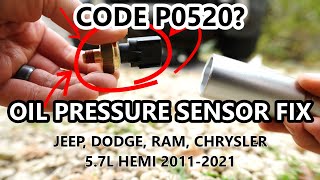
![How to test OIL PRESSURE SWITCH of your car [EASY and QUICK]](https://img.youtube.com/vi/vCyjrPhjiM4/mqdefault.jpg)

The information in this article is provided for general reference and educational purposes only. Vehicle specifications, procedures, and part compatibility can vary by production date, trim level, and region. Always consult your vehicle's factory service manual and verify part numbers before purchasing or performing repairs. Safety-critical components such as airbags, seat belts, and braking systems should be installed by a qualified professional.
- 🎬 Helpful Videos
- What Does P0520 Mean?
- Can I Drive With P0520?
- Common Causes
- Symptoms
- Diagnostic Flowchart
- Common Fixes & Costs
- DIY vs Professional
- Used vs. New Parts: Buying Guide
- What Happens If You Wait — Timeline
- Cost of Not Fixing It
- Diagnosis Steps
- When This Code Triggers (Freeze-Frame Conditions)
- Related Codes
- Climate & Environmental Factors
- How to Talk to a Mechanic About This Code
- Where to Take It: Dealer vs Independent vs Chain
- When to Walk Away From the Repair
- What Scan Tool You Need for This Code
- How to Clear the Code After You Fix It
- Will This Fail Emissions / State Inspection?
- Most Commonly Affected Vehicles
- Manufacturer-Specific Notes
- Real Owner Stories
- 2014 Chrysler 300C 3.6L - The Classic Pentastar Failure
- 2014 Ram 1500 5.7L HEMI - Aftermarket Part Misdiagnosis
- Chevy Silverado V8 - The Hidden Clogged Screen
- 2011 Fiat Qubo 1.3L Diesel - A Diagnostic Nightmare
- How to Prevent This Code From Triggering
- Frequently Asked Questions
- Can I just replace the sensor to fix P0520?
- I replaced the sensor but the code came back. What now?
- Does the oil need to be drained to replace the oil pressure sensor?
- My oil pressure gauge reads 99 PSI, is that bad?
- Can I clean an oil pressure sensor?
- What is the torque spec for an oil pressure sensor?
- I got a P0520 code right after an oil change. Why?
- What's the difference between P0520 and P0524?
- Key Takeaways
- 🎟️ Get 5% Off