

P0316 on 2015-2019 Ford Edge 2.0L EcoBoost: Startup Misfire Causes and Fixes
On a 2015-2018 Ford Edge with the 2.0L EcoBoost, code P0316 is a strong indicator of coolant leaking into the engine cylinders due to a known engine block defect. This is a serious issue that typically requires a complete engine replacement. Check your coolant level immediately.
- On a 2015-2018 Edge 2.0L, P0316 is a critical warning sign, most often pointing to a severe engine defect causing coolant to leak into the cylinders.
- Do not ignore this code. Immediately check your engine coolant level. If it is low and you can't see an external leak, assume the problem is serious.
- Do not waste money on simple tune-up parts like spark plugs or coils as a first step. A proper diagnosis, including a cooling system pressure test and borescope inspection of cylinders 2 and 3, is mandatory.
- The official Ford-recommended repair for this issue is a complete long block engine replacement with the updated part (J2GZ-6006-E).
- This issue is well-documented in Ford TSBs, culminating in TSB 22-2229, and affects several other Ford and Lincoln models with the same engine.
What's Unique About the 2015-2019 Ford Edge
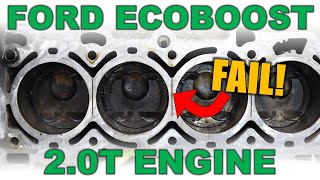
For the 2015-2018 Ford Edge with the twin-scroll 2.0L EcoBoost engine, P0316 is a notorious code. It is strongly linked to a well-documented design flaw in the engine block where coolant can leak into the cylinders. This happens because of the engine's 'open-deck' design, which has a slot machined between the cylinders for coolant flow, creating a thin, weak point in the head gasket 🎬 Watch: See a teardown of this engine block design flaw. sealing surface. Over time, this can lead to a breach or crack, allowing coolant to seep into cylinders (most commonly cylinders 2 and 3) when the engine is off and cools down. This is not a typical ignition or fuel problem; it is a major mechanical failure documented in multiple Ford Technical Service Bulletins (TSBs) and the subject of a class-action lawsuit.
Symptoms You May Notice
- Check Engine Light (MIL) illuminated or flashing
- Rough idle or running rough, especially on cold start
- Noticeable loss of engine coolant with no visible external leaks
- White exhaust smoke with a sweet smell, particularly on startup
- Hesitation or stumbling on acceleration
- Engine overheating codes or temperature gauge rising
- Replacing only the spark plugs and ignition coils. While a coolant-fouled spark plug will cause a misfire, replacing it does not solve the underlying coolant leak. The new plug will soon fail as well, and the code will return.
- Assuming it is a simple head gasket failure. While the head gasket does fail, the root cause is the lack of support in the engine block casting, so simply replacing the gasket will not solve the problem long-term.
Most Likely Causes
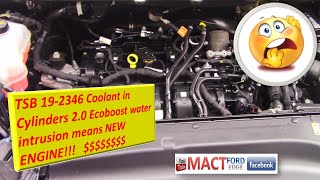
- Internal Coolant Leak (Engine Block Defect) 🔴 High Probability A known design flaw in the 2.0L EcoBoost engine block allows coolant to intrude into the cylinders. This is acknowledged in a series of Ford TSBs, with the latest being 22-2229 which supersedes 19-2346 and others. 🎬 Watch: A mechanic explains the coolant intrusion TSB details. The issue is most common between cylinders 2 and 3.
How to confirm: Check the coolant reservoir for a low level. Perform a cooling system pressure test; Ford's TSB specifies pressurizing the system to 20 psi and checking for a pressure drop of more than 4 psi over 5 hours. Remove spark plugs (especially from cylinders 2 and 3) and inspect for a 'steam-cleaned' appearance or white/green crusty deposits. Use a borescope to look for visible coolant pooled on top of the pistons.
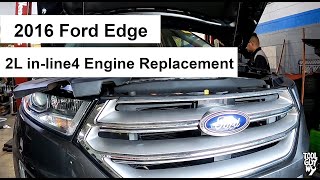
Typical fix: Per Ford's TSBs, the official and only permanent repair is the replacement of the long block engine assembly with a redesigned part.
Est. part cost: $2500-$5000
Rare But Worth Checking
- Faulty Ignition Coil(s) or Spark Plugs: While possible, these are far less common causes for P0316 on this specific engine. If you have this code, you must rule out the coolant issue first. Replacing ignition parts may only be a very temporary fix if coolant is the root cause, as the coolant will foul the new spark plug.
- Faulty Fuel Injector: A leaking fuel injector can flood a cylinder overnight, causing a startup misfire. This is a standard misfire cause but is secondary to the coolant intrusion issue on this platform.
- Crankshaft Position Sensor (CKP) Issue: A failing CKP sensor or wiring can cause misfire detection issues, but this is not a common failure point for this specific code on this vehicle.
- Seasonal Fuel Blend Change: In rare cases, a switch from summer to winter blend fuel can cause a temporary P0316 code with no other symptoms or codes present. If the code appears alone during autumn, it may clear after a few tanks of fresh, winter-blend fuel.
Diagnosis Steps
- Scan for all stored DTCs. Note if P0316 is accompanied by specific cylinder misfire codes (P0301-P0304), especially P0302 and P0303.
- Check the engine coolant level in the reservoir. A low level with no visible external leaks is a primary indicator of this issue.
- If the coolant is low, perform a cooling system pressure test. Per Ford's diagnostic procedure, pressurize the system to 20 psi and let it sit for at least 5 hours. A pressure drop of more than 4 psi confirms an internal leak.
- If a leak is confirmed, remove the spark plugs from all cylinders, paying close attention to cylinders 2 and 3.
- Inspect the spark plug electrodes and ceramic for signs of coolant: a bright white, 'steam-cleaned' look or a crusty green/white residue.
- Use a borescope to look inside the cylinders through the spark plug holes. Look for coolant pooling on top of the pistons or an unusually clean piston surface.
- If no signs of coolant intrusion are found, proceed with standard misfire diagnostics: swap ignition coils between cylinders to see if the misfire code follows the coil, and inspect fuel injectors.
Parts You'll Likely Need
- Engine Long Block Assembly
(OEM #J2GZ-6006-E)— This is the Ford-recommended repair for the common cause of P0316 on this engine: internal coolant intrusion. This part number is for the updated long block with the revised block design.
Trusted brands: Motorcraft
OEM price range: $2500 - $4500 (plus $1000+ core charge)
Aftermarket price range: $3500-$6000
Related Codes That Often Appear With This One
- P0300 — Indicates a random or multiple cylinder misfire, which is common when coolant affects more than one cylinder or the misfire is intermittent.
- P0302, P0303 — These codes pinpoint the specific cylinder(s) that are misfiring. For this engine defect, cylinders 2 and 3 are the most common culprits, so P0302 and P0303 are very frequently seen with P0316.
- P0301, P0304 — Misfire codes for cylinders 1 and 4. While less common than cylinders 2 and 3, the issue can affect any cylinder.
- P0217, P1299 — These codes indicate an Engine Overheat Condition or Cylinder Head Over-temperature Protection. They are listed in TSB 19-2346 as potential companion codes when coolant loss becomes significant enough to cause overheating.
Technical Service Bulletins (TSBs) & Recalls
- TSB 22-2229: The most recent bulletin that supersedes previous versions. It confirms the diagnosis and long block replacement procedure for the coolant intrusion issue.
- TSB 19-2346: Superseded previous TSBs (like 19-2172). It addresses low coolant, white smoke, and rough running with DTCs including P0316, due to coolant intrusion. Recommends long block replacement for affected vehicles including the 2015-2018 Edge.
- SSM 47204: A Special Service Message that preceded the TSBs, outlining the pressure test procedure (20 psi for 5 hours) to diagnose coolant intrusion due to block corrosion.
Platform-Specific Known Issues
- The 2.0L EcoBoost engine used in 2015-2018 Edge models is subject to Ford TSBs, most recently TSB 22-2229, which address coolant intrusion into the cylinders. The root cause is a design flaw in the engine block casting between the cylinders.
- A class-action lawsuit was filed against Ford for knowingly selling vehicles with this defect. Owners may have experienced this failure just outside of the powertrain warranty period, leading to expensive repairs.
- Owner experiences confirm that even with a new engine from Ford, it's crucial to ensure it is the updated design (produced after mid-2019) to prevent a repeat failure.
Mechanic-Grade Diagnostic Values
- High-Pressure Fuel System Pressure — expected: 65 - 2150 psi (448 - 14823 kPa), depending on engine load and demand.. Failure: Pressure that is significantly below the PCM's desired value under load can indicate a weak high-pressure fuel pump. However, this is not a primary cause for P0316 on this vehicle.
- Ignition Coil Primary Resistance (General Spec) — expected: Approximately 0.4 to 2.0 ohms.. Failure: A reading significantly outside this range suggests a faulty coil. However, swapping the coil to another cylinder to see if the misfire follows is a more practical test for coil-on-plug systems.
- Ignition Coil Secondary Resistance (General Spec) — expected: Approximately 6,000 to 10,000 ohms.. Failure: A reading far outside this range indicates a failed coil. This test can be difficult to perform accurately on some coil designs.
Hidden / Shadow Codes Worth Checking
- Mode 6, TID $A2-$A5, CID $0C: Misfire counts for the last 10 driving cycles for cylinders 1-4. This allows a technician to see which cylinder is misfiring, even if the count is not yet high enough to trigger a P0301-P0304 DTC. (see via A professional scan tool capable of viewing Mode 6 data. The data will show a raw count of misfire events per cylinder.)
Scan Tool Commands That Help
- Ford IDS (or equivalent professional scanner): Power Balance Test — This is a critical diagnostic function to pinpoint a weak or misfiring cylinder when P0316 is present. The test disables one cylinder at a time and graphs the resulting drop in engine RPM. A cylinder that causes little or no RPM drop when disabled is not contributing its share of power, confirming the location of the misfire.
Wiring & Ground Locations
- Ignition Coil Ground Circuit — The ignition coils are grounded through the wiring harness back to the PCM and various chassis grounds. Specific ground point locations (e.g., G104) were not identified in searches, but are typically located on the engine block, cylinder head, or inner fender.. A high-resistance ground connection for an ignition coil can cause a weak spark and lead to misfires. While not a common cause for P0316 on this vehicle, checking for voltage drops on the coil's ground circuit can be a valid diagnostic step if the primary coolant intrusion issue has been ruled out.
Real Owner Repair Stories
- Ford Edge Forum user 'nacdj' (2018 Ford Edge SE, 145,000 miles) — Check Engine Light with codes P0302, P0316, and P0036. Confirmed coolant leaking into the engine.
❌ Tried (didn't work) Pouring head gasket sealer (BlueDevil) into the cooling system, which resulted in the engine seizing.
✅ What actually fixed it The engine was replaced with a used engine from a 2020 Ford Fusion with 57,000 miles. The total cost was $2500 for the used engine and $1350 for labor. The vehicle was reported to be running well 1,000 miles after the repair. - NHTSA ODI #11384096 — An owner reported that when their vehicle was started cold, it would chug and stall out at times, with a code reader showing P0303 and P0316.
- NHTSA ODI #11613268 — One driver noted their car felt like it had lost its power or "pep" when accelerating; a diagnosis found P0301 and P0316 misfires, leading to a coolant pressure test per TSB 22-2229.
Documented NHTSA Reports
- NHTSA ODI #11661995: An owner reported codes P0316 and P0302 for a cylinder 2 misfire, noting that the spark plug could not be removed because it was seized to the head due to coolant intrusion fouling the threads.
- NHTSA ODI #11595367: This report describes an internal leak from the engine head into cylinder number 2, causing periodic misfire codes including P0316 and P0302, as well as a drop in coolant levels.
- NHTSA ODI #11603047: A shop noted a history code of P0316 and P0304 (cylinder 4 misfire) after checking active counters on a vehicle.
OEM Part Supersession History
JS7Z-6006-A, JS7Z-6006-C, JJ7Z-6006-B→J2GZ-6006-E— This is the updated long block engine assembly with the revised engine block design that corrects the coolant intrusion flaw.
Heads up: These earlier part numbers represent engine versions prone to the coolant intrusion failure. J2GZ-6006-E is the required replacement part per Ford's TSBs.
Model Year Variations Within This Range
- 2015-2018 (and some 2019 models of other Fords): The 2.0L EcoBoost engines in this range used an 'open-deck' block design with slots between the cylinders for coolant passage. This created a weak point for the head gasket seal.
- Mid-2019 and newer: Ford revised the engine block design to eliminate the slots between the cylinders, replacing them with drilled coolant passages. This provides a much larger and more stable surface area for the head gasket to seal against, preventing the coolant intrusion failure.
Diagnostic Flowchart
Used vs. New Parts: Buying Guide for This Vehicle
When a used part is the smart pick: For the primary repair of engine replacement, a used engine is only a smart choice if it can be definitively identified as the revised version (built mid-2019 or later). A used engine from a 2020 or newer donor vehicle is a good candidate. For secondary causes like faulty ignition coils, a tested, low-mileage used OEM coil is often more reliable than a cheap new aftermarket part.
Donor-vehicle mileage cap: roughly under 60000 miles for the part to have meaningful remaining life.
What to inspect on the donor part:
- For a used engine, locate the build date sticker on the valve cover or a stamping on the block to confirm it is a post-revision (mid-2019 or newer) part.
- For used ignition coils, inspect the plastic housing for cracks and the rubber boot for tears or chalky residue.
- Obtain a vehicle history report for the donor car to check for accident history or signs of poor maintenance.
OEM-only on this vehicle (don't cheap out):
- Engine Long Block Assembly: To guarantee you receive the updated block design and prevent a repeat failure, purchasing a new OEM Motorcraft long block (P/N J2GZ-6006-E) is the most reliable option.
Aftermarket brands forum-validated for this vehicle:
- Ignition Coils: MSD and Granatelli are often cited as reliable, performance-oriented aftermarket brands for Ford EcoBoost engines.
Brands owners have reported issues with on this vehicle:
- Unbranded, no-name ignition coils and sensors from online marketplaces should be avoided, as their quality and longevity are often poor.
Real Owner Stories
Aggregated from forums and TSBs cited above. Mileages and costs reflect what owners reported in those sources.
2018 Ford Edge 2.0L EcoBoost — 1000 miles
Symptoms: Check engine light on, codes P0316 and P0304, almost no coolant in radiator.
What fixed it: Complete long block engine replacement.
Source hint: Ford Edge Forum
2017 Ford Edge SEL AWD 2.0L turbo — 111225 miles
Symptoms: Codes P0316 and P0303, rough start and shakes a bit when it first starts up, but smooth while driving.
What fixed it: User was advised by another commenter to check the coolant level for a suspected leak into the cylinder; the final fix is not stated in the thread.
Source hint: Reddit r/MechanicAdvice
Related OBD-II Codes
Frequently Asked Questions
Does TSB 22-2229 apply to my 2017 Ford Edge with the 2.0L EcoBoost engine?
What is the official Ford-recommended repair for the coolant intrusion problem causing code P0316?
I have a rough start and code P0316, but I don't see any coolant leaking under my car. Could it still be the engine block issue?
How can a mechanic confirm coolant is leaking into the cylinders?
My 2018 Edge is just out of warranty and needs a new engine for this issue. Is there any other recourse?
If I get a replacement engine from Ford, how do I know this won't happen again?
Helpful Videos
We Have This Part in Stock



The information in this article is provided for general reference and educational purposes only. Vehicle specifications, procedures, and part compatibility can vary by production date, trim level, and region. Always consult your vehicle's factory service manual and verify part numbers before purchasing or performing repairs. Safety-critical components such as airbags, seat belts, and braking systems should be installed by a qualified professional.
- Ford Edge:
- 🎬 Helpful Videos
- 🛍️ Shop This Part
- What's Unique About the 2015-2019 Ford Edge
- Symptoms You May Notice
- Most Likely Causes
- Rare But Worth Checking
- Diagnosis Steps
- Parts You'll Likely Need
- Related Codes That Often Appear With This One
- Technical Service Bulletins (TSBs) & Recalls
- Platform-Specific Known Issues
- Mechanic-Grade Diagnostic Values
- Hidden / Shadow Codes Worth Checking
- Scan Tool Commands That Help
- Wiring & Ground Locations
- Real Owner Repair Stories
- Documented NHTSA Reports
- OEM Part Supersession History
- Model Year Variations Within This Range
- Diagnostic Flowchart
- Used vs. New Parts: Buying Guide for This Vehicle
- Real Owner Stories
- 2018 Ford Edge 2.0L EcoBoost — 1000 miles
- 2017 Ford Edge SEL AWD 2.0L turbo — 111225 miles
- Related OBD-II Codes
- Frequently Asked Questions
- 🎟️ Get 5% Off