

P0012 on 2005-2024 Toyota Corolla: VVT-i Timing Over-Retarded Causes and Fixes
On a Toyota Corolla, code P0012 is most often caused by low or dirty engine oil, or a failing intake camshaft oil control valve (VVT solenoid). An oil change and a new solenoid (approx. $30-$80 aftermarket, $90-$150 OEM) is the most likely fix. For 2009+ models with the 2ZR-FE engine, a startup rattle can also point to a failing VVT actuator gear.
- First, check your engine oil. Low or dirty oil is the most common cause of P0012 on a Corolla.
- The second most likely culprit is a faulty or clogged intake Oil Control Valve (VVT solenoid), which is a relatively inexpensive and easy part to replace.
- A rattling noise on startup points towards a more serious issue with the timing chain or VVT actuator.
- Do not ignore this code. Continued driving can lead to reduced performance, poor fuel economy, and potential engine damage.
- Using the correct, high-quality synthetic oil and changing it on schedule is the best way to prevent this code from appearing.
What's Unique About the 2005-2024 Toyota Corolla

Across several generations, the Toyota Corolla has used engines (like the 1ZZ-FE and 2ZR-FE) that are famously reliable but also sensitive to oil maintenance. The VVT-i system, which is at the heart of the P0012 code, is hydraulically operated. This makes regular oil changes with the correct viscosity oil not just a recommendation, but a critical requirement for preventing this specific code. While the core causes are consistent, some 2ZR-FE engines (found in 2009+ models) can be prone to a VVT actuator rattle on startup, which is an early warning sign of the component's failure that can lead to a P0012 code. This rattle lasts for about 1-2 seconds on a cold start and is caused by the VVT gear's internal lock pin failing, allowing it to drain of oil overnight.
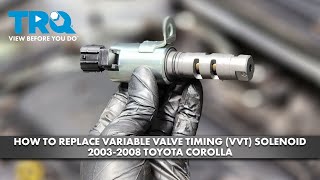
Generation note: This guide covers the 9th (2005-2008), 10th (2009-2013), 11th (2014-2019), and 12th (2020-2024) generations of the Toyota Corolla. The fundamental causes of P0012 are the same across these generations as they all use VVT-i technology. However, the exact location and part numbers for components like the oil control valve will vary slightly. For example, the 1ZZ-FE (2005-2008) and 2ZR-FE (2009+) engines use different OCVs. 🎬 Watch: How to replace the VVT solenoid on 2003-2008 models. Newer models (2020+) are particularly sensitive to oil quality and typically require a full synthetic 0W-20 oil to prevent VVT issues.
Symptoms You May Notice
- Check Engine Light is on
- Rough or unstable idle
- Poor acceleration and loss of power
- Decreased fuel efficiency
- Engine stalling, especially at low speeds
- A brief rattling noise from the engine on cold starts, lasting 1-2 seconds
- Engine struggles to start
- Replacing the camshaft position sensor first. While related, the sensor is usually not the root cause. The issue is typically mechanical or hydraulic (oil-related).
- Replacing the VVT actuator (cam gear) before the much cheaper and more common OCV/solenoid. The actuator is a more expensive and labor-intensive repair.
Most Likely Causes

- Low or Dirty Engine Oil 🔴 High Probability The VVT-i system is hydraulic and extremely sensitive to oil pressure and cleanliness. Sludge from delayed oil changes is the number one cause of VVT problems, accounting for up to 45-60% of P0012 cases.
How to confirm: Check the oil level on the dipstick. Observe the oil's color and consistency; if it is black, thick, or below the 'add' line, this is the likely cause.
Typical fix: Perform an engine oil and filter change using the manufacturer-recommended viscosity (e.g., 5W-30 for 1ZZ-FE, 0W-20 for 2ZR-FE, check your owner's manual).
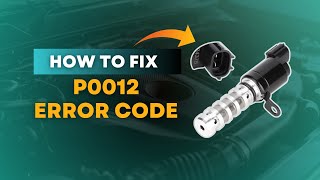
Est. part cost: $30-$70 - Faulty Intake Oil Control Valve (OCV) / VVT Solenoid 🔴 High Probability This solenoid is an electromechanical part that actively controls oil flow. It can get clogged by dirty oil or simply fail electrically over time. This is the second most common cause, after oil issues.
How to confirm: Remove the solenoid (usually held by a single 10mm bolt). Check its small filter screens for sludge. You can test it by applying 12V from the battery to its terminals; a healthy solenoid will make a distinct 'click' as its internal plunger moves. You can also test its internal resistance with a multimeter; a healthy solenoid should typically read between 6.9 and 7.9 ohms at 68°F (20°C).
Typical fix: Replace the intake camshaft oil control valve and its gasket. Cleaning is sometimes possible but often a temporary fix.
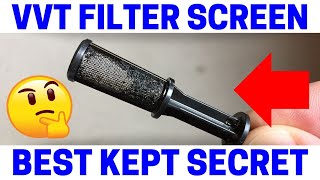
Est. part cost: $30-$150 - Clogged Oil Control Valve (OCV) Filter 🟡 Medium Probability There is a small, cylindrical filter screen located in the cylinder head or block that can become clogged with debris, restricting oil flow to the entire VVT system. Its location varies; on some 1ZZ-FE engines, it's on the back of the engine, while on 2ZR-FE engines, it can be under a main camshaft bearing cap or in the cylinder head, accessible after removing the OCV. 🎬 See this walkthrough on replacing the VVT oil filter screen.
How to confirm: This requires removing the OCV or other components to access the filter's location. The filter is often held in by a plug with a hex head. If it's full of metallic shavings or sludge, it's clogged.
Typical fix: Remove and clean the filter with brake cleaner and compressed air, or replace it if it's damaged or excessively clogged.
Est. part cost: $10-$25 - Stretched Timing Chain ⚪ Low Probability While Toyota timing chains are durable, they can stretch after very high mileage (typically 150,000+ miles), especially if oil changes have been neglected. A stretched chain causes the base mechanical timing to be retarded.
How to confirm: This is a complex diagnosis. A key symptom is a persistent rattling noise on startup that lasts for more than a couple of seconds. Confirmation requires significant engine disassembly to check timing marks and chain tensioner extension.
Typical fix: Replace the timing chain, guides, and tensioner. This is a labor-intensive job.
Est. part cost: $150-$400
Rare But Worth Checking
- Failing VVT-i Actuator (Cam Gear): The gear on the camshaft itself can fail internally. This is a known issue on the 2ZR-FE engine, often causing a distinct 'startup rattle' for 1-2 seconds as oil pressure bleeds out overnight. If the OCV and oil are good, this is the next logical component to suspect, especially if the rattle is present.
- Faulty Camshaft Position Sensor: It's uncommon for the sensor itself to cause a P0012 without throwing its own specific code (like P0340), but it can happen. The sensor provides the data, and if the data is wrong, the ECM's reaction can trigger this code.
- Failing Engine Control Module (ECM): This is extremely rare. The ECM is the last thing to suspect after all other mechanical and electrical components have been thoroughly checked and ruled out.
Diagnosis Steps

- Read the code with an OBD-II scanner and document any other codes present.
- Check the engine oil level and condition. If it is low, dirty, or the wrong viscosity, perform an oil and filter change before proceeding. This solves the problem a high percentage of the time.
- Clear the codes and drive the vehicle to see if the P0012 code returns. If it doesn't, the issue was likely the oil.
- If the code returns, listen for a 1-2 second rattle on a cold startup. This noise strongly suggests a problem with the VVT actuator (cam gear), a known issue on 2ZR-FE engines.
- Locate the intake Oil Control Valve (OCV) on the front of the engine (Bank 1). Inspect the wiring and connector for any damage or oil contamination.
- Remove the OCV (usually one 10mm bolt). Inspect its filter screens for sludge or debris. Clean if necessary.
- Test the OCV. Apply 12V power to its two pins; you should hear a solid click. With a multimeter, check the resistance between the pins. It should be within the manufacturer's spec, typically 6.9-7.9 ohms for these engines.
- With the OCV removed, check for the small, secondary OCV filter in the cylinder head/block and inspect it for blockage.
- If the OCV, filter, and oil are all good, the problem is likely deeper. If a startup rattle is present, suspect the VVT actuator (cam gear). If not, a stretched timing chain is possible. Professional diagnosis is recommended at this stage.
Parts You'll Likely Need

- Intake Camshaft Oil Control Valve (VVT Solenoid)
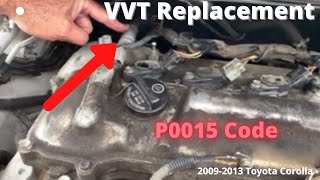
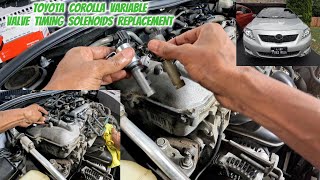
(OEM #15330-37010 (or superseding 15330-0T010) for 2ZR-FE engines (2009+); 15330-22030 (or 15330-22050) for 1ZZ-FE engines (2005-2008). Verify with VIN.)🎬 Watch: Step-by-step VVT solenoid replacement for 2009-2013 Corollas. — This is the most common part to fail or become clogged, directly causing the P0012 code.
Trusted brands: Denso (OEM supplier), Aisin (OEM supplier)
OEM price range: $90-$150
Aftermarket price range: $30-$80 - Engine Oil and Filter — Low, old, or incorrect viscosity oil is the leading cause of this code.
Trusted brands: Mobil 1, Castrol, Valvoline
OEM price range: $50-$90
Aftermarket price range: $30-$70 - VVT-i Actuator (Intake Camshaft Gear)
(OEM #13050-37010 (or superseding numbers) for 2ZR-FE engines. Verify with VIN.)— This part can fail internally, causing a startup rattle and eventually this code. It is a known issue on the 2ZR-FE engine.
Trusted brands: Toyota (OEM)
OEM price range: $150-$250
Aftermarket price range: $80-$150
Related Codes That Often Appear With This One
- P0011 — P0011 is for 'Timing Over-Advanced'. It's the opposite of P0012 but is caused by the same set of components (OCV, sludge, etc.) acting in a different way (e.g., stuck open vs. stuck closed).
- P0300 — A random misfire code. If the camshaft timing is incorrect, it can lead to inefficient combustion and misfires across multiple cylinders.
- P0016 — Crankshaft Position - Camshaft Position Correlation (Bank 1 Sensor A). This code often appears with P0012 when there is a significant mechanical timing issue, such as a jumped or stretched timing chain.
Technical Service Bulletins (TSBs) & Recalls
- T-SB-0094-11: While not directly for P0012, this TSB addresses excessive oil consumption on some 2009 Corollas with the 2AZ-FE engine (a different engine, but highlights Toyota's focus on oil-related issues).
- EG001-07: Not related to P0012. This TSB is for a P0A93 code on 2004-2006 Prius vehicles.
- Scion TSB (un-numbered in source): A technical bulletin for 2005-2006 Scion xA and xB vehicles cites a faulty VVT actuator as a potential cause for P0012, P0011, and P0016.
Mechanic-Grade Diagnostic Values
- Intake Oil Control Valve (OCV) Resistance — expected: 6.9 - 7.9 Ohms at 68°F (20°C). Failure: An open circuit (infinite resistance) or a reading outside of this range indicates a faulty solenoid coil.
- OCV Activation Voltage (at connector) — expected: Approximately 8-9V with key on, engine off. Should see a duty-cycled signal when running.. Failure: No voltage indicates a wiring or ECM problem. Constant 12V could indicate a short.
- Scan Tool Live Data: VVT Target vs. Actual Angle — expected: The 'Intake VVT Target Angle' and 'Intake VVT Change Angle' should be within 4-5 degrees of each other during engine operation.. Failure: A deviation greater than 5 degrees for more than a few seconds will trigger the P0012 code.
- Mode $06, Test ID $81 — expected: Value should be below the maximum threshold set by the manufacturer.. Failure: A high value on this test ID indicates that the VVT system's movement to the most retarded position is slow or incomplete, which can be a precursor to or confirmation of a P0012 fault.
Scan Tool Commands That Help
- Toyota Techstream: Active Test: 'Control the VVT System (Bank 1)' — This is a critical bidirectional test. After verifying oil level, a technician can use this command to manually operate the intake OCV. When activated at idle, the engine should stumble or stall. If there is no change in engine RPM, it confirms a lack of response from the VVT system, pointing to a clogged OCV, bad OCV, clogged passage, or faulty VVT gear.
Wiring & Ground Locations
- OCV Connector (Intake) — On the front of the cylinder head, typically the leftmost solenoid (on transverse engines) near the intake manifold side.. This is the primary connector for testing voltage and resistance of the OCV circuit. Wires are typically a 12V power feed and a duty-cycle ground control from the ECM.
- ECM Terminals (2ZR-FE) — The ECM is typically located behind the glove box. The OCV control wires (OC1+, OC1-) connect to specific pins on the ECM connectors (e.g., A50, B31 on some diagrams).. Allows for checking continuity and for shorts-to-ground on the OCV circuit directly from the ECM, ruling out harness issues.
- Engine Ground (G1xx) — A primary ground strap runs from the negative battery terminal to the chassis and a separate, heavy-gauge wire runs to the engine block, often near the transmission bell housing or a front corner of the block.. A poor engine ground can cause erratic sensor readings and incorrect actuator operation. High resistance between the engine block and the negative battery terminal (>1 ohm) can indicate a corroded or loose ground, which can cause a host of electrical issues, including this code.
Real Owner Repair Stories
- Reddit user in r/MechanicAdvice (2009 Toyota Corolla with 2ZR-FE engine) — Startup 'death rattle' and ticking noise.
❌ Tried (didn't work) The user proactively replaced the VVT actuator (cam gear) with an aftermarket part to fix the rattle.
✅ What actually fixed it After replacing the VVT gear, the car threw code P0012. The user suspected they may not have locked the new gear correctly during installation or that the timing marks were not perfectly aligned, leading to the over-retarded code. This highlights the risk of incorrect installation even when replacing the correct part. - YouTube comment (2009 Toyota Camry, 307,000 miles) — Low oil pressure light and Check Engine Light with two codes (P0012 implied).
❌ Tried (didn't work) None mentioned, direct diagnosis.
✅ What actually fixed it The oil filter was found to be extremely dirty and clogged. An oil and filter change resolved all warning lights and the car returned to normal operation. This confirms that a severely restricted filter can cause enough of an oil pressure drop to the VVT system to trigger this code. - Reddit user in r/COROLLA (2005 Toyota Corolla) — Intermittent no-start, battery not charging correctly despite good alternator.
❌ Tried (didn't work) Replacing alternator, battery, and starter.
✅ What actually fixed it The user found the mounting point for the main engine-to-chassis ground cable was severely rusted and broken. This created high resistance (~150 ohms) between the block and battery negative. Replacing/relocating the ground point fixed the electrical issues. While not directly causing P0012 in this story, it's a perfect example of how a bad ground can cause unpredictable electrical behavior that could easily trigger sensor or actuator codes.
Documented NHTSA Reports
- An owner of a similar Toyota model reported in NHTSA ODI #11302625 that after approximately 60,000 miles, the check engine light would illuminate with code P0012 every 1,000 miles, though technicians found no fault after resetting.
- In NHTSA ODI #10914131, a vehicle failed an emissions test due to code P0012 ("A" Camshaft Position - Timing Over-Retarded Bank 1) despite the owner following the maintenance schedule since purchasing the vehicle new.
- A report in NHTSA ODI #11508837 describes a scenario where the oil pressure light, check engine light, VSC light, and 4WD light appeared simultaneously, with a scan revealing code P0012.
- According to NHTSA ODI #10579431, a technician diagnosed P0012 and P0022 codes by checking the camshaft position and activating both VVT systems to identify the timing malfunction.
- NHTSA ODI #10326139 details a case where a dealer found the oil level one quart low with oil leaking from the VVTI line; the technician found codes P0012 and P0024 and subsequently replaced both VVTI cams, cam housings, gears, and various gaskets.
OEM Part Supersession History
15330-37010→15330-0T010, 15330-0T020, 15330-0T030, 15330-0T040— Standard part revision and improvement by the manufacturer.
Heads up: These parts are generally forward-compatible. However, always verify the correct part number for your specific VIN, as there can be mid-year production changes. Using a part from the wrong engine family (e.g., a 1ZZ-FE OCV on a 2ZR-FE) will not work.
Model Year Variations Within This Range
- 2009+: Engines like the 2ZR-FE use a cartridge-style oil filter. This introduces the potential failure mode of forgetting to swap the center tube during an oil change, which can cause oil starvation and trigger P0012. Earlier models like the 1ZZ-FE use a traditional spin-on filter, which does not have this issue.
- 2014+ (2ZR-FAE): Some later models use the 2ZR-FAE engine, which incorporates Valvematic technology in addition to Dual VVT-i. While the P0012 code still relates to the camshaft phase timing controlled by the OCV, the overall system is more complex. However, the primary causes of P0012 (oil, OCV) remain the same.
Diagnostic Flowchart
Real Owner Stories
Aggregated from forums and TSBs cited above. Mileages and costs reflect what owners reported in those sources.
2008 Toyota Corolla
Symptoms: Check Engine Light illuminated with a P0012 code.
What fixed it: Changing the VVT solenoid and doing an oil change provided a temporary solution, making the code go away initially.
Source hint: r/toyotacorolla
2006 Toyota Corolla — 196343 miles
Symptoms: Vehicle threw codes P0012, P0016, P0138, and P0420 after sitting in a parking lot for a few years completely unprotected and untouched.
What fixed it: Not stated in source (owner was seeking advice on realistic fixes for the multiple codes).
Source hint: r/MechanicAdvice
Related OBD-II Codes
Frequently Asked Questions
Is the 1-2 second engine rattle on cold starts related to the P0012 code on my 2ZR-FE Corolla?
Does the Scion TSB mentioned for P0012 apply to my Corolla?
Where is the OCV filter located on my Corolla's engine?
How do I test the VVT solenoid (OCV) on my Corolla?
Can low engine oil really cause a P0012 code on my Corolla?
At what mileage should I suspect a stretched timing chain for the P0012 code?
Helpful Videos
![How to Fix TOYOTA P0012 Engine Code in 4 Minutes [1 DIY Method / Only $19.45]](https://img.youtube.com/vi/ghNSQqruNxk/mqdefault.jpg)
Used OEM Parts in Stock


New Aftermarket Parts Available


The information in this article is provided for general reference and educational purposes only. Vehicle specifications, procedures, and part compatibility can vary by production date, trim level, and region. Always consult your vehicle's factory service manual and verify part numbers before purchasing or performing repairs. Safety-critical components such as airbags, seat belts, and braking systems should be installed by a qualified professional.
- Toyota Corolla:
- 🎬 Helpful Videos
- 🛍️ Shop This Part
- What's Unique About the 2005-2024 Toyota Corolla
- Symptoms You May Notice
- Most Likely Causes
- Rare But Worth Checking
- Diagnosis Steps
- Parts You'll Likely Need
- Related Codes That Often Appear With This One
- Technical Service Bulletins (TSBs) & Recalls
- Mechanic-Grade Diagnostic Values
- Scan Tool Commands That Help
- Wiring & Ground Locations
- Real Owner Repair Stories
- Documented NHTSA Reports
- OEM Part Supersession History
- Model Year Variations Within This Range
- Diagnostic Flowchart
- Real Owner Stories
- 2008 Toyota Corolla
- 2006 Toyota Corolla — 196343 miles
- Related OBD-II Codes
- Frequently Asked Questions
- 🎟️ Get 5% Off