

P2422 on 2006-2010 Hyundai Sonata: EVAP Vent Valve Stuck Closed Causes and Fixes
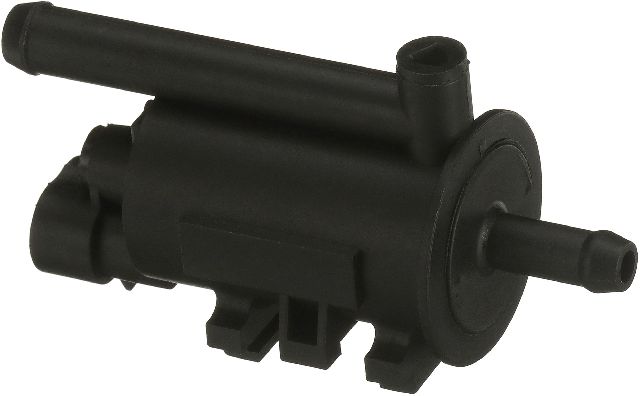
This code almost always means the EVAP Canister Close Valve (Vent Valve) has failed and is stuck closed. A key symptom is the gas pump nozzle clicking off constantly when refueling. Replacing the valve, located behind the driver's side rear wheel, is the most common fix. The OEM part number is 31453-3K600, superseded by 31453-3K600-FFF.
- P2422 on a 2006-2010 Sonata is almost certainly caused by a faulty EVAP Canister Close Valve (part #31453-3K600-FFF).
- The most obvious symptom, besides the Check Engine Light, is the gas pump nozzle repeatedly clicking off during refueling.
- The repair is straightforward for a DIYer, involving the removal of the driver's side rear wheel and wheel well liner to access the valve.
- If replacing the valve doesn't fix the issue, the next most likely cause is a blockage in the vent hose, often from insects or debris.
What's Unique About the 2006-2010 Hyundai Sonata
On the 2006-2010 (NF generation) Sonata, this code is a very common and well-documented issue that applies to both the 2.4L I4 and 3.3L V6 engines. The failure of the canister close valve is so frequent that it's the immediate suspect for both the check engine light and the tell-tale symptom of being unable to fill the gas tank without the pump repeatedly shutting off. The part is relatively inexpensive and accessible, making it a common DIY repair for owners of this specific Sonata generation and its platform mates like the Kia Optima.
Symptoms You May Notice
- Check Engine Light is on
- Difficulty filling the fuel tank (gas pump nozzle clicks off repeatedly).
- Fuel splashing back out of the filler neck during refueling attempts.
- A 'whoosh' sound of escaping pressure when opening the gas cap (less common)
- Possible fuel odor near the rear of the vehicle.
- Replacing the gas cap. A bad gas cap typically causes a small leak code (like P0442 or P0456), not a 'stuck closed' valve code.
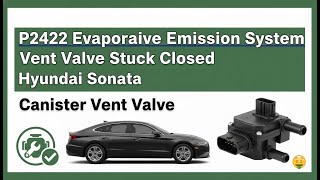
- Replacing the purge control solenoid. This valve is located in the engine bay and controls vapor flow to the engine. While it can fail, it usually produces different codes (like P0441 or P0496) and does not cause refueling issues. 🎬 Watch: Understanding the causes and fixes for code P2422.
Most Likely Causes
- Failed EVAP Canister Close Valve (Vent Valve) 🔴 High Probability The valve is exposed to the elements behind the rear wheel, and the internal solenoid or plunger mechanism commonly fails with age, getting stuck in the closed position. This is a frequent failure on this platform and related Hyundai/Kia models.
How to confirm: With a capable scan tool, command the vent valve to open and close; you should hear an audible click. Alternatively, remove the valve and apply 12V power to its terminals to see if it actuates. When unpowered, the valve should be open, allowing you to blow through it. Note that even a valve that clicks may be mechanically stuck internally.
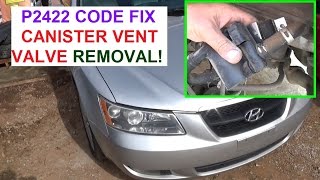
Typical fix: Replace the canister close valve. This part is located behind the driver's side rear wheel well liner, attached to a bracket near the charcoal canister. 🎬 Watch: See this step-by-step vent valve replacement walkthrough.
Est. part cost: $20-$50 - Blocked EVAP Vent Hose or Canister 🟡 Medium Probability Insects (like spiders) can build nests in the vent hose, or the charcoal canister itself can become saturated with fuel or clogged with debris, preventing air from flowing. This will produce the same symptoms as a stuck valve.
How to confirm: After removing the canister close valve, inspect the valve's ports and the attached rubber hoses for any visible blockages or debris. Try blowing low-pressure compressed air through the vent line (disconnected from the tank) to check for flow. A user on Reddit confirmed their valve worked electrically but the refueling issue persisted, pointing to a blockage.
Typical fix: Clear the blockage from the hose or replace the hose. If the charcoal canister is clogged, it will need to be replaced.
Est. part cost: $5-$20 for a hose, $150-$250 for a canister - Wiring or Connector Issue ⚪ Low Probability
How to confirm: Visually inspect the wiring harness and connector leading to the canister close valve for any signs of corrosion, damage, or loose pins. Use a multimeter to check for 12V power and ground at the connector when the valve is commanded on by the scan tool.
Typical fix: Repair the damaged section of wire or clean/replace the electrical connector.
Est. part cost: $5-$25
Rare But Worth Checking
- Faulty Powertrain Control Module (PCM): This is extremely rare. The PCM should only be considered if all other possibilities, including the valve, wiring, and hoses, have been thoroughly tested and ruled out.
Diagnosis Steps
- Confirm the primary symptom: Attempt to fill the fuel tank. If the pump nozzle clicks off repeatedly and fuel splashes back, it strongly points to a venting problem consistent with P2422.
- Scan for codes to confirm P2422 is the only code present. If other EVAP codes are present, diagnosis may be more complex.
- Safely jack up the rear driver's side of the vehicle and remove the wheel.
- Using a Phillips screwdriver and a 10mm socket, remove the plastic wheel well liner to gain access to the EVAP charcoal canister and the attached canister close valve.
- Inspect the electrical connector and wiring going to the valve for any obvious damage or corrosion.
- Disconnect the valve. Test for functionality by applying 12V and ground to the pins; a healthy valve will make an audible click. The valve is normally open, so you should be able to blow through it when it is unpowered.
- If the valve fails the test, replace it. This is the most likely solution.
- If the valve tests good, inspect the attached hoses for blockages from debris or insect nests. Disconnect the vent hose and check if you can blow through it.
- If a blockage is found, clear it or replace the hose.
- If the valve and hoses are good, the charcoal canister itself may be clogged and require replacement.
- After the repair, clear the code with a scan tool and perform a complete drive cycle to ensure the fix is complete and the permanent code is cleared. 🎬 Watch: A mechanic's guide to fixing the P2422 code.
Parts You'll Likely Need
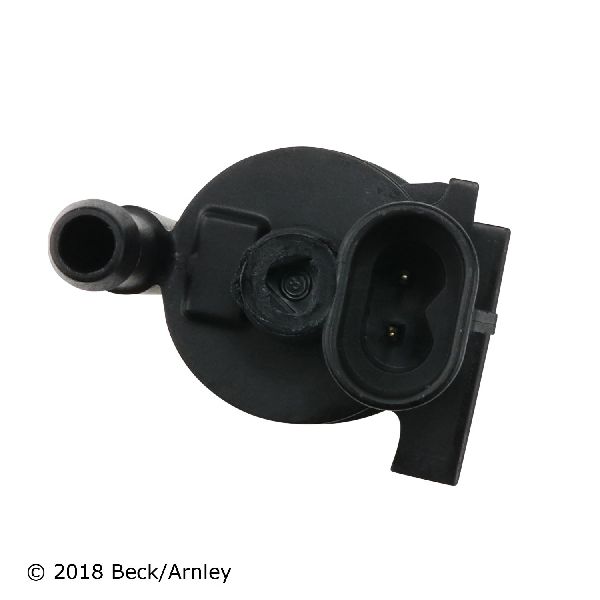
- EVAP Canister Close Valve
(OEM #31453-3K600 / Superseded by 31453-3K600-FFF)— This valve is the most common failure point for code P2422 on this vehicle, getting stuck in the closed position.
Trusted brands: Hyundai (Genuine OEM), Dorman, Standard Motor Products (SMP), Airtex/Wells
OEM price range: $30-$50
Aftermarket price range: $20-$40
Technical Service Bulletins (TSBs) & Recalls
- TSB 10-FL-003: While not directly for P2422, this TSB involves an ECM software update for some 2006-2010 Sonatas to address hard starting and rough idle issues. Applying this update could be relevant for overall vehicle software health.
- TSB Bulletin #21-01-009H: The manufacturer issued this bulletin to provide an Electronic Control Module (ECM) software update which specifically revises the detection logic for DTC P2422: EVAP System Restricted Vent Valve logic.
Mechanic-Grade Diagnostic Values
- Fuel Tank Pressure Sensor (FTPS) signal — expected: Near 0 inches of Mercury (inHg) when the system is at rest and vented.. Failure: If the FTPS signal is detected higher than 14 inH2O for more than 5 seconds while the purge valve is operating, the PCM will set code P2422.
Scan Tool Commands That Help
- Hyundai GDS (Global Diagnostic System): EVAP Leakage Test — This is an automated, dealer-level test that commands the various EVAP solenoids and monitors the fuel tank pressure sensor to provide a pass/fail result for the entire system, helping to confirm a blockage.
- Hyundai GDS (Global Diagnostic System): Actuator Test — Allows a technician to individually command the Canister Close Valve (CCV) on and off to listen for the audible click of the solenoid, confirming electrical function without having to remove the part.
Wiring & Ground Locations
- Canister Close Valve Connector — Behind the driver's side rear wheel well liner, plugged directly into the canister close valve.. This 2-pin connector provides power and ground to the valve. Corrosion or damage here will prevent the valve from actuating, mimicking a failed valve and potentially setting circuit codes alongside P2422.
Real Owner Repair Stories
- Reddit user on r/MechanicAdvice (2008 Hyundai Sonata V6) — Check Engine Light with code P2422, fuel splashes back out of the filler neck when trying to refuel.
❌ Tried (didn't work) The user removed the canister close valve and tested it with 12V power; it actuated correctly., They also used a Hyundai Hi-Scan Pro tool to command the valve and could hear it clicking, confirming it worked electrically.
✅ What actually fixed it The user concluded that since the valve itself was functional, the problem had to be a physical blockage in the venting system, likely the charcoal canister or an attached hose, preventing air from escaping during refueling.
OEM Part Supersession History
31453-3K600→31453-3K600-FFF— Standard part revision and improvement by the manufacturer.
Heads up: The new part number (31453-3K600-FFF) is a direct replacement for the original and is fully compatible.
Model Year Variations Within This Range
- 2006-2010: Some Sonatas were built to PZEV (Partial Zero-Emission Vehicle) standards for states with stricter emissions laws, while others were standard ULEV (Ultra-Low-Emission Vehicle). The vapor canisters for these two systems are different and are not interchangeable. Installing the wrong canister will cause persistent EVAP codes. Owners must verify their vehicle's emissions package via the under-hood sticker before ordering a replacement canister.
Diagnostic Flowchart
Other Known Issues on This Vehicle
Issues unrelated to this code that are worth knowing about as an owner of this generation:
- Rear Subframe Corrosion 🔴 High — Very common in 'Salt Belt' states, can occur at any mileage. Led to NHTSA investigation and recall. (Ref: NHTSA Recall 13V113000)
- Airbag Light On / OCS Failure 🟠 Medium — Common failure of the passenger Occupant Classification System (OCS) sensor mat, often triggering code B1448. Typically occurs after 60,000 miles.
- Timing Chain Tensioner Rattle on Startup 🟠 Medium — A rattling noise for a few seconds on a cold start often indicates a failing timing chain tensioner. An updated part is required for a permanent fix. (Ref: Related TSB SB-10-EM-006 describes a revised replacement procedure.)
- Stop Lamp Switch Failure 🔴 High — Widespread failure causing brake lights not to illuminate and cruise control not to disengage. Subject to a major recall. (Ref: Part of NHTSA Recall 13V113000)
- Parking Lights Stay On / Draining Battery 🟡 Low — An internal short in the in-cabin fuse box can cause the parking lights to remain on after the car is shut off, leading to a dead battery.
Used vs. New Parts: Buying Guide for This Vehicle
When a used part is the smart pick: A used OEM canister close valve from a low-mileage donor vehicle is a reasonable choice for this repair. The part is not a high-wear item in terms of mileage, but rather fails from age and exposure. A used part from a dry climate may be in better condition than a new aftermarket part.
Donor-vehicle mileage cap: roughly under 80000 miles for the part to have meaningful remaining life.
What to inspect on the donor part:
- Check for rust on the mounting bracket and electrical terminals.
- Ensure the plastic housing is not cracked or brittle.
- If possible, test the valve with a 12V source to ensure it clicks before purchasing.
- Verify the part number matches your original or the superseded OEM number.
OEM-only on this vehicle (don't cheap out):
- Charcoal Canister: Aftermarket canisters can have different flow characteristics, potentially causing issues. Given the PZEV vs. ULEV variation, sticking with a verified OEM canister is the safest option.
Aftermarket brands forum-validated for this vehicle:
- Standard Motor Products (SMP)
Brands owners have reported issues with on this vehicle:
- Dorman: While widely available, some users across various forums report premature failure of Dorman electronic components and rubber hoses, with some parts failing in as little as 3-6 months.
Real Owner Stories
Aggregated from forums and TSBs cited above. Mileages and costs reflect what owners reported in those sources.
2008 Hyundai Sonata V6
Symptoms: The Check Engine Light came on with code P2422. When trying to refuel, the gas pump nozzle would immediately click off and fuel would shoot back out of the filler neck.
What fixed it: The owner tested the canister close valve with a scan tool and could hear it clicking, but the problem remained. The issue was determined to be a blockage in the EVAP venting system, not the valve itself.
Source hint: Reddit r/MechanicAdvice: '2008 Hyundai Sonata v6 - P2422 - EVAP Vent Valve Stuck Close'
Related OBD-II Codes
Frequently Asked Questions
Where is the part that causes the P2422 code located on my 2008 Sonata?
I can't fill my gas tank without the pump clicking off constantly. Is this related to the P2422 Check Engine Light?
My mechanic tested the vent valve and it clicks, but the P2422 code and refueling problem persist. What else could be wrong?
Is the P2422 issue common on other Hyundai or Kia models?
How much should I expect to pay for the parts to fix a P2422 code?
Does TSB 10-FL-003 apply to the P2422 code on my Sonata?
Helpful Videos
We Have This Part in Stock


The information in this article is provided for general reference and educational purposes only. Vehicle specifications, procedures, and part compatibility can vary by production date, trim level, and region. Always consult your vehicle's factory service manual and verify part numbers before purchasing or performing repairs. Safety-critical components such as airbags, seat belts, and braking systems should be installed by a qualified professional.
- Hyundai Sonata:
- 🎬 Helpful Videos
- 🛍️ Shop This Part
- What's Unique About the 2006-2010 Hyundai Sonata
- Symptoms You May Notice
- Most Likely Causes
- Rare But Worth Checking
- Diagnosis Steps
- Parts You'll Likely Need
- Technical Service Bulletins (TSBs) & Recalls
- Mechanic-Grade Diagnostic Values
- Scan Tool Commands That Help
- Wiring & Ground Locations
- Real Owner Repair Stories
- OEM Part Supersession History
- Model Year Variations Within This Range
- Diagnostic Flowchart
- Other Known Issues on This Vehicle
- Used vs. New Parts: Buying Guide for This Vehicle
- Real Owner Stories
- 2008 Hyundai Sonata V6
- Related OBD-II Codes
- Frequently Asked Questions
- 🎟️ Get 5% Off