

OBD-II Code P0449: EVAP Vent Valve/Solenoid Circuit Malfunction
The Ultimate Guide to What P0449 Means, Why It Triggers, and How to Fix It for Good
- P0449 is an electrical circuit code, meaning the fault lies in the wiring, a blown fuse, or the vent solenoid itself—not a loose gas cap.
- Driving with P0449 is safe, but it disables remote start on modern vehicles and guarantees an emissions test failure.
- Before replacing the $50 vent solenoid, use a multimeter to verify 12V power and ground at the connector to rule out a broken wire.
- If the gas pump repeatedly shuts off during refueling, the vent valve is stuck closed and trapping air pressure inside the fuel tank.
What Does P0449 Mean?

The Powertrain Control Module (PCM) detected an electrical fault in the evaporative emission (EVAP) vent valve circuit. The EVAP system traps harmful gasoline vapors and routes them into the engine to burn. Code P0449 means the PCM cannot verify the electrical status of the vent valve, preventing the system from testing its own integrity or purging stored vapors.
Technical definition: The SAE/OBD-II definition is "Evaporative Emission Control System Vent Valve/Solenoid Circuit Malfunction." The PCM triggers this code when the commanded state (on or off) of the vent valve circuit does not match the actual voltage signal returning from that circuit. This indicates an open circuit, short to ground, or short to power in the control circuit.
Can I Drive With P0449?
Yes, But With Caution. Yes, you can safely drive with the P0449 code active. It does not affect core engine performance or short-term safety. However, your car will fail an emissions test, you will likely smell raw fuel, and many modern vehicles will automatically disable the remote start feature. Ignoring the code for over a year alters the air-fuel mixture slightly, risking premature and expensive catalytic converter wear.
Common Causes

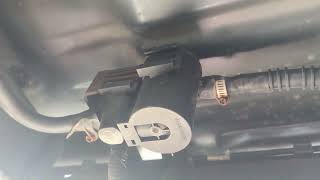
- Faulty EVAP Vent Valve/Solenoid (Very Common) — This is the most frequent culprit. The electromagnetic coil inside the solenoid fails from age, internal shorts, or corrosion. On many trucks and SUVs, it sits under the vehicle where constant exposure to water, road salt, and dirt accelerates its failure.
- Damaged Wiring or Corroded Connector (Common) — Wires leading to the vent solenoid fray, cut, or corrode, especially on chassis-routed harnesses. The electrical connector pins frequently corrode or spread apart, causing an open circuit. A break in the ground control wire is the primary reason this code returns after replacing the solenoid. 🎬 See how to find and repair damaged vent solenoid wiring
- Blown EVAP Fuse (Less Common) — The EVAP system utilizes a dedicated fuse (typically 10A or 15A). If this fuse blows due to a short circuit, the vent solenoid loses power instantly, triggering the P0449 code.
- Clogged EVAP Hoses or Fresh Air Intake (Less Common) — Insects, mud, or road debris block the fresh air intake hose connected to the vent valve. This prevents the system from venting and triggers circuit codes during the EVAP self-test. Excessive dust clogging the canister is a known issue on GM trucks.
- Damaged Charcoal Canister (Rare) — If the vent valve is integrated into the charcoal canister, physical damage or internal blockages cause this code. Repeatedly overfilling the gas tank floods the canister with liquid fuel, destroying the charcoal pellets.
- Faulty Control Module (PCM/FPCM) (Very Rare) — The driver circuit inside the main computer (PCM) or Fuel Pump Control Module (FPCM) that controls the vent solenoid can fail. Consider this only after exhaustively testing the wiring, fuses, and solenoid.
Symptoms

- Gas Pump Shuts Off While Fueling — A classic symptom of a stuck-closed vent valve. As you pump gas, displaced air and fuel vapors have no escape route. This builds pressure that kicks the gas pump nozzle off repeatedly, making refueling extremely slow.
- Remote Start Disabled — On many modern vehicles, the remote start feature automatically disables when any emissions-related trouble code, including P0449, is stored in the PCM.
- Fuel Smell — A faint to moderate smell of raw gasoline is noticeable around the rear of the vehicle if the vent valve is stuck open, allowing fuel vapors to escape into the atmosphere.
- Audible Hissing Sound — If the vent valve is stuck open, you hear a hissing sound from the rear of the vehicle near the fuel tank as vapors escape or as the system attempts to pull a vacuum.
- Check Engine Light is On (also visible on scanner) — This is the most common, and often the only, symptom. The light illuminates as soon as the PCM detects the circuit malfunction.
- Failed Emissions Test (also visible on scanner) — The EVAP system is a primary emissions control component. An active P0449 code guarantees an automatic failure during the onboard diagnostics portion of an emissions inspection.
Diagnostic Flowchart
Tap your situation to follow the diagnostic path that matches what you're seeing on this code.
Common Fixes & Costs
- Replace EVAP Vent Valve/Solenoid — Parts: $25-$150, Labor: $100-$200, ~1 hr book time
- Repair or Replace Wiring/Connector — Parts: $15-$50, Labor: $100-$250, ~1.5 hr book time
- Replace Blown EVAP Fuse — Parts: $1-$5, Labor: $0-$50, ~0.1 hr book time
- Replace Charcoal Canister Assembly — Parts: $150-$400, Labor: $150-$300, ~1.2 hr book time
- Install EVAP Filter Relocation Kit — Parts: $50-$100, Labor: $100-$150, ~1.3 hr book time
Used vs. New Parts: Buying Guide
When a used part is worth it: Buying used rarely makes sense for the vent solenoid. New aftermarket parts are inexpensive ($25-$75) and carry a warranty. Consider used parts only for expensive, integrated canister assemblies from low-mileage donor vehicles.
Donor-vehicle mileage cap: roughly under 60000 miles for the part to have meaningful remaining life.
Donor quality checklist:
- Verify the donor vehicle was not scrapped for an emissions-related failure.
- Avoid parts from vehicles in the 'Rust Belt' as corrosion is a primary failure mode.
- Match the part number exactly.
Decision logic:
- If The part is just the vent solenoid/valve → Buy a new aftermarket or OEM part. The cost saving for used is minimal and not worth the risk.
- If The part is an expensive, integrated canister assembly ($300+) → A used part from a low-mileage donor (<60k miles) is a reasonable option on a tight budget.
- If Vehicle is over 150K miles and any used part is considered → Accept that the used part has a significantly reduced lifespan.
Warranty tradeoff: Used parts typically offer a 30-90 day functional warranty. New aftermarket parts provide a 1-year to limited lifetime warranty, offering better peace of mind.
Worst-case if a used part fails: $200-$400 if a shop-installed used part fails after the warranty period, requiring you to pay for parts and labor again.
What Happens If You Wait — Timeline
- 0-1 month: Check Engine Light illuminates. Remote start is disabled. Vehicle fails an emissions test. (MPG impact: 0-1%% · Added cost: $0)
- 1-4 months: A faint fuel odor becomes noticeable. If the valve is stuck closed, refueling becomes difficult, with the gas pump clicking off frequently. (MPG impact: 1-2%% · Added cost: $20-$60 in wasted fuel and inconvenience.)
- 4-12 months: Sustained incorrect vapor management causes the PCM to adjust the air-fuel ratio. Moisture and dirt enter the system through a failed-open valve, damaging the charcoal canister. (MPG impact: 2-4%% · Added cost: $200-$500 (cost to replace a saturated charcoal canister).)
- 12+ months: The long-term altered air-fuel mixture contributes to premature aging and eventual failure of the catalytic converter by causing it to operate at non-optimal temperatures. (MPG impact: 3-5%% · Added cost: $1200-$2800 (cost to replace a failed catalytic converter).)
Cost of Not Fixing It
- 0-3 months: Guaranteed failure of an emissions test. Potential for a slight decrease in fuel economy and a persistent fuel smell. Remote start is disabled. (Added cost: Negligible, other than wasted fuel.)
- 3-12 months: Continued stress on the EVAP system causes other components, like the purge valve or charcoal canister, to fail. Increased risk of moisture entering the system. (Added cost: $150-$700)
- 12+ months: An improperly functioning EVAP system leads to a consistently incorrect air-fuel mixture, which overheats and damages the catalytic converter over time. (Added cost: $1200-$2800)
Diagnosis Steps

- Scan for Codes and Review Freeze Frame Data
Use an OBD-II scanner to confirm P0449 is the primary code. Look for related EVAP codes like P0446 or P0455. Review the freeze frame data to see the vehicle's operating conditions when the code triggered.
Tools: ['OBD-II Scanner'] (Beginner) - Inspect the EVAP Fuse and Gas Cap
Ensure the gas cap is tight and the seal is intact. Locate and inspect the EVAP system fuse in your vehicle's fuse box (often 10A or 15A). If blown, you found the circuit issue, though you must determine why it blew.
Tools: ['Flashlight', 'Fuse Puller'] (Beginner) - Visually Inspect the Vent Solenoid and Wiring
Locate the EVAP vent solenoid near the charcoal canister by the fuel tank. Look for cracked plastic, disconnected hoses, chafed wiring against the frame, or green corrosion on the connector pins.
Tools: ['Jack and jack stands', 'Flashlight'] (Beginner Intermediate) - Test the Solenoid with a Bidirectional Scan Tool
Navigate to the EVAP system tests and command the vent solenoid circuit 'On' and 'Off'. You should hear a distinct 'click' from the solenoid. If you hear nothing, proceed to manual circuit testing.
Tools: ['Bidirectional Scan Tool'] (Intermediate) - Check for Power at the Connector
Disconnect the electrical connector from the vent solenoid. Turn the ignition to 'On' (engine off). Use a multimeter set to DC Volts to check for battery voltage (12.0V - 14.0V) on the feed wire. If voltage is missing, the problem is upstream.
Tools: ['Multimeter'] (Intermediate) - Verify Ground Signal Integrity
On a ground-side switched circuit, with the key on and connector unplugged, both wires should read 12V. Check continuity (Ohms) on the ground wire between the solenoid connector and the PCM. A reading of 'OL' indicates a broken wire.
Tools: ['Multimeter'] (Intermediate Advanced) - Solenoid Resistance Bench Test
Set your multimeter to Ohms and measure resistance between the two solenoid pins. A good solenoid reads between 10 and 40 ohms. 'OL' indicates an open coil (bad). Apply power and ground with a 9V battery; a good solenoid clicks audibly.
Tools: ['Multimeter', '9V Battery or Power Probe'] (Advanced) - Inspect for Physical Blockages
If electrical tests pass, check for a physical restriction. Disconnect hoses from the vent solenoid and charcoal canister and inspect for dirt, debris, or spider webs. On GM trucks, check the fresh air intake filter box for dust clogs.
Tools: ['Screwdriver', 'Pliers'] (Intermediate)
When This Code Triggers (Freeze-Frame Conditions)
- Engine Coolant Temp: 170-220°F (Engine fully warmed up for the test to run.)
- RPM: 1200-2500 (Steady cruise or light acceleration.)
- Engine Load: 20-50% (Light to moderate throttle, not heavy acceleration or full deceleration.)
- Vehicle Speed: 45-65 mph (Steady highway driving is required for the EVAP monitor to complete its test.)
- Fuel Level: 15-85% (The EVAP monitor will not run if the tank is too full or nearly empty.)
Related Codes
- P0455 — Indicates a large leak in the EVAP system. A P0449 circuit fault directly causes P0455 if the vent valve fails in the 'stuck open' position. Always diagnose and fix the P0449 electrical issue first.
- P0446 — Indicates a restriction or performance issue in the EVAP vent system. P0449 is an electrical fault, while P0446 is a functional fault. The electrical fault (P0449) causes the functional fault (P0446). Fix P0449 first.
- P0442 — Indicates a small leak in the EVAP system. A physically cracked but electrically functioning solenoid causes both codes, but P0449 points to an electrical failure, which is the diagnostic priority.
- P0443 — The sister code to P0449. P0443 indicates a circuit malfunction for the EVAP Purge Valve (located in the engine bay). P0449 is for the Vent Valve (near the fuel tank).
Climate & Environmental Factors
- Road Salt / High Humidity (Rust Belt): Accelerates corrosion of the vent solenoid's electrical connector pins and wiring. Water and salt cause shorts or open circuits that directly trigger P0449.
- Dusty / Off-Road Conditions: Fine dust draws into the EVAP fresh air intake, clogging the vent solenoid, filter, and charcoal canister. This is a well-documented issue on GM trucks addressed by TSB 23-NA-073.
- Cold Weather: Moisture inside the vent solenoid or hoses freezes, causing the valve to stick mechanically or cracking the plastic housing.
How to Talk to a Mechanic About This Code
Say this: "I have a check engine light with code P0449. I'd like to schedule a diagnostic to test the EVAP vent valve circuit. Please verify power, ground, and command signal at the solenoid connector before recommending a part replacement."
This communicates that you know P0449 is an electrical circuit code, not a simple leak. It directs the technician to perform a proper electrical diagnosis first, preventing them from just replacing the solenoid when the issue is a wiring fault.
Avoid saying:
- 'Just fix whatever's wrong'
- 'My check engine light is on, can you look at it?'
- 'Whatever you recommend'
Questions to ask before authorizing the repair:
- What were the results of the electrical tests at the connector? Did it have 12-volt power?
- Did you test the ground control wire for continuity back to the computer?
- If the solenoid is the problem, what was its resistance reading in ohms?
- Is there a TSB for this issue on my vehicle that involves a wiring or filter modification?
Where to Take It: Dealer vs Independent vs Chain
- Dealer:
Best for: Vehicles still under powertrain or emissions warranty, Complex wiring issues or known manufacturer-specific TSBs (like the GM filter relocation kit)
Downsides: 1.5-2x labor rate vs independent shops., Often suggests wholesale fix (e.g., entire canister assembly) when a discrete part swap would do. (Typical cost: +75% vs. baseline) - Independent Shop:
Best overall fit. Offers the best balance of cost and expertise for this common electrical fault.
Best for: Most out-of-warranty vehicles with common codes like P0449., Cost-conscious owners who want a balance of expertise and value.
Downsides: Quality and diagnostic skill vary. Check for ASE certifications and good reviews on electrical repairs. (Typical cost: +0% vs. baseline) - Chain Shop:
Use with caution. Acceptable for a simple solenoid swap, but risky for the electrical diagnosis that is often required.
Best for: Simple, straightforward part replacements if the diagnosis is certain.
Downsides: Technician skill varies greatly; less likely to perform in-depth electrical diagnosis., High pressure to upsell unnecessary services or parts. (Typical cost: -10% vs. baseline)
When to Walk Away From the Repair
If the estimated repair cost exceeds 40-50% of the car's Kelley Blue Book private-party value, consider trading it in or selling it as-is.
- Car worth $3000, fix is $350: Fix it. This is a common repair cost and is well below the threshold.
- Car worth $10000, fix is $650: Fix it. The repair is a reasonable percentage of the car's value.
- Car worth $2500, fix is $1200: Walk away. The repair cost indicates a rare PCM failure and is nearly 50% of the vehicle's value.
What Scan Tool You Need for This Code
Minimum: A code reader that can read/clear codes and view Live Data, specifically the Fuel Tank Pressure (FTP) sensor.
A basic $20 reader only shows the code. To properly diagnose P0449, you need a bidirectional tool that can command the EVAP vent solenoid on and off. Hearing the 'click' determines if the fault is the solenoid or the wiring, saving hours of guesswork.
Budget: Autel AP200 / Topdon TopScan Lite (~$50) — These Bluetooth dongles offer incredible value, providing bidirectional control to command the vent solenoid on/off directly from your smartphone.
Mid-range: XTool A30M / Launch CRP129X / Autel MX808 (~$150) — These are powerful handheld tools with dedicated EVAP system tests, full bidirectional control, and the ability to graph live data.
Professional: Autel MaxiCOM MK808 / MK906BT (~$500-1200) — Provides full, OEM-level diagnostics, including wiring diagrams and advanced testing capabilities, for professionals or serious DIYers.
Rent vs buy: For a one-time fix, use the free 'Loan-A-Tool' program from stores like AutoZone or O'Reilly. Buy a bidirectional tool only if you plan to do your own diagnostics regularly.
How to Clear the Code After You Fix It
- Use an OBD-II scan tool to clear the P0449 code
- Ensure fuel tank is between 1/4 and 3/4 full
- Perform a complete OBD-II drive cycle to run the readiness monitors
Drive cycle (~30 minutes): A general drive cycle involves: 1) A cold start after sitting for 8+ hours. 2) Idling for 2-3 minutes. 3) Driving for 10-15 minutes at a steady highway speed (45-65 mph). 4) Performing stop-and-go city driving. Repeat over several days to set the EVAP monitor to 'Ready'.
Readiness monitors affected: Evaporative (EVAP) System, Catalyst (CAT), Oxygen (O2) Sensor
Before emissions retest: drive at least 100 miles to fully set monitors.
Watch out for:
- Disconnecting the battery clears the code but resets all readiness monitors to 'Not Ready', guaranteeing an emissions test failure.
- The EVAP monitor is notoriously difficult to set and has strict requirements for fuel level and temperature.
- If the underlying electrical fault was not fixed, the code returns as soon as the EVAP monitor runs its test again.
Will This Fail Emissions / State Inspection?
Yes — this code typically fails an OBD-II emissions inspection.
- California: An active P0449 code is an automatic failure. After repair, most readiness monitors must be 'Ready'. Many test stations hesitate to pass a vehicle with the EVAP monitor incomplete.
- New York: An illuminated Check Engine Light for P0449 results in an automatic failure. For 2001+ model year vehicles, the state allows one readiness monitor to be incomplete.
- Texas: A vehicle with P0449 fails the OBD portion of the inspection. After repair, 2001 and newer vehicles are allowed to pass with one monitor not ready.
Most Commonly Affected Vehicles

- Chevrolet Silverado 1500/2500/3500 (2004-2025) — Extremely common due to the vent solenoid's exposed location. For 2020-2025 models, see TSB 23-NA-073 regarding dust intrusion clogging the canister.
- GMC Sierra 1500/2500/3500 (2004-2025) — Mechanically identical to the Silverado, suffering from the same high failure rate of the vent solenoid due to its placement.
- Chevrolet Tahoe / Suburban (2005-2020) — These full-size SUVs use a similar EVAP system design and part location as the trucks, making them highly susceptible to solenoid failures from road debris.
- GMC Yukon / Yukon XL (2005-2020) — As the GMC twin to the Tahoe/Suburban, the Yukon models frequently experience P0449 due to identical vent solenoid and wiring vulnerabilities.
- Ford F-150 / Mustang (2005-2015) — Inspect the wiring harness for chafing against the frame or spare tire before replacing the canister vent solenoid.
- Kia / Hyundai Forte, Elantra, Optima, Sonata (2011-2018) — A failed Canister Close Valve (CCV) is a very common cause of P0449, almost always presenting with the gas pump repeatedly shutting off during refueling.
- Nissan Titan / Altima / Frontier (2004-2015) — The EVAP vent control valve is a frequent failure item. Its location under the vehicle makes it susceptible to road debris and corrosion.
- Chevrolet Colorado / Impala / Cobalt (2006-2012) — Prevalent on smaller Chevy cars and trucks. The cause is almost always a failed vent solenoid or a break in the wiring harness.
Manufacturer-Specific Notes
- General Motors (Chevrolet, GMC, Cadillac, Buick): GM trucks are notorious for P0449. TSB #23-NA-073 identifies dust intrusion into the canister as a known cause for 2020-2025 models, requiring a filter relocation kit. Older models suffer from water intrusion causing corrosion.
- Ford: On Ford trucks, always inspect the EVAP wiring harness for chafing. The harness frequently rubs through against the vehicle's frame or spare tire carrier, causing a short or open circuit.
- Kia / Hyundai: These brands refer to the vent valve as the Canister Close Valve (CCV). Kia TSB TSBFUE038_R1 advises checking for a clog in the 'Air Drain Case' near the fuel filler neck before replacing the CCV.
- Dodge / Ram: The vent solenoid on Ram trucks is a common failure point due to its vulnerable location under the truck bed. The replacement part is often sold as an assembly with a new section of vent hose.
Real Owner Stories
2006 Chevy Trailblazer (~116k miles) - The Classic Misdiagnosis
Check Engine Light with P0449 came on. Based on forum research, the owner replaced the vent solenoid.
What they tried:
- Replaced the EVAP canister vent valve solenoid.
- Cleared the code, but it returned after a short drive.
Outcome: The actual problem was a broken wire in the harness between the PCM and the solenoid connector. The owner performed electrical diagnostics to find and repair the open circuit.
Lesson: P0449 is a CIRCUIT code. Always test for 12V power and a good ground signal at the connector before replacing the part. A new part cannot fix a broken wire.
2016 Kia Sportage - The TSB-Related Fix
P0449 code appeared, accompanied by the gas pump repeatedly shutting off during refueling.
What they tried:
- Replaced the vent valve solenoid (Canister Close Valve), but the problem persisted.
Outcome: The root cause, outlined in Kia TSB #TSBFUE038_R1, was a clogged EVAP canister air filter. The clogged filter strained the new valve, causing the code to return. Replacing both the filter and the valve solved the problem permanently.
Lesson: Always check for manufacturer Technical Service Bulletins (TSBs). For many Kias and Hyundais, replacing the canister air filter is required to permanently fix P0449.
2005 Chevy Silverado - The Simple (and Correct) Fix
P0449 code appeared with no major symptoms other than the Check Engine Light.
What they tried:
- Tested the circuit with a multimeter, found 12V power at the connector, but determined the solenoid coil was open (infinite resistance).
Outcome: Installed a new EVAP vent solenoid (ACDelco 214-2149) for $35. The replacement took 15 minutes near the spare tire. The code cleared and did not return.
Lesson: On domestic trucks, the solenoid is a high-failure part due to its exposed location. It is an inexpensive DIY replacement requiring basic tools.
2020 Chevy Silverado Trail Boss - The Frustrating Wiring Issue
P0449 code appeared, disabling the remote start feature before winter.
What they tried:
- Replaced the purge valve in the engine bay.
- Replaced the vent valve solenoid under the truck.
- The code immediately returned after clearing.
Outcome: Traced the problem to a broken wire in the harness leading to the vent valve. The wire's insulation was intact, but the copper inside broke, creating an open circuit found via a continuity test.
Lesson: If a new part doesn't fix a circuit code, the problem is in the wiring or a fuse. Pull gently on the wires at the connector; stretching reveals internal breaks.
How to Prevent This Code From Triggering
- Avoid Topping Off Your Gas Tank (Every fill-up) — Repeatedly overfilling forces liquid gasoline into the charcoal canister, saturating the pellets, ruining the canister, and sending debris downstream to clog the vent solenoid.
- Inspect and Clean the Vent Solenoid Connector (Every 30,000 miles) — On trucks where the solenoid is exposed under the chassis, the connector is prone to corrosion. Cleaning the pins and applying dielectric grease prevents electrical faults.
- Inspect and Clean EVAP Hoses and Fresh Air Intake (Annually) — Insects build nests in the EVAP fresh air intake hoses. Cleaning out debris with compressed air prevents blockages that stress the vent solenoid.
- Install a Filter Relocation Kit (GM trucks) (Once, if operating in dusty environments) — For GM trucks susceptible to dust intrusion (TSB 23-NA-073), this kit moves the air intake to a cleaner location, permanently preventing repeated canister and solenoid failures.
Frequently Asked Questions
I replaced the vent solenoid, but the P0449 code came back. What now?
The problem is in the electrical circuit, not the solenoid. Use a multimeter to confirm 12V power at the connector with the key on. Then, test the ground control wire for continuity back to the PCM to locate the broken wire.
What is the most common misdiagnosis for P0449?
Replacing the vent valve without testing the electrical circuit first is the biggest mistake. P0449 is an electrical circuit code, meaning a broken wire or corroded connector is just as likely as a failed valve. Always verify power and ground before buying parts.
Can dirt or dust cause a P0449 code?
Yes. On many trucks, particularly GM models, the EVAP fresh air intake sits in a vulnerable location and clogs with dust. GM TSB 23-NA-073 addresses this by recommending a filter relocation kit to prevent repeat failures.
Can I fix P0449 myself?
Yes, replacing the vent solenoid is a beginner-friendly repair that takes about an hour using basic hand tools. The valve is usually located under the vehicle near the gas tank. However, if the new part doesn't clear the code, you must test the wiring with a multimeter.
Will replacing the gas cap fix a P0449 code?
No. A loose gas cap creates a physical leak (triggering codes like P0455), while P0449 specifically indicates an electrical circuit failure. Save your money and focus on the vent valve wiring and solenoid.
What's the difference between the purge valve and the vent valve?
The Purge Valve (Code P0443) sits in the engine bay and opens to pull stored vapors into the engine. The Vent Valve (Code P0449) sits near the gas tank and closes to seal the system for pressure testing. They perform opposite functions in different locations.
Why does my gas pump keep clicking off?
A stuck-closed vent valve or blocked vent hose traps air inside the fuel tank. When you pump gas, the displaced air has nowhere to go, building pressure in the filler neck. This pressure triggers the gas pump's automatic shutoff nozzle.
How much does it cost to fix P0449 at a shop?
A straightforward vent solenoid replacement costs between $125 and $350, including parts and labor. If the wiring harness requires repair, expect to pay $150 to $300. Replacing an integrated charcoal canister assembly pushes the total to $300-$700.
What does it mean that P0449 is a 'circuit' code?
It means the engine computer detected incorrect voltage on the wire controlling the vent solenoid. This points directly to an electrical issue like a broken wire, a blown fuse, or a dead coil inside the solenoid. It does not indicate a mechanical leak in the hoses.
Key Takeaways
- P0449 is an electrical circuit code, meaning the fault lies in the wiring, a blown fuse, or the vent solenoid itself—not a loose gas cap.
- Driving with P0449 is safe, but it disables remote start on modern vehicles and guarantees an emissions test failure.
- Before replacing the $50 vent solenoid, use a multimeter to verify 12V power and ground at the connector to rule out a broken wire.
- If the gas pump repeatedly shuts off during refueling, the vent valve is stuck closed and trapping air pressure inside the fuel tank.
Helpful Videos



The information in this article is provided for general reference and educational purposes only. Vehicle specifications, procedures, and part compatibility can vary by production date, trim level, and region. Always consult your vehicle's factory service manual and verify part numbers before purchasing or performing repairs. Safety-critical components such as airbags, seat belts, and braking systems should be installed by a qualified professional.
- 🎬 Helpful Videos
- What Does P0449 Mean?
- Can I Drive With P0449?
- Common Causes
- Symptoms
- Diagnostic Flowchart
- Common Fixes & Costs
- Used vs. New Parts: Buying Guide
- What Happens If You Wait — Timeline
- Cost of Not Fixing It
- Diagnosis Steps
- When This Code Triggers (Freeze-Frame Conditions)
- Related Codes
- Climate & Environmental Factors
- How to Talk to a Mechanic About This Code
- Where to Take It: Dealer vs Independent vs Chain
- When to Walk Away From the Repair
- What Scan Tool You Need for This Code
- How to Clear the Code After You Fix It
- Will This Fail Emissions / State Inspection?
- Most Commonly Affected Vehicles
- Manufacturer-Specific Notes
- Real Owner Stories
- 2006 Chevy Trailblazer (~116k miles) - The Classic Misdiagnosis
- 2016 Kia Sportage - The TSB-Related Fix
- 2005 Chevy Silverado - The Simple (and Correct) Fix
- 2020 Chevy Silverado Trail Boss - The Frustrating Wiring Issue
- How to Prevent This Code From Triggering
- Frequently Asked Questions
- I replaced the vent solenoid, but the P0449 code came back. What now?
- What is the most common misdiagnosis for P0449?
- Can dirt or dust cause a P0449 code?
- Can I fix P0449 myself?
- Will replacing the gas cap fix a P0449 code?
- What's the difference between the purge valve and the vent valve?
- Why does my gas pump keep clicking off?
- How much does it cost to fix P0449 at a shop?
- What does it mean that P0449 is a 'circuit' code?
- Key Takeaways
- 🎟️ Get 5% Off