

OBD-II Code B1448: Comprehensive Guide to Passenger Seat Sensor Faults
What B1448 means, why it triggers, and how to fix it for good
- For most vehicles, especially Hyundai and Kia, B1448 indicates a serious fault with the passenger seat weight sensor (OCS mat) that disables the passenger airbag.
- Driving with this fault is a significant safety risk. In some cases, the entire vehicle airbag system, including the driver's side, may be deactivated.
- The most common cause is an internally failed sensor mat inside the passenger seat, an expensive repair due to high labor costs often exceeding $2,000.
- CRITICAL FIRST STEP: Before paying for any repairs, contact a dealer with your VIN to check for a 15-year/unlimited mileage warranty extension that covers this exact issue on many Hyundai and Kia models.
- For some brands like Toyota, Lexus, and Ford, B1448 is completely unrelated to the airbag system and points to issues with climate control, wipers, or other systems.
What Does B1448 Mean?

B1448 means the car's main computer, specifically the Supplemental Restraint System (SRS) module, has detected a defect in the Occupant Classification System (OCS) sensor mat located in the front passenger seat. This sensor's job is to detect the weight and profile of the passenger to determine if the airbag should be active. A fault in this system triggers the airbag warning light and disables the smart-deployment function, defaulting to a 'passenger airbag off' state.
Technical definition: The most common formal definition for B1448 is "Occupant Classification System (OCS) - Passenger - Mat Defect." This indicates the pressure-sensitive sensor mat within the passenger seat cushion has failed an internal diagnostic test. For manufacturers like Hyundai and Kia, this is a very specific and common code pointing directly to this component's failure.
🎬 Watch: How to fix B1448 on Hyundai and Kia models.Can I Drive With B1448?
Yes, But With Caution. Yes, the vehicle will drive normally, but the airbag system is critically compromised. This code indicates the passenger airbag is disabled as a failsafe. On some models, like the 2007-2009 Hyundai Santa Fe, this fault can disable the ENTIRE Supplemental Restraint System (SRS), including the driver's airbag. Driving with this light on means a passenger is unprotected by the front airbag in an accident, a serious safety risk that requires immediate attention.
Common Causes

- Defective OCS Sensor Mat (very_common) — The sensor mat, a thin, pressure-sensitive grid embedded in the seat foam, cracks or fails internally from age and the stress of repeated use. This is the most frequent cause, especially on certain Hyundai and Kia models where it is a known defect addressed by warranty extensions.
- Damaged Wiring or Connectors Under Seat (common) — Wires and connectors under the passenger seat are vulnerable to damage from items stored under the seat, corrosion from moisture (spilled drinks, wet carpets), or repeated seat movement fraying the harness. This interrupts the signal from the sensor mat to the control module.
- Spilled Liquids on the Seat (common) — Moisture from spilled drinks can seep into the seat cushion and short out the OCS sensor mat or its delicate electronic components. Kia and Hyundai TSBs specifically list checking for a wet seat cushion as a primary diagnostic step.
- Interference from Electronic Devices (less_common) — Placing electronics like laptops, power inverters, or even cell phones on the passenger seat can interfere with the sensor's electrical field, causing a temporary fault code. Kia TSB BOD 135 mentions this as a specific diagnostic step for certain models.
- Improper ECU/Module Initialization After Repair (less_common) — Connecting the vehicle's battery while dashboard components or SRS modules are disconnected can sometimes trigger a hard fault in the SRS system. One owner reported the B1448 code appeared after working on the car's head unit with the dash partially disassembled and the battery connected.
- Failed OCS/Airbag Control Module (rare) — The control module that reads and interprets the signal from the sensor mat can fail. This is uncommon and should only be considered after the sensor mat and wiring have been definitively ruled out. A faulty module would typically present with multiple, less specific SRS codes.
- Incorrect Part Installed or Improper Calibration (rare) — If the seat cushion or sensor was replaced with an incorrect part number, or if a new sensor was not properly calibrated to the vehicle's SRS module using a dealer-level scan tool, the system will not recognize it and may set a B1448 or related code like B1450.
Symptoms

- Airbag Warning Light is On — This is the most prominent and universal symptom. The red SRS/airbag light will illuminate on the dashboard and stay on.
- Passenger Airbag Off/On Light is Incorrect — The status light near the radio, which indicates if the passenger airbag is active, may not work correctly. It might show "OFF" even when an adult is seated, or stay off when the seat is empty, incorrectly implying the airbag is armed.
- Intermittent Passenger Seatbelt Warning — The passenger seatbelt warning light may blink or chime even when no one is in the seat, as the system gets confusing, erratic signals from the faulty OCS mat.
- Fault Code Stored in Memory — A scan tool that can read SRS (Supplemental Restraint System) codes will find B1448 stored in the airbag control module's memory.
- Failed State Safety Inspection — In many jurisdictions, an illuminated airbag warning light is an automatic failure for a vehicle safety inspection, preventing legal registration until the fault is repaired.
Diagnosis Steps
- Check for TSBs and Warranty Extensions
Before any diagnosis, contact a dealer with your VIN. For many Hyundai and Kia vehicles, the manufacturer has issued 15-year/unlimited mileage warranty extensions for this exact problem. This could result in a no-cost diagnosis and repair. Examples include Hyundai Campaign TXX6 and Kia Program WTY002. - Clear and Check the Passenger Seat Area
Remove all items from the passenger seat, including electronic devices, bags, and anything stored underneath. Ensure the seat and floor area are completely dry. Clear the codes and see if the fault returns. - Scan for Codes and Observe Live Data
Use an OBD-II scanner capable of reading SRS/Airbag codes to confirm B1448 is the active fault. While monitoring live data PIDs for the OCS, have an adult sit in the passenger seat. The 'Passenger Airbag Off' light should turn off, and the scanner's occupant status PID should change from 'Empty' or 'Child' to 'Adult'. If it doesn't, the sensor is not detecting the occupant. 🎬 See this walkthrough on testing the seat occupancy sensor. - Visually Inspect Under-Seat Connectors
Disconnect the negative battery terminal and wait at least 3 minutes. Slide the passenger seat to its limits to get a clear view underneath. Look for the primary (usually yellow) airbag system connectors. Check for pushed-out pins, corrosion, or damaged wires. Disconnect, inspect, and securely reconnect them. - Advanced Test: Check OCS Power and Ground at the Harness Connector
With the OCS sensor connector unplugged and battery disconnected, wait 3 minutes. Reconnect the battery and turn the ignition ON. Using a multimeter, measure voltage between the power pin (Pin 1 on many Hyundai/Kia models) of the harness-side connector and a known good chassis ground. The reading should be battery voltage (approx. 12V). If not, there is a fault in the power supply wire from the ignition switch.
Tools: Multimeter (advanced) - Advanced Test: Test OCS Signal Wires for Shorts
Turn ignition OFF and disconnect the battery. On the harness-side OCS connector, measure resistance between the signal wire pin (e.g., Pin 2 on Hyundai) and chassis ground. The resistance should be infinite (OL on the multimeter). Next, measure resistance between the two signal pins (e.g., Pins 2 and 3 on Hyundai); this should also be infinite. A low resistance reading on either test indicates a short in the vehicle's wiring harness.
Tools: Multimeter (advanced) - Advanced Test: Check for Short to Battery on Signal Wire
Turn ignition ON. On the harness-side OCS connector, measure the voltage between the signal wire pin (e.g., Pin 2 on Hyundai) and chassis ground. The reading should be approximately 0V. Any significant voltage indicates a short to power in the wiring harness.
Tools: Multimeter (advanced) - Test with an OCS Emulator (Bypass Method)
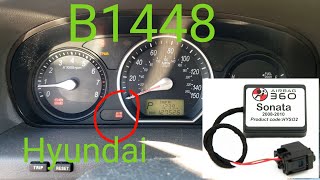
As a diagnostic step (or a temporary fix), an OCS emulator can be used. Unplug the OCS sensor connector under the seat and plug the emulator in its place. Clear the codes. If the airbag light stays off, it confirms the OCS mat is the source of the fault. 🎬 Watch: A quick guide to fixing Hyundai/Kia airbag light problems. - Confirm with OCS Zero Point Calibration Attempt
Using a high-level scan tool (like a dealer's GDS), attempt to perform the 'OCS Zero Point Calibration'. If the procedure fails repeatedly, it provides final confirmation that the sensor mat is defective and unable to communicate properly with the SRS module, necessitating its replacement.
Common Fixes & Costs

- Replace the Entire Seat Bottom Cushion — Parts: $500-$1500+, Labor: $200-$400 (professional)
- Replace the OCS Sensor Mat Only — Parts: $200-$400, Labor: $800-$2200+ (professional)
- Install an OCS Seat Sensor Emulator — Parts: $60-$80, Labor: $0 (diy)
- Repair Damaged Under-Seat Wiring — Parts: $5-$25, Labor: $100-$350 (intermediate)
- Dealer Recalibration or Reprogramming — Parts: $0, Labor: $100-$250 (professional)
Most Commonly Affected Vehicles
- Hyundai Sonata (2006-2008) — Extremely common. Covered by a 15-year/unlimited mileage warranty extension (Campaign TXX6, formerly Campaign 083). The 2008 model had a facelift; models with a single-bar front grille use the 2006-2008 sensor, while 3-bar grilles use the 2009-2010 sensor. Repair quotes can exceed $2,400.
- Hyundai Accent (2006-2011) — Covered by Hyundai's TSB 17-BE-002 and warranty extension TXX6 for OCS mat failure.
- Hyundai Elantra (2007-2010) — Frequently reported by owners for the B1448 OCS sensor mat issue. Check with a dealer for potential warranty extension coverage based on VIN.
- Hyundai Santa Fe (2007-2009) — This model is known for OCS sensor failures. NHTSA Recall 12V354000 (Hyundai Campaign 105) was issued because the system might not detect a small adult, disabling the airbag. A fault on this system may disable all vehicle airbags.
- Kia Optima (Magentis) (2006-2010) — A well-documented issue. A 15-year/unlimited mileage warranty extension was issued for 2006-2008 models (TSB BOD 135) and later extended to 2010 models.
- Kia Rio (2008-2011) — Shares the defect with the Hyundai Accent. Covered by a 15-year/unlimited mileage warranty extension program (WTY002).
- Kia Spectra (2006-2009) — A known issue, with a warranty extension to 15 years/unlimited mileage for 2007-2009 models. Owners of 2006 models have reported being denied coverage despite having the same failure. Repair quotes of $2,350 have been reported.
- Chevrolet Aveo (2011-2020) — The second-generation Aveo (also known as the Sonic in some markets) is known to be affected by the B1448 OCS sensor mat failure.
Manufacturer-Specific Notes
- Toyota / Lexus: On these brands, B1448 means 'Passenger Side Face Servo Motor Circuit.' This is a climate control issue related to the motor that directs air to the passenger's dashboard vents and has nothing to do with the airbag system. It's a common failure on models like the GS 350 and IS 350, with high repair costs due to the labor required to access the motor behind the dashboard.
- Ford: For Ford vehicles, B1448 can have multiple, unrelated meanings depending on the model, including '4WD Control Module Power Supply Circuit Malfunction,' 'Left Rear Ride Height Sensor - Wrong Mounting Position,' or 'Right Rear Stop/Position Lamp Output: Circuit Short To Battery or Open'. It is not typically related to the airbag system.
- Nissan: B1448 is not a standard code for Nissan. However, owners may encounter P1448, which is an entirely different issue related to the EVAP (Evaporative Emission) system, specifically the vent control valve. It is important not to confuse the body control code (B-prefix) with the powertrain code (P-prefix).
- Lancia: On Lancia models, B1448 indicates that the system has detected an incorrect travel time for the windshield wiper assembly, pointing to a fault with the wiper motor or mechanism, not the airbag system.
Related Codes
- B1447 — This code for 'OCS ECU Defect' often appears with B1448. B1447 points to the small electronic control unit attached to the mat, while B1448 points to the mat's pressure sensor itself. Since these parts are integrated into a single seat cushion assembly, the repair (replacing the unit) is identical for both codes.
- B1449 — This code for 'OCS Communication Error' indicates a problem with the data link between the OCS module under the seat and the main SRS/airbag control module. While B1448 is a component (sensor) failure, B1449 points to a wiring or connection issue between modules.
- B1450 — This code for 'OCS Wrong ID' means the main SRS module does not recognize the installed OCS module. This typically occurs after an incorrect part was installed or if the new module was not properly calibrated/programmed to the vehicle. B1448 is a physical failure, while B1450 is a configuration mismatch.
- B1764 — Another code related to the Occupant Classification System ('BodySense MAT Defect'), pointing to a general system malfunction. It is often listed alongside B1447/B1448 in TSBs as a code that justifies the replacement of the OCS mat under warranty.
DIY vs Professional
Climate & Environmental Factors
- Humidity and Moisture: High humidity or direct moisture from spilled liquids are known to accelerate the failure of the OCS mat. Moisture can seep into the seat cushion, causing corrosion and short circuits in the sensor's delicate electronics. This is a more significant factor than ambient temperature.
- Age and Mechanical Stress: The primary factor is physical wear and tear. The sensor mat is a grid of fine wires and pressure sensors that are repeatedly flexed and compressed. Over thousands of cycles, the internal connections can crack and fail, leading to an open or short circuit. This is an age-related failure more than an environmental one.
- Temperature: While not a direct documented cause for B1448, extreme temperature cycles (hot to cold) can make the plastic and foam components of the seat more brittle over time, potentially contributing to the mechanical breakdown of the embedded sensor mat. However, no direct link between cold weather and a higher incidence of this specific code is established in service literature.
Frequently Asked Questions
I have a Hyundai/Kia with code B1448. Is there a recall?
While not an official safety recall, Hyundai and Kia issued massive 15-year/unlimited mileage warranty extensions for the OCS mat on many affected models (like the Sonata, Accent, Rio, Optima, and Spectra). You must have the vehicle diagnosed at a dealer for them to check your VIN and confirm coverage. Diagnosis is typically free if the airbag light is on.
What's the difference between a recall and a warranty extension?
A safety recall is mandated by a government body (like the NHTSA) to fix a widespread, critical safety defect and does not expire. A warranty extension is a manufacturer's voluntary program to cover a specific, common component failure for a longer period than the standard warranty. It has a time limit (in this case, 15 years from the vehicle's first service date) and may not cover all vehicles of that model year.
The dealer said my airbags will still work with the light on. Is that true?
This is dangerously incorrect. An active airbag warning light for code B1448 indicates a critical fault. As a failsafe, the passenger airbag system is disabled. On some models, the entire airbag system, including the driver's side, may be deactivated. Relying on such advice is a major safety risk.
What is an OCS emulator and is it a safe fix?
An emulator is a small electronic device that bypasses the faulty sensor and sends a constant 'seat occupied' signal. This turns off the airbag light but means the passenger airbag will ALWAYS deploy in a crash, even if the seat is empty or occupied by a child. This can be fatal for a child in a rear-facing car seat. It is considered a workaround to pass inspection, not a proper safety repair.
Why did the dealer quote me over $2,000 to fix the B1448 code?
The official repair involves replacing the sensor mat, which is integrated into the seat cushion. This is a very labor-intensive job requiring removing the seat and completely disassembling the upholstery, which takes many hours. Quotes of $2,000 to $2,500 are commonly reported by owners of affected Hyundai and Kia vehicles not covered by warranty.
Can I just clear the code or disconnect the battery to turn the light off?
Clearing the code with a scanner or disconnecting the battery will only turn the light off temporarily. Because B1448 indicates a hard fault with a physical component, the SRS module will detect the failure again as soon as the vehicle is started, and the light will immediately return.
My mechanic replaced the seat belt buckle but the light is still on. What's wrong?
This is a common misdiagnosis. While a faulty seat belt buckle can cause an airbag light, it sets a different diagnostic trouble code. Code B1448 specifically points to the Occupant Classification System (OCS) mat in the seat cushion. If B1448 is the stored code, replacing seat belt components will not fix the problem.
Helpful Videos





The information in this article is provided for general reference and educational purposes only. Vehicle specifications, procedures, and part compatibility can vary by production date, trim level, and region. Always consult your vehicle's factory service manual and verify part numbers before purchasing or performing repairs. Safety-critical components such as airbags, seat belts, and braking systems should be installed by a qualified professional.
- 🎬 Helpful Videos
- What Does B1448 Mean?
- Can I Drive With B1448?
- Common Causes
- Symptoms
- Diagnosis Steps
- Common Fixes & Costs
- Most Commonly Affected Vehicles
- Manufacturer-Specific Notes
- Related Codes
- DIY vs Professional
- Climate & Environmental Factors
- Frequently Asked Questions
- I have a Hyundai/Kia with code B1448. Is there a recall?
- What's the difference between a recall and a warranty extension?
- The dealer said my airbags will still work with the light on. Is that true?
- What is an OCS emulator and is it a safe fix?
- Why did the dealer quote me over $2,000 to fix the B1448 code?
- Can I just clear the code or disconnect the battery to turn the light off?
- My mechanic replaced the seat belt buckle but the light is still on. What's wrong?
- 🎟️ Get 5% Off