

P1604 on 2011-2016 Scion tC: Startability Malfunction Causes and Fixes
P1604 on a 2011-2016 Scion tC means the engine is having trouble starting. The most common causes are a weak battery, a failing fuel pump, or a dirty throttle body. Expect to pay $500-$800 for a fuel pump replacement or $200-$400 for a new battery installed.
- P1604 means your car is having trouble starting; it's a symptom code, not a specific part failure.
- The most common culprits are a weak battery or a failing fuel pump.
- Always check for other OBD-II codes first, as they will provide more direct clues.
- Don't overlook simple things like a loose battery terminal, bad gas, or even running out of fuel.
- Inspect for poorly installed aftermarket electronics, as they are a known cause on the Scion tC.
What's Unique About the 2011-2016 Scion tC

On the Scion tC with the 2AR-FE engine, the P1604 code is a broad indicator of a starting issue and doesn't point to one single common failure. While fuel delivery is a frequent culprit on many Toyota products, owner experiences with the tC show a wider range of possibilities. Documented causes include not only fuel pump failures but also issues with the battery or charging system and, notably, electrical problems caused by improperly installed aftermarket accessories like alarms or remote starters. A dirty throttle body has also been identified as a cause on the same 2AR-FE engine in its platform mate, the Toyota RAV4.
Symptoms You May Notice
- Engine cranks but does not start.
- Extended cranking time before the engine starts.
- Engine starts and then immediately stalls.
- Vehicle stalls when coming to a stop.
- Check Engine Light may or may not be illuminated, as it can be stored as a history code.
- Rough idle immediately after starting.
- Replacing spark plugs or ignition coils when the issue is fuel or battery related. While ignition problems can cause a no-start, they are less likely to be the sole cause of a P1604 without other codes.
Most Likely Causes


- Failing Fuel Pump or Clogged Fuel Filter 🔴 High Probability The fuel pump assembly, which includes the pump, filter, and strainer, can weaken over time, failing to provide adequate pressure for starting. This is a common failure point for starting issues on many modern Toyota vehicles.
How to confirm: Listen for a quiet, 2-3 second hum from the rear seat area when the key is turned to the 'ON' position; a lack of sound suggests the pump isn't running. Note that on many Toyotas, the fuel pump does not prime until the engine is cranking. The definitive test is to check fuel pressure at the engine's fuel rail using a fuel pressure gauge. It should meet the manufacturer's specification (typically 44-50 psi for the 2AR-FE).
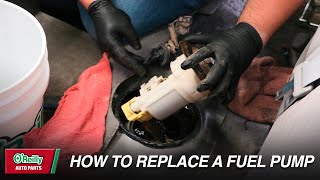
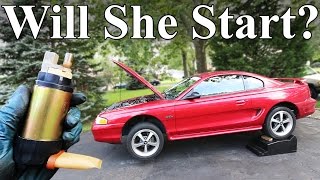
Typical fix: Replace the entire fuel pump module assembly inside the fuel tank. The filter is integrated into this assembly and is not typically replaced separately. 🎬 See this walkthrough on how to replace the fuel pump assembly.
Est. part cost: $400-$610 - Weak or Dead Battery 🟡 Medium Probability A battery with low voltage can still power lights and accessories but may not have enough cranking amps to turn the engine over fast enough to start, triggering a P1604 code. This is one of the most common triggers for this code.
How to confirm: Test the battery with a multimeter; a healthy, fully charged battery should read at least 12.6 volts with the engine off. During cranking, voltage should not drop below 9.6V. Most auto parts stores can perform a more comprehensive load test for free.
Typical fix: Recharge or replace the battery. Clean any corrosion from the terminals.
Est. part cost: $150-$250 - Faulty Aftermarket Electronics 🟡 Medium Probability
How to confirm: Inspect the vehicle for any non-factory wiring, especially around the ignition switch, fuse box, and battery. Look for spliced wires (T-taps are a common red flag), aftermarket control boxes, or anything that interrupts the factory wiring harnesses. If present, have the system professionally inspected or removed.
Typical fix: Professionally remove the faulty aftermarket system and repair any damaged factory wiring to OEM standards.
Est. part cost: $0-$100 for wiring supplies - Dirty Throttle Body ⚪ Low Probability
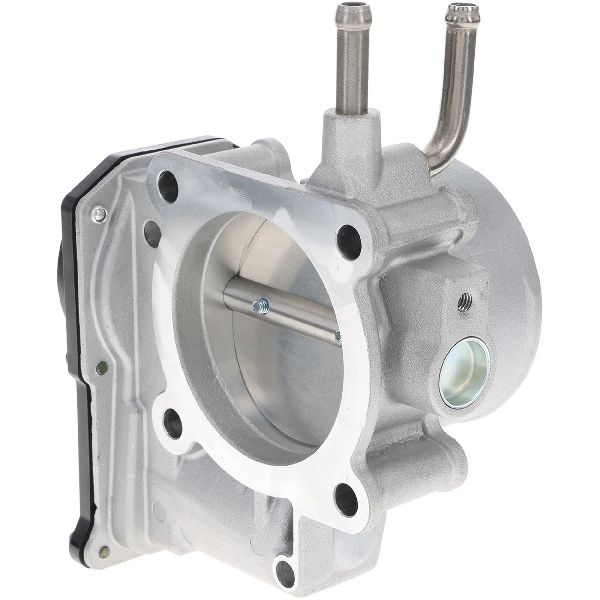
How to confirm: Remove the air intake tube connected to the throttle body and visually inspect the throttle plate and bore for black carbon deposits. A significant coating can hinder its operation.
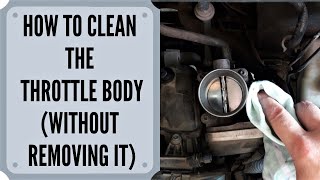
Typical fix: Clean the throttle body using a dedicated throttle body cleaner and a soft cloth or brush. A system relearn procedure may be required after cleaning. 🎬 Watch: A helpful guide on how to clean a throttle body.
Est. part cost: $10-$20 for cleaner - Failing Starter Motor ⚪ Low Probability A failing starter can draw excessive current, slowing down the cranking speed and triggering the code, or it may fail to engage entirely.
How to confirm: If you hear a single click but no cranking, or a slow, labored crank despite a good battery, the starter is suspect. A voltage drop test can be performed on the starter circuit to confirm. Gently tapping the starter with a hammer while a helper tries to crank the engine can sometimes temporarily make it work, confirming the starter is the issue.
Typical fix: Replace the starter motor.
Est. part cost: $250-$350
Rare But Worth Checking
- Faulty Alternator: A failing alternator won't properly recharge the battery, leading to a weak battery condition that causes the P1604 code. You may also notice dimming headlights or a battery warning light. A running vehicle should show 13.7-14.7V at the battery terminals.
- Crankshaft Position Sensor Failure: The ECM needs a signal from the crankshaft sensor to know the engine is rotating. If this sensor fails, the engine will crank but not start. This fault will usually be accompanied by a specific sensor code (e.g., P0335).
- Immobilizer System Fault: If the key is not recognized by the vehicle's immobilizer system, it will prevent the engine from starting and can log a P1604. This is often accompanied by a flashing security light on the dashboard. On smart key models, the start button light should turn green when the brake is pressed, indicating the key is recognized.
- ECM/PCM Malfunction: In rare cases, the Engine Control Module itself can be faulty, causing it to incorrectly log a P1604 or fail to properly manage the starting sequence. This should be considered a last resort after all other possibilities are exhausted.
Diagnosis Steps

- Check for Other Codes: Use an OBD-II scanner to check for any other stored trouble codes. P1604 is often a secondary code, and other codes (e.g., for fuel pressure, crank sensor) can point directly to the problem area.
- Analyze Freeze Frame Data: If your scanner supports it, review the freeze frame data for P1604. This shows engine conditions when the code was set. Key data points like engine speed during cranking (0 rpm vs. slow crank vs. normal crank with no fire) can help isolate the issue between the starter, battery, or fuel/spark delivery.
- Check the Battery: Test the battery's static voltage (should be >12.6V). Perform a load test to ensure it can deliver sufficient cranking amps. Inspect terminals for corrosion and ensure connections are tight.
- Inspect for Aftermarket Devices: Visually inspect for any aftermarket alarms, remote starters, or stereo wiring. Pay close attention to any poorly made connections or splices into factory wiring.
- Listen for the Fuel Pump: Turn the ignition key to the 'ON' position (without starting) and listen for a 2-3 second hum from the rear of the car. No sound suggests a problem with the pump, its relay, or wiring. Note: On this system, the pump may not run until the ECM detects the engine is cranking.
- Check Fuel Pressure: If the pump runs, verify fuel pressure. This is the most definitive test for the fuel system and may require a professional. Pressure should be stable and within the 44-50 psi range. After shutdown, pressure should hold above 21 psi for at least 5 minutes.
- Inspect the Starting & Ignition Systems: If the battery and fuel system are good, inspect the starter motor and its connections. If the engine cranks normally but won't fire, the issue could be with the ignition system (coils, plugs) or a critical sensor like the crankshaft position sensor.
Parts You'll Likely Need
- Fuel Pump Assembly
(OEM #77024-21040 (2011 models) or 23220-36021 (Jan 2012+ models))— This is a highly probable cause of a P1604 code on a Toyota/Scion when no other codes are present. The assembly contains the pump, pressure regulator, and fuel filter/strainer. There was a part change in January 2012.
Trusted brands: Denso, Aisin, Genuine Toyota
OEM price range: $330-$485
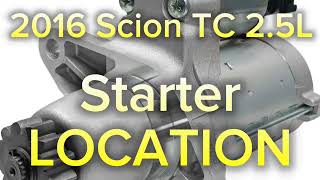
Aftermarket price range: $150-$300 - Starter
(OEM #28100-36120 (supersedes 28100-31102))— If the battery is good but the engine cranks slowly, just clicks, or makes no sound, the starter is the next logical part to replace. Multiple parts suppliers confirm this part number and its superseded status.
Trusted brands: Denso (OEM supplier), Bosch, TYC
OEM price range: $250-$350
Aftermarket price range: $150-$280
Related Codes That Often Appear With This One
- P0420 — In one documented case, a P0420 (Catalyst System Efficiency Below Threshold) was present because the previous owner had removed the catalytic converter in a failed attempt to fix the starting issue. In another case on a high-mileage Toyota, it appeared alongside P1604, suggesting either an exhaust leak or a failing catalytic converter from extended poor running conditions.
- P1603, P1605 — P1603 (Engine Stall Malfunction) and P1605 (Rough Idling Malfunction) are related codes that can appear with P1604, helping to narrow down the symptom to either a stall or a rough idle condition post-start.
Technical Service Bulletins (TSBs) & Recalls
- While no TSB directly addresses P1604, Toyota issued a TSB for the 2AR-FE engine (in 2009-2013 models) regarding a rattling/knocking sound on cold starts due to VVT cam phaser issues. While this typically causes noise and not a no-start, a severely malfunctioning VVT system could potentially affect starting and is worth noting as a known issue with this engine family.
Mechanic-Grade Diagnostic Values
- Fuel Pressure (at fuel rail) — expected: 44 - 50 psi. Failure: Pressure is below 44 psi, or does not hold above 21 psi for 5 minutes after engine shutdown.
- Crankshaft Position Sensor Resistance — expected: 985 to 1,600 Ω (Cold); 1,265 to 1,890 Ω (Hot). Failure: Resistance is outside the specified range for the given temperature.
- Battery Voltage (Engine Running) — expected: 13.7 - 14.7 V. Failure: Voltage is below 13.7V, indicating a charging system problem (alternator).
Scan Tool Commands That Help
- Toyota Techstream: Active Test: Fuel Pump / Spd — Use this to command the fuel pump to turn on without cranking the engine. This directly tests the fuel pump relay, wiring, and the pump motor itself, isolating it from other starting system components.
- Toyota Techstream: Freeze Frame Data Analysis — P1604 is an informational code. The freeze frame data is critical as it captures engine parameters (like cranking RPM) at the exact moment the startability fault was detected, helping to differentiate between a no-crank, slow-crank, or crank-no-fire condition.
Wiring & Ground Locations
- ECM (Engine Control Module) — Left rear of the engine compartment.. The ECM controls the starting sequence, including the fuel pump relay and ignition timing. Poor connections or a bad ground at the ECM can cause a no-start and trigger P1604.
- Engine Ground Points A1, A2 — Left front of the engine compartment.. These are primary ground points for various engine bay components. A corroded or loose ground here can cause a variety of electrical issues, including starting problems.
- Engine Ground Points B1, B2 — Front of the engine.. Provides a ground path for engine-mounted sensors and components. A poor connection can lead to erratic sensor readings or insufficient power for actuators.
- Circuit Opening Relay (Fuel Pump Relay) — Located in the engine compartment fuse/relay box, often under the 'EFI' label.. This relay provides power to the fuel pump. If it fails or its control circuit from the ECM is compromised, the fuel pump will not run. The ECM will not close this relay until it receives a signal from the crankshaft position sensor.
Real Owner Repair Stories
- Facebook post by G-Tech1 AUTO (Professional Technician) (2013 Scion tC 2.5L AT with Smart Key) — Car would not start properly, sometimes taking up to 20 minutes of trying. When it did start, it ran rough and rich. The starter would only engage for less than a second per attempt.
❌ Tried (didn't work) Previous attempts by others to fix the issue failed. The previous owner had removed the catalytic converter, likely in a misguided attempt to solve the problem, which caused a P0420 code.
✅ What actually fixed it A poorly installed aftermarket alarm system was found wired into the vehicle's power source module circuits. The technician removed the entire aftermarket alarm system and repaired the factory wiring, which resolved the starting issue completely.
"I Checked Everything" — The Actual Cause
- In a documented case, standard diagnostic paths for fuel and ignition would likely have come back clean. The root cause was an electrical issue created by a poorly installed aftermarket alarm system that was interfering with the starting circuit. This highlights the need to inspect for any non-factory wiring early in the diagnostic process for a P1604 code.
OEM Part Supersession History
28100-31102→28100-36120— Part revision or supplier change.90919-05060→90919-T5005— Part revision or supplier change for one of the crankshaft position sensors.
Heads up: The 2AR-FE engine may use one of two different crank sensors. It is critical to verify the correct part number for the specific vehicle.90919-05070→90919-A5004— Part revision or supplier change for one of the crankshaft position sensors.
Heads up: The 2AR-FE engine may use one of two different crank sensors. It is critical to verify the correct part number for the specific vehicle.
Model Year Variations Within This Range
- 2011 only: Uses fuel pump plate sub-assembly part number 77024-21040.
- 2012-2016: Uses fuel pump assembly part number 23220-36021, starting from production in January 2012.
- 2014-2016: Received a facelift with revised styling, sport-tuned suspension, and faster-shifting transmission logic. However, the core 2AR-FE engine and primary mechanical components related to code P1604 remained the same as the 2011-2013 models.
Diagnostic Flowchart
Used vs. New Parts: Buying Guide for This Vehicle
When a used part is the smart pick: For a P1604 diagnosis, used parts are generally not recommended for the most common culprits like the fuel pump, starter, or battery, as these are wear items. A used ECM from a reputable recycler could be a cost-effective last resort, but may require programming to the vehicle.
Donor-vehicle mileage cap: roughly under 60000 miles for the part to have meaningful remaining life.
What to inspect on the donor part:
- For any electrical part, inspect connectors for corrosion, melting, or damaged pins.
- For a used ECM, ensure the part number matches exactly and there is no water damage to the case or connectors.
- Avoid parts from vehicles with signs of flood or fire damage.
OEM-only on this vehicle (don't cheap out):
- Engine Control Module (ECM): While a used OEM unit can work, aftermarket ECMs are not recommended due to potential software, immobilizer, and communication issues.
Aftermarket brands forum-validated for this vehicle:
- Denso: OEM supplier for many Toyota/Scion parts, including fuel pumps, starters, and sensors. Often identical to the genuine part without the Toyota branding.
- Aisin: Another trusted OEM supplier for Toyota, particularly for fuel system components.
Brands owners have reported issues with on this vehicle:
- Unbranded, 'white-box' electronic parts (sensors, fuel pumps) from online marketplaces. Failure rates are high and can make diagnosis more difficult.
Real Owner Stories
Aggregated from forums and TSBs cited above. Mileages and costs reflect what owners reported in those sources.
2013 Scion tC
Symptoms: Intermittent no-start condition.
What fixed it: The faulty aftermarket alarm system was professionally removed and the damaged factory wiring was repaired.
Source hint: Facebook (G-Tech1 AUTO)
2014 Scion tC
Symptoms: An intermittent no-start condition where replacing the battery only fixed the problem for a week before it returned with the P1604 code.
What fixed it: The owner's report pointed towards a deeper electrical or charging system issue beyond just the battery, but a final fix was not specified in the source.
Source hint: Reddit (r/SciontC)
2nd generation Scion tC
Symptoms: Vehicle stalls when coming to a stop.
What fixed it: The source only corroborated the symptom with the P1604 code and did not provide a specific fix.
Source hint: ScionLife.com
Related OBD-II Codes
Frequently Asked Questions
My 2013 Scion tC has a P1604 and a weird aftermarket alarm. Could they be related?
I turned the key to 'ON' in my tC but didn't hear the fuel pump. Is it definitely broken?
What is the correct fuel pressure for the 2.5L engine in my 2011-2016 Scion tC?
My tC cranks for a long time before starting and threw a P1604. What's the most likely cause?
Is there a Toyota TSB that specifically addresses the P1604 code on the Scion tC?
My mechanic says my RAV4 with the same engine has this code because of a dirty throttle body. Is that possible?
Helpful Videos
Used OEM Parts in Stock


New Aftermarket Parts Available


The information in this article is provided for general reference and educational purposes only. Vehicle specifications, procedures, and part compatibility can vary by production date, trim level, and region. Always consult your vehicle's factory service manual and verify part numbers before purchasing or performing repairs. Safety-critical components such as airbags, seat belts, and braking systems should be installed by a qualified professional.
- Scion tC:
- 🎬 Helpful Videos
- 🛍️ Shop This Part
- What's Unique About the 2011-2016 Scion tC
- Symptoms You May Notice
- Most Likely Causes
- Rare But Worth Checking
- Diagnosis Steps
- Parts You'll Likely Need
- Related Codes That Often Appear With This One
- Technical Service Bulletins (TSBs) & Recalls
- Mechanic-Grade Diagnostic Values
- Scan Tool Commands That Help
- Wiring & Ground Locations
- Real Owner Repair Stories
- "I Checked Everything" — The Actual Cause
- OEM Part Supersession History
- Model Year Variations Within This Range
- Diagnostic Flowchart
- Used vs. New Parts: Buying Guide for This Vehicle
- Real Owner Stories
- 2013 Scion tC
- 2014 Scion tC
- 2nd generation Scion tC
- Related OBD-II Codes
- Frequently Asked Questions
- 🎟️ Get 5% Off