

OBD-II Code P0012: Intake Camshaft Position Timing - Over-Retarded (Bank 1)
What P0012 means, why it triggers, and how to fix it
- Check your engine oil level and condition immediately; low or sludgy oil is the #1 cause of code P0012 and the cheapest to fix.
- Do not drive with an active P0012 code for more than 7 days, as unburned fuel destroys the catalytic converter, turning a $150 repair into a $2,500 nightmare.
- If you hear a distinct rattling noise from the engine on a cold start, stop driving and tow the vehicle to a shop; this indicates a failing timing chain that costs $4,000+ if it breaks.
- Always test the VVT solenoid's electrical resistance (typically 5-15 ohms) with a multimeter before spending $100+ on a replacement part.
- Check for manufacturer Technical Service Bulletins (TSBs) before replacing parts, as vehicles like the 2021-2025 Nissan Rogue require fixing a faulty Engine Oil Temperature sensor (P0196) first.
What Does P0012 Mean?

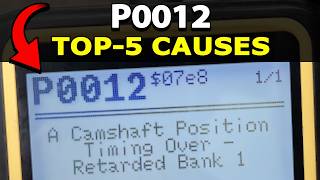
The P0012 code means the Engine Control Module (ECM) detects the intake camshaft for engine bank 1 is out of position. Specifically, it is 'over-retarded,' meaning it opens later than commanded. This delay hurts engine efficiency, power, and emissions. The ECM sets the code when the timing deviation exceeds 8-12 degrees for more than a few seconds.
Technical definition: Intake 'A' Camshaft Position Timing - Over-Retarded (Bank 1). This code indicates the ECM determines the intake camshaft timing for bank 1 is more retarded than commanded. The fault triggers when the difference between the target and actual cam angle exceeds 10 degrees for over 2 seconds.
Can I Drive With P0012?
Yes, But With Caution. You can drive for short, essential trips, but doing so risks severe engine damage. Continuing to drive allows unburned fuel into the exhaust, which destroys the catalytic converter (an $800-$2,500 repair). Prolonged driving causes accelerated internal engine wear, requiring an engine rebuild or replacement costing $4,000-$8,000. The vehicle often enters 'limp mode,' drastically reducing power to prevent further damage. Diagnose and repair the vehicle within a week.
Common Causes

- Low, Dirty, or Incorrect Viscosity Engine Oil (Very Common) — The Variable Valve Timing (VVT) system uses hydraulic oil pressure to adjust camshaft timing. Low oil, incorrect viscosity, or heavy sludge prevents the system from building necessary pressure. Tiny oil passages easily clog, causing a delayed camshaft response.
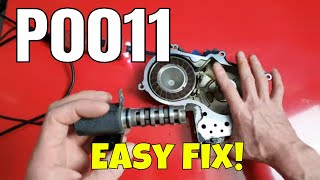
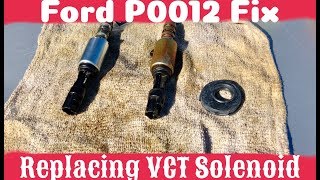
- Failed Variable Valve Timing (VVT) Solenoid (Very Common) — The VVT solenoid (oil control valve) directs oil to the camshaft phaser. These solenoids get stuck from sludge, wear out electrically, or suffer clogged internal filter screens. 🎬 Watch: How to clean your VVT solenoid for a free fix. This is highly common in vehicles with 75,000-120,000 miles.
- Clogged VVT/OCV Filter Screen (Common) — Many engines feature small, cylindrical filter screens in the oil passages leading to the VVT solenoids. These screens clog with sludge and debris, starving the system of oil pressure even if the solenoid and oil level are fine.
- Worn Timing Chain, Guides, or Tensioner (Common) — Timing chains stretch over time, and plastic guides or hydraulic tensioners wear out. This creates slack, altering base engine timing and retarding the camshaft's actual position relative to the crankshaft. A cold start rattle is the classic warning sign. 🎬 See how a rattling timing chain causes these timing codes.
- Faulty Camshaft Position Sensor (Less Common) — This sensor reports the camshaft's exact position to the ECM. A weak, intermittent, or incorrect signal causes the computer to mistakenly believe the timing is retarded.
- Incorrectly Installed Timing Chain/Belt (Less Common) — If P0012 appears shortly after engine service, the timing chain or belt was installed incorrectly. Being off by a single tooth on a gear causes the timing to be over-retarded.
- Damaged Camshaft Phaser (Actuator) (Rare) — The phaser is the gear on the end of the camshaft that oil pressure acts upon. Internal locking pins or vanes fail, seize, or clog with debris, sticking the phaser in the retarded position.
- Wiring Harness Damage or Corrosion (Rare) — Frayed wires, rodent damage, or corrosion in the connectors for the VVT solenoid or camshaft position sensor disrupt the signal. Oil leaking into a connector also causes this fault.
- Faulty Powertrain Control Module (PCM) (Very Rare) — The PCM itself fails due to a software glitch requiring a dealer reflash or a burnt internal driver circuit. Consider this only after exhausting all mechanical and electrical possibilities. 🎬 Watch this step-by-step guide to fixing the P0012 code.
Symptoms

- Check Engine Light is On — This is the first and most obvious sign of a timing error. The light illuminates immediately when the ECM detects the deviation.
- Rough Idle or Stalling — The engine shakes, runs unevenly, or stalls completely when stopped at a light or in heavy traffic.
- Reduced Engine Power and 'Limp Mode' — The vehicle feels sluggish and slow to respond. The ECM intentionally limits engine power and RPM to prevent internal damage.
- Decreased Fuel Economy — Inefficient combustion drops fuel economy by 5-15%, requiring more frequent fill-ups.
- Rattling or Ticking Noises from the Engine — A distinct rattling sound on cold starts indicates a stretched timing chain or broken chain guides.
- Difficulty Starting the Engine — The engine cranks longer than usual before starting, or fails to start on the first try, particularly in cold weather.
Diagnostic Flowchart
Tap your situation to follow the diagnostic path that matches what you're seeing on this code.
Common Fixes & Costs
- Engine Oil and Filter Change — Parts: $40-$100, Labor: $50-$150, ~0.5 hr book time (DIY)
- Replace VVT Solenoid (Oil Control Valve) — Parts: $50-$250, Labor: $100-$250, ~1.2 hr book time (DIY)
- Replace Camshaft Position Sensor — Parts: $30-$150, Labor: $80-$200, ~0.8 hr book time (DIY)
- Replace Timing Chain, Tensioner, and Guides — Parts: $300-$800, Labor: $1000-$2200, ~11.5 hr book time (Professional)
- Replace Camshaft Phaser / VVT Actuator — Parts: $200-$500, Labor: $500-$1200, ~8.5 hr book time (Professional)
DIY vs Professional
- Engine Oil and Filter Change — Beginner:
Tools: Wrench for drain plug, oil filter wrench, drain pan, funnel. - Replace VVT Solenoid — Beginner:
Tools: Basic socket set, torque wrench, rags. - Replace Camshaft Position Sensor — Beginner:
Tools: Basic socket set or Torx bits. - Replace Camshaft Phaser — Beginner:
Tools: Extensive tool set, torque wrenches, valve cover gasket set, timing chain holding tools, phaser-specific lock tools. - Replace Timing Chain Kit — Beginner:
Tools: All tools for phaser replacement plus timing cover gasket set, harmonic balancer puller, and engine-specific timing alignment tools.
Used vs. New Parts: Buying Guide
When a used part is worth it: Buying a used VVT solenoid from a reputable salvage yard is cost-effective for older, high-mileage vehicles where new OEM parts are prohibitive. Ensure the donor vehicle has low mileage and was not scrapped for engine failure.
Donor-vehicle mileage cap: roughly under 80000 miles for the part to have meaningful remaining life.
Donor quality checklist:
- Verify the part number on the used solenoid exactly matches the original part.
- Inspect the filter screens on the used solenoid for metal shavings or heavy sludge.
- Ask for the VIN of the donor car to check its history and mileage.
Decision logic:
- If The cost of a new aftermarket solenoid is less than $100 → Buy new. The small savings from a used part aren't worth the risk of premature failure and repeated labor.
- If The vehicle is over 150,000 miles and you're on a tight budget → A low-mileage used OEM solenoid is a reasonable choice over a cheap, unbranded new part.
- If The part is for a vehicle with a known high failure rate for this component (e.g., Ford or BMW) → Favor a new, updated OEM part, as used versions likely have the same original design flaw.
Warranty tradeoff: Used parts typically come with a 30-90 day warranty, while new parts offer 1-year to lifetime warranties. If a used solenoid fails, you pay diagnostic and labor costs a second time, adding up to $400 in wasted money.
Worst-case if a used part fails: 400
What Happens If You Wait — Timeline
- 0-1 month: Check Engine Light illuminates. You notice a slightly rough idle or minor hesitation when accelerating. The car automatically fails emissions tests. (MPG impact: 3-8%% · Added cost: $20-50 in wasted fuel)
- 1-4 months: Engine performance noticeably degrades. Sluggish acceleration, frequent rough idling, and stalling in traffic occur. The car frequently enters 'limp mode'. (MPG impact: 8-15%% · Added cost: $50-200 in wasted fuel)
- 4-8 months: Unburned fuel from the timing issue continuously enters the exhaust, causing the catalytic converter to overheat and melt internally. (MPG impact: 15-25%% · Added cost: $1,200-2,800 (catalytic converter replacement))
- 8+ months: A stretching timing chain jumps a tooth or breaks. In an interference engine, pistons and valves collide, resulting in catastrophic engine failure. (MPG impact: N/A (Engine destroyed)% · Added cost: $4,000-8,000+ (engine replacement))
Cost of Not Fixing It
- 0-1 month: Noticeable drop in fuel economy (5-15%), rough idle, and sluggish acceleration. Risk of stalling in traffic. Automatic failure of any emissions test. (Added cost: 50-150)
- 1-6 months: Increased risk of damage to the catalytic converter from unburned fuel, leading to overheating and failure. Increased engine sludge buildup due to inefficient combustion. (Added cost: 1200-2800)
- 6+ months: A stretching timing chain jumps a tooth or breaks. This causes catastrophic internal engine damage (bent valves, damaged pistons) in an interference engine, requiring complete replacement. (Added cost: 4000-8000)
Diagnosis Steps

- Check Engine Oil Level and Condition
Pull the dipstick and check the level. The oil must be between the 'MIN' and 'MAX' marks. If it is low, black, or thick and sludgy, perform an oil change with the manufacturer-specified viscosity immediately.
Tools: Rag or paper towel (Beginner) - Scan for Other Trouble Codes
Use an OBD-II scanner to check for additional codes. Codes like P0010 (Solenoid Circuit Malfunction) or misfire codes (P0300-P0308) provide valuable clues. On modern vehicles, codes like P0196 (Oil Temp Sensor) are often the true root cause.
Tools: OBD-II Scanner (Beginner) - Inspect VVT Solenoid and Connector
Locate the VVT solenoid for the Bank 1 intake camshaft. Unplug the electrical connector and check for oil contamination. Remove the solenoid (typically one bolt) and inspect its filter screens for sludge or metallic debris.
Tools: Socket set, rag (Beginner) - Test VVT Solenoid Resistance (Pro Tip)
Set a multimeter to Ohms (Ω). Touch the probes to the two electrical pins on the VVT solenoid. Most solenoids specify a resistance between 5 and 15 ohms. A reading of 'OL' indicates an open circuit, requiring replacement.
Tools: Multimeter (Intermediate) - Test VVT Solenoid Power Supply
Unplug the solenoid's wiring harness. Turn the ignition to 'ON' (engine off). Set your multimeter to DC Volts. Connect the black probe to a good engine ground and touch the red probe to each pin inside the harness connector. One pin must show battery voltage (approx. 12V).
Tools: Multimeter (Intermediate) - Test the VVT Solenoid (Bench Test)
With the solenoid removed, apply 12V power to its terminals using jumper wires. You must hear a distinct 'click' as the internal plunger moves. No click means the solenoid is seized and requires replacement.
Tools: 12V power source (e.g., car battery), jumper wires (Intermediate) - Analyze Live Scan Tool Data (Advanced)
Using an advanced scan tool, monitor 'Bank 1 Camshaft Position - Desired' and 'Actual'. At idle, these values must be within 1-2 degrees. Command the VVT solenoid 'On' with the scan tool; the 'Actual' angle must change immediately to match the 'Desired' angle.
Tools: Advanced OBD-II Scan Tool with Live Data and Bi-Directional Control (Advanced) - Check Cam/Crank Correlation with a Scope (Advanced)
Use an oscilloscope to view waveforms from the camshaft position sensor (CMP) and crankshaft position sensor (CKP) simultaneously. A P0012 code visually shows the CMP sensor's square wave pattern lagging in relation to the CKP signal.
Tools: Automotive Oscilloscope (Advanced) - Check for Mechanical Timing Issues (Advanced)
Listen for a rattling chain on cold starts. Remove the valve cover to visually inspect the timing chain for slack, check the chain guides for broken pieces, and verify the timing marks on the camshafts and crankshaft align perfectly.
Tools: Extensive socket/wrench set, torque wrench, engine-specific timing tools (Advanced)
When This Code Triggers (Freeze-Frame Conditions)
- Engine Coolant Temp: 180-210°F (82-99°C) (The engine must be at full operating temperature for the VVT system self-test to run.)
- Engine RPM: 1500-3000 RPM (The code sets during steady-state cruising or light acceleration, not at idle or full throttle.)
- Engine Load: 20-60% (The fault is detected under moderate engine load when the VVT system actively adjusts timing for efficiency.)
- Vehicle Speed: 40-65 mph (65-105 kph) (These conditions correspond to steady highway driving where the ECM expects a specific cam phaser angle.)
Related Codes
- P0011 — This is the opposite code, indicating the Bank 1 intake camshaft is 'Over-Advanced.' A VVT solenoid stuck open causes P0011; if it is stuck closed or clogged, it causes P0012.
- P0022 — This is the same 'Over-Retarded' timing issue, but for Bank 2. Seeing both P0012 and P0022 suggests a global engine issue like low oil, low oil pressure, or a stretched timing chain.
- P0010 — This code points to an electrical circuit malfunction for the Bank 1 intake VVT solenoid. Seeing P0010 with P0012 strongly suggests a failed solenoid coil or wiring issue.
- P0340 — This code indicates a problem with the Camshaft Position Sensor 'A' Circuit. Diagnose P0340 first, as a bad sensor signal causes the computer to misinterpret cam timing and set P0012.
Climate & Environmental Factors
- Cold Weather: Cold temperatures increase oil viscosity. If the wrong (too thick) oil is used, it flows too slowly on startup to operate the VVT system correctly, triggering P0012. The code often disappears once the engine warms up.
- Extreme Heat: High heat accelerates oil breakdown, leading to sludge formation. Sludge clogs the fine mesh screens on VVT solenoids, restricting oil flow and causing the code.
- High Altitude: Altitude does not directly cause P0012, but engines run differently at high altitudes, exacerbating underlying VVT system weaknesses.
How to Talk to a Mechanic About This Code
Say this: "I have a check engine light with code P0012 for 'Intake Camshaft Position Timing Over-Retarded on Bank 1'. I've already checked the oil level and it's full and clean. I'd like to book a diagnostic appointment to determine if the cause is a faulty VVT solenoid, a sensor, or a deeper timing issue."
This signals to the shop that you are an informed customer. It directs them to the correct diagnostic path (oil -> solenoid -> sensors -> mechanical timing) and prevents them from starting with unnecessary or unrelated diagnostics.
Avoid saying:
- 'My check engine light is on, can you just fix it?'
- 'My car is running rough, I think it needs a tune-up.'
- 'A guy online said to just replace the sensor.'
Questions to ask before authorizing the repair:
- If you are recommending a VVT solenoid replacement, did you test the solenoid's operation and resistance first?
- If you are recommending a timing chain replacement, what were the symptoms that led you to that conclusion over a simpler solenoid or sensor issue? Did you hear a startup rattle?
- Can you provide me with the live data readings for the 'desired' versus 'actual' camshaft position angles?
- What is the warranty on the parts and labor for this specific repair?
Where to Take It: Dealer vs Independent vs Chain
- Dealer:
Best for: Vehicles still under powertrain warranty., Complex European vehicles (BMW, Audi, Mercedes) with known VVT system quirks., When a specific Technical Service Bulletin (TSB) has been issued for the P0012 code on your model.
Downsides: Highest labor rates, charging 50-100% more than independent shops., May recommend replacing an entire assembly when only one component has failed. (Typical cost: +50% vs. baseline) - Independent Shop:
Best fit for most P0012 situations. The causes are well-known, and a competent independent mechanic efficiently diagnoses the oil, solenoid, or sensor issues that are most common.
Best for: Most out-of-warranty vehicles from common makes (Ford, GM, Toyota, Honda)., Diagnosing and replacing common failure items like VVT solenoids and camshaft position sensors., Cost-conscious owners who have already done basic checks (like oil level).
Downsides: Quality and diagnostic capabilities vary widely. Look for ASE certifications and good online reviews., May lack expensive, manufacturer-specific diagnostic tools for deep-level issues. (Typical cost: +0% vs. baseline) - Chain Shop:
Acceptable ONLY for an oil change. AVOID for diagnosing the P0012 code itself, and be extremely cautious about authorizing complex repairs like timing chain work at a chain location.
Best for: Performing a simple oil and filter change if you suspect that is the root cause.
Downsides: Technician skill varies dramatically; they lack the experience to diagnose beyond the code itself., High pressure to upsell services. A P0012 code leads to recommendations for unnecessary engine flushes. (Typical cost: -10% vs. baseline)
When to Walk Away From the Repair
If the estimated repair cost for the P0012 fault exceeds 40-50% of your car's private-party value, it's time to seriously consider selling or trading it in.
- Car worth $4000, fix is $2200: Walk away. A $2,200 timing chain job on a $4,000 car is over the 50% threshold. The money is better put toward a replacement vehicle.
- Car worth $12000, fix is $350: Fix it. A $350 VVT solenoid replacement is well below the threshold and is a common maintenance item.
- Car worth $3000, fix is $2000: Walk away. The repair cost is 67% of the car's value. It is not economically sensible to proceed with the repair.
What Scan Tool You Need for This Code
Minimum: An OBD-II reader that displays live data streams for engine PIDs (Parameter IDs).
A basic $20 code reader only displays the 'P0012' code. Proper diagnosis requires viewing live data for 'Desired vs. Actual' camshaft position to confirm timing lag. Without live data, you are guessing which part to replace.
Budget: BlueDriver Pro (~$100) — Connects to your phone via Bluetooth and displays live data, including camshaft position. It provides freeze-frame data to see the engine conditions when the code was set.
Mid-range: Foxwell NT510 Elite (~$180) — Offers manufacturer-specific diagnostics and bi-directional control. This allows you to actively command the VVT solenoid to open and close while watching the live data response, confirming a faulty solenoid.
Professional: Autel MaxiCOM MK808S (~$450) — A full-featured diagnostic tablet with comprehensive bi-directional controls for VVT system testing, advanced live data graphing, and dealership-level diagnostic capabilities for serious DIYers.
Rent vs buy: For a one-time diagnosis, auto parts stores like AutoZone offer free loaner tools. If you perform regular car maintenance, buying a scanner like the BlueDriver or Foxwell NT510 is a worthwhile investment.
How to Clear the Code After You Fix It
- Use an OBD-II scan tool to clear the diagnostic trouble codes (DTCs).
- Ensure the fuel tank is between 1/4 and 3/4 full.
- Perform a complete OBD-II drive cycle to allow readiness monitors to run.
Drive cycle (~30 minutes): A generic drive cycle involves: 1) Cold start after the vehicle sits for 8+ hours. 2) Idle for 2-3 minutes with electrical loads on. 3) Drive in mixed city/highway conditions, including steady-state cruising at 55 mph for 5-10 minutes. 4) Perform several smooth accelerations and decelerations.
Readiness monitors affected: Catalyst Monitor, Evaporative System Monitor, Oxygen Sensor Monitor, Misfire Monitor
Before emissions retest: drive at least 100 miles to fully set monitors.
Watch out for:
- Disconnecting the battery clears the code but resets all readiness monitors to 'Not Ready,' causing an automatic emissions test failure.
- The code returns immediately if the underlying mechanical or electrical fault is not repaired.
- Failing to complete the full drive cycle leaves monitors 'Not Ready', preventing you from passing an emissions test.
Will This Fail Emissions / State Inspection?
Yes — this code typically fails an OBD-II emissions inspection.
- California: An active P0012 code is an automatic smog check failure. After repairs, a complete drive cycle must be performed to set all readiness monitors to 'Ready' before a retest.
- New York: The NYS DMV inspection includes an OBD-II scan. A check engine light with code P0012 results in an automatic failure.
- Texas: In counties requiring emissions testing, an illuminated check engine light from P0012 is an automatic failure. After clearing the code, driving 50-100 miles is required to reset monitors.
Most Commonly Affected Vehicles

- Ford F-150, Explorer, Edge (2004-2016) — Primarily affects the 5.4L 3-valve and 3.5L/3.7L V6 engines. These are notorious for failing VCT solenoids and camshaft phasers. On the 5.4L, a startup rattle confirms a bad phaser.
- BMW Various models with N52, N54, N55 engines (e.g., 3-series, 5-series, X3, X5) (2006-2017) — Almost always caused by failing VANOS solenoids clogged with oil sludge. Swapping the intake and exhaust solenoids is a common diagnostic trick to confirm the fault.
- Hyundai / Kia Sonata, Santa Fe, Optima, Sorento with 2.0L & 2.4L GDI engines (2011-2019) — These engines experience VVT solenoid (OCV) issues and are highly sensitive to oil quality. The 2011-2014 Sonata 2.4L was particularly prone to this issue.
- General Motors (Chevy, GMC) Equinox, Terrain, Malibu, Cobalt with 2.4L Ecotec engines (2008-2017) — High oil consumption leads to low oil levels, causing this code. Stretched timing chains are also a well-documented problem.
- Subaru BRZ, Forester, Outback, WRX (with FA/FB engines) (2012-2024) — The AVCS system is sensitive to oil. Low or dirty oil is a primary cause, followed by a failing oil control valve (OCV) solenoid for the intake camshaft on Bank 1.
- Toyota / Lexus Camry, RAV4, Corolla, Sienna, ES350 (2005-2024) — Toyota's VVT-i system triggers P0012 due to a faulty VVT solenoid or sludge from infrequent oil changes. A clogged OCV filter screen is a common culprit.
- Honda / Acura Accord, Civic, CR-V, MDX (2003-2024) — On Honda's VTEC/VTC systems, P0012 points to a clogged VTC oil control solenoid or low/dirty engine oil. The solenoid assembly screen easily clogs with sludge.
- Nissan Rogue, Altima (2021-2025) — On models with the 1.5L VC-Turbo engine, P0012 is paired with code P0196. Per Nissan TSB NTB25-007, technicians must diagnose P0196 (Engine Oil Temperature Sensor) first.
Manufacturer-Specific Notes
- Ford: On 5.0L F-150s (2019-2020), TSB SSM 48894 addresses P0012 accompanied by noise, advising VCT solenoid replacement. For 2015-2021 models, Ford advises cycling the VCT solenoid 10 times with a scan tool to clear debris.
- BMW: BMW extended the warranty on VANOS adjustment units to 10 years/unlimited miles for certain non-turbo 6-cylinder engines under SIB 01 10 14. Swapping intake and exhaust solenoids confirms a faulty unit if the code changes to P0015.
- Toyota: The VVT-i system is affected by a small, separate filter screen for the oil control valve located in the cylinder head oil passage. Cleaning this small screen often fixes the problem without replacing the OCV.
- Nissan: For 2021-2025 Rogues with the 1.5L VC-Turbo engine, TSB NTB25-007 states that if P0012 is present with P0196, the technician must diagnose the P0196 (Engine Oil Temperature Sensor) first.
- General Motors: On 2.4L Ecotec engines, high oil consumption leads to low oil levels, triggering P0012. GM issued Special Coverage Adjustment #14404 extending the warranty for timing chain wear.
Real Owner Stories
2007 Ford F-150 5.4L with 166K miles
Check Engine Light came on, accompanied by a new cold start rattle and a rough idle. The code was P0012.
What they tried:
- Replaced the VVT solenoid, which made no difference.
- Prodded the timing chain through the solenoid opening and it felt tight.
Outcome: A cold start rattle with P0012 guarantees a failed timing chain tensioner or broken plastic guides. The owner replaced the entire timing system.
Lesson: On Ford 3-valve engines, a cold start rattle plus a timing code is a classic sign of timing chain failure. Do not just replace the solenoid; the rattle points to a deeper mechanical issue.
2013 Mazda 6 2.5L with 112K miles
Car had a rough idle. Owner proactively replaced the VVT solenoid during an oil change. After the repair, the Check Engine Light came on for the first time with code P0012.
What they tried:
- Replaced the original VVT solenoid with a new aftermarket part.
- Used 5W-20 oil instead of the specified 0W-20 because it was on hand.
Outcome: The code appeared immediately after the repair. The causes are a defective aftermarket solenoid or incorrect oil viscosity, as VVT systems require precise oil weight.
Lesson: If P0012 appears immediately after a repair, suspect a faulty new part or incorrect fluid. Always use the exact oil viscosity specified by the manufacturer.
2008 MINI Clubman (R55)
Owner replaced the timing chain, water pump, and oil/filter. After the oil change, the car threw a P0012 code that returned instantly after being cleared.
What they tried:
- Cleared the code, but it came right back.
- Suspected a dirty VANOS (VVT) solenoid.
- Later suspected the cheap, non-OEM oil filter used during the oil change.
Outcome: The aftermarket oil filter failed to seal the bypass valve correctly, dropping oil pressure at idle. Modern European engines require OEM-spec filters to maintain precise oil pressure.
Lesson: If P0012 appears right after an oil change, the oil filter is the culprit. Low-quality filters cause oil pressure deviations that trigger VVT codes.
How to Prevent This Code From Triggering
- Follow manufacturer oil change intervals (Per owner's manual (e.g., 5,000-10,000 miles)) — Clean oil is the lifeblood of the VVT system. Degraded oil turns to sludge, the #1 cause of clogged VVT solenoid screens and P0012 codes.
- Use high-quality, full synthetic oil of the correct viscosity (Every oil change) — Synthetic oils resist thermal breakdown and sludge formation. Using the exact viscosity (e.g., 0W-20) is critical for the hydraulic VVT system to operate at the correct pressure.
- Always replace the oil filter with a quality, OEM-spec part (Every oil change) — A cheap or clogged filter restricts oil flow, starving the VVT system of pressure and accelerating sludge buildup.
- Avoid frequent short trips and extended idling (Daily habit) — Short trips prevent engine oil from reaching optimal operating temperature, allowing moisture and fuel to build up and accelerate sludge formation.
- Have the timing chain inspected at major service intervals (Every 100,000-120,000 miles) — Timing chains stretch over time. Inspections catch a stretched chain or worn guides before they fail, preventing catastrophic engine damage.
Frequently Asked Questions
Can I fix P0012 myself?
Yes, if the cause is simple like low oil or a bad VVT solenoid. An oil change and VVT solenoid replacement are straightforward DIY tasks requiring basic tools. However, stop DIYing and tow to a shop if the timing chain or camshaft phaser needs replacement.
What is 'Bank 1'?
Bank 1 is the side of the engine containing cylinder #1. On an inline engine, there is only one bank. On a V-shaped engine, it varies by manufacturer but is often the bank closer to the radiator on transverse FWD vehicles.
What happens if I ignore code P0012?
Ignoring this code causes poor engine performance and terrible gas mileage. Over time, unburned fuel destroys the catalytic converter ($800-$2,500). In severe cases, a jumped timing chain causes catastrophic engine failure requiring a $4,000+ replacement.
Can a bad oil filter cause P0012?
Yes, a cheap or clogged oil filter restricts oil flow and fails to filter contaminants. This causes low oil pressure and sludge buildup that clogs the VVT system. Always use a high-quality, OEM-spec filter.
I changed my oil and the code is still there. What's next?
If a fresh oil change with the correct viscosity oil doesn't solve the problem, the next most likely culprit is a faulty VVT solenoid. Inspect, test, and replace the VVT solenoid to restore proper oil flow to the camshaft phaser.
Will an engine flush or Seafoam fix P0012?
Engine flushes are a gamble for fixing P0012. While they sometimes clear minor sludge, they often dislodge larger debris that permanently clogs critical oil passages. A standard oil change or cycling the solenoid with a bi-directional scan tool is much safer.
P0012 showed up, but my car runs fine. Should I worry?
Yes, even without obvious symptoms, the engine is operating inefficiently and will fail emissions testing. The underlying issue causes intermittent stalling, sudden no-start conditions, or severe internal damage without warning. Diagnose and repair the issue within a week.
Is it better to clean or replace the VVT solenoid?
Cleaning the VVT solenoid screens with brake cleaner is only a temporary fix for minor sludge. Solenoids frequently fail internally or electrically, which cleaning cannot resolve. Given its critical role in engine timing, replace the solenoid with a new OEM part.
Key Takeaways
- Check your engine oil level and condition immediately; low or sludgy oil is the #1 cause of code P0012 and the cheapest to fix.
- Do not drive with an active P0012 code for more than 7 days, as unburned fuel destroys the catalytic converter, turning a $150 repair into a $2,500 nightmare.
- If you hear a distinct rattling noise from the engine on a cold start, stop driving and tow the vehicle to a shop; this indicates a failing timing chain that costs $4,000+ if it breaks.
- Always test the VVT solenoid's electrical resistance (typically 5-15 ohms) with a multimeter before spending $100+ on a replacement part.
- Check for manufacturer Technical Service Bulletins (TSBs) before replacing parts, as vehicles like the 2021-2025 Nissan Rogue require fixing a faulty Engine Oil Temperature sensor (P0196) first.
Helpful Videos

The information in this article is provided for general reference and educational purposes only. Vehicle specifications, procedures, and part compatibility can vary by production date, trim level, and region. Always consult your vehicle's factory service manual and verify part numbers before purchasing or performing repairs. Safety-critical components such as airbags, seat belts, and braking systems should be installed by a qualified professional.
- 🎬 Helpful Videos
- What Does P0012 Mean?
- Can I Drive With P0012?
- Common Causes
- Symptoms
- Diagnostic Flowchart
- Common Fixes & Costs
- DIY vs Professional
- Used vs. New Parts: Buying Guide
- What Happens If You Wait — Timeline
- Cost of Not Fixing It
- Diagnosis Steps
- When This Code Triggers (Freeze-Frame Conditions)
- Related Codes
- Climate & Environmental Factors
- How to Talk to a Mechanic About This Code
- Where to Take It: Dealer vs Independent vs Chain
- When to Walk Away From the Repair
- What Scan Tool You Need for This Code
- How to Clear the Code After You Fix It
- Will This Fail Emissions / State Inspection?
- Most Commonly Affected Vehicles
- Manufacturer-Specific Notes
- Real Owner Stories
- 2007 Ford F-150 5.4L with 166K miles
- 2013 Mazda 6 2.5L with 112K miles
- 2008 MINI Clubman (R55)
- How to Prevent This Code From Triggering
- Frequently Asked Questions
- Can I fix P0012 myself?
- What is 'Bank 1'?
- What happens if I ignore code P0012?
- Can a bad oil filter cause P0012?
- I changed my oil and the code is still there. What's next?
- Will an engine flush or Seafoam fix P0012?
- P0012 showed up, but my car runs fine. Should I worry?
- Is it better to clean or replace the VVT solenoid?
- Key Takeaways
- 🎟️ Get 5% Off