

OBD-II Code P0087: Fuel Rail/System Pressure - Too Low
The Ultimate 2026 Guide to Diagnosing and Fixing P0087
- Code P0087 indicates fuel rail pressure has dropped below the ECM's minimum threshold, requiring immediate repair to prevent unexpected stalling in traffic.
- Always replace the $20-$80 fuel filter and test the low-pressure fuel pump before spending $1,000+ on a high-pressure fuel pump (HPFP).
- If you drive a 2017-2024 Subaru, 2018-2022 Honda, or 2017-2019 Nissan, check for manufacturer TSBs and recalls first, as ECM software updates or free pump replacements often fix this code.
- On 2011-2016 Ford and GM diesel trucks, inspect the fuel filter housing for metal shavings immediately; finding metal indicates a catastrophic CP4 pump failure requiring a $5,000+ fuel system overhaul.
What Does P0087 Mean?

Code P0087 means the Engine Control Module (ECM) detects fuel pressure in the fuel rail is below the minimum required threshold. If the actual pressure measured by the sensor fails to meet the pressure requested by the ECM for a set period, the code triggers and activates a failsafe 'limp' mode to protect the engine.
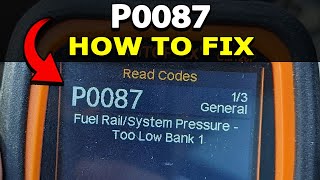
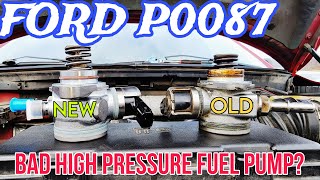
Technical definition: The official OBD-II definition is 🎬 Watch: This quick video explains the P0087 code and common fixes. "Fuel Rail/System Pressure – Too Low." This indicates the powertrain control module (PCM) registers a fuel pressure reading from the fuel rail pressure sensor that falls below the manufacturer's specified minimum threshold.
Can I Drive With P0087?
No — Do Not Drive. Driving is not recommended. The engine stalls unexpectedly, loses significant power, or fails to start, creating a serious safety risk in traffic. Ignoring the code causes severe engine damage, including burned valves and melted catalytic converters from a lean fuel condition, adding $1,000-$2,500+ to repair costs.
Common Causes

- Clogged Fuel Filter (Very Common) — The fuel filter traps dirt and debris. Over time, it becomes clogged, restricting fuel flow to the engine and causing pressure to drop. It is the first and most cost-effective part to check and replace.
- Failing Low-Pressure Fuel Pump (LPFP) (Common) — The in-tank fuel pump sends fuel to the high-pressure pump. A weak or failing LPFP cannot supply enough volume, starving the entire system. This is a primary cause on many modern Hondas due to recalls for defective impellers.
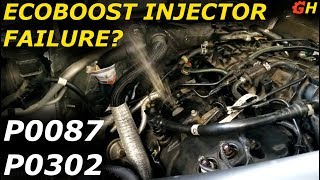
- Failing High-Pressure Fuel Pump (HPFP) (Common) — On direct-injection engines, the HPFP boosts fuel pressure to extreme levels. Internal components fracture or wear out mechanically, causing a massive pressure drop under load 🎬 See how to diagnose a failing HPFP on Ford Ecoboost engines. and occasionally leaking fuel into the engine oil.
- Faulty Fuel Pressure Sensor (Less Common) — The sensor reading the fuel pressure fails and sends incorrect, low readings to the computer. This triggers the P0087 code even if the actual mechanical fuel pressure is perfectly normal.
- Faulty Fuel Pump Driver Module (FPDM) (Less Common) — This module controls the speed and voltage supplied to the in-tank fuel pump. It frequently fails due to corrosion from being mounted on the vehicle's frame, preventing it from commanding the pump to deliver correct pressure.
- Worn Camshaft Lobe or Follower (Less Common) — The high-pressure fuel pump is mechanically driven by a camshaft lobe. This lobe, or the 'follower' riding on it, wears down over time. This wear prevents the pump from achieving its full stroke, resulting in low pressure output.
- Faulty Fuel Pressure Regulator (Less Common) — A malfunctioning fuel pressure regulator fails to maintain correct rail pressure by sticking open or responding incorrectly to ECM commands, allowing pressure to bleed off.
- Leaking Fuel Injector (Rare) — A fuel injector stuck open causes a drop in overall fuel rail pressure. This is always accompanied by a specific cylinder misfire code (e.g., P0301) and a rich running condition.
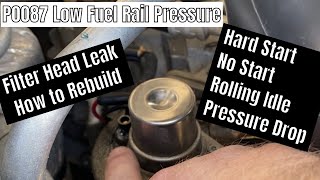
- Air Ingress in Fuel Lines (Diesel) (Rare) — On diesel engines, aged fuel filter housing seals or cracked lines allow air to be sucked into the fuel system. Air bubbles disrupt fuel pressure, causing hard starting and a rolling idle.
- Restricted or Kinked Fuel Line (Rare) — Physical damage to a fuel line or an internal blockage prevents fuel from flowing freely from the tank to the engine. On some GM trucks, soft rubber fuel lines collapse internally under heat and suction.
- Chafed or Damaged Wiring (Rare) — The wiring harness to the fuel pressure sensor, FPDM, or fuel pump corrodes or chafes, leading to an incorrect signal or loss of power.
Symptoms

- Reduced Engine Power / Limp Mode — The vehicle feels sluggish, hesitates during acceleration, and struggles to climb hills. The ECM intentionally limits RPMs (often to 2,000) to prevent damage.
- Engine Stalling — The engine stalls while driving or idling and fails to restart immediately, creating a major safety hazard in traffic.
- Difficulty Starting / Long Crank Time — The engine takes significantly longer than usual to start, cranking for several seconds before firing up.
- Check Engine Light On — The malfunction indicator lamp (MIL) illuminates on the dashboard.
- Rough Idling or Misfiring — The engine runs unevenly or shakes while stopped. You feel a stumbling or bucking sensation while driving due to a lean fuel condition.
- Decreased Fuel Economy — Fuel efficiency drops noticeably because the engine is running inefficiently to compensate for the pressure loss.
- Fuel Smell in Engine Oil — A failing high-pressure fuel pump leaks gasoline directly into the crankcase. Pulling the dipstick reveals a strong smell of fuel mixed with the oil.
Diagnostic Flowchart
Tap your situation to follow the diagnostic path that matches what you're seeing on this code.
Common Fixes & Costs
- Replace Fuel Filter — Parts: $20-$80, Labor: $50-$120, ~0.8 hr book time (DIY)
- Replace In-Tank (Low-Pressure) Fuel Pump — Parts: $200-$450, Labor: $250-$600, ~3.2 hr book time (Intermediate)
- Replace High-Pressure Fuel Pump (HPFP) — Parts: $300-$850, Labor: $400-$1500, ~4.5 hr book time (Professional)
- Replace Fuel Pressure Sensor — Parts: $50-$200, Labor: $75-$150, ~0.8 hr book time (Intermediate)
- Replace Fuel Pump Driver Module (FPDM) — Parts: $75-$150, Labor: $100-$200, ~0.6 hr book time (Intermediate)
- Reprogram Engine Control Module (ECM) — Parts: $0, Labor: $150-$300, ~1.5 hr book time (Professional)
DIY vs Professional
- Replace Fuel Filter — Beginner:
Tools: Wrench set, pliers, line disconnect tools, safety glasses, gloves. - Replace Fuel Pressure Sensor — Beginner:
Tools: Wrench set, socket set, safety glasses, gloves. - Replace In-Tank (Low-Pressure) Fuel Pump — Beginner:
Tools: Socket set, fuel tank lock ring tool, line disconnect tools. Requires dropping the fuel tank. - Replace High-Pressure Fuel Pump (HPFP) — Beginner:
Tools: Advanced tool set, torque wrench, specific high-pressure line wrenches, service manual.
Used vs. New Parts: Buying Guide
When a used part is worth it: For high-cost components like a high-pressure fuel pump (HPFP) on an older, high-mileage vehicle, a used part from a low-mileage donor is cost-effective. Never buy used fuel filters or sensors.
Donor-vehicle mileage cap: roughly under 80000 miles for the part to have meaningful remaining life.
Donor quality checklist:
- Verify the donor vehicle was not scrapped due to engine or fuel system failure.
- Match the part number exactly; manufacturers update pump designs frequently.
- Choose donors from regions with mild weather to avoid internal corrosion.
Decision logic:
- If The part is a low-cost wear item like a fuel filter or sensor. → Always buy new; the savings from a used part are negligible and not worth the risk.
- If The vehicle is over 150,000 miles and the budget is a primary concern. → A used fuel pump is a reasonable choice, but expect a shorter lifespan.
- If The part is known for a high failure rate (e.g., Subaru HPFP). → Strongly favor a new, updated OEM part to avoid a repeat failure.
Warranty tradeoff: Used parts from salvage yards carry a 30-90 day part-only warranty. New aftermarket parts carry a 1-3 year warranty.
Worst-case if a used part fails: $400-$1500 if a used HPFP fails, requiring repeat labor costs and a second replacement part.
What Happens If You Wait — Timeline
- 0-2 weeks: Check Engine Light appears. Code P0087 is stored. You experience slight hesitation during hard acceleration. (MPG impact: 0-5%% · Added cost: $0)
- 2 weeks - 2 months: Engine becomes noticeably sluggish and hesitates when climbing hills. You experience rough idle and longer crank times. (MPG impact: 5-15%% · Added cost: $50-$150 in wasted fuel)
- 2-6 months: Stalling becomes frequent in traffic. The engine runs lean, causing the catalytic converter to overheat from unburned fuel. (MPG impact: 15-25%% · Added cost: $1,200-$2,800 (Catalytic converter failure))
- 6+ months: Catastrophic damage occurs. Prolonged lean conditions burn valves and damage pistons, requiring a complete engine rebuild. (MPG impact: 25%+% · Added cost: $3,000-$8,000+ (Engine replacement))
Cost of Not Fixing It
- 0-1 month: Noticeable drop in fuel economy, engine hesitation, and immediate risk of stalling in traffic. (Added cost: Negligible, besides increased fuel cost.)
- 1-6 months: Running a lean fuel mixture overheats and destroys the catalytic converter and oxygen sensors. (Added cost: $1200-$2800)
- 6+ months: Prolonged lean conditions burn engine valves and score cylinder walls, requiring a complete engine replacement. (Added cost: $3000-$8000+)
Diagnosis Steps

- Check for Other Codes and TSBs
Use an OBD-II scanner to check for companion codes. Codes related to specific sensors (P0191) or misfires (P030X) narrow the focus. Always check for manufacturer Technical Service Bulletins (TSBs) first, as many vehicles have documented software updates or recalls for this exact code.
Tools: OBD-II Scanner (Beginner) - Inspect the Fuel Level and Quality
Running the vehicle with a critically low fuel level causes the pump to suck in air and trigger a false P0087. Contaminated fuel (water or debris) clogs filters and damages pumps.
Tools: None (Beginner) - Replace the Fuel Filter
A clogged fuel filter is a highly common and inexpensive cause. Replacing it is the mandatory first physical diagnostic step, especially if its service history is unknown.
Tools: Basic hand tools (wrench set, pliers) (Beginner) - Inspect Engine Oil for Fuel Contamination
On direct-injection engines, remove the oil dipstick and smell for gasoline. A strong fuel odor proves the HPFP has a failed internal seal and is leaking fuel into the crankcase. This requires immediate HPFP replacement and an oil change.
Tools: None (Beginner) - Inspect for Metal Shavings (Diesel)
On diesel engines (Ford Powerstroke, GM Duramax) with a CP4 pump, carefully check the fuel filter housing for metallic debris. Finding metal indicates a catastrophic pump failure requiring a full $5,000+ fuel system replacement.
Tools: Wrench to open fuel filter housing, clean container (Intermediate) - Test Low-Side Fuel Pressure
Connect a mechanical fuel pressure gauge to the low-pressure test port. With the key on, engine off (KOEO), pressure must build to the manufacturer's specification (typically 45-70 PSI) within 2 seconds. A reading below 45 PSI confirms a weak in-tank pump, clogged filter, or failing driver module.
Tools: Fuel Pressure Gauge Kit (0-100 PSI) (Intermediate) - Compare Mechanical vs. Sensor Readings
With the mechanical gauge connected, compare its reading to the 'Fuel Rail Pressure' data PID on your OBD-II scanner. If the gauge shows 60 PSI but the scanner shows 40 PSI, the fuel pressure sensor is faulty, not the pump.
Tools: Fuel Pressure Gauge Kit, OBD-II Scanner with Live Data (Intermediate) - Test High-Side Fuel Pressure (Under Load)
Monitor the 'Desired' vs. 'Actual' fuel rail pressure PIDs on a scan tool while safely road testing. Under heavy acceleration, desired pressure jumps to 2,000-3,000+ PSI. If actual pressure falls more than 300 PSI behind the desired pressure, the high-pressure fuel pump (HPFP) is failing.
Tools: OBD-II Scanner with Live Data (Advanced) - PRO TIP: Test Fuel Pressure Sensor Voltage
Back-probe the fuel pressure sensor connector. With the key on, engine off, the signal wire reads around 0.5V. At idle, it rises according to spec. If the voltage is stuck near 0V or 5V regardless of pressure, the sensor is dead.
Tools: Digital Multimeter, Wiring Diagram, T-pins (Advanced) - PRO TIP: Test Fuel Pressure Sensor Resistance
With the sensor unplugged, test its internal resistance with a multimeter set to Ohms. Consult the service manual for the exact specification. An open loop (OL) reading means the sensor has failed internally.
Tools: Digital Multimeter, Service Manual (Advanced)
When This Code Triggers (Freeze-Frame Conditions)
- Engine Coolant Temp: 180-205°F (82-96°C) (The engine is fully warmed up and operating at normal temperature.)
- Engine RPM: 1500-3000 RPM (The code sets during periods of moderate, steady throttle, like highway cruising, or during light acceleration when fuel demand increases.)
- Calculated Engine Load: 30-60% (The fault appears under moderate engine load, such as climbing a slight incline or accelerating to merge.)
- Vehicle Speed: 40-65 mph (Consistent with highway driving, where the fuel system is under sustained demand.)
Related Codes
- P0088 — Indicates "Fuel Rail Pressure - Too High." Seeing P0087 and P0088 together points to a faulty fuel pressure regulator or sensor causing erratic pressure swings, rather than a weak pump.
- P0191 — Indicates an electrical issue with the fuel pressure sensor circuit. Paired with P0087, it means a mechanical pressure problem is causing the sensor to report out-of-range data.
- P0089 — Indicates "Fuel Pressure Regulator Performance." P0087 shows pressure is low, while P0089 suggests the regulator is failing to maintain the target pressure.
- P0300-P0308 — Cylinder misfire codes. Low fuel pressure starves the engine, creating a lean condition that causes misfires. These codes are symptoms of P0087, not the root cause.
Climate & Environmental Factors
- Cold Weather: In diesel engines, extreme cold causes fuel to 'gel' and thicken, preventing it from flowing through filters and triggering fuel starvation.
- High Humidity / Road Salt: Moisture and road salt corrode the Fuel Pump Driver Module (FPDM) mounted on the vehicle's frame, leading to electrical failure.
- High Altitude: Lower atmospheric pressure forces fuel pumps to work harder. A borderline fuel pump fails to meet pressure demands at altitude.
- Fuel Quality (Biodiesel): Aged biodiesel forms deposits on internal components of Bosch CP4 high-pressure pumps, accelerating wear and failure.
How to Talk to a Mechanic About This Code
Say this: "I have a P0087 code. Can you test both the low-pressure and high-pressure fuel systems, and compare the fuel pressure sensor readings to a mechanical gauge before recommending a part replacement?"
This directs the shop to perform a thorough analysis rather than immediately replacing the most expensive component, preventing a costly misdiagnosis.
Avoid saying:
- 'Just fix whatever's wrong'
- 'My check engine light is on, can you look at it?'
- 'Whatever you recommend'
Questions to ask before authorizing the repair:
- What were the low-side fuel pressure readings at idle and under load?
- Did the actual high-pressure reading on the scan tool fail to meet the desired pressure during a road test?
- Did you check for any Technical Service Bulletins (TSBs) for my vehicle related to this code?
- Did you inspect the engine oil for any signs of fuel contamination?
- What is the warranty on this specific repair, covering both parts and labor?
Where to Take It: Dealer vs Independent vs Chain
- Dealer:
Recommended if your vehicle is a make known for TSBs/recalls for this code (Subaru, Honda, Ford, Nissan). They have the fastest access to required software flashes.
Best for: Vehicles under warranty, subject to a recall, or with known TSBs., Complex electrical issues requiring proprietary ECM software updates.
Downsides: Higher labor rates., May recommend replacing an entire assembly when a smaller component is the cause. (Typical cost: +50% vs. baseline) - Independent Shop:
Good fit, provided the shop is well-vetted and has experience with modern fuel injection systems. Ask if they have tools to monitor live fuel pressure data.
Best for: Out-of-warranty vehicles where cost is a major factor., Common failures like a clogged fuel filter or low-pressure pump replacement.
Downsides: Diagnostic capabilities for complex GDI systems vary., May lack immediate access to dealer-specific software updates. (Typical cost: +0% vs. baseline) - Chain Shop:
AVOID for initial diagnosis. Their business model is not suited for the in-depth testing required for P0087, increasing the risk of misdiagnosis.
Best for: Simple, confirmed fixes like replacing a fuel filter.
Downsides: Technician skill and diagnostic equipment are highly variable., High pressure to upsell leads to unnecessary part replacements., Complex diagnosis is beyond their scope. (Typical cost: -10% vs. baseline)
When to Walk Away From the Repair
If the repair cost exceeds 40% of the car's private-party value, seriously consider selling the car as-is or trading it in.
- Car worth $5000, fix is $2500: Walk away. The repair cost is 50% of the car's value, making it a poor investment.
- Car worth $15000, fix is $1800: Fix it. The repair cost is only 12% of the vehicle's value and is a worthwhile investment.
- Car worth $3000, fix is $800: Borderline. The cost is ~27% of the car's value. Get a second opinion before proceeding.
What Scan Tool You Need for This Code
Minimum: An OBD-II scanner that reads and graphs live data PIDs, specifically 'Fuel Rail Pressure' and 'Desired Fuel Rail Pressure'.
A basic $20 code reader only shows the P0087 code. It cannot display the live pressure data needed to determine if the cause is a weak pump or a bad sensor.
Budget: BlueDriver Pro Scan Tool (~$99) — Connects to a smartphone app to read codes, view freeze frame data, and graph live fuel pressure data to compare actual vs. desired pressure during a test drive.
Mid-range: Foxwell NT510 Elite / Autel MaxiCOM MK808 (~$150-450) — Dedicated handheld units offering manufacturer-specific PIDs and bidirectional controls to command the fuel pump on for testing, isolating the problem faster.
Professional: Autel MS906Pro / Launch X431 Series (~$1200+) — Provides full professional-level diagnostics, bidirectional control, module coding, and access to advanced OEM-level functions.
Rent vs buy: Buy a budget pick like BlueDriver. Diagnosis requires multiple road tests to capture data under specific load conditions, which is difficult with a rented scanner.
How to Clear the Code After You Fix It
- Use an OBD-II scan tool to clear the P0087 code.
- Ensure the fuel tank is between 35% and 85% full, as EVAP and fuel readiness monitors require this level to run.
- Perform a complete OBD-II drive cycle to allow the vehicle's self-diagnostic routines to complete.
Drive cycle (~30 minutes): 1) Cold start (sit overnight). 2) Idle for 3 minutes. 3) Drive 15 minutes with mixed city and steady highway speeds (55-60 mph). 4) Perform several smooth accelerations. 5) Idle for 2 minutes before shutting down.
Readiness monitors affected: Fuel System Monitor, Catalyst Monitor, O2 Sensor Monitor
Before emissions retest: drive at least 100 miles to fully set monitors.
Watch out for:
- Disconnecting the battery clears the code but resets all readiness monitors to 'Not Ready,' causing an automatic emissions failure.
- The code returns immediately if the underlying mechanical fault is not repaired.
- Driving aggressively or over 65 mph prevents monitors from running successfully.
Will This Fail Emissions / State Inspection?
Yes — this code typically fails an OBD-II emissions inspection.
- California: An illuminated Check Engine Light is an automatic failure. After repair, you must complete a drive cycle. Only one monitor is allowed to be 'Not Ready'.
- New York: Fails the NYVIP3 inspection immediately. After clearing codes, a specific drive cycle must set the readiness monitors before a re-test.
- Texas: In emissions counties, the Check Engine Light is an automatic failure. Vehicles 2001 and newer pass with a maximum of one readiness monitor set to 'Not Ready'.
Most Commonly Affected Vehicles

- Subaru Forester, Crosstrek, Impreza, Legacy, Outback (2017-2024) — HPFP failure is extremely common. Subaru released redesigned pumps (TSB #09-123-24) and required ECM software updates (TSB #09-120-24R). Perform the software update before replacing the pump.
- Honda Accord, Civic, CR-V (2013-2022) — On 2018-2022 models, a failing low-pressure in-tank pump is the primary cause and is subject to major recalls (NHTSA Campaign 23V-473).
- Hyundai / Kia Sonata, Sorento, Optima, Soul (2011-2016) — Widespread failure of the camshaft-driven high-pressure fuel pump (HPFP) is the most common cause.
- Ford F-150, Explorer, Edge (EcoBoost) (2011-2017) — Caused by a failing HPFP, a worn in-tank fuel pump, or a corroded Fuel Pump Driver Module (FPDM) mounted on the frame.
- Ford F-Series Trucks (Powerstroke Diesel) (2011-2016) — Failure of the Bosch CP4 high-pressure pump spreads metal debris throughout the fuel system. Inspecting the fuel filter for metal shavings is critical.
- Chevrolet / GMC Equinox, Terrain (2012-2019) — On 2.4L engines, P0087 is caused by a stretched timing chain affecting the HPFP drive. On 1.5T/2.0T engines, the HPFP itself fails.
- Chevrolet / GMC Silverado / Sierra (Duramax Diesel) (2006-2016) — The 2011-2016 LML Duramax is prone to catastrophic CP4 pump failure. Earlier models suffer from weak CP3 pumps or collapsed rubber fuel lines.
- Volkswagen / Audi Various models with 2.0T TFSI engines (2009-2016) — Wear of the camshaft follower driving the HPFP is a frequent cause. It must be inspected and replaced alongside the HPFP.
- Nissan Rogue Hybrid, Pathfinder, Sentra (2017-2019) — Frequently caused by an ECM software error. A dealer reprogram is the mandatory first step per TSB NTB19-045b.
- BMW Models with N54/N55 engines (335i, X5) (2007-2013) — The HPFP is a notoriously common failure item. BMW issued multiple extended warranties and recalls for this part.
Manufacturer-Specific Notes
- Subaru: On 2017+ models, an ECM software update (TSB #09-120-24R) is a required first step before replacing the HPFP. A class-action settlement also extended the warranty on many low-pressure fuel pumps to 15 years.
- Ford / GM (Diesel): On 2011-2016 Powerstroke and Duramax engines, P0087 is a red flag for catastrophic CP4 pump failure. Check the fuel filter for metal shavings immediately; if found, the entire fuel system requires replacement.
- Volkswagen / Audi: On 2.0T engines, the cam follower for the HPFP is a known wear item. It must be inspected and replaced along with the HPFP to prevent repeat failure.
- Nissan: On 2017-2019 models, P0087 is often a 'ghost' code caused by an ECM software glitch. Reprogram the ECM per TSB NTB19-045b before replacing parts.
- Honda: Many 2018-2022 models are subject to a massive recall for the low-pressure in-tank fuel pump (NHTSA campaign 23V-473). Check for an open recall before paying for diagnostics.
Real Owner Stories
2013 Ford F-150 3.5L EcoBoost with P0087 and misfires
The truck presented with a rough idle, significant power loss, and code P0087 paired with a P0302 misfire code for cylinder #2.
What they tried:
- Noticed heavy tailpipe smoke, suggesting severe over-fueling rather than low pressure.
- Performed a 'clear flood' crank with the spark plug removed from cylinder #2.
Outcome: Fuel violently ejected from the spark plug hole, confirming the fuel injector for cylinder #2 was stuck wide open. This dragged the entire rail pressure down (P0087) and caused the misfire (P0302). Replacing the injector fixed both codes.
Lesson: When P0087 is paired with a specific cylinder misfire code (P030x), the root cause is a leaking or stuck-open injector on that cylinder, not a bad fuel pump.
2017 Subaru Forester with P0087 and stalling
Owner experienced a sudden check engine light, stalling at stop lights, and hesitation when accelerating.
What they tried:
- Took the vehicle to a dealer, aware this is a known issue on Subarus.
Outcome: The dealer performed a required ECM software update (TSB #09-120-24R). When the code returned, they replaced the HPFP with a redesigned part (TSB #09-123-24). The $1,500 repair resolved the issue permanently.
Lesson: On 2017-2024 Subarus, P0087 is a well-documented problem. Always have a dealer check for applicable TSBs for an ECM reflash before replacing the expensive HPFP.
Chevy Duramax Diesel with P0087 only when towing
The truck ran perfectly normally but consistently triggered P0087 and limp mode when towing a heavy trailer up hills in 90°F+ weather.
What they tried:
- Ruled out the fuel pressure relief valve and air leaks, as those occur regardless of load.
- Diagnosed the CP3 injection pump as becoming weak under extreme heat and demand.
Outcome: Installed an aftermarket lift pump. The lift pump pushed fuel from the tank to the CP3, taking the load off the aging injection pump and permanently preventing the code.
Lesson: If P0087 only appears under high heat and heavy load, it signals a weak injection pump. Installing a lift pump is a cost-effective way to support the CP3.
How to Prevent This Code From Triggering
- Use Top Tier certified gasoline (Every fill-up) — Top Tier fuels contain high concentrations of detergents that prevent carbon deposits from clogging fuel injectors, ensuring proper fuel atomization and pressure.
- Replace the fuel filter at recommended intervals (Every 15,000-30,000 miles) — A clean filter ensures unrestricted flow to the fuel pumps, preventing them from being starved and overworked, which is the primary cause of premature pump failure.
- Keep the fuel tank above 1/4 full (Daily habit) — The in-tank fuel pump is cooled and lubricated by surrounding fuel. Consistently running the tank near empty overheats the pump and accelerates wear.
- Perform regular oil changes with high-quality synthetic oil (Every 5,000-7,000 miles) — For GDI engines where the HPFP is driven by the camshaft, clean oil lubricates the cam lobe and follower. Dirty oil accelerates wear, reducing the pump's stroke.
Frequently Asked Questions
What are the most common mistakes when diagnosing P0087?
The biggest mistake is replacing the expensive high-pressure fuel pump (HPFP) without testing the low-pressure system first. Technicians must verify the fuel filter is clean and the in-tank pump delivers adequate volume. Failing to check for required ECM software updates on newer vehicles is another frequent oversight.
Can bad fuel or fuel quality cause a P0087 code?
Yes. Fuel contaminated with water, debris, or excessive ethanol clogs the fuel filter and damages the fuel pump over time. This creates a physical restriction that drops system pressure.
Can I just clear the P0087 code and keep driving?
You can clear it, but the code returns immediately because it indicates a hard mechanical or electrical fault. Driving with low fuel pressure causes unexpected stalling and destroys the catalytic converter.
Can a bad gas cap cause a P0087 code?
No. A loose gas cap triggers an evaporative emissions (EVAP) code like P0455. It does not affect liquid fuel rail pressure.
Why did the code appear when my tank was almost empty?
The in-tank fuel pump relies on surrounding liquid fuel for cooling and lubrication. Running the tank near empty overheats the pump, causing it to temporarily lose pressure and trigger the code.
My mechanic replaced the fuel pump, but the code came back. What now?
If a new pump didn't fix it, test the fuel pressure sensor, fuel pump driver module, and inspect for restricted fuel lines. On direct-injection engines, a worn camshaft lobe fails to actuate the high-pressure pump fully. On diesels, check for air leaks at the filter housing.
What does 'Bank 1' mean in the P0087 definition?
On V-shaped engines, 'Bank 1' refers to the side of the engine containing cylinder #1. Some vehicles use separate fuel rails and pressure sensors for each bank. This designation isolates the diagnostic focus to that specific side.
Can a bad O2 sensor cause a P0087 code?
No. O2 sensors measure exhaust gases to adjust the air-fuel mixture, but they do not control fuel pressure. A P0087 code causes O2 sensor codes due to a lean running condition, but the reverse is impossible.
Key Takeaways
- Code P0087 indicates fuel rail pressure has dropped below the ECM's minimum threshold, requiring immediate repair to prevent unexpected stalling in traffic.
- Always replace the $20-$80 fuel filter and test the low-pressure fuel pump before spending $1,000+ on a high-pressure fuel pump (HPFP).
- If you drive a 2017-2024 Subaru, 2018-2022 Honda, or 2017-2019 Nissan, check for manufacturer TSBs and recalls first, as ECM software updates or free pump replacements often fix this code.
- On 2011-2016 Ford and GM diesel trucks, inspect the fuel filter housing for metal shavings immediately; finding metal indicates a catastrophic CP4 pump failure requiring a $5,000+ fuel system overhaul.
Helpful Videos

The information in this article is provided for general reference and educational purposes only. Vehicle specifications, procedures, and part compatibility can vary by production date, trim level, and region. Always consult your vehicle's factory service manual and verify part numbers before purchasing or performing repairs. Safety-critical components such as airbags, seat belts, and braking systems should be installed by a qualified professional.
- 🎬 Helpful Videos
- What Does P0087 Mean?
- Can I Drive With P0087?
- Common Causes
- Symptoms
- Diagnostic Flowchart
- Common Fixes & Costs
- DIY vs Professional
- Used vs. New Parts: Buying Guide
- What Happens If You Wait — Timeline
- Cost of Not Fixing It
- Diagnosis Steps
- When This Code Triggers (Freeze-Frame Conditions)
- Related Codes
- Climate & Environmental Factors
- How to Talk to a Mechanic About This Code
- Where to Take It: Dealer vs Independent vs Chain
- When to Walk Away From the Repair
- What Scan Tool You Need for This Code
- How to Clear the Code After You Fix It
- Will This Fail Emissions / State Inspection?
- Most Commonly Affected Vehicles
- Manufacturer-Specific Notes
- Real Owner Stories
- 2013 Ford F-150 3.5L EcoBoost with P0087 and misfires
- 2017 Subaru Forester with P0087 and stalling
- Chevy Duramax Diesel with P0087 only when towing
- How to Prevent This Code From Triggering
- Frequently Asked Questions
- What are the most common mistakes when diagnosing P0087?
- Can bad fuel or fuel quality cause a P0087 code?
- Can I just clear the P0087 code and keep driving?
- Can a bad gas cap cause a P0087 code?
- Why did the code appear when my tank was almost empty?
- My mechanic replaced the fuel pump, but the code came back. What now?
- What does 'Bank 1' mean in the P0087 definition?
- Can a bad O2 sensor cause a P0087 code?
- Key Takeaways
- 🎟️ Get 5% Off