

P0868 on 2007-2021 Mitsubishi Outlander: CVT Low Fluid Pressure Causes & Fixes
This code indicates low hydraulic pressure in the Continuously Variable Transmission (CVT). The most common causes are old, degraded fluid or a failing pressure sensor. While a fluid and filter change may help, this code often points to serious internal transmission wear, such as a worn flow control valve in the oil pump, requiring professional diagnosis and potentially a costly repair or replacement.
- P0868 on a Mitsubishi Outlander is a serious code indicating low pressure in the CVT, which can quickly lead to total transmission failure.
- Do not continue to drive the vehicle. Driving in limp mode or with shuddering symptoms will cause expensive, irreversible damage.
- The first diagnostic step is a fluid and filter service, but you MUST use the specific Mitsubishi CVTF-J1 or CVTF-J4 fluid for your model year.
- Due to the complexity of the CVT, this code almost always requires diagnosis and repair by a professional transmission specialist.
- Be prepared for the possibility that the transmission may need to be replaced, especially on higher-mileage vehicles.
What's Unique About the 2007-2021 Mitsubishi Outlander

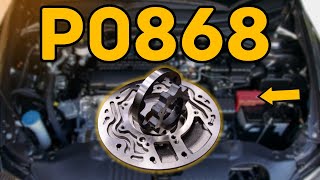
The Mitsubishi Outlander across these years primarily uses a Continuously Variable Transmission (CVT), sourced from Jatco. These transmissions are known for their sensitivity to fluid quality and maintenance schedules. Code P0868 is a very common and serious issue on this platform, often serving as an early warning of significant internal problems beyond just low fluid. Unlike a simple sensor failure on other cars, on an Outlander, this code frequently points to wear in the valve body, a sticking flow control valve in the oil pump, or a failing stepper motor, which precedes shuddering, slipping, and eventual transmission failure.
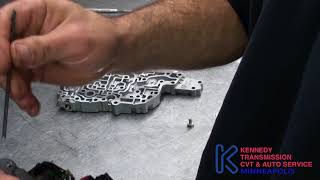
🎬 Watch: Common Mitsubishi CVT problems and how to fix themGeneration note: This range covers two Outlander generations. The 2nd generation (2007-2012) typically uses the Jatco JF011E CVT. The 3rd generation (2013-2021) began with the JF011E and transitioned to the newer Jatco CVT8 (JF016E/JF017E) around the 2015-2016 model years. While the code's meaning is the same, some internal parts, fluid specifications (CVTF-J1 vs CVTF-J4), and known failure points differ. TSBs regarding hydraulic pressure issues and shuddering, like TSB-20-23-001, specifically mention the CVT8 in 2016+ models.
Symptoms You May Notice

- Check Engine Light or "TRANSMISSION SERVICE REQUIRED" message
- Vehicle enters limp mode (fail-safe) with severely reduced engine power.
- Shuddering, jerking, or a 'rubber banding' sensation during acceleration.
- Engine RPMs flare or surge without a corresponding increase in speed.
- Slipping sensation or a feeling of lost power.
- A whining noise from the transmission, which may get louder with acceleration.
- Burning smell from overheated transmission fluid.
- Delayed engagement when shifting into Drive or Reverse.
- Replacing only the pressure sensor without checking for underlying mechanical wear or fluid contamination. If debris from a worn pump or slipping belt is present, the new sensor may fail quickly.
- Assuming the transmission is bad without first performing a proper fluid and filter service with OEM fluid, which can sometimes resolve the issue if caught early.
- Replacing a pressure control solenoid when the root cause is a worn flow control valve bore inside the oil pump, which also triggers pressure-related codes.
Most Likely Causes


- Low, Degraded, or Incorrect Transmission Fluid 🔴 High Probability CVTs are highly sensitive to fluid condition. The fluid acts as a hydraulic medium, coolant, and lubricant. Old fluid loses its properties, and incorrect fluid (non-OEM spec) can cause foaming and pressure loss.
How to confirm: Check the fluid level and condition. This must be done via a specific procedure, as there is no traditional dipstick. The fluid should be translucent green (CVTF-J4) or the specified color and not dark brown, black, or smell burnt.
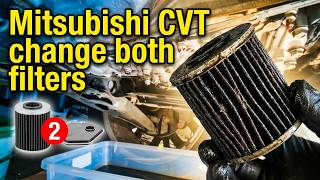
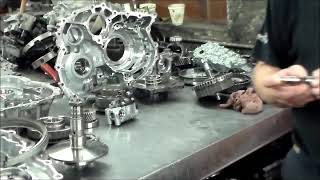
Typical fix: Perform a transmission fluid and filter service using only genuine Mitsubishi Diamond Queen CVTF-J4 (or J1 for older models) fluid. Aftermarket fluids are not recommended. 🎬 See this walkthrough for a CVT oil and filter change
Est. part cost: $150-$250 - Faulty Transmission Pressure Sensor or Solenoid 🟡 Medium Probability The pressure sensor or the pressure control solenoid, often located on the valve body, can fail. Debris from normal wear can clog solenoid passages, causing them to stick.
How to confirm: A professional technician must use a diagnostic scan tool to monitor live pressure data (comparing target vs. actual secondary pressure) and command the solenoid to check its response. This often requires dropping the transmission pan.
Typical fix: Replace the faulty pressure sensor or the entire solenoid kit/valve body. This is a labor-intensive job. On many models, the sensor is integral to the valve body.
Est. part cost: $200-$800 - Internal Transmission Failure (Oil Pump, Valve Body, Pulleys) 🟡 Medium Probability This code is often a symptom of a failing oil pump (specifically a worn flow control valve bore), a worn-out valve body, or damage to the CVT belt and pulleys. Abrasion powder from a slipping belt can contaminate the entire hydraulic system, leading to widespread failure.
How to confirm: After ruling out fluid and sensor issues, a technician will inspect the transmission pan for excessive metal debris. A fine grey paste on the magnets indicates wear, while larger metallic shards suggest catastrophic failure. A full transmission teardown or borescope inspection may be required for definitive diagnosis.
Typical fix: Complete transmission replacement or rebuild. This is the most expensive and unfortunately common outcome for high-mileage vehicles with this code.
Est. part cost: $3000-$6000 - Clogged Transmission Fluid Filter(s) ⚪ Low Probability These CVTs have a strainer in the pan and a secondary paper cartridge filter in the cooler housing. If they become clogged with debris, fluid flow is restricted, causing pressure to drop.
How to confirm: Inspect the filters during a fluid service. A clogged filter is a strong indicator of internal wear and contamination.
Typical fix: Replace both the internal strainer and the external cartridge filter during a fluid service. This should be standard practice for any fluid change.
Est. part cost: $50-$100
Rare But Worth Checking
- Damaged Wiring Harness or Connectors: The wiring to the transmission pressure sensor or main connector can become corroded or damaged, leading to an incorrect signal to the TCM. This should be checked before condemning the transmission.
- Faulty Transmission Control Module (TCM): While rare, the TCM itself can fail, causing it to misinterpret sensor readings or fail to command the solenoids correctly. This is usually the last item to be considered after all other possibilities have been exhausted.
Diagnosis Steps

- Scan the TCM for P0868 and any other related trouble codes (e.g., P0741, P0776, P0746).
- Check for and complete any open recalls, especially SR-16-006 for CVT ECU reprogramming on applicable models.
- Check the transmission fluid level and condition using the manufacturer's specified hot-check procedure. Note any burnt smell, dark coloration, or glittery metal particles.
- Inspect the vehicle for any visible transmission fluid leaks from pans, seals, or cooler lines.
- If the fluid is low, top it off with the correct Mitsubishi CVTF, clear the code, and test drive to see if it returns. If it does, a leak is present.
- If the fluid level is correct but the condition is poor (dark, burnt), perform a complete fluid and filter(s) change using only OEM fluid. Inspect the pan magnets for debris.
- If the code persists, professional diagnosis is required. A technician will use a scan tool to monitor live data, comparing 'Target Secondary Pressure' to 'Measured Secondary Pressure'.
- The technician will inspect the wiring harness for damage between the TCM and the transmission.
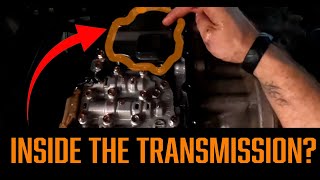
- If wiring is good, the next step is to drop the transmission pan to inspect for metal debris and to access the valve body for testing/replacement 🎬 Watch: How to perform a Jatco JF011E valve body inspection of the pressure sensor and solenoids.
- If significant metal debris (more than a fine paste) is found on the magnets, the transmission has suffered critical internal failure (likely pump, belt, or pulleys) and will require replacement.
Parts You'll Likely Need
- CVT Fluid
(OEM #MZ320185 or MZ321212 (for CVTF-J4))— The correct fluid is critical. Older models use CVTF-J1, while newer (approx. 2014+) use CVTF-J4. Using the wrong type will cause damage.
Trusted brands: Mitsubishi Diamond Queen
OEM price range: $20-$30 per quart
Related Codes That Often Appear With This One
- P0741 — Torque Converter Clutch Circuit Performance/Stuck Off. Often appears with pressure codes as it's part of the same hydraulic system and can be triggered by contamination or pressure loss.
- P0776 — Pressure Control Solenoid 'B' Performance/Stuck Off. Directly related to hydraulic control issues and mentioned in Mitsubishi TSB-20-23-001 for similar symptoms like shudder and surge.
- P0969 — Pressure Control Solenoid 'C' Control Circuit Range/Performance. Another code pointing to a fault in the valve body's hydraulic control circuit, often seen with P0868.
- P0746 — Pressure Control Solenoid 'A' Performance. On Jatco CVTs, this code is a serious indicator that often points to a worn flow control valve bore in the pump, a primary cause of pressure loss that also triggers P0868.
Technical Service Bulletins (TSBs) & Recalls
- TSB-20-23-001: Addresses a potential shudder or surge condition in CVT8-equipped vehicles (2016+ Outlander) caused by poor hydraulic pressure circuit reaction. It provides diagnostic procedures and may lead to CVT replacement if other steps fail.
- TSB-17-23-002: An earlier version of the above TSB, which was superseded. It also dealt with shudder/surge and instructed dealers on diagnosis, potentially leading to transmission replacement.
- SR-16-006: A service recall for 2016 Outlanders (and other models) to reprogram the CVT ECU to correct a hesitation/delay in acceleration. This is a crucial first check for any related drivability complaints.
Platform-Specific Known Issues
- Owner Experience: 2014 Outlander at 90k Miles: An owner on mitsubishiforum.com reported getting the P0868 code along with a "Transmission Service Required" message. The vehicle exhibited shuddering and went into limp mode. The consensus from other members was that at that mileage, despite regular fluid changes, it was likely a terminal internal failure of the CVT unit, with replacement being the only viable option.
- High-Mileage Failure Pattern: Across multiple forums and repair videos, a common story emerges for Outlanders over 100,000 miles. The P0868 code appears, often accompanied by shuddering. A fluid and filter change provides no relief. Further diagnosis reveals significant metal debris in the pan, confirming internal wear (often the flow control valve or pulleys). The final repair is almost always a complete transmission replacement, costing between $4,000 and $7,000.
- Documented Pressure Failures: An owner reported that after a mechanic identified code P0868, it was noted as a known problem with Mitsubishi transmissions (NHTSA ODI #11322793). Additionally, in some cases, P0868 appears alongside codes like P0776 and P0446, where dealership inspections verified internal transmission failure (NHTSA ODI #11636737).
Mechanic-Grade Diagnostic Values
- Secondary Pressure Sensor Voltage (Live Data) — expected: ~0.7 Volts. Failure: Significantly higher or lower voltage at idle, or readings that don't correspond to pressure changes under load.
- Secondary Pressure (Live Data vs. Manual Gauge) — expected: At idle, secondary pressure is lower than line pressure. Under load or during a stall test, it can approach 900 PSI, similar to line pressure. The scan tool PID should closely match a manual gauge reading.. Failure: The scan tool shows a pressure drop of 0.25 MPa (36 psi) or more compared to the target pressure.
- TCC Control (PWM) Solenoid Resistance — expected: 3.0 - 9.0 Ohms. Failure: Resistance outside of this range indicates a faulty solenoid coil.
- Lockup Select Switch Solenoid Resistance — expected: 15.0 - 30.0 Ohms. Failure: Resistance outside of this range indicates a faulty solenoid coil.
- Line/Secondary Pressure Control Solenoid Resistance (JF011E) — expected: 3.0 - 7.0 Ohms. Failure: Resistance outside of this range indicates a faulty solenoid coil.
- CVT Fluid Temperature Sensor Resistance — expected: Approx. 6.5 kOhms at 20°C (68°F), Approx. 0.9 kOhms at 80°C (176°F).. Failure: Resistance readings that deviate significantly from the temperature curve suggest a faulty sensor.
Scan Tool Commands That Help
- Mitsubishi MUT-III SE: Reset (item No.1: Control learning value) or (item number 3: C/V initial & learned value) — This is required after replacing the CVT assembly or valve body. It initializes and clears all learned values in the TCM. The procedure involves a specific sequence of turning the key, shifting to Reverse, and pressing both the brake and accelerator pedals.
- Mitsubishi MUT-III SE: Clear CVT oil degradation level — This must be performed after any transmission fluid change to reset the fluid life monitor recorded in the TCM.
- Mitsubishi MUT-III SE: Write calibration value (Saved calibration value writing) — This is mandatory for CVT8 transmissions (2016+ Outlander) when the CVT assembly or valve body is replaced. Each unit has unique calibration data (often on a CD-R with the new part) that must be written to the TCM.
Wiring & Ground Locations
- CVT Assembly Connector (B-08) — The main electrical connector on the CVT case.. This is the primary connection point for all sensors and solenoids, including the secondary pressure sensor. Corrosion or damage here can interrupt the signal to the TCM, causing P0868.
- TCM Connector (C-40) — Connector at the Transmission Control Module (TCM).. A poor connection at the TCM can prevent it from receiving an accurate pressure signal, leading to a false P0868 code.
- Internal Solenoid Ground — On Nissan and Mitsubishi applications of the JF011E, the ground circuit for all solenoids and the stepper motor is a shared eyelet fastened by a valve body bolt inside the transmission.. A loose or corroded internal ground can cause erratic behavior and fault codes for multiple components, including the pressure control solenoids related to P0868.
Real Owner Repair Stories
- YouTube channel 'transmisiones automaticas' (Nissan Murano with Jatco RE0F09A (JF010E) CVT, similar architecture to Outlander's CVT.) — Shudder/chatter on takeoff, delayed forward engagement, codes P0746 and P0868.
❌ Tried (didn't work) A previous rebuild was performed where the variators (pulleys) were replaced and the valve body was cleaned, but the problem returned immediately.
✅ What actually fixed it The root cause was a stuck flow control valve inside the oil pump. The technician unstuck the original valve and noted extreme wear on a spare pump he considered using. After addressing the flow control valve, the shudder and codes were resolved. - Mitsubishi Forum user 'warrjon' (2014 Mitsubishi Outlander ES 2WD (JF011E CVT) with ~90,000 km.) — CVT overheating ('flashing D' light) and entering limp mode, especially when towing or during spirited driving in mountains. No specific codes mentioned, but overheating is a direct cause of pressure loss.
❌ Tried (didn't work) Following the standard maintenance schedule, which does not specify a CVT fluid change interval under normal conditions.
✅ What actually fixed it The owner performed a thorough fluid and filter service. This included multiple drain-and-fills, dropping the pan to clean the magnets and internal screen filter (part # 2824A007), and replacing the external paper cartridge filter (part # 2824A006). This proactive maintenance is key to preventing pressure issues. - NHTSA ODI #11322793: An owner reported that despite checking and finding the recommended level of transmission fluid, the vehicle triggered code P0868. A transmission specialist stated this is a known problem with these transmissions.
- NHTSA ODI #11636737: An owner reported that a dealership verified internal transmission failure after finding diagnostic codes P0776, P0868, and P0446 during an inspection.
OEM Part Supersession History
JF011E Valve Body (Two Pressure Sensors)→JF011E Valve Body (One Pressure Sensor)— Cost reduction and design simplification in later models.
Heads up: A two-sensor valve body (e.g., part # 200-01B) can be used in a single-sensor application (the extra sensor is just ignored), but a single-sensor valve body (e.g., part # 200-01A) CANNOT be used in a transmission that requires two sensors.
Model Year Variations Within This Range
- 2007-2015: These models typically use the Jatco JF011E CVT (Mitsubishi designation F1CJA/W1CJA). This transmission is known for failures of the flow control valve in the pump and stepper motor issues. It uses CVTF-J1 or CVTF-J4 fluid depending on the specific year.
- 2016-2021: These models transitioned to the newer Jatco CVT8, specifically the JF016E/JF017E (Mitsubishi designation F1CJC/W1CJC). These transmissions require different service procedures, including writing calibration data to the TCM upon replacement, and exclusively use CVTF-J4 fluid.
Diagnostic Flowchart
Other Known Issues on This Vehicle
Issues unrelated to this code that are worth knowing about as an owner of this generation:
- Premature Lower Control Arm Bushing Wear 🟠 Medium — Common on 2nd gen (2007-2013) vehicles, often noticeable after 60,000-80,000 miles. Symptoms include squeaking or rattling over bumps. (Ref: TSB-23-33-003 provides updated service manual procedures for bushing replacement.)
- Faulty Engine Relays Causing Stalling/Overheating 🔴 High — Primarily affects 2015-2017 models. A faulty relay can cause the engine to stall while driving or the radiator fan to fail. (Ref: Recall #17V609000 was issued to replace the affected engine control, valve lift, and radiator fan relays.)
- Paint Chipping and Peeling 🟡 Low — Widespread across many model years. The clear coat is reportedly not very resilient, leading to easy chipping, especially on the hood and front bumper.
- Erratic Blower Motor Operation 🟡 Low — Commonly reported on 2007-2011 and 2014-2015 models. The fan may only work on certain speeds or fail entirely, often due to a failed blower motor resistor.
- ABS/4WD/ASC System Errors 🟠 Medium — Owners of 3rd gen models sometimes experience simultaneous illumination of ABS, 4WD, and ASC warning lights. This is often caused by a failing ABS wheel speed sensor.
- Delayed Acceleration (CVT Hesitation) 🔴 High — Affects 2015-2016 Outlander, Outlander Sport, and Lancer models. The CVT may cause a delay in acceleration under certain conditions. (Ref: Recall SR-16-006 was issued to reprogram the CVT ECU to address this. TSB-20-23-001 also references this issue and recall.)
Used vs. New Parts: Buying Guide for This Vehicle
When a used part is the smart pick: A complete used transmission assembly from a low-mileage, rear-ended donor vehicle can be a cost-effective solution if the price is significantly lower than a remanufactured unit. It is critical to get the matching TCM from the donor vehicle if possible, as this can sometimes avoid reprogramming issues.
Donor-vehicle mileage cap: roughly under 80000 miles for the part to have meaningful remaining life.
What to inspect on the donor part:
- Verify the donor vehicle's VIN to confirm the exact transmission model (JF011E vs CVT8) and year.
- Ask for service history if available; proof of fluid changes is a major plus.
- Inspect the fluid from the donor transmission. If it's dark, burnt, or full of metal, reject the part.
- Check for any external damage to the case, connectors, and sensors.
OEM-only on this vehicle (don't cheap out):
- CVT Fluid (Mitsubishi Diamond Queen CVTF-J4/J1)
- Transmission Control Module (TCM) - Aftermarket/used units often create programming conflicts.
Aftermarket brands forum-validated for this vehicle:
- Sonnax (For internal components like oversized flow control valves and valve body repair kits).
- TransGo (For valve body and pump repair kits).
Brands owners have reported issues with on this vehicle:
- Unbranded, no-name valve bodies or solenoids from online marketplaces. These often fail quickly or are dead on arrival, as they lack the rigorous testing and calibration of OEM or reputable remanufacturers like Valve Body Pro.
Real Owner Stories
Aggregated from forums and TSBs cited above. Mileages and costs reflect what owners reported in those sources.
2014 Mitsubishi Outlander — 90000 miles
Symptoms: Received the P0868 code along with a 'Transmission Service Required' message, vehicle exhibited shuddering and went into limp mode.
What fixed it: The consensus from other owners was that it was a terminal internal failure of the CVT, with replacement being the only viable option.
Source hint: mitsubishiforum.com/forum/mitsubishi-outlander-10/p0868-code-49206/
Mitsubishi Outlander (High-Mileage) — ~110000 miles
Symptoms: The P0868 code appears, often accompanied by shuddering. A fluid and filter change provides no relief.
What fixed it: Further diagnosis reveals significant metal debris in the pan, confirming internal wear. The final repair is almost always a complete transmission replacement.
Cost: $4000-$7000
Source hint: High-Mileage Failure Pattern from vehicle_specific_issues
Mitsubishi Outlander — NHTSA ODI #11322793
Symptoms: The owner reported that the transmission fluid was checked and found to be at the recommended level, yet the vehicle produced error code P0868.
What fixed it: A transmission specialist stated this is a known problem with Mitsubishi transmissions.
Mitsubishi Outlander Sport — NHTSA ODI #11636737
Symptoms: A dealership inspection verified internal transmission failure after finding diagnostic codes P0776, P0868, and P0446.
What fixed it: The vehicle was inspected by the dealership’s service department to confirm the failure.
Related OBD-II Codes
Frequently Asked Questions
I have a 2016 Outlander that hesitates when I accelerate. Is there a recall for this?
What is the correct transmission fluid for my Outlander's CVT, and can I use an aftermarket brand?
My Outlander is shuddering and has a P0868 code. Is there a TSB for this issue?
My mechanic found a lot of metal shavings in the transmission pan. What does this mean?
Can simply changing the transmission fluid and filters fix the P0868 code?
Is it common for the transmission pressure sensor to fail on these Outlanders?
Helpful Videos

Used OEM Parts in Stock


New Aftermarket Parts Available

The information in this article is provided for general reference and educational purposes only. Vehicle specifications, procedures, and part compatibility can vary by production date, trim level, and region. Always consult your vehicle's factory service manual and verify part numbers before purchasing or performing repairs. Safety-critical components such as airbags, seat belts, and braking systems should be installed by a qualified professional.
- Mitsubishi Outlander:
- 🎬 Helpful Videos
- 🛍️ Shop This Part
- What's Unique About the 2007-2021 Mitsubishi Outlander
- Symptoms You May Notice
- Most Likely Causes
- Rare But Worth Checking
- Diagnosis Steps
- Parts You'll Likely Need
- Related Codes That Often Appear With This One
- Technical Service Bulletins (TSBs) & Recalls
- Platform-Specific Known Issues
- Mechanic-Grade Diagnostic Values
- Scan Tool Commands That Help
- Wiring & Ground Locations
- Real Owner Repair Stories
- OEM Part Supersession History
- Model Year Variations Within This Range
- Diagnostic Flowchart
- Other Known Issues on This Vehicle
- Used vs. New Parts: Buying Guide for This Vehicle
- Real Owner Stories
- 2014 Mitsubishi Outlander — 90000 miles
- Mitsubishi Outlander (High-Mileage) — ~110000 miles
- Mitsubishi Outlander — NHTSA ODI #11322793
- Mitsubishi Outlander Sport — NHTSA ODI #11636737
- Related OBD-II Codes
- Frequently Asked Questions
- 🎟️ Get 5% Off