

P0711 on 2004-2017 Toyota Camry: Transmission Temperature Sensor Causes and Fixes
P0711 on a Toyota Camry usually means the transmission fluid temperature (TFT) sensor has failed. This sensor is often part of the internal transmission wiring harness, requiring the transmission pan to be removed for replacement. Expect a repair cost of $350-$700, depending on whether just the sensor or the entire harness is replaced.
- P0711 on a 2004-2017 Camry points to a problem with the transmission temperature sensor's signal, not necessarily an overheating transmission.
- The most likely cause is a failed sensor, which is often integrated into the internal transmission wire harness, especially on 2007 and newer models.
- This is not a DIY-friendly repair for beginners. It involves working inside the transmission, and later models require a special procedure to check the fluid level.
- Do not drive the vehicle with this code. You risk damaging the transmission, which could turn a sub-$1000 repair into a multi-thousand dollar transmission replacement.
- Always use the correct Toyota WS (World Standard) automatic transmission fluid when refilling.
What's Unique About the 2004-2017 Toyota Camry

On many Toyota Camry models from this era, especially those with the U660E (V6) or U760E (I4) 6-speed automatic transmission common from 2007-2017, the transmission fluid temperature (TFT) sensor is not a separate, standalone part. Instead, it is integrated directly into the main internal transmission wiring harness located inside the oil pan. This means that if the sensor fails, the entire internal wire harness must be replaced, making the repair more involved and costly than simply swapping a small sensor. Additionally, most Camrys from 2007 onwards do not have a traditional transmission fluid dipstick, making a simple fluid level check a more complex service procedure requiring specific temperature and overflow checks.
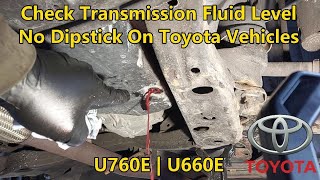
🎬 Watch: How to check fluid levels on transmissions without a dipstick.Generation note: This range covers three Camry generations: the XV30 (2004-2006), XV40 (2007-2011), and XV50 (2012-2017). While the P0711 code has the same meaning, the specific transmission (e.g., U250E 5-speed vs. U760E 6-speed) and the part number for the sensor/harness will differ. The trend of integrating the sensor into the harness is definitive for the 6-speed transmissions in the XV40 and XV50 generations. Older 5-speeds may have a separate sensor.
Symptoms You May Notice
- Check Engine Light illuminated
- Harsh, erratic, or delayed gear shifts
- Vehicle enters 'limp mode' with reduced power and limited gear selection
- Transmission may feel like it is slipping or hesitating
- In some cases, a burning smell from the transmission fluid due to actual overheating or fluid degradation
- Transmission Over-Temperature warning light on the dashboard, even when the transmission is not hot
- Replacing the entire transmission when only the internal harness is needed.
- Replacing the ECM without first thoroughly testing the sensor circuit and wiring.
- Assuming the transmission is overheating when it is just a sensor performance fault.
Most Likely Causes

- Faulty Transmission Fluid Temperature (TFT) Sensor / Internal Wire Harness 🔴 High Probability On many Toyota transmissions of this era (U660E/U760E), the TFT sensor is integrated into the internal wire harness, which lives in the hot, harsh environment of the transmission fluid. Over time, the sensor component or the wiring itself can fail, causing an open or short in the circuit.
How to confirm: Use a scan tool to monitor the transmission fluid temperature (TFT) live data. On a cold engine, the TFT reading should be nearly identical to the engine coolant temp and ambient air temp (within ~5 degrees Fahrenheit). If it's stuck at a default value (like -40°F) or doesn't rise as the car warms up, the sensor or its circuit is faulty.
Typical fix: Drain the transmission fluid, remove the transmission oil pan, and replace the internal wiring harness which contains the new sensor. The valve body may need to be removed to access the harness. Refill with the correct type and amount of Toyota WS (World Standard) fluid.
Est. part cost: $150-$250 for an OEM internal harness. - Low or Degraded Transmission Fluid 🟡 Medium Probability Many of these transmissions are advertised as having 'lifetime' fluid, leading owners to neglect fluid changes. Over time, the fluid degrades and can no longer properly manage heat or may become contaminated, potentially affecting sensor readings or causing other issues.
How to confirm: Check the fluid level and condition. On older models with a dipstick, this is straightforward. On later models (approx. 2007+), this requires a specific service procedure involving an overflow plug and getting the transmission to a precise temperature. Fluid should be reddish-pink; if it's dark brown, black, or smells burnt, it needs to be changed.
Typical fix: Perform a transmission fluid drain-and-fill or a full fluid exchange using the correct Toyota-specific fluid (e.g., Toyota WS).
Est. part cost: $60-$120 for fluid. - Damaged External Wiring or Connectors ⚪ Low Probability The main transmission harness connector can be exposed to moisture and road debris, leading to corrosion on the pins.
How to confirm: Visually inspect the main electrical connector going into the transmission case. Unplug it and check for green or white corrosion, bent pins, or moisture. Test for the 5V reference signal and ground at the connector with a multimeter.
Typical fix: Clean the connector pins carefully or replace the connector pigtail if corrosion is severe. Apply dielectric grease before reconnecting to prevent future moisture intrusion.
Est. part cost: $20-$50 for a connector pigtail.
Rare But Worth Checking
- Faulty ECM/TCM: This is rare. The Engine Control Module (ECM) or Transmission Control Module (TCM) is the last thing to suspect after all wiring and sensor issues have been definitively ruled out.
Diagnosis Steps

- Connect an OBD-II scanner and check for P0711 and any other related codes. Record the freeze frame data.
- View live data. Compare the Transmission Fluid Temperature (TFT) to the Engine Coolant Temperature (ECT) and Intake Air Temperature (IAT) on a completely cold vehicle. They should be within a few degrees of each other.
- Start the vehicle and watch the TFT reading. It should climb steadily as the transmission warms up. If it's stuck, jumps erratically, or stays at a default low/high reading (e.g., -40°F), a circuit fault is likely.
- If the reading is plausible but shifting issues persist, check the transmission fluid level and condition. This is a complex procedure on models without a dipstick and must be done correctly at a specific temperature.
- Inspect the external transmission wiring harness and the main connector at the transmission case for any visible damage, corrosion, or loose connections.
- If external wiring is okay and the fluid level is correct, the issue is almost certainly internal to the transmission. The next step is to replace the component containing the TFT sensor.
- Drain the fluid, drop the transmission pan, and identify if the sensor is separate or part of the internal wire harness. For most 2007+ models, you will be replacing the entire harness.
- Reinstall the pan with a new gasket, and refill the transmission with the manufacturer-specified fluid (Toyota WS) to the correct level using the overflow procedure.
- Clear the codes and perform a test drive to ensure the problem is resolved.
Parts You'll Likely Need

- Transmission Wire Harness (Internal, U760E for I4)
(OEM #82125-73010)— On 4-cylinder Camry models from ~2009-2017 with the U760E transmission, the TFT sensor is integrated into this harness, making it the primary point of failure for P0711.
Trusted brands: Toyota (OEM)
OEM price range: $180-$250
Aftermarket price range: $100-$180 - Transmission Wire Harness (Internal, U660E for V6)
(OEM #82125-33090)— On V6 Camry models from ~2007-2017 with the U660E transmission, the TFT sensor is integrated into this harness.
Trusted brands: Toyota (OEM)
OEM price range: $200-$280
Aftermarket price range: $120-$200 - Automatic Transmission Fluid (Toyota WS)
(OEM #00289-ATFWS)— This specific fluid is required when refilling the transmission after dropping the pan. Using the wrong fluid can cause severe damage.
Trusted brands: Toyota (OEM), Idemitsu TLS-LV, Valvoline MaxLife ATF (check compatibility)
OEM price range: $12-$18 per quart
Aftermarket price range: $8-$12 per quart - Transmission Pan Gasket — A new gasket is required to prevent leaks when reinstalling the transmission oil pan.
Trusted brands: Toyota (OEM), Fel-Pro, Mahle
OEM price range: $25-$40
Aftermarket price range: $10-$20
Related Codes That Often Appear With This One
- P0712 — This code indicates 'TFT Sensor Circuit Low Input,' which can be caused by the same failing sensor or a short in the wiring.
- P0713 — This code indicates 'TFT Sensor Circuit High Input,' which can be caused by the same failing sensor or an open circuit in the wiring.
Technical Service Bulletins (TSBs) & Recalls
- T-SB-0312-17: Addresses torque converter shudder on 2012-2014 models, a separate but common transmission-related issue.
- Warranty Enhancement Program ZE6: Related to the melting/sticky da
Platform-Specific Known Issues
- A recall was issued for 2012-2014 Camry models with the U760E transmission for a software update to correct a shudder during acceleration. While not directly for P0711, it highlights the sensitivity of this transmission's control system.
Mechanic-Grade Diagnostic Values
- TFT Sensor Resistance vs. Temperature — expected: Resistance is inversely proportional to temperature. A specific known-good value is approximately 6.4 kΩ at 10°C (50°F).. Failure: The ECM will log a fault if resistance is less than 79 Ω (short circuit, reads as >150°C) or greater than 156 kΩ (open circuit, reads as -40°C).
- TFT Sensor Circuit Reference Voltage — expected: Approximately 5.0 Volts DC at the sensor connector with the key on, engine off.. Failure: A reading near 0V could indicate a short to ground in the harness, while a reading significantly different from 5V could point to an ECM or wiring issue.
Scan Tool Commands That Help
- Toyota Techstream: Data List (Live Data) — This is the primary diagnostic function for P0711. A technician should access the Powertrain -> Engine and ECT -> Data List menu to monitor the 'A/T Oil Temperature' value. Compare this to the Intake Air and Coolant temperatures on a cold start; they should be within a few degrees. Then, watch for the temperature to rise steadily with operation. A stuck or erratic value confirms a sensor/circuit fault.
Wiring & Ground Locations
- THO1 and E2 Terminals — These are pin designators within the transmission wire connector at the transaxle case and at the main ECM connector.. To definitively test the sensor and wiring, a technician can measure resistance directly between terminals THO1 (the temperature signal) and E2 (sensor ground) at the transmission connector to test the internal harness/sensor, and at the ECM connector to test the entire circuit.
- General Engine/Chassis Grounds — Varies by year, but common locations include the left/right radiator supports, the rear of the engine/surge tank, and points on the firewall or left side of the dash.. While a bad ground for the entire transmission is less common than a sensor failure, a poor ground connection can cause a variety of erratic electrical issues, including incorrect sensor readings. Verifying the main grounds are clean and tight is a good practice if circuit tests are inconclusive.
OEM Part Supersession History
82125-73010→82125-73011— Standard part revision by the manufacturer. The new part is a direct replacement.
Heads up: The new part number (82125-73011) should be used when ordering for the U760E (I4) transmission.
Model Year Variations Within This Range
- 2004-2006 (approx.): Older Camry models equipped with 5-speed transmissions (like the U250E) may have a separate, standalone TFT sensor that can be replaced individually. It is typically located on the valve body inside the transmission pan. This differs from the 2007+ models with 6-speed transmissions where the sensor is almost always integrated into the internal wire harness.
Diagnostic Flowchart
Other Known Issues on This Vehicle
Issues unrelated to this code that are worth knowing about as an owner of this generation:
- Excessive Oil Consumption (2AZ-FE Engine) 🔴 High — Very common in 2007-2011 Camry models with the 2.4L 4-cylinder engine. Caused by a design flaw in the piston rings. Owners may need to add a quart of oil every 1,000-1,500 miles. (Ref: Toyota issued a warranty enhancement program (now expired) to address this.)
- Melting / Sticky Dashboard 🟠 Medium — Widespread on 2007-2011 Camry models, especially in warmer climates. The dashboard material degrades, becomes sticky, and creates a dangerous glare on the windshield. (Ref: Toyota initiated a Warranty Enhancement Program (ZE6) to replace affected dashboards, but the program had deadlines.)
- Torque Converter Shudder 🟠 Medium — Affects some 2012-2014 models with the U760E transmission, causing a vibration or shudder under light load between 25-50 mph. Feels like driving over rumble strips. (Ref: Toyota released TSB T-SB-0312-17 (superseding T-SB-0034-14) which involves replacing the torque converter and/or reprogramming the ECM.)
- A/C System Musty Odor 🟡 Low — Common on the XV50 (2012-2017) generation. Moisture builds up on the evaporator core, leading to a moldy smell from the vents upon startup.
- VVT Cam Gear Rattle on Cold Start (2AR-FE) 🟠 Medium — Some 2010-2017 4-cylinder models may develop a brief rattle on cold startup due to a faulty VVT gear assembly. (Ref: Toyota addressed this with TSB T-SB-0041-13 for the 2012 model year.)
Used vs. New Parts: Buying Guide for This Vehicle
When a used part is the smart pick: For this specific repair, using a used internal transmission wire harness from a junkyard is NOT recommended. The labor to access the part is significant, and a used harness carries a high risk of having the same age-related electronic failure as the part being replaced. The cost of the OEM part is not high enough to justify the risk of a repeat repair.
What to inspect on the donor part:
- Not applicable as used part is not recommended.
OEM-only on this vehicle (don't cheap out):
- Transmission Wire Harness (Internal)
Aftermarket brands forum-validated for this vehicle:
- For transmission fluid, Idemitsu TLS-LV and Valvoline MaxLife ATF are widely considered reliable alternatives to Toyota WS fluid.
Brands owners have reported issues with on this vehicle:
- Be cautious of unbranded, low-cost internal wire harnesses from online marketplaces. A premature failure of a cheap aftermarket harness will require repeating the entire, labor-intensive repair.
Real Owner Stories
Aggregated from forums and TSBs cited above. Mileages and costs reflect what owners reported in those sources.
2011 Camry SE 2.5L
Symptoms: Check Engine Light on with codes P0711 and P0713.
What fixed it: Internal harness replacement.
Source hint: https://www.toyotanation.com/threads/p0711-and-p0713-on-2011-camry-se-2-5l.1693054/ (Discussion on a 2011 Camry with P0711/P0713, confirming internal harness replacement as the fix.)
2010 Camry
Symptoms: Check Engine Light on with code P0711.
What fixed it: Owner confirmed the sensor is part of the internal wire harness, which was replaced to resolve the code.
Source hint: https://www.toyotanation.com/threads/2010-camry-transmission-fluid-temp-sensor-p0711.411099/ (Thread detailing a 2010 Camry P0711 case, where the owner confirmed the sensor is part of the harness.)
Related OBD-II Codes
Frequently Asked Questions
My 2010 Camry has a P0711 code. Is the temperature sensor a separate part I can buy?
I have a 2013 Camry that shudders during acceleration. Is this related to the P0711 code?
What is a reasonable cost for the internal wire harness needed to fix P0711?
My mechanic can't find a dipstick to check the transmission fluid on my 2009 Camry. Is there one?
My scan tool shows the transmission temperature is stuck at -40°F. Does this confirm a bad sensor?
What type of transmission fluid should I use when refilling my Camry's transmission after the repair?
Helpful Videos
Used OEM Parts in Stock


New Aftermarket Parts Available

The information in this article is provided for general reference and educational purposes only. Vehicle specifications, procedures, and part compatibility can vary by production date, trim level, and region. Always consult your vehicle's factory service manual and verify part numbers before purchasing or performing repairs. Safety-critical components such as airbags, seat belts, and braking systems should be installed by a qualified professional.
- Toyota Camry:
- 🎬 Helpful Videos
- 🛍️ Shop This Part
- What's Unique About the 2004-2017 Toyota Camry
- Symptoms You May Notice
- Most Likely Causes
- Rare But Worth Checking
- Diagnosis Steps
- Parts You'll Likely Need
- Related Codes That Often Appear With This One
- Technical Service Bulletins (TSBs) & Recalls
- Platform-Specific Known Issues
- Mechanic-Grade Diagnostic Values
- Scan Tool Commands That Help
- Wiring & Ground Locations
- OEM Part Supersession History
- Model Year Variations Within This Range
- Diagnostic Flowchart
- Other Known Issues on This Vehicle
- Used vs. New Parts: Buying Guide for This Vehicle
- Real Owner Stories
- 2011 Camry SE 2.5L
- 2010 Camry
- Related OBD-II Codes
- Frequently Asked Questions
- 🎟️ Get 5% Off