

OBD-II Code P0710: Transmission Fluid Temperature Sensor 'A' Circuit Malfunction
The Ultimate Guide to P0710: What it means, why it triggers, and how to fix it for good.
What Does P0710 Mean?

The Powertrain Control Module (PCM) or Transmission Control Module (TCM) detected a malfunction in the transmission fluid temperature (TFT) sensor circuit. This sensor reports the exact temperature of the transmission fluid, allowing the computer to control shift points, adjust hydraulic line pressure, and manage the torque converter clutch. Code P0710 triggers when the sensor's signal is irrational, erratic, out of range, or completely absent.
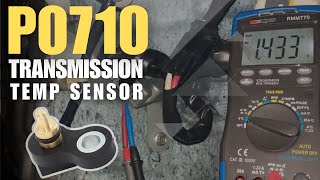
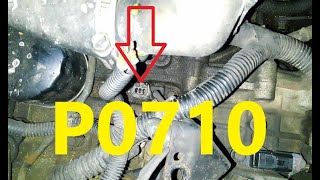
🎬 Watch: How to diagnose the ATF temperature sensor circuit.Technical definition: The SAE/OBD-II definition for P0710 is "Transmission Fluid Temperature Sensor 'A' Circuit Malfunction." The TFT sensor is a negative temperature coefficient (NTC) thermistor; its internal resistance decreases as temperature increases. The PCM supplies a 5-volt reference and expects a return voltage corresponding to a plausible fluid temperature (e.g., ~3.5V cold, <1.0V hot). A signal stuck high (5V) or low (0V) indicates a hard circuit fault, such as resistance below 79 Ω (>302°F) or above 156 kΩ (<-40°F).
Can I Drive With P0710?
yes_but_not_recommended. You can drive short distances to reach a repair shop, but it is highly discouraged. The transmission will likely shift harshly, lock into a single gear ('limp mode'), or overheat, posing a safety risk. Continuing to drive turns a $150 sensor repair into a $3,500+ catastrophic transmission failure.
Common Causes

- Faulty Transmission Fluid Temperature (TFT) Sensor (Very Common) — The thermistor degrades over time, becomes contaminated by dirty fluid, or fails electrically, sending incorrect resistance values to the TCM.
- Wiring or Connector Issues (Very Common) — External wiring harnesses suffer damage from heat, vibration, and road debris. Frayed wires, shorts to ground, or corroded connector pins disrupt the 5V signal.
- Internal Transmission Harness Failure (Common) — In modern vehicles, the TFT sensor integrates into a plastic lead frame inside the transmission pan. Constant heat cycles make this assembly brittle, causing internal cracks and open circuits.
- Low or Contaminated Transmission Fluid (Common) — Degraded fluid filled with clutch material insulates the sensor, causing inaccurate readings. Low fluid causes genuine overheating that triggers the sensor.
- Failed TCM or PCM (Rare) — The control module's internal driver circuit fails due to cracked solder joints or software corruption. Rule out all physical circuit issues before replacing modules.
Symptoms
- Check Engine Light is On — The Malfunction Indicator Lamp (MIL) illuminates immediately upon the TCM detecting the circuit fault.
- Harsh or Delayed Shifting — Without accurate temperature data, the TCM fails to regulate line pressure, causing the transmission to slam into gear or hesitate.
- Vehicle Enters 'Limp Mode' — The TCM defaults to a single gear (usually 3rd) to prevent internal damage, severely limiting acceleration and top speed.
- Decreased Fuel Economy — Inefficient shifting and failure of the torque converter clutch to lock up force the engine to work harder, dropping fuel efficiency by 10-20%.
- Irrational Temperature Reading on Scan Tool (scan-tool only — no driver-felt sign) — Live data displays an illogical TFT value, such as -40°F or 300°F, confirming an electrical open or short.
Diagnostic Flowchart

Tap your situation to follow the diagnostic path that matches what you're seeing on this code.
Common Fixes & Costs
- Replace Transmission Fluid Temperature (TFT) Sensor — Parts: $20-$100, Labor: $150-$350, ~1.5 hr book time (Intermediate)
- Repair Damaged Wiring or Replace Connector — Parts: $10-$50, Labor: $100-$200, ~1.2 hr book time (Intermediate)
- Replace Internal Transmission Wiring Harness/Lead Frame — Parts: $150-$400, Labor: $300-$600, ~3.5 hr book time (Advanced)
- Transmission Fluid and Filter Service — Parts: $50-$150, Labor: $150-$300, ~1.5 hr book time (DIY)
- TCM/PCM Software Update or Re-flash — Parts: $0, Labor: $150-$250, ~1.0 hr book time (Professional)
DIY vs Professional
- Replace External TFT Sensor — Beginner: True
Tools: Wrench set, socket set, drain pan. - Transmission Fluid and Filter Service — Beginner: True
Tools: Socket set, torque wrench, drain pan, fluid pump/funnel. - Repair Damaged Wiring or Replace Connector — Beginner: False
Tools: Multimeter, wire strippers, crimpers, heat shrink tubing. - Replace Internal TFT Sensor / Harness / Lead Frame — Beginner: False
Tools: Socket set, torque wrench, drain pan, fluid pump, inch-pound torque wrench. - Replace TCM/PCM — Beginner: False
Tools: Socket set, specialized programming tools.
Used vs. New Parts: Buying Guide
When a used part is worth it: For an external TFT sensor, a used OEM part from a low-mileage vehicle is cost-effective. For internal parts like a lead frame, buying used is highly risky due to labor costs.
Donor-vehicle mileage cap: roughly under 60000 miles for the part to have meaningful remaining life.
Donor quality checklist:
- Verify the donor vehicle was not scrapped due to transmission failure.
- Avoid donors from flood-damaged or high-corrosion regions.
- Match the part number exactly to ensure compatibility.
Decision logic:
- If The part is an external sensor and the new OEM part is over $100 → A used sensor from a reputable salvage yard is a reasonable gamble.
- If The part is internal (harness, lead frame, conductor plate) → Buy new. The labor cost to replace it is too high to risk using a part with an unknown history.
- If The part is a TCM/PCM → Favor a new or professionally remanufactured unit with a warranty and programming support.
Warranty tradeoff: Used parts carry 30-90 day warranties that exclude labor. New aftermarket parts offer 1-year warranties, while new OEM parts carry 1-2 year warranties.
Worst-case if a used part fails: 400-800 if a used internal part fails shortly after installation, requiring you to pay labor twice.
What Happens If You Wait — Timeline
- 0-1 month: Check Engine Light is on. Shifting becomes slightly harsher. The torque converter fails to lock up efficiently. (MPG impact: 3-8%% · Added cost: $20-$80 in wasted fuel.)
- 1-4 months: Harsh shifting becomes consistent. The vehicle intermittently enters 'limp mode'. Accelerated wear on clutch packs occurs due to incorrect line pressure. (MPG impact: 10-20%% · Added cost: $500-$1,500 (Premature wear on clutches and solenoids begins).)
- 4-8 months: Prolonged operation with incorrect pressures leads to significant internal damage. Transmission slips or produces a burnt fluid smell. Limp mode becomes permanent. (MPG impact: 20-30%+% · Added cost: $1,500-$3,500 (Solenoid and valve body damage requires minor rebuild).)
- 8+ months: Catastrophic internal failure. The transmission fails to engage any gear, leaving the vehicle stranded. (MPG impact: N/A (Vehicle is likely undrivable)% · Added cost: $3,500-$8,000+ (Full transmission replacement or rebuild is necessary).)
Cost of Not Fixing It
- 0-1 month: Erratic shifting, poor fuel economy (10-20% reduction), and potential for being stranded if limp mode engages. (Added cost: 50-150)
- 1-6 months: Harsh shifting causes premature wear on clutches and bands. Incorrect line pressure damages internal seals and solenoids. (Added cost: 1500-3500)
- 6+ months: Catastrophic transmission failure due to prolonged operation with incorrect pressures and overheating. Requires a complete rebuild. (Added cost: 3500-8000)
Diagnosis Steps
- Scan for All Diagnostic Trouble Codes (DTCs)
Use an OBD-II scanner to read all codes. Note related codes like P0712 (Low Input/Short) or P0713 (High Input/Open). The specific code combination dictates whether you are hunting for a broken wire or a grounded circuit.
Tools: OBD-II Scanner (Beginner) - Analyze Live Sensor Data
Monitor the 'Transmission Fluid Temperature' PID. A reading stuck at -40°F or 300°F confirms a hard circuit fault. Normal operating temperature is 170°F-200°F. If the temperature is plausible but static, suspect a failing sensor.
Tools: Advanced OBD-II Scanner (Intermediate) - Visually Inspect External Wiring and Connectors
Check the transmission's main electrical connector for broken wires, fluid intrusion, or backed-out pins. Focus on areas where the harness routes near hot exhaust components.
Tools: Flashlight, Inspection Mirror (Intermediate) - Inspect Transmission Fluid Level and Condition
Low, dark, or burnt fluid indicates overheating or contamination. Verify levels on a level surface at the correct temperature specified in the service manual.
Tools: Rag, Gloves, Level Surface (Beginner) - Test Sensor Reference Voltage and Signal Circuit
Disconnect the sensor. With key on/engine off, verify a 5-volt reference from the PCM. An open circuit shows 5V on the signal wire; a short to ground shows 0V. This isolates wiring issues from sensor failure.
Tools: Multimeter, Service Manual (Advanced) - Test Sensor Internal Resistance
Measure resistance across the disconnected sensor pins. Compare to the manufacturer's temperature-to-resistance chart. Infinity (open) or zero (shorted) means the sensor is dead.
Tools: Multimeter, Service Manual (Advanced) - Perform Voltage Drop Test on Ground Circuit
Back-probe the sensor's ground pin with the engine running. A reading above 100mV indicates high resistance in the ground path, a common cause of false sensor codes.
Tools: Multimeter, Back-Probes (Advanced)
When This Code Triggers (Freeze-Frame Conditions)
- Engine Coolant Temp: 180-205°F (82-96°C) (The fault often sets when the engine reaches full operating temperature.)
- RPM: 1200-2500 (Triggers during steady-state driving or light acceleration.)
- Vehicle Speed: 30-60 mph (48-97 kph) (Frequently triggers during city or highway cruise conditions.)
- Transmission Fluid Temp (Reported): -40°F or >300°F (-40°C or >150°C) (Freeze frame shows an irrational temperature, confirming an electrical open or short.)
Related Codes
- P0711 — TFT Sensor 'A' Circuit Range/Performance. The sensor provides a signal, but it fluctuates implausibly or fails to rise with engine temperature.
- P0712 — TFT Sensor 'A' Circuit Low. The signal voltage is lower than minimum specification, interpreted as extremely high temperature (>300°F). Caused by a short to ground.
- P0713 — TFT Sensor 'A' Circuit High. The signal voltage is higher than maximum specification, interpreted as extremely low temperature (<-40°F). Caused by an open circuit.
- P0218 — Transmission Over Temperature Condition. The transmission is confirmed to be overheating. If paired with P0710, the sensor is likely working and reporting a real mechanical issue.
Climate & Environmental Factors
- Cold Climates / Road Salt: Salt brine acts as an electrolyte, accelerating the corrosion of copper pins and external wiring connectors, leading to high resistance or open circuits.
- High Heat / Hot Climates: High ambient temperatures increase transmission operating temperatures, accelerating the degradation of internal plastic wiring harnesses until they become brittle and crack.
- High Humidity: Humid environments promote moisture intrusion into poorly sealed connectors, causing intermittent signals and corrosion.
How to Talk to a Mechanic About This Code
Say this: "I have a P0710 code and harsh shifting. I need a diagnostic to test the transmission fluid temperature sensor circuit, including the 5V reference and ground, and check for any related TSBs."
This signals that you understand the code relates to a circuit, not just the sensor. It directs the mechanic to perform proper multimeter diagnosis rather than immediately replacing parts.
Avoid saying:
- 'My check engine light is on, can you look at it?'
- 'My transmission is acting weird.'
- 'Just replace the transmission temperature sensor.'
Questions to ask before authorizing the repair:
- Did you test the sensor's resistance and the circuit's voltage/ground, or just read the code?
- Can you show me the live data reading for the transmission temperature from your scan tool?
- Is there a Technical Service Bulletin (TSB) for this issue on my vehicle? Did you check for a software update?
- If the sensor is internal, does the estimate include a new pan gasket, filter, and the correct type of transmission fluid?
- What is the warranty on the parts and labor for this repair?
Where to Take It: Dealer vs Independent vs Chain
- Dealer:
Recommended if a known TSB/warranty extension applies or for complex German cars. Otherwise, an independent shop is more cost-effective.
Best for: Vehicles under warranty or with a known TSB (e.g., Nissan/Infiniti CVT software update, Ford lead frame)., Complex European makes (Mercedes, BMW) requiring programming of electronic conductor plates.
Downsides: Highest labor rates., Defaults to replacing expensive assemblies rather than repairing wiring. (Typical cost: +50% vs. baseline) - Independent Shop:
Best overall fit for most P0710 repairs. A transmission-focused independent shop provides the best value.
Best for: Out-of-warranty vehicles with common P0710 failures (e.g., Hyundai/Kia internal harness)., General wiring and circuit diagnosis.
Downsides: Diagnostic capabilities vary; look for ASE certifications in transmission work., Lacks access to the latest manufacturer software updates. (Typical cost: +0% vs. baseline) - Chain Shop:
Use with caution. Acceptable for a straightforward external sensor swap, but avoid for internal transmission work.
Best for: Simple, external sensor replacements where the diagnosis is already certain.
Downsides: Technician skill varies greatly; lacks in-depth transmission diagnostic experience., High pressure to upsell unnecessary transmission flushes. (Typical cost: -10% vs. baseline)
When to Walk Away From the Repair
If the estimated repair cost exceeds 40-50% of the car's private-party value, sell the car as-is.
- Car worth $4000, fix is $2000: Walk away. The repair cost is 50% of the car's value, and a transmission issue significantly lowers resale value.
- Car worth $12000, fix is $700: Fix it. The repair is well under the threshold and restores the vehicle's function and value.
- Car worth $3000, fix is $2500: Walk away. The repair cost is over 80% of the car's value. It is not a sound financial decision.
What Scan Tool You Need for This Code

Minimum: An OBD-II scanner that reads live data, specifically the 'Transmission Fluid Temperature' PID.
A basic $20 code reader only shows the P0710 code. It cannot display the live temperature reading, which is essential to determine if the sensor is providing an illogical signal (-40°F) or a static signal.
Budget: XTOOL A30M or BlueDriver Pro (~$80-120) — Connects to a smartphone via Bluetooth to access and graph live data from the transmission module, sufficient for DIY diagnosis.
Mid-range: Foxwell NT510 Elite or XTOOL D7 (~$150-350) — Handheld tablets offering full-system diagnostics, live data graphing, and bidirectional controls to read manufacturer-specific transmission codes.
Professional: Autel MaxiCOM MK808/MK906BT or Launch X431 series (~$500-1200) — Provides full bidirectional control to test circuits, performs advanced programming for replacing modules, and accesses OEM-level diagnostic procedures.
Rent vs buy: Auto parts stores rent basic scanners for free, but they lack live data capability. Buying a budget-friendly scanner under $100 is a necessary investment for diagnosing P0710.
How to Clear the Code After You Fix It
- Use an OBD-II scan tool to clear the Diagnostic Trouble Codes (DTCs).
- Perform a transmission drive cycle to allow the computer to re-learn and verify the fix.
Drive cycle (~20 minutes): Start the engine cold. Let it idle for 3 minutes. Drive through all gears, including reverse. Continue with 15 minutes of mixed city/highway driving. Park and check for pending codes.
Readiness monitors affected: Comprehensive Component Monitor (CCM)
Before emissions retest: drive at least 50 miles to fully set monitors.
Watch out for:
- Disconnecting the battery clears the code but erases readiness monitors, causing an immediate emissions test failure.
- If the underlying fault is not fully repaired, the code returns during the drive cycle.
Will This Fail Emissions / State Inspection?
Yes — this code typically fails an OBD-II emissions inspection.
- California: A P0710 code is an automatic failure. The Check Engine Light being on fails the OBD-II portion of the Smog Check.
- New York: The NYS Vehicle Inspection Program requires an OBD-II scan. A P0710 code results in an emissions test failure.
- Texas: In the 17 counties requiring emissions testing, an illuminated Check Engine Light and a P0710 code cause an inspection failure.
Most Commonly Affected Vehicles
- Hyundai / Kia Elantra, Sonata, Optima, Sportage (2011-2016) — Extremely common failure of the internal transmission wiring harness (part # 46307-3B650) which contains the integrated TFT sensor. Replacing the harness is the standard fix.
- Nissan / Infiniti Altima, Rogue, Murano, Sentra, G37, QX60 (2007-2018) — Very common on CVTs. TSBs ITB15-004 and NTB15-014 address updating TCM software to correct false P0710 codes before replacing hardware.
- Ford Focus, Fiesta, F-150, Explorer (2011-2019) — For F-150/Explorer with 6R80 transmissions, the molded lead frame is a known high-failure part (Part # AL3Z-7G276-D). Ford issued Customer Satisfaction Program 19N01 for this issue.
- Mercedes-Benz C-Class, E-Class, S-Class, ML, GL (with 722.9 transmission) (2004-2015) — The TFT sensor is integrated into the VGS/conductor plate. These plates are a notorious failure point, requiring replacement and programming of the entire unit.
- BMW X5, 3-Series, 5-Series (E46, E39, E60, E90) (1999-2013) — P0710 often appears due to corrosion in the main transmission harness connector or mechatronics sleeve leaking fluid into the connector.
- Honda / Acura CR-V, Accord, Civic, MDX (with CVTs) (2014-2022) — Service information suggests P0710 is frequently caused by an electrical circuit problem (wiring or connectors) rather than a mechanical failure.
- Toyota Camry, 4Runner, Corolla, RAV4 (2002-2016) — On the 4th Gen 4Runner, the sensor is on the exterior of the transmission case. On many Camry/Corolla models, it is internal to the pan.
- Chevrolet / GMC Silverado, Sierra, Tahoe, Suburban (with 6L80/6L90) (2009-2019) — Common failure of the Transmission Electro-Hydraulic Control Module (TEHCM), which includes the TFT sensor. The whole assembly requires replacement.
Manufacturer-Specific Notes
- Infiniti/Nissan: TSBs (like NTB15-014) fix false P0710 codes with a simple TCM software update. Always check for applicable TSBs before replacing hardware.
- Hyundai/Kia: The temperature sensor integrates into the main internal wiring harness, which becomes brittle and cracks. Replacing the entire harness is the standard repair.
- Mercedes-Benz: On 7G-Tronic transmissions, the sensor is permanently part of the electronic conductor plate. This entire unit must be replaced and programmed as a whole.
- Ford: On 6R80 transmissions, the molded lead frame containing the TFT sensor is a known weak point subject to extended warranty 19N01.
Real Owner Stories
2013 Ford F-150 at 140K miles
Check engine light came on, transmission suddenly downshifted to 1st gear on the highway, and the speedometer dropped to zero.
Outcome: The owner paid $1,500 at an independent shop to replace the lead frame assembly (part AL3Z-7G276-D) after the extended warranty expired.
Lesson: For Ford 6R80 transmissions, P0710 combined with speed sensor codes almost always points to the internal lead frame. Check for warranty extensions like 19N01.
2013 Infiniti G37x with clunky shifting
Owner experienced clunky shifting between gears 1-3 in stop-and-go traffic. The Service Engine Soon light illuminated with code P0710.
Outcome: A Nissan dealer performed a TCU software update for one hour of labor ($180). This resolved the P0710 code and the clunky shifting.
Lesson: On Nissan/Infiniti vehicles, P0710 is often a software glitch. A 1-hour software update is much cheaper than hardware replacement.
2011-2016 Hyundai/Kia (various models)
Car suddenly goes into limp mode (stuck in 3rd gear) with a P0710 code. Scan tool shows an irrational temperature reading of -40°F.
Outcome: The owner replaced the cracked internal transmission wiring harness (Part # 46307-3B650) for $600 at a local shop, permanently fixing the issue.
Lesson: For affected Hyundai/Kia models, P0710 guarantees a failed internal harness. Replace the entire harness assembly, not just the sensor.
2006 Nissan Titan with recent repair
Immediately after replacing the valve body and TCM, a P0710 code appeared and would not clear.
Outcome: The integrated TFT sensor within the new valve body was faulty from the factory. The owner replaced the valve body assembly again under parts warranty.
Lesson: If a code appears immediately after a repair, suspect a faulty new part or an unseated connector. Test new sensors before installation.
How to Prevent This Code From Triggering
- Change transmission fluid and filter at recommended intervals (Every 30,000-60,000 miles) — Fresh fluid provides superior heat dissipation, preventing overheating conditions that stress the sensor. It removes metallic debris that contaminates the sensor.
- Inspect and clean external electrical connectors (Every 1-2 years) — Applying dielectric grease to connector pins creates a barrier against moisture and road salt, preventing corrosion that leads to open circuits.
- Maintain the engine's cooling system (As per manufacturer schedule) — The transmission cooler integrates with the engine's radiator. A healthy cooling system prevents genuine fluid overheating that damages transmission internals.
- Avoid excessive towing and aggressive driving (Daily habit) — Towing beyond capacity generates excessive heat. Keeping heat levels normal prolongs the life of the fluid, internal wiring harness, and sensor.
Helpful Videos


The information in this article is provided for general reference and educational purposes only. Vehicle specifications, procedures, and part compatibility can vary by production date, trim level, and region. Always consult your vehicle's factory service manual and verify part numbers before purchasing or performing repairs. Safety-critical components such as airbags, seat belts, and braking systems should be installed by a qualified professional.
- 🎬 Helpful Videos
- What Does P0710 Mean?
- Can I Drive With P0710?
- Common Causes
- Symptoms
- Diagnostic Flowchart
- Common Fixes & Costs
- DIY vs Professional
- Used vs. New Parts: Buying Guide
- What Happens If You Wait — Timeline
- Cost of Not Fixing It
- Diagnosis Steps
- When This Code Triggers (Freeze-Frame Conditions)
- Related Codes
- Climate & Environmental Factors
- How to Talk to a Mechanic About This Code
- Where to Take It: Dealer vs Independent vs Chain
- When to Walk Away From the Repair
- What Scan Tool You Need for This Code
- How to Clear the Code After You Fix It
- Will This Fail Emissions / State Inspection?
- Most Commonly Affected Vehicles
- Manufacturer-Specific Notes
- Real Owner Stories
- 2013 Ford F-150 at 140K miles
- 2013 Infiniti G37x with clunky shifting
- 2011-2016 Hyundai/Kia (various models)
- 2006 Nissan Titan with recent repair
- How to Prevent This Code From Triggering
- 🎟️ Get 5% Off