

P0700 on 2007-2018 Jeep Wrangler: Transmission Fault Causes and Fixes
P0700 is a general alert that your Jeep Wrangler's transmission has a problem. It means the Transmission Control Module (TCM) has stored a specific fault code. The most common underlying issues are a faulty transmission solenoid pack (42RLE) or conductor plate (W5A580), or a bad speed sensor, often putting the Jeep in 'limp mode.'
- P0700 is not the problem, it's a signpost. You MUST scan the Transmission Control Module (TCM) for the specific fault code.
- For a 2007-2018 Wrangler stuck in limp mode with a P0700, the most likely culprits are a bad solenoid pack or a faulty speed sensor.
- Always check the transmission fluid level and condition first, as it's a simple and common cause.
- Be aware of potential TIPM (fuse box) failure on this platform, especially if you have other strange electrical symptoms.
- Do not immediately assume the transmission needs to be replaced; the fix is often a much less expensive component.
What's Unique About the 2007-2018 Jeep Wrangler

On the 2007-2018 (JK) Wrangler, the P0700 code is frequently the first sign of the vehicle entering 'limp mode,' where it gets stuck in a single gear (usually second) to prevent further damage. This generation spans two different automatic transmissions: the 42RLE (2007-2011) and the more robust W5A580/NAG1 (2012-2018). While both can suffer from common issues like solenoid failure, the JK platform is also uniquely prone to problems with the Totally Integrated Power Module (TIPM), which can cause bizarre electrical issues that mimic or directly cause transmission faults. Off-road use also makes these vehicles particularly susceptible to wiring harness damage.
Generation note: The 2007-2018 model years cover the entire 'JK' generation of the Jeep Wrangler. However, there is a significant powertrain change: - 2007-2011 models use a 3.8L V6 engine with a 42RLE 4-speed automatic transmission. - 2012-2018 models use the 3.6L Pentastar V6 with a Mercedes-designed W5A580 (also called NAG1) 5-speed automatic transmission. While many causes are similar, the specific parts (like solenoid packs and valve bodies) are different between these two transmissions. The failure points and repair procedures are distinct for each.
Symptoms You May Notice

- Check Engine Light is on
- Transmission is stuck in one gear (limp mode, usually 2nd gear)
- Harsh or erratic shifting
- Delayed engagement when shifting from Park to Drive or Reverse
- Inability to shift gears
- Vehicle may stall, especially when shifting into gear from a cold start
- Hot oil warning light on the dashboard after struggling in limp mode
- Replacing the entire transmission without proper diagnosis. The P0700 code often points to a much cheaper, replaceable component like a sensor, solenoid pack, or conductor plate.
- Ignoring the specific codes in the TCM. P0700 is only a general alert; the real problem is identified by the secondary codes.
- Replacing the PCM/TCM without first ruling out wiring, sensor, and solenoid issues. The PCM is expensive and often not the root cause.
Most Likely Causes

- Faulty Transmission Solenoid Pack (42RLE) or Conductor Plate (W5A580) 🔴 High Probability Solenoids are high-wear components controlling fluid flow. On the 42RLE, the entire solenoid pack is a common failure item. On the W5A580/NAG1, the solenoids are part of a 'conductor plate' which also houses the speed sensors and is a notorious weak point.
How to confirm: Scan the TCM for specific solenoid-related codes (e.g., P0750, P0755, P0760). The fix involves dropping the transmission pan to access and replace the solenoid pack (42RLE) or the entire conductor plate/valve body assembly (W5A580).
Typical fix: For 42RLE, replace the solenoid pack, transmission fluid, and filter. 🎬 Watch: Step-by-step guide to replacing the 42RLE transmission solenoid pack. For W5A580, replace the conductor plate, fluid, filter, and the electrical connector sleeve, which is prone to leaking.
Est. part cost: $100-$350 - Faulty Input or Output Speed Sensor 🟡 Medium Probability On the 42RLE, these are individual sensors on the outside of the case that can fail. On the W5A580, they are integrated into the conductor plate, so the whole plate must be replaced if a sensor fails. Sensor failure prevents the TCM from verifying gear changes.
How to confirm: Scan the TCM for speed sensor codes (e.g., P0715, P0720, P0721). On the 42RLE, the sensor can be removed and tested. On the W5A580, the code confirms a conductor plate issue.
Typical fix: On 42RLE, replace the specific faulty sensor. On W5A580, this requires replacing the entire conductor plate assembly. 🎬 See how to remove the conductor plate on NAG1 transmissions.
Est. part cost: $25-$75 (for 42RLE sensor), $150-$300+ (for W5A580 conductor plate) - Low or Dirty Transmission Fluid 🟡 Medium Probability Off-road use can lead to leaks from pan damage, and neglected maintenance allows fluid to break down, causing poor hydraulic pressure and overheating.
How to confirm: Check the transmission fluid level and condition. The 2007-2011 42RLE has a dipstick. The 2012-2018 W5A580 does not have a dipstick and must be checked from a fill plug at a specific temperature. Burnt-smelling or dark fluid indicates a problem.
Typical fix: Perform a transmission fluid and filter change. Use only the specified fluid (ATF+4 for 42RLE, specific fluid for W5A580). If the level is low, top it off and inspect for leaks.
Est. part cost: $60-$150 - Faulty Totally Integrated Power Module (TIPM) ⚪ Low Probability The TIPM in JK Wranglers is notoriously unreliable. Internal relays, including those that power the transmission circuits, can fail and cause a host of intermittent electrical issues, including limp mode.
How to confirm: Diagnosis is difficult. Look for other unrelated electrical symptoms like horn, wipers, or fuel pump issues occurring simultaneously. A mechanic may need to perform a hard reset or test power output from the TIPM. Forum threads often describe a cascade of bizarre electrical failures.
Typical fix: Repair or replace the TIPM. This is an expensive part and often requires programming to the vehicle. Some owners opt for used or refurbished units.
Est. part cost: $400-$1000
Rare But Worth Checking
- Damaged Wiring Harness: Wranglers used off-road are susceptible to damage to the wiring harness leading to the transmission from rocks, branches, or water intrusion, causing shorts or open circuits. Corrosion in the connectors at the TIPM or TCM/PCM is also a common issue.
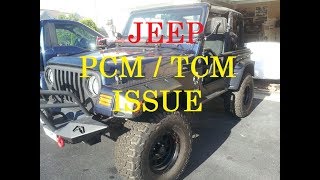
- Faulty Transmission Control Module (TCM) / Powertrain Control Module (PCM): While less common than sensor or solenoid failure, the control module itself can fail. On the JK Wrangler, the TCM function is integrated into the PCM. This is usually the last part to suspect after all other components and wiring have been checked. 🎬 Watch this video to understand TCM failure codes and diagnosis.
- Weak Battery or Failing Alternator: Low system voltage can cause communication errors between modules, leading to a P0700 code without an actual transmission fault. This is a common misdiagnosis and should be checked early in the diagnostic process. In NHTSA ODI #11268694, an owner reported that after receiving codes P0700, P0562, and P0750, they replaced the battery and changed the transmission fluid and filters to address the high RPMs before shifting.
Diagnosis Steps
- Obtain a full code scan using an advanced scanner capable of reading codes from the Transmission Control Module (TCM). Do not rely on a basic reader that only shows engine codes.
- Record the P0700 code from the ECM and, more importantly, all specific P0xxx or Uxxxx codes from the TCM. These secondary codes are the key to the diagnosis.
- Check the transmission fluid level and condition. For 2012+ models (W5A580), this requires the vehicle to be at a specific temperature and is checked via a fill plug. Fluid should be bright red and not smell burnt.
- Based on the specific TCM codes, begin diagnosing the indicated component (e.g., shift solenoid for P0750, speed sensor for P0720).
- Inspect the transmission wiring harness and connectors for any signs of physical damage, corrosion, or loose connections, especially if the vehicle is used off-road. Pay close attention to the main connector on the transmission.
- Test the battery and charging system to ensure stable voltage is being supplied to all modules. Low voltage can cause numerous spurious codes.
- If multiple, seemingly unrelated electrical issues are present (wipers, horn, door locks), investigate the TIPM as a potential cause.
- If all sensors, solenoids, and wiring check out, the final step is to diagnose the PCM/TCM itself, which may require professional assistance.
Parts You'll Likely Need

- Transmission Solenoid Pack (42RLE)
(OEM #Mopar 04800171AA, 5143151AA)— This is the most frequent failure point on the 2007-2011 42RLE transmission that will trigger a P0700 and put the transmission in limp mode.
Trusted brands: Mopar, Rostra, Napa (Remanufactured)
OEM price range: $250-$350
Aftermarket price range: $80-$200 - Transmission Conductor Plate (W5A580/NAG1)
(OEM #Mopar 52108308AC (supercedes 52108308AB))— For 2012-2018 models, failure of the speed sensors integrated into this plate is a primary cause of P0700 and limp mode.
Trusted brands: Mopar, Dorman, APDTY
OEM price range: $250-$400
Aftermarket price range: $85-$270
Related Codes That Often Appear With This One
- P0750-P0770 — These codes point to specific shift solenoid circuit malfunctions, which are a primary cause of P0700, especially on the 42RLE transmission.
- P0715 / P0721 — These codes indicate a fault with the input or output speed sensor circuits, respectively. On a W5A580, this points directly to a faulty conductor plate.
- U0101 — This code indicates a loss of communication with the TCM, which could be caused by a wiring issue, a TIPM fault, or a failed PCM/TCM itself.
- P0882 — This code indicates a fault with the TCM power input circuit being low. It can be caused by a bad relay in the TIPM, a wiring short, or a failing PCM.
Platform-Specific Known Issues
- 42RLE (2007-2011) Solenoid Pack Failure: The 4-speed 42RLE is known for failures of the solenoid pack, which is a single block containing multiple shift solenoids. Replacement is a common repair and involves dropping the transmission pan and valve body. A DIY-focused video shows the process, highlighting the messiness but feasibility for a home mechanic.
- W5A580/NAG1 (2012-2018) Conductor Plate Failure: The 5-speed W5A580 has a different common failure point: the conductor plate. This plastic plate sits atop the valve body and contains the speed sensors and all electrical contacts for the solenoids. It is known to fail, causing speed sensor codes and limp mode. The entire plate must be replaced as the sensors are integrated.
- TIPM Electrical Gremlins: The Totally Integrated Power Module (TIPM) is a known weak point on all JK Wranglers. Failing internal relays can cause intermittent power loss to the transmission control circuits, triggering a P0700 and limp mode, often accompanied by other strange electrical behavior like wipers or horn activating on their own.
Mechanic-Grade Diagnostic Values
- 42RLE Shift Solenoid Resistance — expected: ~1.7 ohms (varies with temperature). Failure: An open circuit (infinite resistance) or a reading significantly outside the expected range.
- 42RLE Pressure Switch Resistance — expected: ~299 ohms (varies with temperature). Failure: An open circuit or a reading significantly outside the expected range.
- W5A580/NAG1 Solenoid Resistance (tested from TCM connector) — expected: Line Pressure (Pins 38-36): ~5.5 ohms; 2-3 Shift (Pins 38-16): ~4.5 ohms; 3-4 Shift (Pins 38-15): ~4.5 ohms; TCC Lock-up (Pins 38-17): ~2.7 ohms.. Failure: Readings that are significantly different, indicating a faulty solenoid or wiring issue.
- TCM Power Input Voltage (related to P0882) — expected: Greater than 3.0 volts when the ignition is in the 'RUN' position.. Failure: Voltage less than 3.0 volts will set code P0882 and put the vehicle in limp mode.
Scan Tool Commands That Help

- JScan, Autel, wiTECH: Quick Learn — Required after replacing the transmission, valve body, solenoid pack, or sometimes after a battery disconnect to reset shift adapts and ensure smooth shifting.
- JScan, wiTECH: TCM Reset Learned Additives (W5A580/NAG1) — Used to force the transmission to re-calibrate itself to a baseline operation. This is recommended after replacing the valve body, conductor plate, or internal clutch components.
- JScan, wiTECH: Initialize EGS (W5A580/NAG1) — This function transfers data (like axle ratio or tire size changes) into the transmission module. It's necessary when vehicle parameters that affect shift points are modified.
Wiring & Ground Locations

- Transmission Wiring Harness Chafe Point (42RLE) — Behind the engine, near the top of the transmission bellhousing. The harness can rub against the engine block or firewall.. A common, but hidden, cause for a short circuit on the TCM power supply wire. This often results in a P0882 code (TCM Power Input Low) and causes the transmission to enter limp mode. The wire insulation wears through, grounding the circuit.
- Transmission Control Relay (in TIPM) — Inside the Totally Integrated Power Module (TIPM) in the engine bay. For a 2010 model, it is one of the large relays.. This relay supplies power to the TCM/PCM transmission control circuits. A faulty relay can cause code P0882 and lead to limp mode. Swapping it with an identical relay (like the rear defogger) is a quick diagnostic test.
- W5A580/NAG1 TCM Connector — The TCM is located under the dashboard, near the steering column. The connector can be accessed to test the entire transmission electrical system without dropping the pan.. Allows a technician to test resistance of all solenoids and speed sensors from a single point. Pin 38 is the common power return for the solenoids, allowing for easy testing of each one against its respective control pin.
Real Owner Repair Stories
- YouTube channel 'Jeep Wrangler Limp Mode FIX' (2010 Jeep Wrangler (42RLE)) — Stuck in 2nd gear (limp mode), check engine light on, blowing the J18 fuse repeatedly.
❌ Tried (didn't work) Continuously replacing the blown fuse.
✅ What actually fixed it Found a shorted wire in the main engine wiring harness where it was rubbing against the back of the engine block. The insulation on the power wire to the transmission had worn through, causing a direct short to ground. Repairing the single damaged wire and protecting the harness with loom fixed the issue for free. - YouTube channel 'slowlow_crewcab' (GM Truck with Allison 1000 (similar principle to Jeep connector leaks)) — Transmission limp mode, P0700 code present. Resetting the code would work for a couple of days before the light returned.
❌ Tried (didn't work) Clearing the codes without addressing the leak.
✅ What actually fixed it Transmission fluid was found to have wicked up into the main electrical harness connector. The internal seal of the connector on the transmission case had failed. Replacing the connector housing (which includes new seals) and cleaning the harness-side plug with electrical cleaner resolved the fault. - NHTSA ODI #11376167 — An owner of a similar Jeep model reported that occasionally the transmission ceased in first gear. A diagnosis retrieved DTC codes P0700 (TCM) and P0734 (Incorrect Gear Ratio).
- NHTSA ODI #10992967 — A report for a similar vehicle noted a P0700 code accompanied by shifting problems described as "slipping (free wheeling)."
Documented NHTSA Reports
- NHTSA ODI #10984300: An owner reported a transmission control system malfunction involving code P0700, noting that the issue is frequently discussed on Jeep forum sites as an unsafe condition that has not yet been recalled.
- NHTSA ODI #11308068: A report describes a check engine light incident where OBDII codes U0404 and P0700 were downloaded. A mechanic suggested driving the vehicle for a while, after which the codes reportedly cleared on their own.
OEM Part Supersession History
52108308AB→52108308AC— Updated design or manufacturing process for the W5A580/NAG1 conductor plate.
Model Year Variations Within This Range

- 2007-2011 (42RLE): The TCM function is integrated directly into the Powertrain Control Module (PCM). A common failure is a short in the wiring harness behind the engine causing a P0882 code.
- 2012-2018 (W5A580/NAG1): Uses a separate Transmission Control Module (TCM) located under the dash. The most common failure is the conductor plate inside the transmission, which houses the speed sensors.
Diagnostic Flowchart
Real Owner Stories
Aggregated from forums and TSBs cited above. Mileages and costs reflect what owners reported in those sources.
2009 Jeep Wrangler
Symptoms: Experienced limp mode and a 'hot oil' warning on the dashboard after off-roading.
What fixed it: Identified as 'Limp Home Mode'; required a dealer visit for advanced code scanning to pinpoint the exact transmission fault.
Source hint: JK-Forum.com thread titled 'Transmission stuck in 2nd'
2007 Jeep Wrangler
Symptoms: Endured a two-month battle with limp mode and a P0082 code (TCM power input low).
What fixed it: Dealership diagnosed and replaced a faulty TIPM and repaired a wiring harness short.
Source hint: JK-Forum.com thread titled 'TiPM/Wiring Harness Nightmare'
2012 Jeep Wrangler Unlimited (JKU)
Symptoms: Vehicle threw P0700 and P0732 (Gear 2 Incorrect Ratio) codes.
What fixed it: Replaced the valve body and conductor plate assembly.
Source hint: WranglerForum thread titled 'P0700 and P0732'
Related OBD-II Codes
Frequently Asked Questions
How do I check the transmission fluid on my 2012-2018 Wrangler to see if it's causing the P0700?
My 2007-2011 Wrangler has a P0700 and is stuck in 2nd gear. What is the most likely cause?
I have a 2012 Wrangler with a P0700 and speed sensor codes. Can I just replace the speed sensor?
My Wrangler has a P0700, but my wipers and horn are also acting crazy. Are these related?
What transmission fluid should I use if I'm doing a fluid and filter change to fix a P0700?
Why did my dashboard show a 'hot oil' warning light along with the P0700 code?
Helpful Videos


Used OEM Parts in Stock


New Aftermarket Parts Available


The information in this article is provided for general reference and educational purposes only. Vehicle specifications, procedures, and part compatibility can vary by production date, trim level, and region. Always consult your vehicle's factory service manual and verify part numbers before purchasing or performing repairs. Safety-critical components such as airbags, seat belts, and braking systems should be installed by a qualified professional.
- Jeep Wrangler:
- 🎬 Helpful Videos
- 🛍️ Shop This Part
- What's Unique About the 2007-2018 Jeep Wrangler
- Symptoms You May Notice
- Most Likely Causes
- Rare But Worth Checking
- Diagnosis Steps
- Parts You'll Likely Need
- Related Codes That Often Appear With This One
- Platform-Specific Known Issues
- Mechanic-Grade Diagnostic Values
- Scan Tool Commands That Help
- Wiring & Ground Locations
- Real Owner Repair Stories
- Documented NHTSA Reports
- OEM Part Supersession History
- Model Year Variations Within This Range
- Diagnostic Flowchart
- Real Owner Stories
- 2009 Jeep Wrangler
- 2007 Jeep Wrangler
- 2012 Jeep Wrangler Unlimited (JKU)
- Related OBD-II Codes
- Frequently Asked Questions
- 🎟️ Get 5% Off