

P0460 on 2010-2018 Subaru Outback: Fuel Level Sensor Causes and Fixes
P0460 on a Subaru Outback usually means the main fuel level sensor in the gas tank is failing. This causes an erratic or incorrect fuel gauge. The most common fix is replacing the faulty sensor unit. For 2018 models, a software update may be needed to fix a related fuel gauge issue.
- P0460 on a 2010-2018 Outback points to a bad main fuel level sensor, causing an unreliable fuel gauge.
- The most likely fix is replacing the sensor, which is accessible under the rear seat.
- If you own a 2018 model, first verify with a dealer that the WRI-18 software recall has been completed, as it can cause identical symptoms.
- Always replace the fuel pump assembly gasket when performing this repair to prevent future leaks.
- Due to the saddle tank design, be sure you are diagnosing and replacing the 'main' sensor (Sensor 'A'), not the sub-sensor.
What's Unique About the 2010-2018 Subaru Outback
Subaru Outbacks in this year range use a saddle-shaped fuel tank to accommodate the all-wheel-drive system's driveshaft. This design requires two separate fuel level sending units: a main sensor (Sensor 'A') and a sub-sensor. Code P0460 specifically points to a problem with the main sensor circuit. Over time, the resistive contacts on these sensors can become worn or develop a coating from fuel additives and contaminants (sometimes called 'varnish' or dendritic corrosion), leading to incorrect resistance readings and triggering the code.
Generation note: This range covers two Outback generations: the 4th Gen (2010-2014) and the 5th Gen (2015-2018). The underlying cause is similar for both, but the fuel level sending units are different parts with different part numbers. Additionally, 2018 models have a specific software recall that can mimic the symptoms of a bad sensor.
Symptoms You May Notice
- Check Engine Light is on
- Fuel gauge is inaccurate, erratic, or stuck on empty or full
- Distance-to-empty (DTE) display is unreliable
- Low fuel warning light illuminates at the wrong time
- Engine stalling or hesitating (less common, but possible if the car runs out of fuel unexpectedly)
- Replacing the entire fuel pump assembly when only the sending unit has failed. While they are housed together, the sending unit can often be replaced separately.
- Replacing the sub-level sensor (the secondary sensor) when P0460 specifically refers to the main sensor ('A' circuit).
Most Likely Causes
- Faulty Main Fuel Level Sending Unit 🔴 High Probability The variable resistor contacts on the sending unit wear out or accumulate deposits from fuel over time, causing incorrect readings. This is a common wear item on many vehicles, including the Outback.
How to confirm: Test the resistance of the sending unit with a multimeter while moving the float arm. 🎬 See how to test sensor resistance and replace the level unit. The resistance should change smoothly. A new sensor for a Subaru typically reads approximately 45 ohms when the float is at the empty position and near 0-3 ohms at the full position. If the reading jumps to very high numbers, shows an open circuit (OL), or doesn't change smoothly, the sensor is confirmed bad.
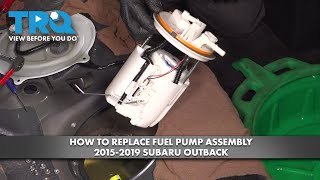
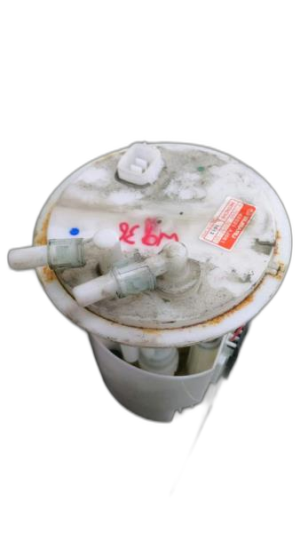
Typical fix: Replace the main fuel level sending unit inside the fuel tank. The sender is attached to the fuel pump module, and there are access panels under the rear seat 🎬 Watch: Step-by-step guide to accessing and replacing the fuel pump assembly. to reach it without dropping the tank.
Est. part cost: $75-$150 - Corroded or Damaged Wiring/Connectors 🟡 Medium Probability The connectors on top of the fuel tank are exposed to the elements under the car, and the in-tank wiring is constantly submerged in gasoline, which can degrade connections over time.
How to confirm: Visually inspect the wiring harness and connectors at the fuel pump access panel for corrosion, damage, or loose pins. Perform a continuity test on the signal wire between the sensor and the PCM.
Typical fix: Clean the corroded terminals with a contact cleaner or repair/replace the damaged section of the wiring harness.
Est. part cost: $10-$100
Rare But Worth Checking
- Faulty Instrument Cluster (Combination Meter): While rare, the instrument cluster itself can fail to interpret the signal from the fuel level sensor correctly. This should only be considered after the sensor and wiring have been confirmed to be good.
- Faulty Powertrain Control Module (PCM): A PCM failure is extremely unlikely but possible. This is the last resort after all other possibilities, including the instrument cluster, have been exhaustively ruled out.
Diagnosis Steps
- Read the code with an OBD-II scanner and check for any other related codes.
- Access the fuel pump/sending unit assembly via the access panel under the rear passenger-side seat.
- Inspect the external wiring and connector for any signs of corrosion or damage.
- Disconnect the sensor and measure its resistance with a multimeter. Actuate the float arm by hand (if the unit is removed).
- Watch the resistance reading. It should change smoothly from approximately 45 ohms (empty) to 3 ohms (full). If it jumps, drops out (open circuit), or doesn't change, the sending unit is bad and needs to be replaced.
- If the sensor tests good, check for voltage and ground at the connector. Then, perform a continuity test on the signal wire back to the instrument cluster or PCM to rule out a wiring issue.
- For 2018 models specifically: Before replacing parts, check with a Subaru dealer to see if recall WRI-18 / NHTSA 18V-773 has been performed. This software update fixes an incorrect distance-to-empty calculation that can cause the car to run out of fuel unexpectedly.
- As a general best practice, check for any open recalls or warranty extensions related to the CVT (TSB 16-90-13R, etc.) or oil consumption (TSB 02-157-14R), as these are common issues on this platform.
Parts You'll Likely Need
- Main Fuel Level Sending Unit (2015-2018)
(OEM #42081AL00A)— This is the primary sending unit ('Sensor A') that fails on the 5th generation Outback, causing P0460.
Trusted brands: Subaru (Genuine), Denso
OEM price range: $75-$110
Aftermarket price range: $50-$80 - Main Fuel Level Sending Unit (2010-2014)
(OEM #42081AJ201)— This is the primary sending unit ('Sensor A') that fails on the 4th generation Outback. It replaces the older part number 42081AJ200.
Trusted brands: Subaru (Genuine), Hitachi
OEM price range: $80-$110
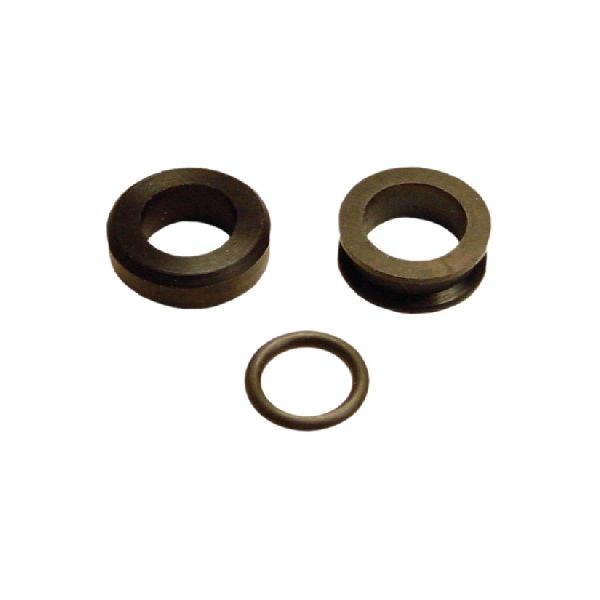
Aftermarket price range: $60-$90 - Fuel Pump Gasket / Seal — The large rubber gasket that seals the fuel pump assembly to the tank should always be replaced when the assembly is removed to prevent fuel leaks and EVAP codes. This is considered a mandatory best practice.
Trusted brands: Subaru (Genuine)
OEM price range: $20-$40
Aftermarket price range: $15-$30
Related Codes That Often Appear With This One
- P0461 — This code indicates 'Fuel Level Sensor 'A' Circuit Range/Performance,' which can be set along with P0460 if the sensor's signal is erratic or not changing as expected during driving.
Technical Service Bulletins (TSBs) & Recalls
- WRI-18 / NHTSA 18V-773: Software update for incorrect Distance-to-Empty display on 2018 models.
- WRG-21R / NHTSA 21V587: Safety recall for fuel pump impeller failure on 2018-2020 models.
- TSB 02-157-14R: Warranty extension for excessive oil consumption on 2.5L engines.
- TSB 16-90-13R: Addresses torque converter lock-up issue on 2010-2012 models with CVT, which can cause stalling.
Platform-Specific Known Issues
- Recall WRI-18 (NHTSA Campaign 18V-773): Affects 228,648 2018 Legacy and Outback models. A software error in the instrument cluster can cause the distance-to-empty (DTE) display to show a positive range even when the tank is empty, leading to unexpected stalling. The fix is a software update performed by a dealer.
- Recall WRG-21R (NHTSA Campaign 21V587): Affects certain 2018-2020 Outback models. A low-pressure fuel pump impeller can fail, causing the engine to run rough or stall. While the primary symptom is stalling, it can illuminate the check engine light and involves the fuel pump assembly where the sensor is located.
Mechanic-Grade Diagnostic Values
- Main Fuel Level Sensor Resistance (at sensor) — expected: Approx. 3-5 Ω at Full, Approx. 45-50 Ω at Empty. The sweep should be smooth with no dropouts.. Failure: Readings of OL (Open Loop), infinite resistance, or erratic jumps in value as the float arm is moved.
- Fuel Level Sensor Signal Voltage (at Combination Meter connector) — expected: Variable DC voltage, typically inverse to level (e.g., ~0.5V at Full, ~4.5V at Empty). The exact range can vary.. Failure: Voltage is stuck at 0V, 5V, or does not change when fuel level changes. A voltage drop of more than 1V between the sensor and the meter points to a wiring issue.
- Subaru Select Monitor Live Data PID: 'Fuel Level' — expected: A voltage reading (e.g., 0.0V - 5.0V) that correlates with the fuel gauge position.. Failure: The voltage is static or irrational despite changes in fuel level, pointing to an issue in the circuit or sensor.
- Subaru Select Monitor Live Data PID: 'Fuel level resistance' — expected: A resistance value in Ohms (Ω) that matches the physical sensor test (e.g., ~3-50 Ω).. Failure: The resistance value is erratic, maxed out, or does not match the known good range, confirming a sensor or wiring fault as seen by the Combination Meter.
Scan Tool Commands That Help
- Subaru Select Monitor (SSM): Current Data Display > Fuel Level / Fuel level resistance — This is the primary way to see what the Combination Meter is reporting to the PCM. If the live resistance data is erratic, but the sensor tests good at its connector, it points to a wiring issue between the tank and the cluster. If the sensor and wiring test good, but the live data is still bad, it points to a faulty Combination Meter.
Wiring & Ground Locations
- R58 (Main Fuel Level Sensor Connector) — On top of the main fuel pump assembly, accessed via a panel under the rear seat. For 2.5i models, this is typically the passenger (RH) side. For 3.6R models, it is often the driver (LH) side.. This is the primary connector for the sensor triggering P0460. Testing for resistance and voltage occurs here. Corrosion on these pins is a common cause of failure.
- R59 (Sub Fuel Level Sensor Connector) — On top of the sub-level sender assembly, on the opposite side of the tank from R58.. While P0460 is for the 'A' (main) circuit, the sensors are wired in series. A problem at this connector or with the sub-sensor can sometimes affect the reading of the main sensor, though it would typically set other codes.
- Combination Meter Connector (Gen 4: i8; Gen 5: i10) — At the back of the instrument panel cluster.. The fuel level sensor signal wire runs directly to this connector, not the PCM. The Combination Meter processes the signal and sends it to the PCM via CAN bus. A pin-fit issue or corrosion here can cause P0460.
- Fuel Pump Assembly Ground — The ground wire from the R58 connector typically terminates at a chassis ground point near the fuel tank area. A common failure point is the bolt securing this ground, which can corrode.. A poor or corroded ground is a very common cause of erratic resistance readings and can trigger P0460 even if the sensor itself is perfectly fine.
Real Owner Repair Stories
- Reddit user r/subaru (2015 Outback) — Fuel gauge at 'E', flashing fuel light, multiple warning lights including CEL with code P0463 (High Input, a related code).
❌ Tried (didn't work) Initial research into replacing sensors.
✅ What actually fixed it Upon removing the rear seat and access panel, found that rodent damage had torn the wiring on the passenger side sending unit to shreds. Repairing the chewed wires resolved the issue completely. - subaruoutback.org forum user (2011 Outback 3.6R) — P0460, fuel gauge reads empty after filling up.
❌ Tried (didn't work) Initially suspected wiring but it tested good.
✅ What actually fixed it Confirmed the main fuel level sensor was faulty via resistance test. Replaced the main sending unit, which is located on the DRIVER'S side for the 3.6R model. This fixed the code and gauge issue. - General mechanic knowledge from forum discussions (N/A) — P0460 returns intermittently even after replacing the fuel level sensor.
❌ Tried (didn't work) Replacing the main fuel level sending unit.
✅ What actually fixed it The ground wire for the fuel pump assembly harness was not making a clean connection to the chassis. Removing the ground bolt, cleaning the contact point and terminal of all corrosion and rust, and re-securing it provided a stable ground and resolved the code.
OEM Part Supersession History
42081AJ200→42081AJ201— Revision/update by manufacturer.42081sc010, 42081sc011→42081SC012— Revision/update by manufacturer. This part fits some 2010-2011 Outback models.
Heads up: Part descriptions can be confusing, sometimes listing this as 'sub unit' or 'primary'. VIN confirmation is critical.
Model Year Variations Within This Range
- 2010-2014 (4th Gen) vs 2015-2018 (5th Gen): Different part numbers for main and sub sending units. Different instrument cluster (Combination Meter) and associated wiring connectors.
- 2010-2018 (All): The main fuel pump assembly (containing sensor 'A') is on the passenger (RH) side for 2.5i models but on the driver (LH) side for 3.6R models. The sub-level sender is on the opposite side, respectively.
- 2018: A specific software recall (WRI-18) for the instrument cluster can cause symptoms mimicking a P0460 failure (incorrect fuel reading, running out of gas unexpectedly). A dealer software update is the required fix.
Diagnostic Flowchart
Other Known Issues on This Vehicle
Issues unrelated to this code that are worth knowing about as an owner of this generation:
- Excessive Oil Consumption (2.5L FB25 Engine) 🔴 High — Common in 2013-2014 models (and some 2011-2012 Foresters/2013 Crosstreks with the same engine). Caused by defective piston rings. Led to a class-action lawsuit. (Ref: TSB 02-157-14R; Subaru extended the powertrain warranty to 8 years/100,000 miles for affected vehicles.)
- CVT Transmission Shudder/Failure 🔴 High — Affects both 4th (2010-2014) and 5th (2015-2018) generations. Symptoms include shuddering on acceleration/deceleration, hesitation, or outright failure. (Ref: Subaru extended the CVT warranty to 10 years/100,000 miles. TSB 16-90-13R addresses torque converter issues in 2010-2012 models causing stalling. Other TSBs like 16-156-25R address shudder in later models.)
- Spontaneously Cracking Windshields 🟠 Medium — Commonly reported on 2015-2018+ models, especially those with the windshield wiper de-icer element. Cracks can appear without a significant impact. This led to multiple class-action lawsuits. (Ref: Settlements from class-action lawsuits resulted in extended warranties for windshield replacement on certain model years.)
- Premature Headlight Burnout 🟡 Low — A frequent complaint on the 4th Gen (2010-2014), where low-beam headlight bulbs fail often and are difficult to access for replacement.
- Parasitic Battery Drain 🟠 Medium — Reported frequently on 5th Gen (2015-2019) models. The battery may drain unexpectedly when parked, often attributed to onboard computer modules failing to enter 'sleep' mode.
Used vs. New Parts: Buying Guide for This Vehicle
When a used part is the smart pick: Almost never for the fuel level sensor itself. It is a high-failure, wear-and-tear item with delicate electronic contacts. Buying a used sensor carries a high risk of premature failure. A complete, low-mileage fuel pump assembly from a reputable salvage yard might be a budget option if the entire unit is needed, but the sensor's remaining life is unknown.
Donor-vehicle mileage cap: roughly under 60000 miles for the part to have meaningful remaining life.
What to inspect on the donor part:
- Verify the donor vehicle's low mileage.
- Inspect the electrical connector pins for any signs of green or white corrosion.
- Ensure the float arm is present and moves freely without binding.
- Check the plastic housing for any cracks or signs of heat damage.
OEM-only on this vehicle (don't cheap out):
- Fuel Level Sending Unit
- Fuel Pump Gasket / Seal (must be purchased new)
Aftermarket brands forum-validated for this vehicle:
- Denso
- Hitachi
Brands owners have reported issues with on this vehicle:
- Unbranded 'white-box' parts from online marketplaces (e.g., eBay, Amazon) are a significant gamble and may have incorrect resistance values, leading to a persistently inaccurate gauge even if the P0460 code is resolved.
Real Owner Stories
Aggregated from forums and TSBs cited above. Mileages and costs reflect what owners reported in those sources.
2011 Outback 3.6R
Symptoms: The P0460 code was present and the fuel gauge read empty immediately after a fill-up.
What fixed it: After confirming the wiring was good, the owner replaced the main fuel level sensor, which resolved the issue. The repair required removing the rear seat bottom cushion to get to the access panel.
Source hint: subaruoutback.org
2018 Outback
Symptoms: Ran out of gas even though the distance-to-empty (DTE) display showed miles remaining.
What fixed it: A software update performed by a dealer as part of a recall.
Source hint: Recall WRI-18 / NHTSA 18V-773, confirmed in subaruoutback.org discussions
Related OBD-II Codes
Frequently Asked Questions
I have a 2018 Outback and my distance-to-empty display is wrong, but the Check Engine Light isn't on. Is this related to P0460?
How do I access the fuel level sensor on my 2010-2018 Outback to test it?
What resistance values should I look for when testing the fuel level sensor with a multimeter?
My Outback is stalling. Could this be caused by the P0460 code?
Is it better to just replace the sending unit or should I check the wiring first for a P0460?
Does the fuel pump recall (WRG-21R) for my 2018 Outback cover the P0460 fuel level sensor issue?
Helpful Videos

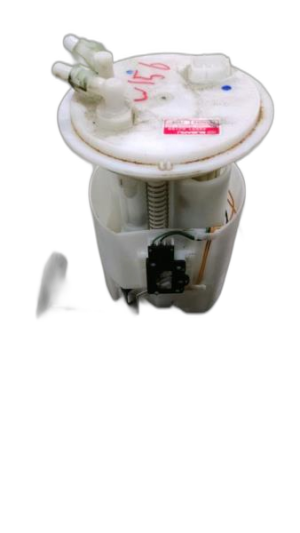
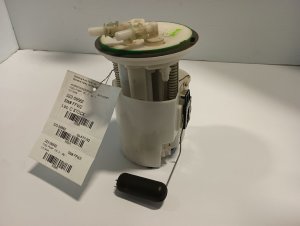
Used OEM Parts in Stock
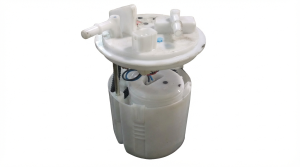


New Aftermarket Parts Available


The information in this article is provided for general reference and educational purposes only. Vehicle specifications, procedures, and part compatibility can vary by production date, trim level, and region. Always consult your vehicle's factory service manual and verify part numbers before purchasing or performing repairs. Safety-critical components such as airbags, seat belts, and braking systems should be installed by a qualified professional.
- Subaru Outback:
- 🎬 Helpful Videos
- 🛍️ Shop This Part
- What's Unique About the 2010-2018 Subaru Outback
- Symptoms You May Notice
- Most Likely Causes
- Rare But Worth Checking
- Diagnosis Steps
- Parts You'll Likely Need
- Related Codes That Often Appear With This One
- Technical Service Bulletins (TSBs) & Recalls
- Platform-Specific Known Issues
- Mechanic-Grade Diagnostic Values
- Scan Tool Commands That Help
- Wiring & Ground Locations
- Real Owner Repair Stories
- OEM Part Supersession History
- Model Year Variations Within This Range
- Diagnostic Flowchart
- Other Known Issues on This Vehicle
- Used vs. New Parts: Buying Guide for This Vehicle
- Real Owner Stories
- 2011 Outback 3.6R
- 2018 Outback
- Related OBD-II Codes
- Frequently Asked Questions
- 🎟️ Get 5% Off