

OBD-II Code P0462: Fuel Level Sensor 'A' Circuit Low
The Ultimate 2026 Guide to Meaning, Diagnosis, and Repair
- A P0462 code triggers when the Powertrain Control Module (PCM) sees the fuel level sensor signal drop below 0.5 volts, indicating a short to ground or a failed sensor.
- Do not immediately replace the entire $600 fuel pump assembly; on many vehicles like Nissan trucks, you can replace just the $75 sensor to fix the code.
- Track your mileage using the trip odometer immediately after the code appears to prevent running out of fuel and causing a $1,000 fuel pump failure.
- Use a scan tool with live data to verify the fuel level sensor voltage is stuck below 0.5V before starting any physical repairs.
- If replacing the sensor fails to clear the code, perform a short-to-ground test on the wiring harness, as chewed wires under the rear seat are a primary cause on VW and Honda models.
What Does P0462 Mean?

P0462 means your Powertrain Control Module (PCM) receives a voltage signal from the primary fuel level sensor persistently below the minimum expected value. The sensor sends a variable voltage corresponding to fuel level; a low voltage means an empty tank. When this signal sticks below the calibrated threshold (typically under 0.5 volts), the PCM triggers the Check Engine Light.
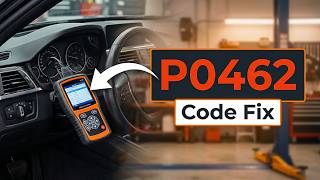
🎬 Watch: How to fix P0462 and repair a broken gas gauge.Technical definition: SAE/ISO defines P0462 as "Fuel Level Sensor 'A' Circuit Low Input." The PCM detects the fuel level sensor voltage is below the normal specified range for a set period. This indicates a direct short to ground, a failed sensor with internal shorting, or a damaged wiring harness.
Can I Drive With P0462?
Yes, But With Caution. Yes, but your fuel gauge is completely unreliable. Track your mileage with the trip odometer immediately to avoid running out of fuel on the highway. The P0462 fault will not damage mechanical components, but running the tank dry destroys the fuel pump.
Common Causes

- Faulty Fuel Level Sensor (Sending Unit) (Very Common) — The variable resistor attached to the fuel tank float arm wears out. Contaminants corrode the contacts, or the physical float arm bends or sticks, causing a constant low voltage signal.
- Shorted or Damaged Wiring (Common) — The wiring harness running from the fuel tank to the PCM chafes against the frame, corrodes from road salt, or suffers rodent damage. This creates a short to ground that pulls the signal voltage low.
- Corroded or Loose Connector (Common) — Moisture seeps into the electrical connector on top of the fuel pump module. This corrodes the pins, creating a poor connection or a short that artificially lowers the voltage reading.
- Faulty Instrument Cluster (Uncommon) — On specific vehicles (Subaru, Hyundai, older Dodge/Chrysler), the instrument cluster processing the signal fails. Cold or cracked solder joints on the circuit board cause the code, even with a perfect sensor and wiring.
- Poor Ground Circuit Integrity (Uncommon) — A corroded ground strap for the fuel tank or sensor circuit introduces high resistance. While typically causing a high voltage code (P0463), erratic signals sometimes register as a low input fault.
- Faulty Powertrain Control Module (PCM) (Rare) — The PCM's internal circuit for reading the fuel level signal fails. Consider this only after exhaustively ruling out the sensor, wiring, and cluster.
Symptoms

- Fuel Gauge Stuck on 'E' — The fuel gauge needle remains fixed on empty, regardless of the actual fuel level.
- Low Fuel Warning Light Stays On — The low fuel warning light illuminates constantly because the computer receives a permanent empty tank signal.
- Erratic Fuel Gauge Behavior — The needle fluctuates wildly, jumping from full to empty during acceleration, braking, or turns.
- Inaccurate 'Distance to Empty' Display — The trip computer displays dashes ('---') or a highly inaccurate, low range number.
- Check Engine Light is On (also visible on scanner) — The PCM illuminates the Malfunction Indicator Lamp (MIL) after detecting the fault across multiple drive cycles.
Diagnostic Flowchart
Tap your situation to follow the diagnostic path that matches what you're seeing on this code.
Common Fixes & Costs
- Replace Fuel Level Sensor (Sending Unit) — Parts: $50-$150, Labor: $150-$300, ~2.5 hr book time (Intermediate)
- Repair Damaged Wiring or Connector — Parts: $10-$50, Labor: $150-$300, ~1.5 hr book time (Intermediate)
- Replace Fuel Pump Module Assembly — Parts: $200-$600, Labor: $200-$400, ~2.5 hr book time (Intermediate)
- Clean or Repair Ground Connection — Parts: $1-$10, Labor: $50-$150, ~0.5 hr book time (Beginner)
- Replace Instrument Cluster — Parts: $300-$1000, Labor: $150-$300, ~1.2 hr book time (Professional)
Used vs. New Parts: Buying Guide
When a used part is worth it: A used fuel pump/sensor assembly generally does not make sense. It is a known wear item and the labor cost to install it is significant. If the used part fails, you pay for the labor twice.
Donor-vehicle mileage cap: roughly under 50000 miles for the part to have meaningful remaining life.
Donor quality checklist:
- Verify the exact OEM part number matches; aftermarket parts often have fitment issues.
- Avoid parts from vehicles in rust-belt regions, as the assembly top and connectors may be heavily corroded.
- Ask for a functional guarantee, even if it's only for 30 days.
Decision logic:
- If The fuel level sensor is available separately from the pump assembly. → Always buy the sensor new. It is a relatively low-cost electronic part.
- If The complete fuel pump module must be replaced and the vehicle is less than 10 years old. → Buy a new OEM or high-quality aftermarket (e.g., Denso, Bosch) part. The risk of premature failure with a used unit is too high.
- If Budget is the absolute primary concern and you are performing the labor yourself. → A low-mileage used OEM part is a gamble but may be considered. Avoid generic aftermarket brands.
Warranty tradeoff: Used parts typically offer a 30-90 day warranty at best. Aftermarket new parts often come with a 1-year to limited-lifetime warranty. OEM parts usually carry a 1-2 year warranty.
Worst-case if a used part fails: $300-$800 if a used part fails after installation, representing the repeat labor cost plus the cost of another part.
What Happens If You Wait — Timeline
- 0-1 month: Check Engine Light is on with code P0462. The fuel gauge is stuck on 'E' or behaves erratically. The driver must use the trip odometer to estimate fuel. (MPG impact: 0%% · Added cost: $0. The primary cost is inconvenience and the risk of running out of fuel.)
- 1-3 months: By misjudging the trip odometer, the driver runs the fuel tank completely dry for the first time. The engine sputters and stalls. The fuel pump is stressed from overheating as it runs without the cooling effect of gasoline. (MPG impact: 0%% · Added cost: $75-$250 for a roadside assistance call or tow.)
- 3-6 months: Repeatedly running the tank low or dry causes cumulative damage to the fuel pump. The driver notices a whining noise from the fuel tank, difficulty starting the engine, or sputtering under load as the pump weakens. (MPG impact: 0-5% (due to inefficient fuel delivery from a failing pump)% · Added cost: $400-$1200. The original P0462 fault has now caused a much more severe problem: a failing fuel pump that requires complete replacement.)
- 6+ months: The fuel pump fails completely, possibly while driving, causing the engine to stall in traffic. The vehicle will not restart. The underlying electrical short that caused P0462 could also, in rare cases, damage the fuel pump relay or fuse. (MPG impact: 100% (vehicle is inoperable)% · Added cost: $800-$1500+. This represents the full cost of diagnosing and replacing the fuel pump assembly, plus emergency towing, far exceeding the cost of the original, simpler P0462 repair.)
Cost of Not Fixing It
- Immediate: High risk of running out of fuel unexpectedly, potentially in a dangerous location (highway, intersection). This leads to a towing bill and significant inconvenience. (Added cost: $75-$250)
- 1-3 Months: Repeatedly running the tank completely dry damages the electric fuel pump, which relies on fuel for cooling and lubrication. (Added cost: $400-$1200)
- 3+ Months: Continued stress on a potentially failing fuel pump leads to complete pump failure, causing the vehicle to stall while driving or fail to start. (Added cost: $400-$1200)
Diagnosis Steps

- Verify Code and Check Live Data
Connect a scanner and check 'Live Data' for 'Fuel Level Sensor Voltage'. A reading stuck below 0.5V (often 0.1V-0.3V) confirms the hard fault.
Tools: OBD-II Scanner (Beginner) - Inspect Fuses and Relays
Check fuses related to the fuel pump, instrument cluster ('GAUGE', 'METER'), and PCM. A blown fuse cuts the reference voltage to the circuit.
Tools: Owner's Manual, Fuse Puller (Beginner) - Visual Inspection of Wiring
Trace the wiring harness from the fuel tank forward. Look for chafing, melted insulation, or rodent damage (especially under the rear seat). Inspect the main connector on the fuel pump.
Tools: Flashlight (Intermediate) - Test Circuit at Pump Connector
Disconnect the fuel pump connector. With the key on, test the terminals for a 5V reference voltage and a solid ground. If the signal wire shows near-zero voltage here, the sensor is faulty.
Tools: Multimeter, Wiring Diagram (Intermediate) - Test Sensor Resistance Sweep
Remove the fuel sending unit. Connect a multimeter (set to Ohms) to the sensor pins and move the float arm. Resistance must change smoothly (e.g., 40 to 250 ohms). A reading of 0 ohms indicates a shorted sensor.
Tools: Multimeter, Basic Hand Tools (Advanced) - Check for Short to Ground in Harness
Disconnect the harness at the fuel pump and PCM. Test for continuity between the signal wire and chassis ground. A low resistance reading confirms a short in the wiring.
Tools: Multimeter, Wiring Diagram (Advanced) - Perform Voltage Drop Test on Ground
Connect the black multimeter lead to the battery negative. Back-probe the ground wire at the fuel pump connector with the red lead (key on). A reading above 100mV indicates a poor ground.
Tools: Multimeter (Advanced) - Command Gauge Sweep
Use a scan tool to activate an 'Instrument Cluster Self-Test'. If the fuel gauge needle sweeps correctly, the gauge motor is good, isolating the fault to the sensor or wiring.
Tools: Professional Bi-Directional Scan Tool (Professional) - Simulate Sensor Signal
Feed a known-good resistance (e.g., 45 ohms for a half-tank reading) into the signal wire. If the gauge responds correctly, the wiring and cluster are good, proving the sensor is dead.
Tools: Potentiometer, Wiring Diagram (Advanced) - Check Fuel Pressure
If the vehicle stalls, check fuel pressure. Low pressure indicates a failing fuel pump or a severe wiring issue at the pump connector causing both the stall and the P0462 code.
Tools: Fuel Pressure Gauge (Intermediate)
When This Code Triggers (Freeze-Frame Conditions)
- Engine Coolant Temp: 175-210°F (Engine at normal operating temperature.)
- RPM: Idle (700-900) or Cruise (1500-2500) (The fault is continuous, so it logs at idle or during steady driving.)
- System Voltage: 11-16.5V (Logged when the vehicle's electrical system is within normal operating voltage.)
- Time Since Engine Start: > 2 seconds (The fault is checked continuously after the engine starts, not during cranking.)
Related Codes
- P0463 — This is the opposite code, 'Fuel Level Sensor Circuit High Input,' typically caused by an open circuit or bad ground. If P0462 and P0463 appear together, it strongly suggests an intermittent wiring problem or a failing sensor sending erratic signals.
- P0461 — 'Fuel Level Sensor Circuit Range/Performance.' This code sets when the signal is irrational, like changing too quickly or not matching calculated fuel usage. P0461 often appears as a precursor to P0462 as the sensor begins to fail erratically.
- P0460 — A general 'Fuel Level Sensor Circuit Malfunction' code. P0462 is a more specific version of this, pointing directly to a low voltage condition. If you only have P0460, the diagnostics are similar, but P0462 indicates a short or low voltage.
- P0464 — 'Fuel Level Sensor Circuit Intermittent.' This code indicates the low voltage fault is not constant. This points strongly to a loose connection, a corroded pin, a chafing wire that only shorts on bumps, or a sensor that only fails at certain fuel levels.
Climate & Environmental Factors
- Road Salt / High Humidity: Salt and moisture accelerate corrosion on the fuel pump electrical connector, wiring harnesses exposed under the vehicle, and chassis ground points. This corrosion creates a short to ground or a poor connection, triggering P0462.
- Water Intrusion: Driving through high water or having a compromised seal allows water directly into the fuel pump connector, creating a conductive path that shorts the signal wire to ground.
- Extreme Cold: Cold weather lowers a battery's overall voltage. If system voltage is already marginal, it causes various electronic modules to behave erratically and log voltage-related fault codes.
How to Talk to a Mechanic About This Code
Say this: "I have a P0462 code and my fuel gauge is stuck on empty. I'd like to schedule a diagnostic. Before replacing the whole fuel pump assembly, please test the sensor circuit for a short to ground, check the connector for corrosion, and see if the sensor is available as a separate part. If it's a Nissan, please check for TSB NTB22-026."
This signals you understand the common causes and are not just a 'blank check'. It directs the mechanic toward a logical, cost-effective diagnostic process, preventing them from immediately jumping to the most expensive repair (replacing the entire fuel pump module). Mentioning a specific TSB shows you've done your homework.
Avoid saying:
- 'My check engine light is on, can you look at it?'
- 'Just fix whatever's wrong.'
- 'The internet said it's the fuel pump, just replace it.'
Questions to ask before authorizing the repair:
- What was the result of the short-to-ground test on the signal wire?
- Did you test the sensor's resistance sweep, and did it show any dead spots?
- Is the fuel level sensor available separately from the fuel pump assembly for my vehicle?
- If the sensor and wiring are good, did you perform a gauge sweep test to check the instrument cluster?
- Can you provide a breakdown of the parts and labor costs for the recommended repair?
Where to Take It: Dealer vs Independent vs Chain
- Dealer:
A strong choice if a known software TSB exists or if the problem is confirmed to be the instrument cluster. Otherwise, likely the most expensive option for a common sensor or wiring fault.
Best for: Vehicles under warranty, Vehicles with known TSBs requiring a software update (e.g., some VW or Honda models), Complex electrical issues where the instrument cluster is suspected and may need programming
Downsides: Highest labor rates, May be more inclined to replace the entire fuel pump assembly rather than just the sensor to guarantee the fix (Typical cost: +50% vs. baseline) - Independent Shop:
Best overall fit. A good independent shop provides the best balance of expertise and cost for the most common causes of P0462, which are the sensor, wiring, or connectors.
Best for: Most out-of-warranty P0462 repairs, Diagnosing wiring shorts, corroded connectors, or bad grounds, Cost-conscious customers where the shop is willing to install a separate sensor if available
Downsides: Diagnostic skill varies; ensure the shop has strong electrical diagnostic capabilities (look for ASE certifications). (Typical cost: +0% vs. baseline) - Chain Shop:
High risk. AVOID for initial diagnosis. If you have already confirmed the fix is a simple fuel pump assembly replacement, they could be a cheap option for labor, but you risk them misdiagnosing a wiring or cluster issue and performing an expensive, unnecessary repair.
Best for: Potentially the cheapest labor rate if the diagnosis is straightforward.
Downsides: Technician skill varies dramatically., High pressure to replace parts rather than diagnose complex electrical faults., Very likely to recommend replacing the entire fuel pump assembly as a default, potentially costing you more if only the sensor was needed. (Typical cost: -10% vs. baseline)
When to Walk Away From the Repair
If the estimated repair cost for the P0462 fault exceeds 40-50% of your car's private-party value, you should pause and reconsider the repair.
- Car worth $3000, fix is $1200: Walk away. The repair is 40% of the car's value. Since the car is still drivable with this issue, selling it 'as-is' to a DIYer or trading it in is a more financially sound decision.
- Car worth $15000, fix is $800: Fix it. The repair cost is well below the threshold and is necessary for the vehicle's normal, safe operation and resale value.
- Car worth $5000, fix is $750: Borderline, but likely fix it. While approaching 15% of the value, fixing it restores a key function. Get a second opinion to ensure the diagnosis is correct before proceeding.
What Scan Tool You Need for This Code
Minimum: OBD-II reader that can display Live Data, specifically 'Fuel Level Input' or 'Fuel Level Sensor Voltage'.
A basic $20 code reader will only show you the P0462 code. It cannot show you the real-time voltage from the sensor, which is critical. Seeing a voltage stuck below 0.5V on a live data scanner is the first and most important step in confirming the 'Circuit Low' fault.
Budget: BlueDriver Pro Scan Tool (~$100) — Connects to your smartphone and provides detailed live data, including fuel level percentage and sensor voltage, which is essential for diagnosing P0462.
Mid-range: Foxwell NT510 Elite (~$180) — Includes full live data capabilities plus bidirectional controls. Its 'Active Test' function can command a 'Gauge Sweep' to test the instrument cluster's needles, which is a powerful step to rule out a faulty gauge motor without disassembly.
Professional: Autel MaxiCOM MK808 (~$500) — Offers extensive bidirectional controls, including gauge sweeps and potentially the ability to simulate sensor signals. Provides OEM-level diagnostics that can be crucial for pinpointing obscure faults in the instrument cluster or body control module.
Rent vs buy: For a one-time diagnosis, many auto parts stores like AutoZone will let you use a scanner for free to read the code. However, these are often basic readers. To properly diagnose P0462, you need live data. Buying a budget-friendly scanner like the BlueDriver is a worthwhile investment for any car owner.
How to Clear the Code After You Fix It
- Use an OBD-II scan tool to erase the diagnostic trouble codes.
- Do not disconnect the battery, as it resets all vehicle memory and readiness monitors.
- Perform a complete drive cycle to allow the vehicle's self-tests to run.
Drive cycle (~20 minutes): A general drive cycle includes a cold start, a few minutes of idling, followed by mixed city and highway driving (e.g., 10 minutes of stop-and-go, 10 minutes at a steady 55 mph). The goal is to allow the onboard computer to re-run its self-tests (readiness monitors).
Readiness monitors affected: Comprehensive Component Monitor, EVAP System Monitor, Catalyst Monitor, O2 Sensor Monitor
Before emissions retest: drive at least 50 miles to fully set monitors.
Watch out for:
- Clearing the code with a scanner resets the readiness monitors to 'Not Ready.' Taking the car for an emissions test before these monitors are 'Ready' results in an automatic failure.
- The code returns immediately or within a few drive cycles if the underlying electrical fault (short, bad sensor) is not properly repaired.
Will This Fail Emissions / State Inspection?
Yes — this code typically fails an OBD-II emissions inspection.
- California: An illuminated Check Engine Light is an automatic failure for the smog check. After repair, a full drive cycle must be completed to set the readiness monitors before a re-test is possible.
- New York: NYS requires an annual safety and emissions inspection. An illuminated Malfunction Indicator Lamp (MIL) from a P0462 code causes an automatic failure of the OBD-II emissions test.
- Texas: In counties requiring an emissions test (such as Harris, Dallas, and Travis), an active Check Engine Light is an automatic failure. After clearing the code, you must drive 50-100 miles to set the readiness monitors before re-inspection.
Most Commonly Affected Vehicles
- Nissan Pathfinder, Frontier, Rogue, Sentra, Titan, NV series, NV200, Rogue Sport (2016-2022) — Extremely common failure. Nissan issued TSB NTB22-026 advising technicians to replace only the sensor, not the entire fuel pump assembly, to save costs. Insist on this TSB. The failure is typically the sensor's resistor card wearing out.
- Volkswagen Tiguan, Jetta, Passat, Golf, Atlas, Taos (2018-2024) — Prone to sending unit failure. For 2019+ Jetta/Tiguan, a software update for the instrument cluster (TSB 20-23-01) resolves the issue. On the Atlas, check for rodent-damaged wiring under the rear seat before replacing parts.
- Honda Civic, CR-V (2006-2019) — Often a faulty fuel gauge sending unit. On 2006-2011 Civics, the issue is sometimes the gauge control module (tachometer) itself. For later models, a software glitch in the instrument cluster requires a dealer update.
- Dodge / Chrysler Charger, Magnum, 300 (2005-2010) — A very common cause on these platforms is not the fuel sensor, but failed or cracked solder joints on the instrument cluster's printed circuit board. Technicians can 'reflow' the solder to fix it without replacing the entire cluster.
- Hyundai Sonata, Tucson, Genesis (2010-2015) — While sensor failure is common, these models are known for the instrument cluster failing and causing P0462, often after a frustrated owner has already replaced the fuel pump assembly.
- BMW 1, 3, 5, X3, X5 Series (2006-2016) — Frequently cited for P0462 due to failure of the in-tank fuel level sensor. These models often have a saddle-style tank with two sensors; 'Sensor A' is typically the primary one.
- Toyota Corolla (2014-2019) — Prone to a worn-out resistor track on the fuel level sensor, causing it to fail and trigger the P0462 code.
- Ford Fusion (2013-2018) — These vehicles experience shorted ground wires in the sensor circuit, leading to a low voltage signal.
- Subaru Impreza, WRX/STI, Forester (2005-2014) — On many models, the issue is not the sensor itself but a failure within the 'Combination Meter' (the instrument cluster), which processes the fuel level signal.
Manufacturer-Specific Notes
- Nissan: Nissan has a Technical Service Bulletin (TSB NTB22-026) for many models stating to replace only the fuel level sensor, not the entire fuel pump assembly. Insisting on this saves hundreds of dollars.
- Volkswagen: On the Atlas model, P0462 is frequently caused by rodent-damaged wiring under the rear seat carpet. For 2019+ models like the Jetta, a software update for the instrument cluster (TSB 20-23-01) resolves the code without hardware replacement.
- Dodge/Chrysler: For 2005-2010 models like the Charger, 300, and Magnum, P0462 is very often caused by failed solder joints on the instrument cluster's circuit board, not the fuel sensor. This is repaired by a specialist without replacing the whole cluster.
- Subaru: On many Subarus from the mid-2000s to mid-2010s, a P0462 code is frequently caused by an internal failure of the instrument cluster, which they call the 'Combination Meter'.
- General Motors (Chevrolet/GMC): On some models, high sulfur content in fuel leads to premature corrosion and failure of the fuel level sensor contacts. GM has issued bulletins about using specific fuel system cleaners (like Techron) as a potential first step, although replacement is often still necessary.
Real Owner Stories
2018 Nissan Frontier at 75K miles - The Textbook Fix
Check Engine Light came on, and the fuel gauge was stuck on Empty, even after filling the tank. The owner was using the trip meter to guess fuel levels.
Outcome: The shop followed the TSB, replacing only the fuel level sending unit (Part # 25060-ZS00B) and the O-ring seal instead of the whole fuel pump assembly. The total repair cost was around $450. The code cleared and the gauge worked perfectly.
Lesson: For Nissan owners, always check for TSBs related to P0462. Insisting the shop replace only the sensor, per the bulletin, saves hundreds of dollars on parts.
2019 VW Atlas at 40K miles - The Misdiagnosis Story
The fuel gauge started behaving erratically, sometimes showing full, sometimes empty. Codes P0462 and P0463 appeared intermittently. The owner was worried about being stranded.
Outcome: Forum posts for the VW Atlas pointed to a common issue of rodent damage to the wiring harness that runs under the rear seat carpet. Upon inspection, the owner found chewed wires. They repaired the damaged section of the harness for less than $20 in materials. The codes were cleared and never returned.
Lesson: Don't automatically replace the most expensive part. On certain models like the VW Atlas, a specific wiring vulnerability is a more likely cause than the sensor itself. A visual inspection prevents a costly and unnecessary repair.
2010 Infiniti G37 at 120K miles - The Unusual Root Cause
P0462 code was persistent. The fuel gauge read correctly until the tank was half-full, then it dropped to empty and the Check Engine Light came on.
Outcome: After extensive research on G37 forums, the owner discovered the issue was often caused by cracked solder joints on the 'Unified Meter and A/C Amplifier' board located behind the radio. Following a guide, they removed the board and re-flowed the solder on several specific microchips with a basic soldering iron. After reassembly, the code cleared and the fuel gauge began working correctly through its full range.
Lesson: On some vehicles (Infiniti, Dodge, Subaru), the problem isn't in the tank or the main cluster, but in a secondary processing module. If replacing the sensor and checking the wiring doesn't work, research model-specific electronic failures before replacing more parts.
How to Prevent This Code From Triggering
- Keep the fuel tank at least 1/4 full (Always) — The electric fuel pump is submerged in the fuel tank and relies on the gasoline to cool and lubricate its motor. Consistently running the tank near empty causes the pump to run hotter, accelerating wear on the entire assembly, including the integrated sensor.
- Use high-quality fuel with detergents (Every fill-up) — Lower-tier fuels have higher levels of contaminants like sulfur, which corrode the delicate resistor contacts on the fuel level sending unit over time, causing it to fail.
- Take measures to deter rodents (If parking outdoors or in a rural area) — Rodents are attracted to the soy-based insulation used on modern vehicle wiring. They chew through the fuel sensor harness, causing a short. Using peppermint oil, rodent-repellent tape (laced with capsaicin), or ultrasonic repellents around the vehicle prevents costly wiring repairs.
- Periodically clean chassis ground connections (Every few years, especially in rust-belt areas) — The fuel sensor circuit relies on a clean ground connection to the vehicle chassis. Corrosion at the ground point causes erratic signals. Periodically disconnecting, cleaning with a wire brush, and re-securing main ground straps prevents various electrical gremlins, including fuel gauge issues.
Frequently Asked Questions
I replaced the fuel pump assembly and still have a P0462 code. What now?
The fault is likely a short to ground in the wiring harness or a failed instrument cluster. Perform a short-to-ground test on the signal wire between the tank and PCM. Use a bidirectional scan tool to perform a gauge sweep test to isolate the cluster.
What is the most common mistake when diagnosing P0462?
The most costly mistake is replacing the entire fuel pump assembly without testing the sensor or wiring first. Many vehicles allow you to replace just the inexpensive sensor. Overlooking a simple wiring short or corroded ground connection wastes hundreds of dollars.
How much does it cost to fix P0462?
A professional diagnostic fee runs $150-$185. Replacing just the sensor costs $300-$500, while a full fuel pump module replacement ranges from $600 to $1,200. Repairing a chewed wire or bad ground often costs under $200.
Will a fuel additive or cleaner fix a P0462 code?
No. P0462 indicates a hard electrical fault, typically a short circuit or completely worn resistor track. Fuel system cleaners cannot repair broken wires, failed resistors, or faulty computers.
My car stalls and has a P0462 code. Are these related?
Yes, but indirectly. The bad fuel reading doesn't cause stalling, but the underlying electrical short can interrupt power to the fuel pump. Diagnosing the stalling symptom by checking fuel pressure and pump voltage is your top priority.
Can a bad battery cause a P0462 code?
Yes, a failing battery or alternator causing system-wide low voltage can trigger this code. If the 5V reference voltage supplied by the PCM drops, the return signal falls below the 0.5V threshold. Check your battery health if multiple voltage-related codes appear together.
What is the difference between Fuel Level Sensor 'A' and 'B'?
Sensor 'A' is the primary fuel level sensor. Vehicles with saddle-style fuel tanks (like many BMWs and Infinitis) use a second sensor ('B') for the other half of the tank. P0462 specifically isolates the fault to the primary 'A' circuit.
Key Takeaways
- A P0462 code triggers when the Powertrain Control Module (PCM) sees the fuel level sensor signal drop below 0.5 volts, indicating a short to ground or a failed sensor.
- Do not immediately replace the entire $600 fuel pump assembly; on many vehicles like Nissan trucks, you can replace just the $75 sensor to fix the code.
- Track your mileage using the trip odometer immediately after the code appears to prevent running out of fuel and causing a $1,000 fuel pump failure.
- Use a scan tool with live data to verify the fuel level sensor voltage is stuck below 0.5V before starting any physical repairs.
- If replacing the sensor fails to clear the code, perform a short-to-ground test on the wiring harness, as chewed wires under the rear seat are a primary cause on VW and Honda models.
Helpful Videos


The information in this article is provided for general reference and educational purposes only. Vehicle specifications, procedures, and part compatibility can vary by production date, trim level, and region. Always consult your vehicle's factory service manual and verify part numbers before purchasing or performing repairs. Safety-critical components such as airbags, seat belts, and braking systems should be installed by a qualified professional.
- 🎬 Helpful Videos
- What Does P0462 Mean?
- Can I Drive With P0462?
- Common Causes
- Symptoms
- Diagnostic Flowchart
- Common Fixes & Costs
- Used vs. New Parts: Buying Guide
- What Happens If You Wait — Timeline
- Cost of Not Fixing It
- Diagnosis Steps
- When This Code Triggers (Freeze-Frame Conditions)
- Related Codes
- Climate & Environmental Factors
- How to Talk to a Mechanic About This Code
- Where to Take It: Dealer vs Independent vs Chain
- When to Walk Away From the Repair
- What Scan Tool You Need for This Code
- How to Clear the Code After You Fix It
- Will This Fail Emissions / State Inspection?
- Most Commonly Affected Vehicles
- Manufacturer-Specific Notes
- Real Owner Stories
- 2018 Nissan Frontier at 75K miles - The Textbook Fix
- 2019 VW Atlas at 40K miles - The Misdiagnosis Story
- 2010 Infiniti G37 at 120K miles - The Unusual Root Cause
- How to Prevent This Code From Triggering
- Frequently Asked Questions
- I replaced the fuel pump assembly and still have a P0462 code. What now?
- What is the most common mistake when diagnosing P0462?
- How much does it cost to fix P0462?
- Will a fuel additive or cleaner fix a P0462 code?
- My car stalls and has a P0462 code. Are these related?
- Can a bad battery cause a P0462 code?
- What is the difference between Fuel Level Sensor 'A' and 'B'?
- Key Takeaways
- 🎟️ Get 5% Off