

OBD-II Code P0461: Fuel Level Sensor 'A' Circuit Range/Performance
The Ultimate Guide to Diagnosing and Fixing P0461
- Code P0461 indicates an erratic fuel level sensor signal; track your mileage manually using the trip odometer to avoid running out of gas.
- Always check for Technical Service Bulletins (TSBs) first, as many 2012-2022 Honda, Kia, and Toyota models require a simple $100-$200 software update rather than new parts.
- If hardware replacement is necessary, verify if your vehicle allows replacing just the $50-$200 fuel level sensor instead of the entire $500+ fuel pump assembly (especially critical for Nissan models).
- Never replace the fuel pump without first testing the sensor's resistance (typically 0-300 Ohms) and inspecting the top-of-tank electrical connector for high-resistance corrosion.
What Does P0461 Mean?

Code P0461 means your Powertrain Control Module (PCM) detects a performance problem with the primary fuel level sensor ('A') signal. The voltage reading is erratic, stuck, or illogical based on your fuel consumption. For example, the gauge stays on full after driving 100 miles. This discrepancy triggers the Check Engine Light and disables accurate 'Distance to Empty' readings.
Technical definition: The SAE/OBD-II definition is "Fuel Level Sensor 'A' Circuit Range/Performance." The PCM detects the sensor's voltage signal is outside the acceptable range (typically 0.5V to 4.5V), is not changing after driving 100+ miles, or behaves erratically compared to calculated fuel consumption. It flags a 'performance' issue rather than a hard circuit failure like a short or open.
Can I Drive With P0461?
Yes, But With Caution. Yes, but your fuel gauge is completely unreliable, creating a high risk of running out of gas. Use your trip odometer to track mileage manually from your last fill-up. Do not ignore this long-term; some modern vehicles enter a failsafe mode and shut down the engine if they believe the tank is empty to protect the high-pressure fuel pump.
Common Causes

- Faulty Fuel Level Sensor (Sending Unit) (Very Common) — This is the most frequent culprit. The sensor is a variable resistor with a float arm. The resistor strip wears out from constant contact with the wiper arm and fuel corrosion, creating 'dead spots' that cause the voltage signal to jump or drop out entirely.
- PCM Software Glitch (Common) — Many manufacturers use overly sensitive software logic for monitoring fuel levels. A simple software update (reflash) from the dealer fixes this. This is a documented issue for several Honda, Kia, and Toyota models.
- Damaged or Corroded Wiring/Connectors (Common) — The wiring harness from the fuel tank to the PCM is exposed to road salt and moisture. Corrosion on the connector pins on top of the fuel tank causes high resistance or intermittent signal loss.
- Stuck Float Arm or In-Tank Debris (Less Common) — Rust or sediment from low-quality fuel accumulates in the tank and physically obstructs the float arm. Alternatively, the float itself becomes saturated with fuel and sinks, resulting in a static signal.
- Corroded Fuel Tank Ground Strap (Less Common) — A rusted or loose ground strap creates a poor ground reference for the fuel pump module. This unstable ground alters the sensor's voltage signal, causing erratic readings.
- Incorrect Fueling Habits (Rare) — On certain Ram and Ford trucks, consistently adding less than 2 gallons of fuel or refueling with the ignition on confuses the PCM's fuel consumption logic, triggering a performance code.
- Faulty PCM or Instrument Cluster (Very Rare) — A hardware failure within the PCM's analog-to-digital converter or the instrument cluster itself misinterprets a perfectly good signal. Consider this only after ruling out the sensor, wiring, and software.
Symptoms

- Inaccurate or Erratic Fuel Gauge — The gauge needle jumps around, drops to 'E' from a half tank, gets stuck on 'F' after a fill-up, or doesn't move at all.
- Check Engine Light is On — The PCM logs a fault in the powertrain system, alerting the driver.
- Low Fuel Light Stays On or Flashes — The low fuel warning illuminates even with a full tank because the computer receives an 'empty' signal from the faulty sensor.
- Inaccurate "Distance to Empty" Reading — The trip computer's calculation for remaining mileage is incorrect because it depends on the faulty fuel level input.
- Remote Start Disabled — The remote start feature disables if the PCM detects a low fuel level or an active Check Engine Light.
Diagnostic Flowchart
Tap your situation to follow the diagnostic path that matches what you're seeing on this code.
Common Fixes & Costs
- Perform a PCM/ECM Software Update at Dealer — Parts: $0, Labor: $100-$200 (Often free under a TSB), ~1 hr book time (Pro Only)
- Replace the Fuel Level Sensor (Sending Unit) Only
— Parts: $50-$200, Labor: $150-$400, ~2 hr book time
(Intermediate)
Nissan Titan/Armada: OEM - Replace the Entire Fuel Pump Module Assembly
— Parts: $250-$600, Labor: $250-$500, ~2.5 hr book time
(Intermediate)
Ram 1500 (2015): OEM
Ford F-150 (2011): OEM - Repair Damaged Wiring or Clean Connectors — Parts: $10-$30, Labor: $100-$250, ~1.5 hr book time (DIY)
- Clean or Replace Fuel Tank Ground Strap — Parts: $0-$15, Labor: $50-$100, ~0.5 hr book time (DIY)
DIY vs Professional
- Perform a PCM/ECM Software Update — Beginner:
Tools: Proprietary dealership software and hardware. - Replace Fuel Level Sensor / Fuel Pump Module — Beginner:
Tools: Floor jack, jack stands, socket set, multimeter, fuel tank lock ring tool, safety glasses, chemical-resistant gloves. - Repair Damaged Wiring or Clean Connectors — Beginner:
Tools: Multimeter, wire cutters/strippers, soldering iron or quality crimp connectors, heat shrink tubing, contact cleaner. - Clean or Replace Fuel Tank Ground Strap — Beginner:
Tools: Socket set, wire brush, sandpaper.
Used vs. New Parts: Buying Guide
When a used part is worth it: Buying a used fuel pump module or sending unit is rarely recommended due to the high labor cost of replacement. Consider a used part only for an older, low-value vehicle where budget is the primary concern and you accept the high risk of premature failure.
Donor-vehicle mileage cap: roughly under 60000 miles for the part to have meaningful remaining life.
Donor quality checklist:
- Verify the part comes from a low-mileage, accident-damaged vehicle, not one scrapped for fuel system issues.
- Avoid parts from regions with heavy road salt use, as electrical connectors corrode.
- Match the part number exactly. Different tank sizes or engine types use different modules.
Decision logic:
- If Labor for replacement is high (tank drop required) → Buy a new OEM or high-quality aftermarket part. The risk of paying for labor twice on a failed used part is too high.
- If Vehicle is >10 years old and has >150K miles → A new, value-line aftermarket part is a good compromise. A used part remains a high-risk gamble.
- If Part has an easy access panel under the seat → The risk of using a used part is lower since labor for a second replacement is minimal, but a new part is still the most reliable choice.
Warranty tradeoff: Used parts from a salvage yard typically have a 30-90 day warranty. Value-line aftermarket parts offer a 1-year warranty. Premium aftermarket and OEM parts offer the best warranty and reliability.
Worst-case if a used part fails: $400-$800 if a used part fails after installation, requiring a second payment for labor and another part.
What Happens If You Wait — Timeline
- 0-1 month: Check Engine Light illuminates. Fuel gauge is erratic or stuck. Driver is forced to use the trip odometer to estimate fuel level. High risk of being stranded. (MPG impact: 0%% · Added cost: $0-$200 (Cost of a tow or roadside assistance for running out of fuel).)
- 1-6 months: Due to uncertainty, the driver repeatedly runs the tank very low. This increases thermal stress on the fuel pump motor, which is cooled by the surrounding fuel. (MPG impact: 0%% · Added cost: $0 (Risk of premature fuel pump wear increases).)
- 6-12 months: The fuel pump motor fails prematurely from consistent overheating. The original, cheaper sensor-only repair is no longer sufficient, and the entire fuel pump module requires replacement. (MPG impact: 0%% · Added cost: $500-$1300 (Cost to replace the entire fuel pump assembly).)
- 12+ months: Vehicle automatically fails state emissions inspection due to the Check Engine Light. Vehicle registration cannot be renewed. (MPG impact: 0%% · Added cost: Original repair cost + state inspection fees ($30-$70) + fines for expired registration.)
Cost of Not Fixing It
- Immediate (0-1 month): High risk of being stranded. With an unreliable fuel gauge, you run out of gas unexpectedly, leading to severe inconvenience and safety risks. (Added cost: $75-$200 for a tow or roadside assistance.)
- Medium-Term (1-6 months): Damage to the fuel pump. Fuel pumps are cooled and lubricated by gasoline. Repeatedly running the tank low causes the pump to overheat and fail prematurely. (Added cost: $500-$1300 to replace the fuel pump assembly.)
- Long-Term (6+ months): Guaranteed failure of state emissions inspection. An active Check Engine Light is an automatic fail in any jurisdiction with OBD-II testing. (Added cost: Cost of the original repair plus fines for expired registration.)
Diagnosis Steps

- Check for Technical Service Bulletins (TSBs)
Before any physical inspection, search online for TSBs for your specific vehicle. Manufacturers like Nissan, Honda, Kia, and Toyota issue bulletins for P0461 pointing to a simple software update or a sensor-only replacement, saving hundreds of dollars.
Tools: Internet Access, VIN (Beginner) - Read the Code and Freeze Frame Data
Use an OBD-II scanner to confirm P0461 is active. Analyze the freeze frame data to see the vehicle's conditions when triggered. Note related codes like P0460, P0462, P0463, or P0464 to pinpoint the issue.
Tools: OBD-II Scanner (Beginner) - Analyze Live Data with a Scan Tool
Monitor the 'Fuel Level Sensor Voltage' or 'Fuel Level Percentage' PID. Voltage typically ranges from ~0.5V (full) to ~4.5V (empty). Have a helper gently rock the vehicle. A healthy sensor shows smooth fluctuations. A faulty sensor shows no change or erratic jumps.
Tools: Advanced OBD-II Scanner (Intermediate) - Visually Inspect Wiring and Grounds
Inspect the wiring harness leading to the fuel tank for chafed or burnt wires. Check the main electrical connector on top of the fuel pump assembly for green or white corrosion. Locate and inspect the fuel tank's ground strap for rust.
Tools: Flashlight, Safety Glasses (Beginner) - Test the Sensor Resistance with a Multimeter
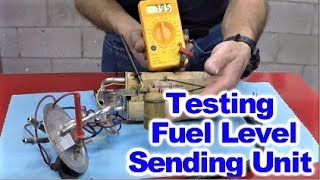
Disconnect the fuel level sensor connector at the tank. Set a multimeter to Ohms (Ω) and measure resistance across the signal and ground terminals. Resistance varies (e.g., GM is ~0-90 Ohms, post-1987 Fords are ~16-158 Ohms). As you rock the vehicle, resistance must change smoothly. Jumps to OL (Open Loop) indicate a worn-out sensor.
Tools: Multimeter, Vehicle-Specific Wiring Diagram (Intermediate) - Perform a Voltage Drop Test on Power and Ground
With the circuit connected and key on, set the multimeter to DC Volts. Place the black lead on the battery negative and the red lead on the ground wire pin at the sensor connector. A reading above 0.1V indicates high resistance in the ground circuit. Repeat for the power side; readings over 0.2V point to a wiring issue.
Tools: Multimeter, Back-Probe Kit (Advanced) - [PRO TIP] Simulate a Sensor Signal
Disconnect the sensor and connect a potentiometer to the signal and ground wires in the harness. Manually sweep the potentiometer (e.g., 0 to 300 Ohms) to simulate a changing fuel level. If the dashboard gauge and scan tool live data respond smoothly, the wiring, PCM, and cluster are perfect, confirming the sending unit is faulty.
Tools: Potentiometer (0-500 Ohm), Jumper Wires (Advanced) - [PRO TIP] Use an Oscilloscope for Intermittent Issues
Back-probe the sensor's signal wire with an oscilloscope. Driving over bumps or sloshing the fuel reveals dropouts or noise a multimeter misses. A good sensor shows a stable line changing slowly; a bad one shows sharp, vertical drops to zero.
Tools: Automotive Oscilloscope, Back-Probe Kit (Advanced)
When This Code Triggers (Freeze-Frame Conditions)
- Engine Coolant Temp: 175-210°F (80-99°C) (Engine is fully warmed up to ensure stable operating conditions.)
- Vehicle Speed: 40-65 mph (65-105 kph) (Steady highway cruising speed minimizes fuel slosh for a stable reading.)
- Fuel Level: 15-85% (The PCM runs this check when the tank is neither completely full nor empty.)
- Time Since Engine Start: > 10 minutes (The test runs after the vehicle operates for a set duration, not immediately after startup.)
- Miles Driven Since Last Refuel: > 100 miles (160 km) (The PCM expects a change in fuel level after significant distance traveled.)
Related Codes
- P0460 — General Fuel Level Sensor Circuit Malfunction. P0461 is more specific, flagging a 'performance' issue. P0460 is a broader code set for general irrationality. They share the same root causes.
- P0462 — Indicates the Fuel Level Sensor Circuit input is too low (short to ground). P0461 means the signal is present but erratic. P0462 means the signal is stuck at a low voltage.
- P0463 — Indicates the Fuel Level Sensor Circuit input is too high (open circuit). P0461 means the signal exists but doesn't correlate with fuel usage. P0463 means there is a break in the circuit or sensor.
- P0464 — Flags an intermittent signal from the fuel level sensor. P0461 is set when the signal is continuously present but irrational. P0464 is set when the signal cuts in and out rapidly.
Climate & Environmental Factors
- High Humidity & Road Salt: Moisture and salt accelerate corrosion on the fuel pump module's electrical connector, exposed on top of the fuel tank. This corrosion creates high resistance, disrupting the sensitive voltage signal and triggering the code.
- Fuel Composition: Higher concentrations of ethanol in gasoline degrade the resistive material on the fuel level sensor card over many years, leading to premature wear and dead spots.
- Cold Weather: Low battery voltage during cold starts causes electronic modules to behave erratically. Materials contracting in the cold also worsen intermittent electrical connections.
How to Talk to a Mechanic About This Code
Say this: "I have a check engine light with a P0461 code, and my fuel gauge is erratic. Can you check for any Technical Service Bulletins related to a software update for this code on my specific vehicle before quoting a hardware replacement? I also need you to test the sensor's wiring and resistance before recommending a full fuel pump assembly replacement."
This directs the shop to follow a logical diagnostic path (check for software fixes first, then test components) rather than jumping to the most expensive conclusion. It forces them to prove the cheaper parts are good before condemning the expensive fuel pump module.
Avoid saying:
- 'My check engine light is on, can you just fix it?'
- 'My gas gauge is broken, I probably need a new fuel pump.'
- 'Just do whatever you think is best.'
Questions to ask before authorizing the repair:
- Did you find a TSB for a software update for my vehicle?
- Did you test the resistance of the fuel level sensor itself? What were the readings?
- Did you perform a voltage drop test on the sensor's wiring and ground circuit?
- Is it possible to replace only the fuel level sending unit, or is the entire fuel pump module the only option?
- What is the warranty on the recommended parts and labor?
Where to Take It: Dealer vs Independent vs Chain
- Dealer:
The necessary first stop if your vehicle make/model is known for software TSBs that fix P0461. If no TSB exists, their diagnostic tools are top-tier, but the repair is expensive.
Best for: Vehicles known to have software-related P0461 issues (many Kia, Honda, Toyota models)., Vehicles still under powertrain or emissions warranty., Complex diagnostics on vehicles with dual fuel tanks (e.g., Ram, BMW, Nissan).
Downsides: Highest labor rates., Quick to recommend replacing the entire fuel pump module instead of a cheaper sensor-only fix if not guided by a TSB. (Typical cost: +50% vs. baseline) - Independent Shop:
The best choice for most out-of-warranty P0461 repairs, provided it's not a software issue. A good independent shop balances cost and expertise for replacing a fuel sending unit or repairing wiring.
Best for: Out-of-warranty vehicles where the cause is hardware (sensor, wiring, or pump)., Following specific TSBs for hardware replacement (e.g., the Nissan sensor-only swap)., General diagnosis and repair at a reasonable price.
Downsides: Diagnostic skill varies; choose a shop with strong reviews and ASE certifications in electrical systems., Lacks proprietary tools to perform a PCM software update if needed. (Typical cost: +0% vs. baseline) - Chain Shop:
AVOID for P0461 diagnosis. This code requires careful electrical diagnosis beyond the scope of most chain shops. You are highly likely to be sold an expensive, incorrect repair.
Best for: Simple, non-diagnostic work like tires and oil changes.
Downsides: Technician skill varies dramatically., Lacks advanced diagnostic training and equipment for electrical issues., High pressure to sell parts leads to misdiagnosis and unnecessary replacement of the entire fuel pump assembly. (Typical cost: -10% vs. baseline)
When to Walk Away From the Repair
If the estimated repair cost for the P0461 fault exceeds 40-50% of your car's private-party market value, seriously consider selling the vehicle instead.
- Car worth $3000, fix is $1200: Walk away. The repair cost is a huge percentage of the car's value. You are unlikely to recoup this cost.
- Car worth $10000, fix is $800: Fix it. The repair cost is well under the threshold and restores a critical function, preserving vehicle value.
- Car worth $5000, fix is $2200: Borderline, but likely a walk-away. Get a second opinion to confirm the high cost. If the car has other significant needs, it's not worth the investment.
What Scan Tool You Need for This Code

Minimum: A scanner that reads and displays **Live Data** for the Fuel Level Sensor PID (Parameter ID).
A basic $20 code reader only confirms P0461 is present. It cannot show the live voltage or percentage reading from the sensor, which is essential for diagnosis. Without live data, you cannot see if the sensor signal is stuck, erratic, or unchanging.
Budget: Veepeak Mini Bluetooth / Car Scanner ELM OBD2 App (~$40) — This Bluetooth dongle and smartphone app combo allows you to read codes, clear them, and graph live data from the fuel level sensor. It easily determines if the sensor signal behaves correctly.
Mid-range: Innova 5610 / Foxwell NT510 Elite (~$150) — A dedicated handheld scanner provides live data graphing for the fuel level sensor. It connects faster than a Bluetooth adapter and provides manufacturer-specific data to diagnose quirks on certain vehicles.
Professional: Autel MaxiCOM MK808BT (~$500) — Offers full-system access, advanced live data graphing, and bidirectional controls. Bidirectional functions allow you to command the instrument cluster gauge to sweep, isolating a faulty gauge from a faulty sensor circuit.
Rent vs buy: You can borrow a basic code reader from auto parts stores for free, but these rarely support live data viewing. For P0461, viewing live data is critical. Purchasing a budget-pick scanner for under $100 is a necessary investment.
How to Clear the Code After You Fix It
- Use an OBD-II scan tool to clear the P0461 code.
- Ensure the fuel tank is between 1/4 and 3/4 full.
- Perform the specific drive cycle required for the fuel system monitor to run.
Drive cycle (~60 minutes): The monitor for P0461 runs a rationality check over a long distance. After clearing the code, drive the vehicle for 100-125 miles (160-200 km) without refueling. This can be broken into multiple trips. A general drive cycle includes a cold start, a 2-3 minute idle, 10-15 minutes of steady 55 mph driving, and city stop-and-go driving.
Readiness monitors affected: Fuel System Monitor, Evaporative System (EVAP), Catalyst (CAT), Oxygen (O2) Sensor
Before emissions retest: drive at least 125 miles to fully set monitors.
Watch out for:
- Clearing codes by disconnecting the battery resets all readiness monitors, forcing multiple drive cycles.
- The code returns immediately if the underlying mechanical or electrical fault is not fixed.
- Taking the vehicle for an emissions test before the Fuel System monitor shows 'Ready' results in an automatic failure.
Will This Fail Emissions / State Inspection?
Yes — this code typically fails an OBD-II emissions inspection.
- California: An active Check Engine Light for P0461 is an automatic failure of the smog check. After repair, you must complete the required drive cycle until the Fuel System monitor is 'Ready' before re-testing.
- New York: The NYS Vehicle Inspection Program includes an OBD-II scan. P0461 causes the vehicle to fail the emissions portion of the inspection.
- Texas: In the 17 Texas counties requiring emissions testing, a vehicle with an illuminated Check Engine Light for P0461 fails the inspection.
Most Commonly Affected Vehicles
- Nissan Titan, Armada, Frontier, Xterra, Rogue, Kicks, Versa, Murano (2016-2022) — Extremely common issue. Nissan TSB NTB22-026 advises technicians to replace ONLY the fuel level sensor, not the entire fuel pump assembly. Insisting on this TSB saves over $500.
- Dodge / Ram Ram 1500/2500/3500, Charger, Durango (2008-2021) — Often caused by a failed sending unit. For 2020 diesel trucks with the 50-gallon tank, TSB 14-002-20 notes the code triggers from specific fueling habits. Trucks with saddle tanks have two sensors; P0461 refers to the primary 'A' sensor.
- Ford F-150, Expedition, Fusion (2004-2012 (Trucks), 2013-2019 (Fusion)) — On F-150s, this triggers from refueling with the ignition on, a failing sending unit, or a faulty Fuel Pump Driver Module (FPDM). Very common on the 2011 F-150.
- Chevrolet / GMC Silverado, Sierra, Terrain, Malibu (2007-2014 (Trucks), 2016-2020 (Malibu)) — Failure of the fuel level sensor is very common. On most models, the sensor integrates into the fuel pump module and must be replaced as a complete unit.
- Honda Civic, Accord (2013-2022) — For 2019 Civics, check TSB A19-035 for a PCM software update before replacing parts. On Accords, debris in the fuel tank physically blocking the float is a documented cause.
- Kia Soul, Rio (2012-2014) — Frequently caused by a software issue. Kia TSBs #TSBENG146R1 and #TSB-ENG118R2 explicitly state to perform an ECM software update BEFORE replacing any hardware.
- Toyota Sequoia, Tundra (2012-2013) — On models with the 5.7L engine, this code appears after refueling. Toyota TSB-0206-12 resolves the issue by recalibrating the ECM logic.
- Volkswagen Golf, Jetta, Atlas (2009-2017) — Typically caused by a worn-out fuel level sending unit. For the Jetta/Golf (Mk6), access is conveniently under the rear seat. Resistance is often 10-73 Ohms.
- BMW 3-Series, 5-Series (e.g., E90, F10) (2006-2016) — Commonly caused by a failing fuel level sending unit. BMWs use two sensors due to the saddle tank design. A faulty sensor sometimes causes the DME to trigger a failsafe and shut the engine off.
Manufacturer-Specific Notes
- Nissan: TSB NTB22-026 explicitly states to replace only the fuel level sensor for this code, not the entire fuel pump assembly. Dealerships are warned that warranty claims for replacing the whole pump will be rejected.
- Kia / Hyundai: For 2012-2014 Soul and Rio models, TSBs mandate an ECM software update as the first step. The TSB warns: "DO NOT replace any parts...unless proven to be the cause AFTER the reflash has been performed."
- Toyota: For 2012-2013 Tundra and Sequoia models, TSB-0206-12 corrects oversensitive ECM logic that triggers P0461 after refueling. The fix is an ECM recalibration at the dealer.
- Honda: For 2019 Civics, TSB A19-035 points to a PCM software glitch as the primary cause. For other models, check for debris in the tank physically obstructing the float arm.
- Dodge / Ram: Trucks with dual 'saddle' fuel tanks have two fuel level sensors. P0461 refers to the primary sensor ('Sensor A'). A failure of the secondary sensor or transfer pump causes illogical readings that trigger a fault for the primary sensor.
- Ford: On some F-150 models, this code triggers by refueling while the engine is running or the key is in the 'on' position. The PCM sees the instantaneous level change as a sensor performance error.
Real Owner Stories
2017 Nissan Armada at 110K miles - The Smart Fix
Fuel gauge became erratic, dropping from half-full to empty and triggering P0461. The 'Distance to Empty' was unreliable.
What they tried:
- Owner researched the code and found Nissan TSB NTB22-026.
Outcome: Took the vehicle to an independent shop and requested they follow the TSB. The shop replaced only the main fuel level sensor (Part # 25060-1LA0D), not the entire fuel pump assembly. Total cost was $550 ($180 part, $370 labor). The code cleared and did not return.
Lesson: Always search for TSBs. For many Nissan models, insisting on the sensor-only replacement for P0461 saves over $500 compared to replacing the whole fuel pump assembly.
2013 Kia Soul at 85K miles - The Misdiagnosis
Check Engine Light came on with code P0461. The fuel gauge was stuck on full.
What they tried:
- A general repair shop recommended replacing the entire fuel pump module for $750.
- Owner paid for the repair, but P0461 returned within a week.
Outcome: The owner went to a Kia dealership. The technician identified Kia TSB #TSBENG146R1, specifying an ECM software update. The dealer performed the reflash for $150. The code cleared and the gauge worked correctly.
Lesson: On modern cars, especially Kia and Honda, P0461 is a known software glitch. Have the dealer check for PCM/ECM updates before agreeing to replace expensive hardware.
2011 Ford Expedition at 136K miles - The Unusual Cause
Fuel gauge dropped to empty, triggering P0461. Shortly after, the owner was unable to add fuel—the gas pump nozzle clicked off immediately. Fuel spilled from near the charcoal canister.
What they tried:
- Owner assumed the fuel pump/sensor was the sole issue.
Outcome: A mechanic diagnosed that the failed sensor caused the gauge to read empty, but the tank was completely full. The owner's attempts to add fuel caused it to overflow into the EVAP system's charcoal canister. The root cause was the P0461 sensor failure.
Lesson: If P0461 is accompanied by fueling issues, the tank is likely full despite the gauge reading. Forcing more fuel damages the EVAP system. Fix the P0461 code first to get an accurate reading.
How to Prevent This Code From Triggering
- Use Top Tier Certified Gasoline (Every fill-up) — Higher levels of detergents prevent sulfur and contaminants from building up on the fuel level sensor's delicate resistor card.
- Avoid Consistently Running the Tank Below 1/4 Full (Daily habit) — Gasoline acts as a coolant for the fuel pump motor. Running the tank low causes the pump to run hotter and exposes sensor components to air and humidity, accelerating corrosion.
- Add a Fuel System Cleaner with PEA Detergents (Every 3,000-5,000 miles) — Additives like Chevron Techron clean existing deposits from the fuel sending unit, restoring function to a contaminated sensor.
- Clean the Fuel Tank Ground Strap (Every 5 years or when working in the area) — A corroded ground strap creates an unstable voltage reference for the fuel pump module, leading to erratic sensor signals. Cleaning to bare metal prevents this.
- Avoid Refueling with the Ignition On (Every fill-up) — The PCM performs a rationality check at startup. A sudden, massive change in fuel level with zero miles driven flags as a sensor performance error.
Frequently Asked Questions
Can I pass an emissions test with code P0461?
No. An active Check Engine Light for P0461 causes an automatic failure of an emissions or state inspection in all OBD-II testing jurisdictions.
What are the most common mistakes when diagnosing P0461?
The biggest mistake is immediately replacing the entire fuel pump assembly without proper diagnosis. Technicians often fail to check for TSBs pointing to a cheaper software update. They also neglect testing wiring and ground connections, which mimic a failed sensor.
Can a bad battery cause a P0461 code?
Yes, a failing battery causes low system voltage, leading to erratic electronic issues and false trouble codes. Test your battery and alternator before diving into the fuel system.
Can a P0461 code make my car shut off while driving?
Yes, though rare. If the computer believes the fuel tank is completely empty due to the faulty signal, a failsafe protocol shuts down the engine to protect the high-pressure fuel pump from running dry.
Do I have to replace the whole fuel pump to fix P0461?
Not always. On many cars, the fuel level sensor is replaced separately from the fuel pump. Always check TSBs; manufacturers like Nissan explicitly advise against replacing the whole pump for this code.
Why did my fuel gauge drop to empty right after I filled up?
This is a classic symptom of a worn-out fuel level sensor. The sensor's internal resistor develops a 'dead spot' at the 'full' position. When the float arm hits that spot, the signal drops, and the gauge defaults to empty.
Can using a fuel additive or cleaner fix code P0461?
It is highly unlikely. P0461 is almost always caused by physical mechanical wear or an electrical circuit failure. A chemical additive cannot repair a worn resistor strip or corroded wiring.
My truck has two gas tanks. How does that affect P0461?
Trucks with dual 'saddle' tanks have two fuel level sensors, and P0461 specifically refers to the primary 'Sensor A'. A proper diagnosis requires checking live data from both sensors. A problem with the secondary sensor or transfer pump causes illogical readings that trigger a fault for the primary sensor.
Key Takeaways
- Code P0461 indicates an erratic fuel level sensor signal; track your mileage manually using the trip odometer to avoid running out of gas.
- Always check for Technical Service Bulletins (TSBs) first, as many 2012-2022 Honda, Kia, and Toyota models require a simple $100-$200 software update rather than new parts.
- If hardware replacement is necessary, verify if your vehicle allows replacing just the $50-$200 fuel level sensor instead of the entire $500+ fuel pump assembly (especially critical for Nissan models).
- Never replace the fuel pump without first testing the sensor's resistance (typically 0-300 Ohms) and inspecting the top-of-tank electrical connector for high-resistance corrosion.
Helpful Videos


The information in this article is provided for general reference and educational purposes only. Vehicle specifications, procedures, and part compatibility can vary by production date, trim level, and region. Always consult your vehicle's factory service manual and verify part numbers before purchasing or performing repairs. Safety-critical components such as airbags, seat belts, and braking systems should be installed by a qualified professional.
- 🎬 Helpful Videos
- What Does P0461 Mean?
- Can I Drive With P0461?
- Common Causes
- Symptoms
- Diagnostic Flowchart
- Common Fixes & Costs
- DIY vs Professional
- Used vs. New Parts: Buying Guide
- What Happens If You Wait — Timeline
- Cost of Not Fixing It
- Diagnosis Steps
- When This Code Triggers (Freeze-Frame Conditions)
- Related Codes
- Climate & Environmental Factors
- How to Talk to a Mechanic About This Code
- Where to Take It: Dealer vs Independent vs Chain
- When to Walk Away From the Repair
- What Scan Tool You Need for This Code
- How to Clear the Code After You Fix It
- Will This Fail Emissions / State Inspection?
- Most Commonly Affected Vehicles
- Manufacturer-Specific Notes
- Real Owner Stories
- 2017 Nissan Armada at 110K miles - The Smart Fix
- 2013 Kia Soul at 85K miles - The Misdiagnosis
- 2011 Ford Expedition at 136K miles - The Unusual Cause
- How to Prevent This Code From Triggering
- Frequently Asked Questions
- Can I pass an emissions test with code P0461?
- What are the most common mistakes when diagnosing P0461?
- Can a bad battery cause a P0461 code?
- Can a P0461 code make my car shut off while driving?
- Do I have to replace the whole fuel pump to fix P0461?
- Why did my fuel gauge drop to empty right after I filled up?
- Can using a fuel additive or cleaner fix code P0461?
- My truck has two gas tanks. How does that affect P0461?
- Key Takeaways
- 🎟️ Get 5% Off