

P0197 on 2011-2018 Ram 1500 5.7L HEMI: Engine Oil Temperature Sensor Circuit Low Causes and Fixes
P0197 on a 5.7L HEMI Ram most often means the Engine Oil Temperature (EOT) sensor has failed or its wiring is damaged. The sensor is located next to the oil filter, making it an easy DIY fix for around $20-$50 in parts. Always inspect the wiring for cracks or bulges before replacing the sensor.
- P0197 on your Ram 1500 points to a problem with the Engine Oil Temperature sensor circuit, not necessarily the oil itself.
- Before buying a new sensor, carefully inspect the wiring harness leading to it for cracks or bulges, as it's a very common failure point.
- The sensor is located on the oil filter housing, making this a very accessible and DIY-friendly repair.
- If a scan tool reads -40°F for oil temp, it's a strong sign of a wiring short or a completely failed sensor.
- Replacing the sensor is easiest during a routine oil change.
What's Unique About the 2011-2018 Ram 1500
On the 2011-2018 Ram 1500, the 5.7L HEMI engine has a distinct advantage regarding this code: the Engine Oil Temperature sensor is mounted externally on the oil filter housing. This makes it far more accessible for inspection and replacement than on other engines like the 3.6L Pentastar, where the sensor is buried under the intake manifold. Owners and technicians frequently find that the wiring harness leading to the sensor is the true culprit. Constant exposure to engine heat and oil causes the insulation to become brittle, crack, or develop a characteristic 'bulge,' leading to a short circuit.
Symptoms You May Notice
- Check Engine Light is on
- Oil temperature gauge on the dashboard is inaccurate, reads zero, or doesn't move
- Oil temperature gauge may jump to its maximum reading immediately after startup.
- Scan tool shows a default low temperature reading, such as -40°F, which strongly suggests a circuit short.
- Engine cooling fan may run constantly at high speed as a fail-safe measure
- In some cases, the engine may enter a reduced-power 'limp mode'.
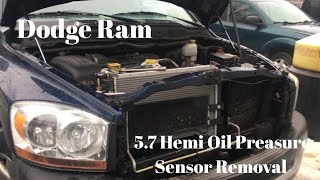
- Replacing the oil pressure sensor, which is a different sensor located nearby. 🎬 Watch: How to remove the oil pressure sensor for comparison.
- Replacing the engine coolant temperature sensor, which is located elsewhere on the engine.
- Confusing the Mopar part 5149077AB with a coolant or camshaft sensor due to ambiguous descriptions on some online parts stores.
Most Likely Causes
- Damaged Wiring or Connector 🔴 High Probability The wiring harness is located low on the engine near the hot oil filter housing, making it susceptible to heat damage, oil saturation, and physical abrasion over time, leading to cracked insulation and short circuits.
How to confirm: Visually inspect the two-wire harness leading to the sensor. Look for cracks, exposed copper wire, or an oil-soaked connector. A key sign of failure is a noticeable 'bulge' or swelling in the wire insulation near the connector, which indicates an internal short. Wiggling the harness while monitoring live data on a scan tool may cause the temperature reading to fluctuate, confirming a wiring fault. 🎬 See how to test and replace the sensor for P0197.
Typical fix: Repair the damaged section of wire using solder and heat-shrink tubing or replace the connector pigtail.
Est. part cost: $5-$25 - Faulty Engine Oil Temperature (EOT) Sensor 🔴 High Probability The sensor operates in a high-heat environment and can fail internally over time.
How to confirm: If the wiring is confirmed to be good (has a 5V reference and a solid ground), the sensor is the likely cause. You can test the sensor's internal resistance with a multimeter while applying heat (like from a hairdryer); the resistance should decrease smoothly as temperature rises. However, given the low cost, replacement is often the most practical diagnostic step after a thorough wiring inspection.
Typical fix: Replace the Engine Oil Temperature sensor. This is best done during an oil change, as the oil filter must be removed to access it and some oil will be lost.
Est. part cost: $15-$60
Rare But Worth Checking
- Faulty Powertrain Control Module (PCM): This is extremely rare. The PCM should only be considered if both the sensor and its entire circuit have been thoroughly tested and confirmed to be in perfect working order.
Diagnosis Steps
- Connect an OBD-II scanner and confirm P0197 is the active code. Check the live data for the Engine Oil Temperature reading. A value of -40°F or another fixed, illogical number strongly points to a circuit fault, most likely in the wiring.
- Raise the vehicle safely. Locate the oil filter on the driver's side of the engine.
- Visually inspect the EOT sensor and its two-wire connector, which is screwed into the oil filter housing. Look closely for signs of cracked insulation, bulging wires, oil contamination, or physical damage. The area where the wires enter the connector is the most common failure point.
- If no visual damage is found, disconnect the sensor. Turn the ignition to the 'On' position (engine off).
- Use a multimeter to check for a 5-volt reference signal on one of the pins in the harness connector. Check the other pin for a good ground connection.
- If the 5-volt reference and ground are present, the wiring is likely okay, and the sensor itself is the primary suspect.
- If either voltage or ground is missing, trace the wiring back toward the PCM to find the break or short.
- If the circuit is good, the most effective step is to replace the EOT sensor. It is recommended to do this during an oil change to minimize oil spillage.
Parts You'll Likely Need
- Engine Oil Temperature Sensor
(OEM #5149077AB (supersedes 5149096AB))— This is the most common part to fail for this code after wiring issues have been ruled out.
Trusted brands: Mopar, Standard Motor Products, Walker Products
OEM price range: $40-$60
Aftermarket price range: $15-$35
Related Codes That Often Appear With This One
- P0196 — This code indicates an 'EOT Sensor Range/Performance' issue. It can appear if the sensor's signal is erratic due to a failing sensor or wiring, but not a hard short or open circuit like P0197.
- P0198 — This is the opposite code, 'EOT Sensor Circuit High,' which is caused by an open circuit (broken wire or unplugged sensor). If the wiring is severely damaged, both codes could appear intermittently.
Technical Service Bulletins (TSBs) & Recalls
- TSB 09-019-23: Addresses a 'ticking noise from exhaust manifold' on 2019-2022 models by replacing the manifold, gasket, and fasteners with an updated kit to fix broken bolts.
- TSB 11-002-11: An older bulletin for 2009 models that involves replacing the exhaust manifold bolts for cylinders 7 and 8 with stronger stainless steel bolts to prevent breakage.
Platform-Specific Known Issues
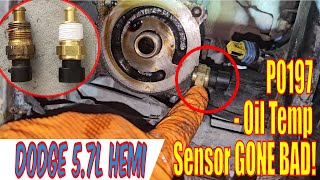
- A YouTube video by 'Scotty's Hobbies' diagnosing P0197 on a 5.7L HEMI (in a Dodge Charger) provides an excellent real-world example. The technician found the cause was not the sensor but a small, visible bulge and crack in the insulation of the signal wire right at the connector, causing a short to ground. This confirms that a detailed visual inspection of the harness is more critical than immediately replacing the sensor.
Mechanic-Grade Diagnostic Values
- EOT Sensor Circuit Voltage at PCM — expected: Varies with temperature (e.g., ~4.5V cold, ~0.5V hot). Failure: Voltage is less than the calibrated amount, typically < 0.5V or even < 0.17V, triggering the code.
- EOT Sensor Harness Voltage (Sensor Disconnected, KOEO) — expected: Approximately 5.0 Volts (+/- 0.1V) on the signal wire.. Failure: No voltage indicates an open in the 5V supply from the PCM.
- EOT Signal Circuit Resistance to Ground — expected: Greater than 100 Ohms.. Failure: Resistance below 100 Ohms indicates a short to ground in the signal wire.
- Resistance between EOT Signal and Ground wires (at sensor connector) — expected: Greater than 5.0 Ohms.. Failure: Resistance below 5.0 Ohms indicates the signal wire and ground wire are shorted together in the harness.
Scan Tool Commands That Help
- Generic OBD-II Scanner / Mopar wiTECH: Live Data Viewer - Engine Oil Temperature — This is the primary diagnostic method. A reading of -40°F/°C indicates a hard fault (open or short). Monitoring the voltage while wiggling the harness can help identify intermittent wiring issues. No specific bidirectional commands are used for this sensor; diagnosis is based on monitoring its output.
Wiring & Ground Locations
- EOT Sensor Signal Circuit — Wire running from the EOT sensor to the PCM C2 Connector.. This is the '(G24)' circuit. A short to ground on this wire is the direct electrical cause of a P0197 code.
- EOT Sensor Ground Circuit — Wire running from the EOT sensor to the PCM C2 Connector.. This is the '(K915)' or '(K900)' circuit. While an open in this circuit would cause a P0198 (Circuit High), a short between this wire and the G24 signal wire will cause P0197.
- PCM Connector C2 — This is one of the main connectors on the Powertrain Control Module (PCM).. This is the termination point for the EOT sensor circuit. Testing for voltage, ground, and continuity must be done between the sensor connector and this connector to isolate a wiring fault from a PCM fault.
Real Owner Repair Stories
- YouTube - Scotty's Hobbies (Dodge Charger 5.7L HEMI (same engine and sensor setup)) — Check Engine Light with code P0197. Scan tool showed oil temperature stuck at -40 degrees.
❌ Tried (didn't work) The owner was about to replace the sensor.
✅ What actually fixed it A detailed visual inspection revealed a bulge and a crack in the insulation of the signal wire, right near the connector. The wire was shorting to ground. The temporary fix was applying liquid electrical tape, confirming the wiring was the sole issue, not the sensor.
OEM Part Supersession History
5149096AB→5149077AB— Standard part number update/revision by Mopar.
Heads up: The same part number (5149077AB) is used for both the Engine Oil Temperature sensor and the Engine Coolant Temperature sensor on many Chrysler/Dodge/Jeep/Ram vehicles. This can lead to confusion and misdiagnosis if not careful when ordering.
Model Year Variations Within This Range
- 2011-2018: No significant variations have been noted for the P0197 code on the 5.7L HEMI within this model year range. The sensor, its location on the oil filter housing, and the common wiring failure points are consistent across the 4th generation Ram 1500.
Diagnostic Flowchart
Other Known Issues on This Vehicle
Issues unrelated to this code that are worth knowing about as an owner of this generation:
- Camshaft and Lifter Failure ('Hemi Tick') 🔴 High — A notorious and widespread issue for 2009+ 5.7L HEMI engines, often occurring between 70,000 and 130,000 miles. It is frequently linked to MDS (Multi-Displacement System) lifters failing, seizing, and destroying the camshaft lobes.
- Broken Exhaust Manifold Bolts 🟠 Medium — Extremely common. The stock steel bolts expand and contract at a different rate than the aluminum cylinder heads, causing them to snap, especially on the rear cylinders (7 & 8). This results in an exhaust leak and a ticking noise that is loudest on a cold start. (Ref: TSB 09-019-23, TSB 09-011-22, TSB 11-002-11)
- Water Pump Failure 🟠 Medium — Water pumps on this platform are a common failure item, often identified by coolant leaking from the weep hole, leading to overheating if not addressed.
Used vs. New Parts: Buying Guide for This Vehicle
When a used part is the smart pick: A used wiring harness pigtail from a salvage yard is a smart, cost-effective choice if your original connector or a few inches of wire are damaged. It is often higher quality than a generic aftermarket pigtail.
Donor-vehicle mileage cap: roughly under 80000 miles for the part to have meaningful remaining life.
What to inspect on the donor part:
- For a wiring pigtail, ensure the plastic is not brittle or cracked.
- Check that the locking tab on the connector is intact.
- Inspect the wire insulation for at least 6 inches back from the connector; it should be flexible and free of cracks or bulges.
- Look for clean, corrosion-free terminals inside the connector.
OEM-only on this vehicle (don't cheap out):
- Powertrain Control Module (PCM) - In the extremely rare event the PCM is the cause, a new or professionally remanufactured OEM unit is required due to vehicle-specific programming.
Aftermarket brands forum-validated for this vehicle:
- For the EOT Sensor: Standard Motor Products (Standard Ignition), Walker Products.
Brands owners have reported issues with on this vehicle:
- No specific brands are consistently reported as problematic for this part, but ultra-low-cost, unbranded sensors from online marketplaces carry a higher risk of premature failure or inaccurate readings.
Real Owner Stories
Aggregated from forums and TSBs cited above. Mileages and costs reflect what owners reported in those sources.
Dodge Charger 5.7L HEMI V8
Symptoms: The vehicle had a Check Engine Light on with code P0197 stored. The oil temperature gauge was likely reading incorrectly or not at all.
What fixed it: The cause was a small, visible bulge and crack in the insulation of the signal wire right at the connector, which created a short to ground. Repairing the damaged section of the wire harness fixed the problem without needing to replace the sensor.
Source hint: YouTube (Scotty's Hobbies - 'P0197 Fix for Dodge & Ram')
Related OBD-II Codes
Frequently Asked Questions
Where is the Engine Oil Temperature (EOT) sensor located on my 2011-2018 Ram 5.7L HEMI?
My scanner shows the oil temperature is -40°F. Does this mean the sensor is bad?
What should I check first for a P0197 code: the sensor or the wiring?
I hear a ticking noise from my HEMI. Is this related to the P0197 code?
Is it best to replace the EOT sensor during an oil change?
Are there any recommended aftermarket brands for the EOT sensor on this truck?
Helpful Videos

We Have This Part in Stock



The information in this article is provided for general reference and educational purposes only. Vehicle specifications, procedures, and part compatibility can vary by production date, trim level, and region. Always consult your vehicle's factory service manual and verify part numbers before purchasing or performing repairs. Safety-critical components such as airbags, seat belts, and braking systems should be installed by a qualified professional.
- Ram 1500:
- 🎬 Helpful Videos
- 🛍️ Shop This Part
- What's Unique About the 2011-2018 Ram 1500
- Symptoms You May Notice
- Most Likely Causes
- Rare But Worth Checking
- Diagnosis Steps
- Parts You'll Likely Need
- Related Codes That Often Appear With This One
- Technical Service Bulletins (TSBs) & Recalls
- Platform-Specific Known Issues
- Mechanic-Grade Diagnostic Values
- Scan Tool Commands That Help
- Wiring & Ground Locations
- Real Owner Repair Stories
- OEM Part Supersession History
- Model Year Variations Within This Range
- Diagnostic Flowchart
- Other Known Issues on This Vehicle
- Used vs. New Parts: Buying Guide for This Vehicle
- Real Owner Stories
- Dodge Charger 5.7L HEMI V8
- Related OBD-II Codes
- Frequently Asked Questions
- 🎟️ Get 5% Off