

Ultimate P0196 Guide: Engine Oil Temperature Sensor Range/Performance
The Most Comprehensive P0196 Resource for Outranking the Competition
- Check your engine oil level and condition first; sludgy or extremely low oil causes P0196 in roughly 15% of cases.
- Test the sensor with a live data scanner before replacing it; a cold engine reading of -40°F or 250°F confirms a dead sensor or wiring short.
- Inspect the water pump on 2008-2019 VW/Audi 2.0L engines; leaking coolant destroys the sensor wiring and requires a $900 to $1,500 repair.
- Do not drive more than 100 miles with this code active, as the resulting rich fuel mixture can destroy a $1,500 catalytic converter.
What Does P0196 Mean?

P0196 means the Powertrain Control Module (PCM) is receiving an irrational signal from the Engine Oil Temperature (EOT) sensor. The computer expects oil to warm up steadily as you drive. If the sensor reading stays cold after 30 minutes on the highway, or drastically conflicts with the Engine Coolant Temperature (ECT) sensor, the PCM flags the data as impossible.
Technical definition: The SAE/OBD-II definition is "Engine Oil Temperature (EOT) Sensor Circuit Range/Performance". This indicates the sensor's signal is outside its logical range compared to other sensors over a specific timeframe. For example, if the ECT shows 195°F but the EOT is stuck at 40°F, the PCM triggers P0196.
Can I Drive With P0196?
Yes, But With Caution. You can drive short distances to a repair shop, but do not ignore this code. The engine computer is using faulty oil temperature data, forcing a rich fuel mixture that reduces fuel economy. Driving over 100 miles risks accelerated internal engine wear and can destroy the catalytic converter, adding $800 to $2,500 in repair costs.
Common Causes

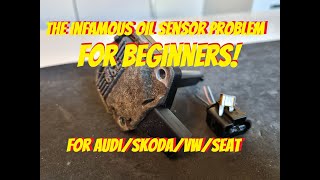
- Faulty Engine Oil Temperature (EOT) Sensor (Very Common) — The most frequent cause. The internal thermistor degrades and stops reporting temperature changes accurately 🎬 See this walkthrough on fixing the P0196 range performance code., getting stuck at one value or responding too slowly.
- Damaged Wiring or Corroded Connectors (Common) — Exposed to extreme heat and road debris, wires fray or melt. Corroded connector pins create high resistance, disrupting the 5-volt reference signal to the computer.
- Incorrect Engine Oil Level or Sludge (Common) — Extremely low oil, thick sludge, or the wrong viscosity alters how oil heats up. Sludge insulates the sensor probe, preventing accurate readings.
- Coolant Contamination (VW/Audi Specific) (Less Common) — On modern VW/Audi engines, a leaking water pump drips coolant directly onto the EOT sensor harness, shorting the circuit and triggering the code.
- Stuck-Open Thermostat (Less Common) — If the engine thermostat is stuck open, the engine never reaches operating temperature. The oil stays too cool, triggering P0196 as a secondary fault.
- Incompatible Aftermarket Sensor (Less Common) — European vehicles require precise OEM resistance curves. Cheap aftermarket sensors often send slightly skewed data that the PCM rejects as implausible.
- Outdated PCM Software (Rare) — Older PCM calibrations are sometimes too sensitive. Manufacturers release software updates to widen the acceptable temperature parameters and prevent false flags.
- Faulty Powertrain Control Module (PCM) (Very Rare) — The computer itself fails to process the incoming voltage. Rule out all wiring and sensor issues before replacing the PCM.
Symptoms

- Check Engine Light On — The primary and often only noticeable symptom for most drivers.
- Decreased Fuel Economy — The PCM defaults to a rich fuel mixture to protect the engine, dropping efficiency by 5-10%.
- Erratic Oil Temperature Gauge — Dashboard oil temp gauges jump randomly, read completely cold, or peg to maximum hot.
- Reduced Engine Power or 'Limp Mode' — The computer initiates Limp Mode to prevent overheating damage, limiting acceleration and RPMs.
- Rough Idle or Hard Starting — Diesel engines rely heavily on EOT for glow plug timing; faulty data causes extended cranking and rough cold starts.
- Delayed Transmission Shifting — The transmission control module uses EOT data to determine shift points, causing harsh shifts or preventing overdrive engagement.
Diagnostic Flowchart

Tap your situation to follow the diagnostic path that matches what you're seeing on this code.
DIY vs Professional
- Replacing the EOT Sensor — Beginner:
- Performing an Oil Change — Beginner:
- Repairing Damaged Wiring — Beginner:
- Replacing a Thermostat — Beginner:
Used vs. New Parts: Buying Guide
When a used part is worth it: Buying a used EOT sensor is never recommended. The low cost of a new OEM part makes the risk of a used part failing shortly after installation unacceptable.
Donor-vehicle mileage cap: roughly under 50000 miles for the part to have meaningful remaining life.
Donor quality checklist:
- Match the part number exactly; sensors for different engines look identical but have different resistance curves.
- Avoid parts from vehicles with signs of engine sludge or overheating.
- Ensure the plastic connector is not brittle or cracked.
Decision logic:
- If The cost of a new OEM sensor is under $150. → Buy a new OEM sensor. The reliability is worth the cost.
- If The sensor is difficult to access (high labor cost to replace). → Always buy a new OEM part to eliminate the chance of paying for labor twice.
Warranty tradeoff: Used parts have a 30-day warranty. New aftermarket sensors carry a 1-year to lifetime warranty. New OEM parts have a 1-year warranty.
Worst-case if a used part fails: $150-$400 if a used part fails, primarily due to repeated labor costs.
What Happens If You Wait — Timeline
- 0-2 weeks: Check Engine Light illuminates. The PCM defaults to a safe, slightly rich fuel strategy. No drivability issues are noticed. (MPG impact: 0-5%% · Added cost: $0)
- 2 weeks - 3 months: Fuel economy drops noticeably as the engine consistently runs rich. Carbon begins building up on spark plugs and oxygen sensors. (MPG impact: 5-10%% · Added cost: $25-$75 in wasted fuel.)
- 3-8 months: Prolonged rich fuel mixtures cause the catalytic converter to overheat, degrading the precious metal substrate. Engine feels sluggish. (MPG impact: 7-12%% · Added cost: $800-$2500 (catalytic converter replacement becomes likely).)
- 8+ months: Incorrect fuel and timing strategies based on faulty data accelerate wear on internal engine bearings and piston rings. Catalytic converter failure is imminent. (MPG impact: 10-20%% · Added cost: $3000+ (engine damage and catalytic converter failure).)
Cost of Not Fixing It
- 0-1 Month: Reduced fuel economy by 5-10% as the PCM defaults to a rich fuel mixture to protect the engine. (Added cost: $20-$50 in wasted fuel.)
- 1-6 Months: A prolonged rich fuel condition causes the catalytic converter to overheat and degrade, leading to premature failure. (Added cost: $800-$2500 for catalytic converter replacement.)
- 6+ Months: Incorrect oil temperature data leads to accelerated wear on internal engine bearings and piston rings due to suboptimal lubrication strategies. (Added cost: $3000+ for potential engine repairs or replacement.)
When This Code Triggers (Freeze-Frame Conditions)
- Engine Coolant Temp: 180-210°F (Engine is fully warmed up and at operating temperature.)
- RPM: 1500-2500 (Steady cruise or light acceleration, not at idle or heavy load.)
- Engine Load: 25-60% (Vehicle is maintaining speed on a flat road or slight incline.)
- Vehicle Speed: 40-65 mph (Sustained city or highway driving for a sufficient period for the engine to warm up.)
Related Codes
- P0197 — Engine Oil Temperature Sensor Circuit Low. The PCM sees sustained low voltage (under 0.2V), interpreted as extreme heat. Points to a short to ground. P0196 is an illogical reading; P0197 is a hard electrical short.
- P0198 — Engine Oil Temperature Sensor Circuit High. The PCM sees sustained high voltage (near 5.0V), interpreted as extreme cold (-40°F). Caused by an open circuit, unplugged sensor, or broken wire.
- P0195 — A general Engine Oil Temperature Sensor Malfunction code. P0196, P0197, and P0198 provide more specific diagnostic direction. If P0196 is present, it takes diagnostic priority over P0195.
- P0115 — Engine Coolant Temperature Sensor Circuit Malfunction. The PCM cross-references EOT and ECT sensors. If the ECT sensor provides faulty data, it complicates P0196 diagnosis or causes it to set erroneously.
Climate & Environmental Factors
- Cold Climates: Triggered more frequently in sub-freezing weather on short trips. The PCM expects oil to reach a specific temperature within a set time. In extreme cold, oil warms up too slowly, triggering a false P0196, especially on diesel engines.
How to Talk to a Mechanic About This Code
Say this: "I have a P0196 code. Before replacing the sensor, please check the live data stream to compare the EOT and ECT readings during warm-up. Also, visually inspect the sensor's wiring for fluid contamination and check for any relevant TSBs."
This signals you understand P0196 has multiple causes. It directs the technician to perform a proper diagnosis, preventing them from blindly replacing the sensor and missing a wiring issue or manufacturer quirk.
Avoid saying:
- 'My check engine light is on, can you just fix it?'
- 'I need a new oil temperature sensor.'
- 'Just do whatever you think is necessary.'
Questions to ask before authorizing the repair:
- What did the live data show? Did the EOT sensor reading change as the engine warmed up?
- Did the EOT and ECT sensor readings look plausible compared to each other?
- Was there any oil or coolant contamination on the wiring harness?
- Did you find any Technical Service Bulletins for my vehicle related to P0196?
- What is the warranty on this specific repair?
Where to Take It: Dealer vs Independent vs Chain
- Dealer:
Best for: Vehicles under powertrain or emissions warranty., Vehicles with complex TSBs for P0196 (Nissan and VW/Audi)., Newer vehicles requiring proprietary software updates.
Downsides: Highest labor rates, often double an independent shop., High markup on OEM parts. (Typical cost: +50% vs. baseline) - Independent Shop:
Best fit for most situations. An experienced independent technician easily diagnoses common causes. However, for VW/Audi or newer Nissans with specific TSBs, a dealer or brand-specialist is safer.
Best for: Out-of-warranty vehicles where P0196 is a bad sensor or wiring issue., Finding a balance between cost and diagnostic expertise.
Downsides: Diagnostic capabilities vary widely; vet shops by ASE certifications., May lack access to proprietary software for brand-new models. (Typical cost: +0% vs. baseline) - Chain Shop:
AVOID for diagnosis. They are not equipped for the diagnostic work required to differentiate between a bad sensor, a wiring fault, or a TSB-related issue. Misdiagnosis is highly likely.
Best for: An oil change if you suspect degraded oil is the cause.
Downsides: Technician skill varies dramatically., High pressure to upsell services., Lack in-depth diagnostic tools for anything beyond a simple sensor failure. (Typical cost: -10% vs. baseline)
When to Walk Away From the Repair
If the estimated repair cost exceeds 40-50% of the car's private-party value, sell or trade it in instead of repairing it.
- Car worth $4000, fix is $350: Fix it. This is a routine repair cost well below the threshold.
- Car worth $4000, fix is $1500: Walk away. A $1,500 VW water pump repair costs 38% of the car's value. Put this money toward a replacement vehicle.
- Car worth $2500, fix is $1500: Walk away. The repair cost is 60% of the vehicle's value, making it a poor investment.
What Scan Tool You Need for This Code

Minimum: A scanner that reads codes and displays multiple streams of live data simultaneously.
A $20 code reader only gives you the P0196 code. You must watch the EOT and ECT live readings simultaneously to see if they behave logically as the engine warms up.
Budget: BlueDriver Pro or OBDLink MX+ (~$100) — These Bluetooth dongles graph live data streams. You can perform the cold soak test by comparing EOT and ECT readings before starting the engine to verify a bad sensor.
Mid-range: Innova 5610 or Ancel BD310 (~$150) — Dedicated handheld units providing robust live data, freeze frame data, and repair suggestions. The Innova 5610 offers bidirectional controls for advanced diagnostics.
Professional: Autel MaxiCOM MK808 / Launch X431 CRP919E (~$450-700) — Provides full system diagnostics, advanced live data graphing, and bidirectional controls needed to diagnose complex issues like the Nissan water control valve.
Rent vs buy: Auto parts stores read codes for free but won't perform live data diagnosis. Buying a $100 Bluetooth scanner offers the best value, providing necessary live data for this and future issues.
How to Clear the Code After You Fix It
- Use an OBD-II scan tool to clear the diagnostic trouble codes.
- Disconnecting the battery for 15 minutes clears codes but resets all vehicle memory and readiness monitors.
- Perform a complete drive cycle to allow the vehicle's readiness monitors to run.
Drive cycle (~30 minutes): A generic drive cycle includes a cold start, 3 minutes of idling, 15 minutes of mixed city/highway driving (steady speeds between 45-65 mph), and a period of coasting. Exact procedures are manufacturer-specific.
Readiness monitors affected: Catalyst (CAT) monitor, Evaporative System (EVAP) monitor, Oxygen (O2) Sensor monitor
Before emissions retest: drive at least 100 miles to fully set monitors.
Watch out for:
- Clearing the code without fixing the root cause results in the code returning within 50 miles.
- Disconnecting the battery resets all readiness monitors to 'incomplete', causing an automatic emissions failure.
- Failing to perform the specific drive cycle leaves monitors 'incomplete' even after extensive driving.
Will This Fail Emissions / State Inspection?
Yes — this code typically fails an OBD-II emissions inspection.
- California: An active P0196 is an automatic smog check failure. After repair, a full drive cycle must be completed to set all readiness monitors to 'Ready' before a retest.
- New York: The NYS DMV inspection includes an OBD-II scan. The presence of P0196 results in an immediate emissions test failure.
- Texas: In the 17 counties requiring emissions testing, a vehicle with an illuminated Check Engine Light for P0196 fails the inspection.
Most Commonly Affected Vehicles
- Ford F-Series Trucks (Powerstroke and 5.4L V8) (2004-2018) — Common on diesels where EOT is critical. On 2004-2008 5.4L F-150s, an engine swap from a later year without an EOT sensor port causes this code. Powerstroke PCMs block Cylinder Contribution Tests if EOT is not at operating temp.
- Volkswagen / Audi GTI, Tiguan, A4, A6, Passat (2006-2019) — On EA888 engines (2008+), this is a secondary fault caused by a leaking water pump dripping coolant onto the sensor's wiring. A blown fuse for the sensor is a common associated finding.
- Chevrolet / GMC Silverado / Sierra (Duramax diesel and V8s) (2007-2020) — The sensor location on V8 models is often in a difficult-to-access spot behind the intake manifold or above the oil filter, increasing labor time to $200-$460 for replacement.
- Dodge / Ram Ram Trucks (Cummins diesel) (2007-2018) — The EOT sensor plays a vital role in diesel engine management. The sensor is located on the side of the engine block near the oil filter.
- Nissan Rogue, Maxima, Altima (2009-2025) — TSB NTB25-007 for 2021-2025 Rogues notes P0196 often appears with P0012. If oil temp exceeds coolant temp by 22°F during testing, the water control valve requires replacement, not the EOT sensor.
- BMW 3 Series, 5 Series, X3, X5 (2005-2015) — Frequently related to the oil level/temperature combination sensor in the oil pan. Also triggered by stuck-open thermostats in the transmission heat exchanger.
- Subaru Impreza, Forester, Outback (2008-2016) — Occurs on non-turbo and turbo models. The sensor is located on the engine block near the oil filter, making it highly accessible for testing.
- Hyundai / Kia Tucson, Sportage, Santa Fe (2011-2023) — EOT data is critical for the CVVT system. For 2022-2023 Tucson Hybrids, a PCM software update (TSB 23-EE-002H) corrects misdiagnosis logic.
Manufacturer-Specific Notes
- Volkswagen / Audi: For EA888 engines, TSB 2049924/5 highlights a leaking water pump as the primary cause of P0196. Coolant destroys the wiring for the oil level/temp sensor below it. Inspect the water pump for pink crust before replacing the sensor.
- Nissan: TSB NTB25-007 for 2021-2025 Rogues states that if oil temp exceeds coolant temp by 22°F after running at 3,000 RPM, the water control valve must be replaced, not the EOT sensor. Often accompanied by P0012.
- Ford: On Powerstroke diesels, the PCM blocks the Cylinder Contribution Test (CCT) unless the EOT sensor shows full operating temperature. Attempting the test on a cold engine triggers P0196 and aborts the diagnostic.
- General Motors: On Chevy/GMC V8s, the sensor is integrated with the oil level sensor in the oil pan or buried behind the intake manifold. Replacement requires draining oil or removing the intake, significantly increasing labor costs.
- All Diesel (Ford, GM, Ram): EOT readings dictate injection timing, fuel pressure, and glow plug on-time. A faulty reading causes severe cold starting issues and rough idling, making P0196 a critical drivability code on diesels.
Real Owner Stories
2005 Ford F-150 with a 2008 Engine Swap
Owner bought a 2005 F-150 with a persistent P0196. Discovered a previous owner swapped in a 2008 5.4L engine. The 2008 oil pan lacked an EOT sensor port, leaving the wiring dangling.
What they tried:
- Reset the code repeatedly.
- Considered splicing resistors to 'fool' the computer.
Outcome: The correct fix requires swapping the 2008 oil pan for a 2005-compatible pan with the threaded bung. The owner opted to live with the issue by periodically clearing the code.
Lesson: Always check for mismatched components from undocumented engine swaps on used vehicles. Missing sensor ports guarantee persistent codes.
2018 Volkswagen Atlas 3.6L at 70k miles
Check Engine Light illuminated with P0196, accompanied by slow coolant loss.
What they tried:
- Independent shop almost replaced the EOT sensor.
Outcome: The actual cause was a leaking water pump. Coolant dripped onto the EOT sensor connector, causing a short. The repair required replacing the water pump assembly and the contaminated sensor pigtail.
Lesson: On VW 3.6L and 2.0L engines, inspect the water pump for pink crust before replacing the EOT sensor. Coolant leaks are the true root cause.
2022 Nissan Rogue 1.5L VC-Turbo
MIL illuminated with P0196 and P0012 (Intake Camshaft Timing).
What they tried:
- Dealership technician initially suspected a bad EOT sensor.
Outcome: Per TSB NTB25-007, the tech ran the engine at 3,000 RPM. The oil temperature exceeded the coolant temperature by more than 22°F (12°C), proving the 'water control valve' was faulty, not the EOT sensor.
Lesson: Always check TSBs. For 2021-2025 Rogues, P0196 often requires a water control valve replacement, especially if P0012 is present.
2012 Ford F-350 6.7L Powerstroke Diesel
Towing in 35°F weather, P0196 triggered. Oil temp gauge read a low 170°F.
What they tried:
- Cleared the code with a scan tool.
Outcome: The code did not return. Extreme cold prevented the diesel oil from warming up fast enough to satisfy the PCM's timer, causing a false positive.
Lesson: In sub-freezing weather, P0196 is sometimes a nuisance code on slow-warming diesel engines. Clear it and monitor before replacing parts.
How to Prevent This Code From Triggering
- Perform regular oil and filter changes with high-quality oil. (Every 5,000-7,500 miles.) — Prevents sludge buildup that insulates the sensor probe. Fresh oil of the correct viscosity ensures the oil heats up at the rate the PCM expects.
- Use OEM sensors for replacements. (At time of repair.) — Cheaper aftermarket sensors lack precise resistance curves. A sensitive PCM interprets this difference as an implausible signal, causing the code to return.
- Address fluid leaks promptly. (As soon as noticed.) — Coolant leaks saturate electrical connectors and degrade wiring insulation, leading to shorts. This is the primary cause of P0196 on VW/Audi models.
- Inspect wiring harnesses in the engine bay. (Every 15,000 miles.) — Catching wires rubbing against hot exhaust components or showing rodent damage prevents circuit faults before they trigger a code.
Frequently Asked Questions
I replaced the EOT sensor, but the P0196 code came back. What now?
This usually points to a misdiagnosis. Inspect the wiring harness and connector for damage, corrosion, or fluid contamination (like a VW water pump leak). If you used a cheap aftermarket sensor, replace it with an OEM part.
Can incorrect or bad engine oil cause a P0196 code?
Yes. Using the wrong oil viscosity causes the oil to heat up at an unexpected rate. Extremely old, sludgy, or contaminated oil insulates the sensor, generating erratic readings and triggering the code.
What's the difference between an aftermarket and OEM EOT sensor?
An OEM sensor perfectly matches your car's computer resistance requirements. Cheaper aftermarket sensors often have slightly different electrical properties. A sensitive PCM flags this difference as an implausible signal, triggering P0196 even with a new part.
Can I just ignore code P0196 if the car drives fine?
No. The computer uses this data to optimize fuel mixture, cooling fans, and timing. Ignoring it reduces fuel economy and accelerates engine wear over time.
Will P0196 clear itself?
No, this code indicates a hardware or performance fault. The Check Engine Light stays on until you properly diagnose and repair the underlying problem. Once fixed, clear the code with a scanner.
How much does it cost to fix P0196?
A DIY sensor replacement costs $15-$40 for the part. Professional sensor replacement ranges from $150 to $350 for parts and labor. Complex root causes, like a leaking VW water pump damaging the harness, cost $900-$1,500.
Will P0196 cause my car to fail an emissions test?
Yes. An active Check Engine Light is an automatic failure for any OBD-II emissions inspection. You must fix the issue and complete a drive cycle before retesting.
Key Takeaways
- Check your engine oil level and condition first; sludgy or extremely low oil causes P0196 in roughly 15% of cases.
- Test the sensor with a live data scanner before replacing it; a cold engine reading of -40°F or 250°F confirms a dead sensor or wiring short.
- Inspect the water pump on 2008-2019 VW/Audi 2.0L engines; leaking coolant destroys the sensor wiring and requires a $900 to $1,500 repair.
- Do not drive more than 100 miles with this code active, as the resulting rich fuel mixture can destroy a $1,500 catalytic converter.
Helpful Videos


The information in this article is provided for general reference and educational purposes only. Vehicle specifications, procedures, and part compatibility can vary by production date, trim level, and region. Always consult your vehicle's factory service manual and verify part numbers before purchasing or performing repairs. Safety-critical components such as airbags, seat belts, and braking systems should be installed by a qualified professional.
- 🎬 Helpful Videos
- What Does P0196 Mean?
- Can I Drive With P0196?
- Common Causes
- Symptoms
- Diagnostic Flowchart
- DIY vs Professional
- Used vs. New Parts: Buying Guide
- What Happens If You Wait — Timeline
- Cost of Not Fixing It
- When This Code Triggers (Freeze-Frame Conditions)
- Related Codes
- Climate & Environmental Factors
- How to Talk to a Mechanic About This Code
- Where to Take It: Dealer vs Independent vs Chain
- When to Walk Away From the Repair
- What Scan Tool You Need for This Code
- How to Clear the Code After You Fix It
- Will This Fail Emissions / State Inspection?
- Most Commonly Affected Vehicles
- Manufacturer-Specific Notes
- Real Owner Stories
- 2005 Ford F-150 with a 2008 Engine Swap
- 2018 Volkswagen Atlas 3.6L at 70k miles
- 2022 Nissan Rogue 1.5L VC-Turbo
- 2012 Ford F-350 6.7L Powerstroke Diesel
- How to Prevent This Code From Triggering
- Frequently Asked Questions
- I replaced the EOT sensor, but the P0196 code came back. What now?
- Can incorrect or bad engine oil cause a P0196 code?
- What's the difference between an aftermarket and OEM EOT sensor?
- Can I just ignore code P0196 if the car drives fine?
- Will P0196 clear itself?
- How much does it cost to fix P0196?
- Will P0196 cause my car to fail an emissions test?
- Key Takeaways
- 🎟️ Get 5% Off