

OBD-II Code P0117: Engine Coolant Temperature (ECT) Sensor Circuit Low
The Ultimate Guide to Diagnosing and Fixing P0117
- Code P0117 triggers when the ECT sensor signal drops below 0.14V, forcing the engine computer to falsely assume a catastrophic 284°F+ overheating event.
- Do not replace the sensor without performing the 'unplug test'; if unplugging the sensor changes the code to P0118, the sensor is bad, but if P0117 remains, the wiring is shorted.
- Driving with P0117 slashes fuel economy by 15-25% and dumps raw fuel into the exhaust, risking a $1,200+ catalytic converter replacement within weeks.
- Always check the physical coolant level first; a system low on coolant exposes the sensor to air pockets, causing erratic readings that mimic a hard electrical short.
What Does P0117 Mean?

Your Powertrain Control Module (PCM) is receiving a voltage signal from the Engine Coolant Temperature (ECT) sensor that falls below the minimum threshold (typically under 0.14V). The computer interprets this near-zero voltage as an impossibly high engine temperature, often exceeding 284°F (140°C). To prevent perceived engine meltdown, the PCM enters a fail-safe mode, commanding cooling fans to run at maximum speed and enriching the fuel mixture to cool the cylinders.
Technical definition: The SAE/OBD-II definition is "Engine Coolant Temperature (ECT) Sensor 1 Circuit Low Input." The PCM has detected the ECT signal wire voltage is below 0.2V. This specific electrical condition dictates a direct short to ground in the signal circuit, an internally shorted sensor, or severe connector corrosion.
Can I Drive With P0117?
No — Do Not Drive. Driving with a P0117 code is strongly discouraged. The engine computer (PCM) receives a false signal indicating extreme engine heat, causing it to default to a rich fuel mixture and run cooling fans constantly. This slashes fuel economy by 15-25% and masks true overheating events. Prolonged driving fouls spark plugs and destroys the catalytic converter due to the unburned fuel, adding $1,200 to $2,500 to your repair costs. Modern vehicles will also enter 'limp mode,' severely restricting acceleration.
Common Causes

- Faulty Engine Coolant Temperature (ECT) Sensor (Very Common) — The thermistor inside the sensor shorts out, sending a constant low-voltage signal. Plastic housing cracks also allow coolant to seep into the connector, creating an internal short circuit.
- Shorted Wiring or Connector (Common) — Engine heat and vibration melt or fray the wiring harness, shorting the signal wire directly to the engine block. Corroded connector pins or a loose ground strap also mimic this short-to-ground condition.
- Low Coolant or Trapped Air (Common) — Low coolant levels or air pockets from a recent flush expose the sensor tip to air instead of liquid. This prevents accurate temperature readings and triggers erratic voltage drops the PCM flags as a hard fault.
- Stuck Open Thermostat (Less Common) — A thermostat stuck open prevents the engine from reaching operating temperature. The PCM logic flags P0117 if it determines the sensor's cold readings are implausible over a long drive cycle.
- Actual Overheating Event (Rare) — A separate mechanical failure causes the engine to genuinely overheat. This extreme heat melts the ECT sensor internals or its wiring, causing a short circuit that sets P0117 after the initial overheating.
- Faulty Powertrain Control Module (PCM) (Very Rare) — The PCM has a failed internal circuit and cannot process the 5V reference signal. Consider this only after exhaustively ruling out sensor, wiring, and ground faults.
Symptoms

- Temperature Gauge Pegged Hot & Fans on High — The dashboard temperature gauge instantly shoots to maximum 'Hot' while engine cooling fans run at full speed, even on a cold start.
- Check Engine Light Illuminated — The PCM triggers the Malfunction Indicator Lamp (MIL) within seconds of detecting the low voltage fault.
- Hard Starting, Rough Idle & Black Smoke — The engine struggles to start cold because the PCM injects fuel calibrated for a 284°F engine, causing flooding, hesitation, and unburned fuel exiting as black exhaust smoke.
- Drastically Reduced Fuel Economy — Gas mileage drops by 15-25% as the computer defaults to a rich fuel mixture to 'cool' the supposedly overheating cylinders.
- No Cabin Heat — Automatic climate control systems rely on ECT data and disable the heater core valve if they receive conflicting temperature signals.
Diagnostic Flowchart
Tap your situation to follow the diagnostic path that matches what you're seeing on this code.
Common Fixes & Costs
- Replace the Engine Coolant Temperature (ECT) Sensor — Parts: $25-$85, Labor: $100-$200, ~0.8 hr book time (DIY)
- Repair Damaged Wiring or Connector — Parts: $15-$50, Labor: $120-$300, ~1.5 hr book time (Intermediate)
- Top Off Coolant and Bleed Air — Parts: $20-$40, Labor: $100-$180, ~1.2 hr book time (DIY)
- Replace the Engine Thermostat — Parts: $20-$150, Labor: $150-$400, ~1.8 hr book time (Intermediate)
Used vs. New Parts: Buying Guide
When a used part is worth it: Never. The ECT sensor is a low-cost, high-wear electronic component. The labor to replace it twice negates any minor savings from a used part.
Donor quality checklist:
- Always purchase a new ECT sensor from an OEM or reputable aftermarket brand.
- Verify the part number is an exact match, as resistance curves vary by engine.
Decision logic:
- If The cost of a new ECT sensor is under $100 → Buy new. Do not risk a used sensor.
Warranty tradeoff: Used parts offer a 30-day warranty. New aftermarket sensors offer 1-year to lifetime warranties. New OEM parts carry a 1-year/12,000-mile warranty.
Worst-case if a used part fails: $200-$300 to pay for labor a second time when the used sensor fails.
What Happens If You Wait — Timeline
- 0-1 week: Code sets, MIL illuminates. Temp gauge reads max hot, cooling fans run constantly. Engine is hard to start cold. (MPG impact: 10-15%% · Added cost: $10-$30 in wasted fuel.)
- 1 week - 2 months: The rich fuel mixture causes heavy carbon buildup on spark plug tips, leading to hesitation and rough idle. (MPG impact: 15-25%% · Added cost: $50-$150 in wasted fuel. Risk of spark plug fouling ($100-$200).)
- 2-6 months: Unburned fuel ignites inside the catalytic converter, raising its temperature over 1600°F. The ceramic substrate begins to melt. (MPG impact: 20-30%% · Added cost: $1,200-$2,500 for catalytic converter replacement. Damage is irreversible.)
- 6+ months: Catalytic converter melts completely, creating a severe exhaust blockage. The engine stalls frequently and cannot exceed 40 mph. (MPG impact: 30-50%+% · Added cost: $2,000-$4,000+ including converter, O2 sensors, and potential engine valve damage.)
Cost of Not Fixing It
- Immediate (0-1 month): Fuel economy drops by 15-25%, causing hard starting, rough running, and constant fan noise. Failed emissions test is guaranteed. (Added cost: $50-$150 per month in wasted fuel.)
- Medium Term (1-6 months): The continuous rich fuel mixture overheats the catalytic converter. Spark plugs foul with heavy carbon deposits. (Added cost: $1,200-$2,800 for catalytic converter replacement, plus $100-$200 for spark plugs.)
- Long Term (6+ months): Catalytic converter substrate melts completely, blocking the exhaust. This causes severe power loss and potential internal engine damage from fuel washing the cylinder walls. (Added cost: $2,000-$4,000+ for exhaust system replacement and engine repair.)
Diagnosis Steps

- Check Coolant Level and Condition
Ensure the engine is completely cool. Check the coolant level in the overflow reservoir and radiator. A low level exposes the sensor to air, causing false readings. Top off if necessary.
Tools: Flashlight, Correct Engine Coolant (Beginner) - Scan Live Data
Connect an OBD-II scanner and observe the live ECT sensor reading. A P0117 fault typically shows an impossibly high temperature (e.g., 284°F / 140°C) on a cold engine. Compare it to the Intake Air Temperature (IAT); they must be within a few degrees of each other when cold.
Tools: OBD-II Scanner (Beginner) - [PRO TIP] Circuit Integrity Quick Test
Unplug the ECT sensor connector. Turn the ignition to 'On' (engine off). If the P0117 code changes to P0118 (high input) on your scanner, the wiring is intact and the sensor is internally shorted. If the code remains P0117, the signal wire is shorted to ground between the connector and the PCM.
Tools: OBD-II Scanner (Intermediate) - Visually Inspect the Sensor and Wiring
Inspect the ECT connector for corrosion, pushed-out pins, or wetness from coolant. Trace the wiring harness back to the PCM, looking for melted insulation or areas rubbing against the hot engine block.
Tools: Flashlight (Beginner) - Check 5V Reference and Ground
With the sensor unplugged and ignition 'On', use a multimeter to test the harness connector. One pin must have a 5-volt reference signal from the PCM, and the other must read close to 0 volts (ground). If the 5V reference is missing, stop DIY testing and take the vehicle to a diagnostic technician for PCM or deep harness repair.
Tools: Multimeter (Intermediate) - Test Sensor Resistance
Set your multimeter to Ohms (Ω). Measure the resistance across the unplugged sensor's two terminals. At room temperature (~70°F/20°C), a good sensor reads between 2,000-3,000 Ω. A reading near zero confirms an internal short.
Tools: Multimeter (Intermediate) - Voltage Drop Test on Ground Circuit
If you suspect a bad ground, reconnect the sensor. Set the multimeter to DC Volts. Place the positive lead on the battery negative terminal and back-probe the negative lead into the ECT ground wire. With the engine running, the reading must be under 0.1 volts (100mV). Higher readings indicate excessive ground resistance.
Tools: Multimeter with back-probe pins (Advanced)
When This Code Triggers (Freeze-Frame Conditions)
- Engine Coolant Temp: >284°F (140°C) (The fault triggers instantly, showing this impossibly high temperature just after startup or at very low RPM.)
- Fault Trigger Voltage: < 0.14V (Sets the moment the PCM detects the sensor's signal voltage has dropped below the minimum threshold, confirming a short circuit.)
- Engine Run Time: < 1 minute (Because it is a hard circuit fault, it logs within seconds of turning the ignition on.)
Related Codes
- P0118 — P0118 (Circuit High Input) is the exact opposite of P0117. It indicates an open circuit, such as an unplugged sensor or severed wire. Unplugging a sensor with a P0117 code should instantly trigger a P0118.
- P0116 — P0116 is a 'Range/Performance' rationality fault. The sensor reading is electrically valid but illogical (e.g., engine runs for 20 minutes but temp doesn't rise). P0117 is strictly an electrical short.
- P0128 — P0128 means the engine physically fails to reach operating temperature, usually due to a stuck-open thermostat. P0117 makes the gauge read max hot; P0128 makes it read too cold.
Climate & Environmental Factors
- High Humidity / Salty Climates: Accelerates corrosion on wiring connectors. Water intrusion into a cracked sensor directly causes the short-circuit condition of P0117.
- Extreme Cold: Makes starting an engine with a P0117 fault significantly harder. The PCM injects fuel for a hot engine, flooding the cold cylinders and preventing startup.
How to Talk to a Mechanic About This Code
Say this: "I have a P0117 code. Please perform a circuit integrity test to confirm if the issue is the sensor or a short in the wiring harness before replacing any parts."
This directs the technician to perform a complete electrical diagnosis, preventing them from blindly replacing the sensor only for the code to return due to a wiring fault.
Avoid saying:
- 'My check engine light is on, can you just fix it?'
- 'I need a new temperature sensor.'
- 'Just do whatever you think is best.'
Questions to ask before authorizing the repair:
- Did you perform the unplug test to see if the code changed to P0118?
- What was the resistance reading on the sensor itself?
- If the wiring is shorted, can you show me exactly where the damage is?
Where to Take It: Dealer vs Independent vs Chain
- Dealer:
Recommended only for in-warranty vehicles or if a specific manufacturer TSB exists.
Best for: Vehicles under warranty., Known TSBs (e.g., VW Taos head gasket).
Downsides: Labor rates are 40-50% higher than independent shops., May default to replacing entire wiring harnesses rather than repairing a single wire. (Typical cost: +40% vs. baseline) - Independent Shop:
Best overall fit. A competent independent shop easily diagnoses and repairs ECT sensor or wiring faults at a reasonable cost.
Best for: Out-of-warranty vehicles., Cost-effective electrical diagnosis and wire repair.
Downsides: Diagnostic expertise varies; vetting via reviews and ASE certifications is mandatory. (Typical cost: +0% vs. baseline) - Chain Shop:
Avoid for initial diagnosis. Acceptable only if you have diagnosed the problem yourself and just need the sensor swapped.
Best for: Pre-diagnosed repairs (e.g., you already proved the sensor is bad).
Downsides: High pressure to upsell., Technicians often lack advanced electrical diagnostic skills. (Typical cost: -10% vs. baseline)
When to Walk Away From the Repair
If an estimated repair cost exceeds 40-50% of the car's private-party value, evaluate your options. A standard P0117 fix is low-cost and rarely triggers this rule.
- Car worth $4500, fix is $250: Fix it. This repair is a small fraction of the car's value and prevents catastrophic catalytic converter damage.
- Car worth $2500, fix is $2800: Walk away. This implies the P0117 was ignored for months, leading to catalytic converter failure. The repair now exceeds the car's value.
What Scan Tool You Need for This Code

Minimum: An OBD-II scanner that reads codes, clears codes, and displays live sensor data.
A $15 code reader only shows 'P0117'. A scanner with live data is required to see the faulty 284°F temperature reading that confirms the electrical short.
Budget: BlueDriver Pro (~$100) — Connects to your smartphone to view live ECT temperature data and provides repair suggestions based on a database of verified fixes.
Mid-range: Foxwell NT510 Elite (~$250) — Provides a dedicated handheld device with faster processing and access to manufacturer-specific modules.
Professional: Autel MaxiCOM MK808 (~$500-1200) — Offers full bidirectional control. Overkill for a simple P0117, but standard equipment for professional shops.
Rent vs buy: For a one-time diagnosis, use the free loaner tool program at auto parts stores like AutoZone. Buy a scanner only if you plan to do your own diagnostics regularly.
How to Clear the Code After You Fix It
- Use an OBD-II scan tool to clear the P0117 code.
- Ensure the fuel tank is between 15% and 85% full.
- Perform a complete OBD-II drive cycle to reset readiness monitors.
Drive cycle (~30 minutes): Start the engine cold and idle for 3 minutes. Drive in mixed city traffic for 10 minutes. Accelerate to a steady 55 mph highway speed and maintain for 5 minutes. Coast down to 20 mph without braking. Repeat the city/highway mix. Allow the vehicle to cool completely.
Readiness monitors affected: Catalyst Monitor, O2 Sensor Monitor, Evaporative System (EVAP) Monitor
Before emissions retest: drive at least 100 miles to fully set monitors.
Watch out for:
- Disconnecting the battery clears the code but resets all readiness monitors to 'Not Ready', causing an automatic emissions failure.
- The code returns immediately upon startup if the underlying electrical short to ground was not repaired.
Will This Fail Emissions / State Inspection?
Yes — this code typically fails an OBD-II emissions inspection.
- California: An active P0117 code is an automatic failure. After repair, a complete drive cycle must be performed to set readiness monitors before a retest.
- New York: Any fault code illuminating the Check Engine Light results in an automatic failure during the NYS DMV OBD-II scan.
- Texas: Vehicles fail if the Check Engine Light is on or if readiness monitors are unset due to recently cleared codes.
Most Commonly Affected Vehicles
- Honda Civic, Accord, CR-V (2001-2017) — These models often utilize two ECT sensors (Sensor 1 for PCM, Sensor 2 for gauge). Replacing the wrong one is a frequent diagnostic error.
- Toyota Corolla, Camry, Prius (2005-2017) — On the 2010-2015 Prius, the sensor requires removing a small bracket for access. Wiring harness chafing is common.
- Chevrolet / GM Silverado, Cruze, Impala (2007-2016) — On V8 trucks, the sensor is tucked under accessories on the driver-side cylinder head, increasing labor costs. On the Cruze, it links to frequent thermostat housing leaks.
- Ford F-150, Focus (2011-2020) — On 2.7L EcoBoost F-150s (2015-2020), TSB SSM 48991 addresses a poor connector fit requiring a new harness pigtail.
- Subaru Impreza, Forester, Outback (2005-2015) — Highly susceptible to trapping air pockets after coolant service. Properly 'burping' the system with a spill-free funnel is mandatory.
- Volkswagen Taos, Tiguan, Jetta (2018-2023) — On 2022+ Taos models, P0117 is a known early warning for catastrophic head gasket failure (TSB 15-23-01).
Manufacturer-Specific Notes
- Honda: Many models use two ECT sensors. ECT Sensor 1 communicates with the PCM and sets the code. ECT Sensor 2 drives the dashboard gauge. You must test Sensor 1 to fix P0117.
- Volkswagen: On 2022+ VW Taos models, TSB 15-23-01 links P0117 directly to head gasket failure. Do not ignore this code on modern VWs, as it precedes major engine damage.
- Ford: For 2015-2020 F-150s (2.7L), TSB SSM 48991 addresses P0117 caused by connector tension loss. The fix requires splicing in a new wiring pigtail.
Real Owner Stories
2011 Subaru Impreza 2.5i after radiator replacement
Owner replaced the radiator and immediately got a P0117 code. They replaced the ECT sensor, but the code remained.
What they tried:
- Replaced the radiator.
- Replaced the ECT sensor.
- Cleared the code with a scanner.
Outcome: After driving for a few miles, the code cleared permanently. The issue was an air pocket trapped in the cooling system after the radiator replacement, which temporarily blinded the sensor.
Lesson: After any cooling system service, you must properly 'burp' the system to remove trapped air. Air pockets prevent the ECT sensor from reading liquid temperature correctly.
2022 Volkswagen Taos with low coolant and P0117
Owner experienced a low coolant warning light, which progressed to a P0117 check engine light on a low-mileage vehicle.
What they tried:
- Topped off coolant.
- Took the vehicle to the dealership.
Outcome: The dealership diagnosed a failing head gasket, a known issue covered by VW TSB 15-23-01. The head gasket was replaced under warranty.
Lesson: On certain modern vehicles, P0117 is a strong indicator of a serious mechanical failure rather than a simple sensor fault. Always check for manufacturer TSBs.
How to Prevent This Code From Triggering
- Perform coolant flushes at recommended intervals (Every 5 years or 100,000 miles) — Old coolant loses anti-corrosive properties, leading to scale buildup that damages the ECT sensor and thermostat.
- Inspect wiring harnesses during oil changes (Every 5,000 to 7,500 miles) — Spotting wires rubbing against hot engine parts prevents the short-to-ground condition that triggers P0117.
- Apply dielectric grease to the ECT connector (Whenever the sensor is unplugged) — Prevents moisture and road salt from corroding the pins, a primary cause of circuit faults in winter climates.
Frequently Asked Questions
What is the most common fix for P0117?
Replacing the ECT sensor is the most common fix. However, you must test the circuit first using the unplug method. A wiring short to ground causes the exact same code and symptoms.
I replaced the sensor, but the code came back. What now?
If a new sensor fails to clear P0117, the signal wire is shorted to ground between the connector and the PCM. You must trace the harness for melted insulation or pinched wires. Alternatively, trapped air in the cooling system is causing false readings.
Why are my cooling fans always on with a P0117 code?
Code P0117 tells the computer the engine is catastrophically overheating. As a fail-safe, the PCM commands the cooling fans to run at maximum speed to protect the engine. This happens even if the engine is ice cold.
Can low coolant cause a P0117 code?
Yes. If the coolant level drops below the sensor, the tip reads air temperature instead of liquid temperature. This causes erratic voltage drops that the PCM interprets as a circuit fault.
What is a common misdiagnosis for P0117?
The most frequent mistake is replacing the ECT sensor without testing the wiring harness for a short to ground. Mechanics also frequently replace the wrong sensor on Honda and Toyota models equipped with two separate coolant temperature sensors.
Can I just clear the P0117 code and keep driving?
Clearing the code turns off the light temporarily, but it returns immediately on the next drive cycle because P0117 is a hard electrical fault. Ignoring it guarantees terrible fuel economy and destroys the catalytic converter.
Is there a difference between P0117 and P0128?
P0117 is an electrical short circuit that makes the computer think the engine is at maximum heat. P0128 is a mechanical fault, usually a stuck-open thermostat, where the engine physically fails to warm up. They require completely different diagnostic approaches.
Key Takeaways
- Code P0117 triggers when the ECT sensor signal drops below 0.14V, forcing the engine computer to falsely assume a catastrophic 284°F+ overheating event.
- Do not replace the sensor without performing the 'unplug test'; if unplugging the sensor changes the code to P0118, the sensor is bad, but if P0117 remains, the wiring is shorted.
- Driving with P0117 slashes fuel economy by 15-25% and dumps raw fuel into the exhaust, risking a $1,200+ catalytic converter replacement within weeks.
- Always check the physical coolant level first; a system low on coolant exposes the sensor to air pockets, causing erratic readings that mimic a hard electrical short.
Helpful Videos
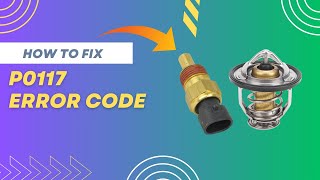
![How to Fix P0117 Engine Code in 3 Minutes [2 DIY Methods / Only $7.43]](https://img.youtube.com/vi/0PE930ETa4Y/mqdefault.jpg)

The information in this article is provided for general reference and educational purposes only. Vehicle specifications, procedures, and part compatibility can vary by production date, trim level, and region. Always consult your vehicle's factory service manual and verify part numbers before purchasing or performing repairs. Safety-critical components such as airbags, seat belts, and braking systems should be installed by a qualified professional.
- 🎬 Helpful Videos
- What Does P0117 Mean?
- Can I Drive With P0117?
- Common Causes
- Symptoms
- Diagnostic Flowchart
- Common Fixes & Costs
- Used vs. New Parts: Buying Guide
- What Happens If You Wait — Timeline
- Cost of Not Fixing It
- Diagnosis Steps
- When This Code Triggers (Freeze-Frame Conditions)
- Related Codes
- Climate & Environmental Factors
- How to Talk to a Mechanic About This Code
- Where to Take It: Dealer vs Independent vs Chain
- When to Walk Away From the Repair
- What Scan Tool You Need for This Code
- How to Clear the Code After You Fix It
- Will This Fail Emissions / State Inspection?
- Most Commonly Affected Vehicles
- Manufacturer-Specific Notes
- Real Owner Stories
- 2011 Subaru Impreza 2.5i after radiator replacement
- 2022 Volkswagen Taos with low coolant and P0117
- How to Prevent This Code From Triggering
- Frequently Asked Questions
- What is the most common fix for P0117?
- I replaced the sensor, but the code came back. What now?
- Why are my cooling fans always on with a P0117 code?
- Can low coolant cause a P0117 code?
- What is a common misdiagnosis for P0117?
- Can I just clear the P0117 code and keep driving?
- Is there a difference between P0117 and P0128?
- Key Takeaways
- 🎟️ Get 5% Off