

OBD-II Code P0198: Engine Oil Temperature Sensor Circuit High
What P0198 means, why it triggers, and how to fix it
- P0198 means the Powertrain Control Module detects a voltage signal above 4.7V from the engine oil temperature sensor circuit, indicating an open circuit or failed sensor.
- Replacing the engine oil temperature sensor resolves up to 80% of P0198 cases, but always verify the 5V reference signal at the connector first.
- Drive no more than 1 to 2 weeks with an active P0198 code to prevent the engine from entering limp mode or overheating due to disabled cooling fans.
- Visually inspect the sensor's wiring harness for frayed insulation or corroded pins before buying parts, as a broken wire mimics a dead sensor perfectly.
What Does P0198 Mean?

P0198 means the Powertrain Control Module (PCM) detects a voltage signal from the Engine Oil Temperature (EOT) sensor exceeding the normal range (typically above 4.7V). This indicates an electrical circuit problem—usually an open circuit or a short to voltage—not necessarily overheating oil. The PCM uses this data to manage fuel delivery, cooling fans, and glow plug timing, so an incorrect signal disrupts engine performance.
Technical definition: The official SAE/OBD-II definition is "Engine Oil Temperature (EOT) Sensor Circuit High". 🎬 See a real-world diagnosis of the P0198 circuit high code The PCM sets this code when the EOT sensor voltage signal exceeds 4.7V. This results from an open circuit in the signal or ground wire, a short to voltage, or an internally failed sensor.
Can I Drive With P0198?
Yes, But With Caution. You can drive short distances (like to a repair shop), but do not ignore this code. Extended driving causes reduced engine performance, poor fuel economy, and potential engine overheating because cooling fans fail to activate correctly. Ignoring the code contributes to internal engine damage from unmanaged temperatures, adding thousands to the repair bill. Inspect the vehicle within a week.
Common Causes

- Faulty Engine Oil Temperature (EOT) Sensor (Very Common) — The sensor's internal thermistor fails, creating an open circuit that sends a constant high-voltage signal to the computer. This accounts for up to 80% of P0198 cases.
- Wiring or Connector Issues (Common) — Harsh engine bay conditions cause frayed wires, loose connections, or corroded connector pins. A broken wire creates an open circuit, which the PCM reads as high voltage.
- Short to Voltage in Signal Circuit (Less Common) — The sensor's signal wire melts against a hot exhaust component and contacts a power source, sending a constant high voltage to the PCM.
- Low or Contaminated Engine Oil (Less Common) — Extremely low oil levels or severe sludge contamination cause the remaining oil to overheat, physically damaging the sensor's thermistor over time.
- Outdated PCM Software (Rare) — The PCM's software calibration is overly sensitive. Manufacturers release software updates to adjust the parameters for setting this code.
- Faulty Powertrain Control Module (PCM) (Rare) — The internal PCM circuit that reads the sensor's signal fails. Consider this only after exhaustively ruling out wiring and sensor failures.
Symptoms

- Check Engine Light is On — The PCM illuminates the check engine light immediately upon detecting the high voltage fault.
- Engine Cooling Fan Runs Constantly — The PCM commands the cooling fans to run at full speed continuously as a protective measure because it cannot verify a safe oil temperature.
- Reduced Engine Power / Limp Mode — The PCM triggers 'limp mode' to protect the engine, resulting in a significant loss of power and limited RPMs.
- Poor Fuel Economy — The engine runs inefficiently without accurate oil temperature data, causing a noticeable drop of 2-4 MPG.
- Incorrect Oil Temperature Gauge Reading — The dashboard oil temperature gauge sticks at its highest reading or shows a high temperature on a cold engine.
- Engine Overheating Risk — If the PCM defaults to a 'cold' reading, it fails to engage cooling fans when the engine gets hot, risking severe overheating.
Diagnostic Flowchart
Tap your situation to follow the diagnostic path that matches what you're seeing on this code.
Common Fixes & Costs
- Replacing the Engine Oil Temperature (EOT) Sensor — Parts: $30-$120, Labor: $80-$200, ~1.2 hr book time (DIY)
- Repairing Damaged Wiring or Connectors — Parts: $10-$60, Labor: $100-$300, ~1.5 hr book time (Intermediate)
- Changing the Engine Oil and Filter — Parts: $40-$100, Labor: $20-$50, ~0.5 hr book time (DIY)
- PCM Reprogramming/Updating — Parts: $0, Labor: $100-$250, ~1.0 hr book time (Professional)
- Replacing the Powertrain Control Module (PCM) — Parts: $600-$900, Labor: $200-$300, ~2.0 hr book time (Professional)
Used vs. New Parts: Buying Guide
When a used part is worth it: Buying a used Engine Oil Temperature (EOT) sensor is generally not recommended. The cost savings are minimal compared to a new aftermarket part, and sensors are wear items with a finite lifespan. A used sensor carries a high risk of premature failure.
Donor-vehicle mileage cap: roughly under 40000 miles for the part to have meaningful remaining life.
Donor quality checklist:
- Verify the part number exactly. EOT sensors are specific to engine models.
- Avoid sensors from high-mileage vehicles or those showing signs of oil leaks or physical damage at the connector.
- Preferably source from a vehicle scrapped for non-engine related reasons (e.g., collision).
Decision logic:
- If The cost of a new OEM or quality aftermarket sensor is less than $100 → Always buy new. The labor to replace a failed used sensor negates any initial savings.
- If The vehicle is very old and a new part is unavailable → A used part is acceptable, but test its resistance before installation to ensure it is not open-circuit.
Warranty tradeoff: Used parts typically have a 30-90 day warranty at best. New aftermarket sensors often come with a 1-year to limited lifetime warranty. New OEM parts carry a 1-2 year warranty.
Worst-case if a used part fails: $150-350 if a used sensor fails after installation, requiring repeat labor costs plus the cost of another part.
What Happens If You Wait — Timeline
- 0-1 month: Check Engine Light is on. PCM defaults to a pre-set value for oil temperature. Cooling fans run constantly. No other major symptoms are likely. (MPG impact: 0-5%% · Added cost: $0-25 in wasted fuel and minor wear on fan motors.)
- 1-3 months: Engine enters a protective 'limp mode,' limiting power and RPMs. Fuel economy noticeably drops as the PCM runs a rich fuel mixture to be safe. (MPG impact: 5-10%% · Added cost: $50-100 in wasted fuel.)
- 3-6 months: Continued inefficient operation causes carbon buildup. The primary risk is an actual overheating event going undetected by the PCM, leading to oil breakdown and loss of lubrication. (MPG impact: 5-15%% · Added cost: $200-500 (potential for internal engine wear to begin).)
- 6+ months: Severe risk of engine damage. If the oil overheats without the PCM's knowledge, it loses viscosity, leading to catastrophic failure of bearings and internal components. (MPG impact: 10-20%% · Added cost: $2000-8000+ (for major engine repairs or replacement).)
Cost of Not Fixing It
- 0-1 month: Reduced fuel economy (2-4 MPG loss) and potential for engine to enter limp mode. Cooling fans run constantly, causing premature wear on the fan motors. (Added cost: Negligible, other than increased fuel costs.)
- 1-6 months: Continued inefficient engine operation leads to carbon buildup on internal components. The PCM fails to activate cooling fans when needed, risking engine overheating and a blown head gasket. (Added cost: $1500-2500 (for head gasket replacement))
- 6+ months: Driving with an unmonitored oil temperature leads to severe internal engine damage if the oil overheats and loses its viscosity, causing excessive wear on bearings and critical parts. This ultimately results in complete engine failure. (Added cost: $4000-8000+ (for engine replacement))
Diagnosis Steps

- Check for Other Codes
Use an OBD-II scanner to read the trouble codes. Note any other codes present, as they help pinpoint the problem. P0198 often appears with related codes like P0197 or P0196.
Tools: OBD-II Scanner (Beginner) - Visual Inspection
Look at the EOT sensor and its connector (usually found in the oil pan, oil filter housing, or cylinder head). Check for broken wires, frayed insulation, melting, or corrosion on the connector pins. A loose plug is a common, easy fix.
Tools: Flashlight (Beginner) - Check Live Data
View the live data stream for the EOT PID. When the engine is cold, the EOT reading should match the ambient air and engine coolant temperatures. If it reads a fixed, extremely high temperature (like 250°F/121°C) on a cold engine, it confirms the 'Circuit High' fault.
Tools: OBD-II Scanner with Live Data (Beginner) - Check the Oil Level and Condition
Check the engine oil dipstick. Ensure the oil level is correct and not black, sludgy, or milky. Low or contaminated oil contributes to sensor failure.
Tools: Rag (Beginner) - Test the Circuit at the Connector
Disconnect the sensor connector. With the ignition on (engine off), use a multimeter to test the harness terminals. You should find one terminal with a 5-volt reference signal from the PCM and another with a good ground (near 0 volts). Missing voltage indicates a wiring issue to the PCM.
Tools: Multimeter (Intermediate) - Test the Sensor's Resistance
With the sensor disconnected, measure the resistance across its two pins. A typical sensor shows high resistance when cold (e.g., 2,000-3,000 Ω at 68°F) and low resistance when hot (e.g., 200-300 Ω at 194°F). A reading of infinite resistance (OL) means the internal thermistor is broken and the sensor requires replacement.
Tools: Multimeter, Vehicle-specific repair manual for resistance specs (Intermediate) - Pro Tip: Jumper Wire Test to Isolate Sensor
To definitively rule out a wiring problem, use a jumper wire to connect the signal and ground terminals on the harness-side connector. Observe the live data on your scan tool. The EOT reading should drop to a very low temperature. This confirms the wiring to the PCM is good and the sensor is faulty.
Tools: Jumper wire (or paperclip), OBD-II Scanner with Live Data (Advanced) - Advanced: Quantitative Voltage Check
With the sensor connected and the key on (engine off), back-probe the EOT signal wire. The voltage should be between 0.5V (hot engine) and 4.0V (cold engine). A P0198 sets when the PCM sees voltage above 4.7V. Wiggling the harness while observing voltage identifies intermittent open circuits.
Tools: Multimeter with back-probe kit, OBD-II Scanner with Live Data (Advanced) - Advanced: Quantitative Resistance-to-Temperature Check
Remove the sensor and test its resistance at controlled temperatures. Measure resistance submerged in ice water (32°F/0°C) and boiling water (212°F/100°C). Compare readings to the service manual specifications. A sensor reading 'OL' at any temperature is faulty.
Tools: Multimeter, Thermometer, Containers for ice and boiling water (Advanced) - Pro Tip: Verifying Signal Voltage at the PCM
Locate the EOT signal wire pin at the PCM connector using a wiring diagram. Back-probe this pin with the key on. If the voltage is high (near 5V) but the wiring and sensor are good, it points to a rare internal PCM fault. Stop DIY diagnosis and tow the vehicle to a professional shop if you reach this conclusion.
Tools: Multimeter, Vehicle-specific wiring diagram, T-pins or back-probe kit (Advanced)
When This Code Triggers (Freeze-Frame Conditions)
- Engine Coolant Temp: 70-100°F (During or shortly after a cold start)
- EOT Sensor Voltage: > 4.7V (At the moment the fault is triggered)
- RPM: 600-1200 (Engine at idle or low RPM after starting)
- Engine Load: < 20% (Low load, as the fault often registers before driving)
Related Codes
- P0197 — This is the opposite code, 'Engine Oil Temperature Sensor Circuit Low,' indicating a short to ground. P0198 (High) points to an open circuit. If the signal wire has 0 volts with the sensor disconnected, suspect a short to ground (P0197); if it has 5 volts, suspect an open circuit (P0198).
- P0196 — This code, 'Engine Oil Temperature Sensor Range/Performance,' is a logic fault. It sets when the PCM sees a signal implausible compared to other sensors, like the Engine Coolant Temperature (ECT) sensor. P0198 is a hard electrical fault where the circuit voltage is stuck high.
- P0199 — This code is for 'Engine Oil Temperature Sensor Intermittent,' meaning the signal cuts in and out. This points to a loose connection or a frayed wire. With P0198, the reading is typically stuck at a constant high value.
- P0520 — This code for 'Engine Oil Pressure Sensor/Switch Circuit' sometimes appears with P0198. The sensors sit near each other, and a wiring harness issue affects both circuits.
Climate & Environmental Factors
- Extreme Cold: Cold temperatures make wire insulation brittle and susceptible to cracking. A crack in the EOT sensor's signal or ground wire creates an open circuit, triggering a P0198 code.
- High Heat & Humidity: Prolonged exposure to high engine bay temperatures accelerates the degradation of the sensor's internal components. Moisture penetrates non-sealed connectors, leading to pin corrosion that increases resistance and causes an open circuit.
- Road Salt & Corrosion: In regions using winter road salt, salt spray causes aggressive corrosion on the sensor body, connector, and exposed wiring, especially if the sensor sits low on the engine.
How to Talk to a Mechanic About This Code
Say this: "I have an OBD-II code P0198, which is 'Engine Oil Temperature Sensor Circuit High'. I'd like to schedule a diagnostic. Can you please confirm that your procedure includes testing the 5-volt reference, ground, and signal wire continuity at the sensor connector before recommending a sensor replacement?"
This signals to the shop that you understand P0198 is an electrical fault that could be the sensor OR the wiring. It encourages a thorough diagnosis to find the true cause, preventing a scenario where you pay for a new sensor only to have the light return because the actual problem was a broken wire.
Avoid saying:
- 'My check engine light is on, can you just fix it?'
- 'I think I need a new oil temperature sensor.' (This invites them to replace it without diagnosis).
- 'Just do whatever you think is best.'
Questions to ask before authorizing the repair:
- Did you find the failure? Was it the sensor itself, the wiring, or the connector?
- If it was the sensor, did it fail the resistance test (read open)?
- If it was the wiring, can you show me where the break or short was found?
- What is the warranty on the parts and labor for this specific repair?
Where to Take It: Dealer vs Independent vs Chain
- Dealer:
Best for: Vehicles still under a powertrain or emissions warranty., Repairs where a Technical Service Bulletin (TSB) indicates a PCM software update is the required fix., Complex electrical issues on newer or high-end European vehicles.
Downsides: Significantly higher labor rates (1.5-2x) compared to independent shops., May default to replacing an entire wiring harness rather than repairing a single wire. (Typical cost: +50% vs. baseline) - Independent Shop:
Best fit for most cases. An experienced independent technician diagnoses a circuit-high fault efficiently and is more likely to perform a cost-effective wiring repair if needed.
Best for: Out-of-warranty vehicles where cost is a major factor., Diagnosing and repairing common electrical faults like P0198.
Downsides: Quality and diagnostic skill vary greatly; it is important to vet the shop through reviews and ASE certifications. (Typical cost: +0% vs. baseline) - Chain Shop:
Use with caution. Acceptable for a simple sensor replacement *if* you have already confirmed the diagnosis yourself. AVOID for initial diagnosis of this code.
Best for: Basic maintenance like oil changes and tire rotations.
Downsides: Technician skill for electrical diagnostics is inconsistent., High pressure to meet sales targets leads to upselling unnecessary parts and services. (Typical cost: -10% vs. baseline)
When to Walk Away From the Repair
If the estimated repair cost exceeds 40-50% of the car's private-party value (e.g., from Kelley Blue Book), you should seriously consider selling the car as-is or trading it in.
- Car worth $4000, fix is $350: Fix it. The repair cost is less than 10% of the vehicle's value.
- Car worth $12000, fix is $350: Fix it. This is a minor cost relative to the car's value.
- Car worth $2500, fix is $1200: Walk away. The worst-case repair cost (a rare PCM failure) is almost 50% of the car's value. Get a firm diagnosis first, but be prepared to sell.
What Scan Tool You Need for This Code

Minimum: An OBD-II reader with Live Data functionality.
A basic $20 code reader only tells you the P0198 code is present. It cannot show you the live data from the Engine Oil Temperature (EOT) sensor, which is the most critical first step in diagnosing the problem. Without seeing if the temperature reading is stuck high, you are flying blind and may replace parts unnecessarily.
Budget: BlueDriver Pro Scan Tool (~$99) — Connects to your smartphone via Bluetooth and the free app allows you to view and graph live data, including the EOT sensor readings. This is sufficient to confirm the fault condition before taking it to a shop.
Mid-range: Foxwell NT604 Elite (~$170) — A dedicated handheld unit providing live data and graphing for the engine, transmission, ABS, and airbag systems. A good investment for a serious DIYer tackling more than just engine codes.
Professional: Autel MaxiCOM MK808 / Launch X431 series (~$500-1200) — These professional-grade tools offer full bidirectional control and all OEM-level functions. While overkill for just reading a P0198 code, they represent the level of equipment a good repair shop uses for deep diagnostics.
Rent vs buy: For a one-time diagnosis, use the AutoZone 'Loan-A-Tool' program. You pay a deposit for a scanner, which is fully refunded when you return the tool within 90 days, making it effectively a free rental. Only buy a scanner if you plan to perform your own diagnostics regularly.
How to Clear the Code After You Fix It
- Use an OBD-II scan tool to clear the code
- Perform a complete drive cycle to allow readiness monitors to reset
Drive cycle (~30 minutes): Start the engine from cold and let it idle for 2-3 minutes. Drive at a steady speed (around 55 mph) for 10-15 minutes. Perform stop-and-go city driving for 5-10 minutes. Allow the engine to cool down completely. This process helps the PCM verify the repair and reset the system monitors.
Readiness monitors affected: Comprehensive Component Monitor, Catalyst Monitor, Evaporative System Monitor
Before emissions retest: drive at least 100 miles to fully set monitors.
Watch out for:
- Simply disconnecting the battery clears the code but also resets all readiness monitors, guaranteeing an emissions test failure until a full drive cycle is completed.
- The code returns immediately if the underlying electrical fault (the open circuit or faulty sensor) was not properly repaired.
Will This Fail Emissions / State Inspection?
Yes — this code typically fails an OBD-II emissions inspection.
- California: A P0198 code causes an automatic smog check failure. After the repair, a complete drive cycle must be performed to set all readiness monitors before a re-test is possible.
- New York: The NYS DMV inspection includes an OBD-II scan. An active P0198 trouble code results in an immediate failure.
- Texas: In the 17 counties requiring emissions testing, a vehicle with an illuminated Check Engine Light for P0198 fails the inspection.
Most Commonly Affected Vehicles
- Ford F-Series with Power Stroke Diesel (especially 6.0L and 7.3L) (1999-2010) — Very common issue. The EOT sensor is crucial for injection timing and glow plug operation. On 7.3L engines, the wiring harness over the driver-side valve cover is a known chafe point. For 6.0L models, the sensor (Part #3C3Z-6G004-BA) sits on top of the oil cooler housing and is prone to failure.
- Chevrolet / GMC Silverado, Sierra, Tahoe, Suburban with V8 engines (2007-2014) — Common on GM trucks and SUVs. The sensor sits in the side of the oil pan, making it susceptible to damage. On models with Active Fuel Management (AFM), oil consumption issues (TSB 10-06-01-008K) lead to oil sludging, indirectly causing sensor failure.
- Hyundai / Kia Elantra, Santa Fe, Azera, Carnival (2006-2012) — Commonly reported. On engines with CVVT, the EOT sensor reading is critical for the PCM to compensate for changes in oil density. Check for engine-related warranty extensions (e.g., Campaign 966) before repair.
- Ram 1500 with EcoDiesel V6 (2014-2018) — The EOT sensor is a known failure point on the EcoDiesel engine, often located on the oil filter housing. Replacement is straightforward during an oil change.
- Subaru Forester, Legacy, Impreza (2008-2018) — Frequently seen on Subaru models. On non-turbo models like the 2011 Forester, the sensor is known to fail, and testing its resistance against temperature changes is a key diagnostic step.
- BMW 3 Series, 5 Series, X3, X5 (2005-2015) — Frequently reported on BMW models from this era, often related to sensor failure. The sensor is sometimes called the 'Oil Condition Sensor' and is a costly repair at a dealership.
- Mercedes-Benz C-Class, E-Class, ML-Class (2006-2016) — Commonly occurs on these models, pointing towards sensor or wiring issues. Checking for oil wicking up the harness from the sensor connector is a common diagnostic step.
- Audi/Volkswagen A4, A6, Passat, Touareg (2007-2018) — These vehicles often log P0198 due to sensor failure or circuit problems. The sensor sits in the bottom of the oil pan, requiring the oil to be drained for replacement.
Manufacturer-Specific Notes
- Ford: On 7.3L and 6.0L Power Stroke engines, if the PCM detects a fault with the EOT sensor (like a broken wire causing P0198), it substitutes the Engine Coolant Temperature (ECT) value for the EOT value. This masks oil cooling problems and affects starting and performance.
- Ram (EcoDiesel): On the 3.0L EcoDiesel, a faulty EOT sensor causes the PCM to command higher-than-normal oil pressure as a protective measure, which is noticeable on the oil pressure gauge.
- Chevrolet/GMC: On V8 engines (approx. 2007-2014) with Active Fuel Management (AFM), TSB 10-06-01-008K addresses high oil consumption leading to fouled spark plugs and rough running. Technicians must be aware of these related engine health issues when diagnosing sensor codes.
- Hyundai/Kia: Many Hyundai/Kia vehicles have extended warranties and service campaigns (e.g., 966, 982) related to engine connecting rod bearing wear. Any engine performance issue on an eligible vehicle should prompt an immediate check of these campaigns at a dealership.
Real Owner Stories
2004 Ford F-250 6.0L Power Stroke with 50K miles
While driving, the engine suddenly lost significant power and the fan became very loud. The check engine light came on with code P0198.
Outcome: The immediate issue resolved itself after the truck sat for an hour, though the CEL remained. This case highlights how mechanical issues (overfilled oil) trigger electrical codes.
Lesson: Always verify the engine oil level is correct after an oil change. Overfilling causes oil to aerate (foam), leading to poor lubrication, overheating, and triggering protective engine modes that set codes like P0198.
Ford 6.0L Power Stroke with an existing P0198 code
The owner had a known P0198 code due to a broken wire to the EOT sensor. The truck's computer substituted the coolant temperature for the oil temperature, so the gauge appeared normal.
Outcome: The wiring fix revealed that the oil cooler was clogged and failing, a common issue on this engine. The P0198 code masked a serious mechanical problem.
Lesson: A circuit code like P0198 sometimes hides a severe mechanical issue. On Ford 6.0L engines, the PCM defaults to the coolant temp sensor reading if the EOT sensor fails, giving a false sense of security while the oil overheats.
2017 Subaru Forester 2.5i after DIY oil pan replacement
Immediately after replacing the oil pan and exhaust gaskets, the car threw a P0198 code and the low oil level light illuminated as soon as the engine warmed up.
Outcome: The owner removed the oil pan again and found the float for the oil level sensor stuck. Freeing the float resolved the issue.
Lesson: If a code appears immediately after a repair, the cause is highly likely related to the work just performed. In this case, a component inside the oil pan inadvertently jammed during reassembly.
How to Prevent This Code From Triggering
- Perform regular oil changes with manufacturer-specified oil (Per vehicle's maintenance schedule (e.g., 5,000-10,000 miles)) — Using the correct, high-quality oil prevents sludge formation and ensures proper lubrication, reducing thermal stress on the EOT sensor.
- Inspect sensor wiring during maintenance (During every oil change) — Visually checking the EOT sensor's wiring harness for cracking, fraying, or proximity to hot exhaust components allows early detection of potential open circuits.
- Apply dielectric grease to the sensor connector (Anytime the connector is unplugged) — Dielectric grease is a non-conductive sealant preventing moisture and road salt from entering the electrical connector, stopping pin corrosion.
- Keep the engine bay and undercarriage clean (Seasonally, especially after winter in salt-belt regions) — Washing away road salt, oil residue, and dirt prevents the buildup of corrosive agents that degrade wiring insulation and connector seals.
- Address engine oil leaks promptly (As soon as they are noticed) — Leaking oil saturates wiring harnesses and connectors, causing plastic and rubber to degrade, soften, and fail, exposing wires to shorts or open circuits.
Frequently Asked Questions
Can I just replace the sensor to fix P0198?
Replacing the sensor fixes the issue in most cases, as it is the most common failure point. However, a broken wire mimics a bad sensor perfectly. Test the circuit and inspect the connector before buying parts to avoid unnecessary expenses.
What are common misdiagnosis mistakes for P0198?
The most common mistake is replacing the EOT sensor without testing the circuit for a 5V reference signal and ground. Technicians also frequently overlook broken wires hidden inside the harness. Always check for Technical Service Bulletins (TSBs) related to PCM software updates before replacing hardware.
Is the Engine Oil Temperature (EOT) sensor the same as the oil pressure sensor?
No, they are two different sensors. The EOT sensor is a thermistor measuring temperature, while the oil pressure sensor measures pressure. They often sit near each other in the same housing but perform different functions and are not interchangeable.
Can using the wrong kind of oil cause a P0198 code?
Not directly, as P0198 indicates an electrical circuit fault. However, using a significantly incorrect oil viscosity increases friction and oil temperatures. Over a long period, this excessive heat contributes to the premature failure of the sensor.
Where is the P0198 sensor located?
The Engine Oil Temperature (EOT) sensor typically screws into the engine block, oil pan, or the oil filter housing. Its exact location varies widely by vehicle make and model. Consult a repair manual for your specific vehicle to find it.
Will a P0198 code cause my car to fail an emissions test?
Yes. An active Check Engine Light causes an automatic failure in most jurisdictions. Additionally, the incorrect sensor reading forces the engine to run a rich fuel mixture, increasing tailpipe emissions.
I cleared the code and it came back immediately. What now?
An immediate return indicates a 'hard fault' that remains unfixed. The underlying electrical problem—such as a broken wire, a faulty new sensor, or a poor connection—is still present. Re-diagnose the circuit using a multimeter to pinpoint the open connection.
What does 'circuit high' actually mean?
'Circuit High' means the PCM reads a voltage at the top of its expected range, typically near 5 volts. This happens when there is an 'open' in the circuit, like a broken wire or a failed sensor. The open circuit prevents the sensor from pulling the reference voltage down to its correct level.
Key Takeaways
- P0198 means the Powertrain Control Module detects a voltage signal above 4.7V from the engine oil temperature sensor circuit, indicating an open circuit or failed sensor.
- Replacing the engine oil temperature sensor resolves up to 80% of P0198 cases, but always verify the 5V reference signal at the connector first.
- Drive no more than 1 to 2 weeks with an active P0198 code to prevent the engine from entering limp mode or overheating due to disabled cooling fans.
- Visually inspect the sensor's wiring harness for frayed insulation or corroded pins before buying parts, as a broken wire mimics a dead sensor perfectly.
Helpful Videos


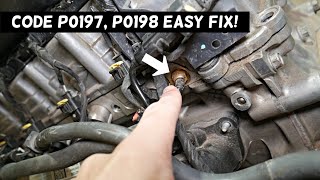

The information in this article is provided for general reference and educational purposes only. Vehicle specifications, procedures, and part compatibility can vary by production date, trim level, and region. Always consult your vehicle's factory service manual and verify part numbers before purchasing or performing repairs. Safety-critical components such as airbags, seat belts, and braking systems should be installed by a qualified professional.
- 🎬 Helpful Videos
- What Does P0198 Mean?
- Can I Drive With P0198?
- Common Causes
- Symptoms
- Diagnostic Flowchart
- Common Fixes & Costs
- Used vs. New Parts: Buying Guide
- What Happens If You Wait — Timeline
- Cost of Not Fixing It
- Diagnosis Steps
- When This Code Triggers (Freeze-Frame Conditions)
- Related Codes
- Climate & Environmental Factors
- How to Talk to a Mechanic About This Code
- Where to Take It: Dealer vs Independent vs Chain
- When to Walk Away From the Repair
- What Scan Tool You Need for This Code
- How to Clear the Code After You Fix It
- Will This Fail Emissions / State Inspection?
- Most Commonly Affected Vehicles
- Manufacturer-Specific Notes
- Real Owner Stories
- 2004 Ford F-250 6.0L Power Stroke with 50K miles
- Ford 6.0L Power Stroke with an existing P0198 code
- 2017 Subaru Forester 2.5i after DIY oil pan replacement
- How to Prevent This Code From Triggering
- Frequently Asked Questions
- Can I just replace the sensor to fix P0198?
- What are common misdiagnosis mistakes for P0198?
- Is the Engine Oil Temperature (EOT) sensor the same as the oil pressure sensor?
- Can using the wrong kind of oil cause a P0198 code?
- Where is the P0198 sensor located?
- Will a P0198 code cause my car to fail an emissions test?
- I cleared the code and it came back immediately. What now?
- What does 'circuit high' actually mean?
- Key Takeaways
- 🎟️ Get 5% Off