

P2703 on 2018-2023 Ford Expedition: Transmission Clutch D Apply Time Fault Guide
On a 2018-2023 Ford Expedition, code P2703 almost always points to an internal failure in the 10R80 transmission, specifically a known issue with the CDF clutch drum. A bushing within the drum walks out of position, causing a hydraulic leak, which leads to harsh shifts, slipping, and eventually, significant damage. This is not a simple fix, requires transmission removal and disassembly, and often costs between $4,000 and $8,000 to repair professionally.
- P2703 on a 2018-2023 Expedition is a serious code that points to a known internal transmission defect.
- The most likely cause is a failed CDF clutch drum bushing, a well-documented issue covered by multiple Ford TSBs.
- Do not simply replace solenoids or flush the fluid; the root cause is mechanical and requires disassembly to fix correctly.
- This is a costly repair that should only be performed by a qualified transmission specialist.
- Driving with these symptoms can lead to complete transmission failure.
What's Unique About the 2018-2023 Ford EXPEDITION
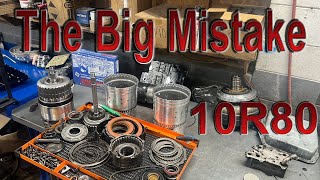
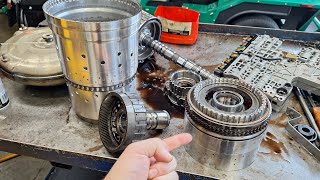
The 2018-2023 Expedition uses the Ford-GM 10R80 10-speed automatic transmission. This specific transmission has a well-documented design flaw with the C-D-F (CDF) clutch drum assembly. A metal bushing (sleeve) inside the drum can move axially (walk out), uncovering an oil passage and/or chewing up a Teflon sealing ring. This causes a critical loss of hydraulic pressure to the clutch packs, leading to delayed engagement, slipping, and harsh shifts. Ford has released an updated CDF drum with a lip or retaining feature machined into it to prevent the bushing from moving. 🎬 Watch: See the failed bushing and the updated drum design. This design flaw is the subject of multiple Technical Service Bulletins (TSBs) and is the most common reason for seeing code P2703, often along with a host of other transmission codes. [TSB 26-2046, TSB 22-2428]
Diagnostic Flowchart
Tap your situation to follow the diagnostic path that matches what you're seeing on this vehicle.
Symptoms You May Notice
- Harsh, clunky, or delayed shifts, especially the 3-5 upshift or downshifts when stopping.
- Transmission slipping, where the engine RPMs flare up without an increase in vehicle speed, often between gears.
- Vehicle may enter "Limp Mode," limiting available gears and displaying a wrench icon.
- Illuminated Malfunction Indicator Lamp (Check Engine Light).
- A "Transmission Fault" message on the instrument cluster.
- Delayed engagement when shifting from Park to Drive or Reverse.
- Shuddering feeling under light acceleration, particularly in gears 3, 4, and 5.
- Problems are often more pronounced when the transmission is cold.
- Replacing only a shift solenoid without addressing the underlying CDF drum failure. The solenoid code is often a symptom of the hydraulic leak, not the root cause.
- Performing a transmission fluid flush. While good for maintenance, a flush will not fix the mechanical failure of the slipping CDF drum bushing and will not resolve the code or symptoms long-term.
- Replacing the valve body alone. While the valve body can be damaged by debris from the initial failure, replacing it without also replacing the faulty CDF drum will lead to a repeat failure.
Most Likely Causes
- Worn or Migrated CDF Clutch Drum Bushing 🔴 High Probability This is a widely acknowledged design defect in early 10R80 transmissions affecting these model years. Ford has issued multiple TSBs (e.g., TSB 22-2428, TSB 25-2023) that point to axial movement of the CDF clutch cylinder sleeve causing hydraulic circuit leaks. [TSB 22-2428, TSB 25-2023] The failure is so common that updated parts were engineered to correct it.
How to confirm: Diagnosis requires a professional technician. The presence of multiple related transmission codes is a strong indicator. [TSB 26-2046] A technician may perform a specific hydraulic leak test outlined in newer TSBs. Ultimately, confirmation requires transmission disassembly and visual inspection of the CDF drum for a moved bushing and damaged Teflon seal.
Typical fix: The transmission must be removed and partially disassembled to replace the faulty CDF clutch drum with an updated part (Part No. JL3Z-7H351-B) that has a lipped bushing to prevent it from moving. Associated seals, gaskets, and often the valve body are inspected and replaced at the same time.
Est. part cost: $250-$500 for the updated CDF drum assembly and necessary seals. - Low or Contaminated Transmission Fluid ⚪ Low Probability While possible, this is rarely the root cause. More often, contaminated fluid (dark, burnt, full of clutch material) is a *symptom* of the internal damage caused by the failing CDF drum, not the cause of the P2703 code itself.
How to confirm: Check the transmission fluid level and condition according to the specific procedure for the 10R80 (checked at a high operating temperature). The fluid should be bright red (Mercon ULV). Dark, burnt-smelling fluid with metallic particles indicates severe internal wear.
Typical fix: If the fluid is simply low, topping it off may provide temporary relief but does not fix the leak. A fluid and filter change will not fix the mechanical failure of the CDF drum and may be a waste of money if a teardown is imminent.
Est. part cost: $150-$250 for a fluid and filter service. - Faulty Valve Body or Solenoid ⚪ Low Probability A solenoid can fail, but it's much more common for the issue to be the mechanical/hydraulic failure at the CDF drum. The resulting pressure loss and debris can damage the valve body or cause solenoids to perform out of range, making the valve body a secondary failure. Technicians often replace or overhaul the valve body during the CDF drum repair.
How to confirm: A technician can command solenoids on and off with a high-level scan tool and monitor pressures. However, a pressure test may show a leak that originates at the drum, not the valve body itself. In some cases, valves can stick in the valve body bores, which can be found upon disassembly and inspection.
Typical fix: Replacement of the specific solenoid or the entire valve body assembly. This is often done in conjunction with the CDF drum replacement.
Est. part cost: $800-$1500 for a new valve body assembly.
Rare But Worth Checking
- Faulty Transmission Control Module (TCM): A TCM failure is extremely unlikely to be the cause of P2703 on this platform. This code is almost always a result of the mechanical CDF drum failure. The TCM should only be considered after all mechanical and hydraulic issues have been definitively ruled out.
Diagnosis Steps
- Verify the code with a professional OBD-II scanner capable of reading transmission codes.
- Check for the presence of other transmission codes. A long list of related clutch and solenoid codes strongly points to the known TSBs for the CDF drum. [TSB 26-2046]
- Check the transmission fluid level and condition. This requires getting the transmission to a specific high temperature (around 200°F). Dark, burnt, or glittery fluid indicates significant internal damage.
- Review the vehicle's history against the known TSBs (e.g., TSB 22-2428, TSB 25-2023). A complaint of harsh shifts, especially 3-5, is a key indicator. [TSB 25-2023]
- If symptoms and codes align with the TSB, the next step is transmission removal and inspection of the CDF clutch drum assembly for a migrated bushing and related seal damage.
Parts You'll Likely Need
- CDF Clutch Cylinder (Drum)
(OEM #JL3Z-7H351-B)— This is the updated component that contains the revised 'anti-walk' bushing design. It is the essential part to permanently fix the hydraulic leak. It supersedes older part numbers like HL3Z-7H351-A and JL3Z-7H351-A.
Trusted brands: Motorcraft
OEM price range: $350-$500 - Transmission Overhaul Seal Kit — When the transmission is disassembled to replace the CDF drum, all related seals, gaskets, and O-rings must be replaced to ensure proper sealing upon reassembly.
Trusted brands: Motorcraft
OEM price range: $150-$300
Aftermarket price range: $100-$200 - Ford Mercon ULV Automatic Transmission Fluid
(OEM #XT-12-QULV)— The 10R80 transmission requires this specific ultra-low viscosity fluid. The system will need to be refilled with approximately 8-10 quarts after the repair.
Trusted brands: Motorcraft
OEM price range: $10-$15 per quart - Main Valve Body Assembly — Often recommended for replacement if the fluid is heavily contaminated with clutch material, as debris can score the valve body or damage solenoids, leading to future issues.
Trusted brands: Motorcraft
OEM price range: $800-$1500
Related Codes That Often Appear With This One
- P0751, P0756, P0761, P2700, P2701, P2702, P2704 — These are all codes related to the performance of other clutches (A, B, C, E, F) and shift solenoids within the 10R80 transmission. Ford's own TSBs list a large group of over 20 DTCs that are all caused by the same single failure point: the CDF drum hydraulic leak. Seeing P2703 with any of these other codes makes the diagnosis of a faulty CDF drum almost certain. [TSB 22-2428, TSB 24-2254]
Technical Service Bulletins (TSBs) & Recalls
- TSB 22-2428: Cites P2703 and a long list of other codes for harsh/delayed shifts in 2017-2022 models due to the CDF clutch cylinder sleeve moving and causing hydraulic leaks.
- TSB 24-2254 / 25-2023 / 26-2046: These are likely superseded or related TSBs that describe the same fundamental issue across different model years, all pointing to the CDF drum as the culprit for a wide array of transmission codes.
- TSB 23-2061: A newer TSB that also addresses harsh shifting and engagement concerns related to the 10R80 transmission, continuing to point toward internal component updates.
- TSB 25-2024: Mentioned on a Ford Ranger forum as superseding TSB 24-2101, this TSB reportedly includes an extensive testing procedure to check the CDF drum for leakage before authorizing a repair, even without codes present.
Platform-Specific Known Issues
- Ford has released multiple Technical Service Bulletins regarding harsh/delayed shifts and numerous transmission trouble codes, including P2703. The bulletins state the cause may be "axial movement of the CDF clutch cylinder (7H351) sleeve causing hydraulic circuit leaks." [TSB 24-2254, TSB 22-2428] The repair involves replacing the CDF clutch drum with an updated part.
Mechanic-Grade Diagnostic Values
- Shift Solenoid Resistance — expected: 5.0 - 5.4 ohms at 68°F (20°C). Failure: A reading outside of this range indicates a faulty solenoid coil.
- Line Pressure Control (LPC) Solenoid Current — expected: High current (approx. 850 mA) results in low pressure; Low current (approx. 50 mA) results in high pressure.. Failure: This is an inversely proportional solenoid; behavior contrary to this indicates a fault in the solenoid or its control circuit.
- Torque Converter Clutch (TCC) Solenoid Current — expected: Low current (approx. 50 mA) results in low pressure; High current (approx. 850 mA) results in high pressure.. Failure: This is a proportional solenoid; pressure not corresponding to current indicates a fault.
Hidden / Shadow Codes Worth Checking
- P163E: Transmission Control Module (TCM) Programmable Parameters Internal Error. This code can appear after replacing the main control valve body if there is a software incompatibility between the new valve body's solenoid strategy file and the existing PCM/TCM software. (see via This code is stored in the PCM or TCM and is visible with a Ford IDS or equivalent professional scan tool. It is specifically mentioned in Ford's TSB 22-2339.)
Scan Tool Commands That Help
- Ford IDS, FORScan, or equivalent professional scanner: Clear Transmission Adaptive Tables — This function should be used after any transmission repair, especially valve body or CDF drum replacement, or as a diagnostic step for erratic shifting. It resets the learned shift pressure values, forcing the TCM to start a new learning process.
- Ford IDS or equivalent: Transmission Strategy Download / Transmission Characterization — This is required when the valve body or a solenoid is replaced. The technician must enter the 13-digit solenoid body strategy number from the new part into the TCM to ensure correct solenoid operation. Failure to do so can cause shifting problems and set codes like P163E.
- FORScan: Halt Transmission Adaptive Learning — Some owners and tuners use this function to lock in the learned shift strategy and prevent it from changing over time, which they feel provides more consistent shift quality, especially on tuned vehicles. This is an advanced function and should be used with caution.
- Ford IDS or equivalent: Adaptive Learning Drive Cycle — This is not a direct command, but a mandatory procedure to be performed after clearing the adaptive tables. It involves a specific sequence of accelerations, stops, and gear shifts to allow the TCM to properly relearn clutch fill times and pressures.
Wiring & Ground Locations
- C175T — This is a major 52-pin connector at the Powertrain Control Module (PCM).. This connector contains the circuits for the Transmission Fluid Temperature (TFT) sensor (Pin 19), Transmission Range (TR) sensors, and various shift solenoid controls. A poor connection or corrosion at this specific connector could interrupt signals between the transmission and the PCM, potentially causing shifting faults.
- G104 — On the right side of the engine compartment, on the frame rail.. This is a primary ground point for various engine and powertrain components. A loose or corroded G104 can cause erratic behavior in sensors and solenoids controlled by the PCM, leading to a wide range of difficult-to-diagnose issues, including transmission faults.
Real Owner Repair Stories
- Reddit user on r/f150 (Early 2022 Ford F-150 SuperCrew 5.0 4x4 with 23k miles) — Erratic shifting, hanging in first gear.
❌ Tried (didn't work) Reprogramming the TCM and clearing KAM/shift tables provided only temporary relief.
✅ What actually fixed it A technician performed a pressure test (passed) and an air pressure test on the main control (passed). Upon disassembling the main control (valve body), they found a couple of valves were sticking in their bores. The technician overhauled the main control, reassembled it, and performed the adaptive road test procedure, which resolved the shifting issues.
OEM Part Supersession History
HL3Z-7H351-A→JL3Z-7H351-A, then JL3Z-7H351-B— The original CDF clutch drum design allowed an internal bushing/sleeve to 'walk' out of position, causing a major hydraulic leak. The final updated part, JL3Z-7H351-B, incorporates a machined lip to physically prevent the bushing from moving.
Heads up: Using an older part number (HL3Z or JL3Z-A) for a repair will likely result in a repeat failure of the same issue.
Model Year Variations Within This Range
- 2018 - mid-2022: Vehicles produced before approximately August 2022 are more susceptible to the CDF drum failure as they were built with the original flawed design. Later models are believed to have the updated drum from the factory, though failures are not impossible.
Helpful Videos

Used OEM Parts in Stock


New Aftermarket Parts Available


The information in this article is provided for general reference and educational purposes only. Vehicle specifications, procedures, and part compatibility can vary by production date, trim level, and region. Always consult your vehicle's factory service manual and verify part numbers before purchasing or performing repairs. Safety-critical components such as airbags, seat belts, and braking systems should be installed by a qualified professional.
- Ford EXPEDITION:
- 🎬 Helpful Videos
- 🛍️ Shop This Part
- What's Unique About the 2018-2023 Ford EXPEDITION
- Diagnostic Flowchart
- Symptoms You May Notice
- Most Likely Causes
- Rare But Worth Checking
- Diagnosis Steps
- Parts You'll Likely Need
- Related Codes That Often Appear With This One
- Technical Service Bulletins (TSBs) & Recalls
- Platform-Specific Known Issues
- Mechanic-Grade Diagnostic Values
- Hidden / Shadow Codes Worth Checking
- Scan Tool Commands That Help
- Wiring & Ground Locations
- Real Owner Repair Stories
- OEM Part Supersession History
- Model Year Variations Within This Range
- 🎟️ Get 5% Off