

P2281 on 2015-2024 Ford Transit 3.5L EcoBoost: Air Leak Causes and Fixes
This code almost always means there is a physical air leak in the intake system between the Mass Airflow (MAF) sensor and the throttle body. On the 3.5L EcoBoost, this is frequently caused by a cracked plastic or rubber intake pipe, a split in a flexible coupler, or a loose clamp. A smoke test is the most reliable way to find the leak.
- P2281 means there is a leak in the intake system between the MAF sensor and the throttle body.
- Do not replace the MAF sensor; the code is indicating a physical leak, not a sensor failure.
- The most common cause on a 3.5L EcoBoost Transit is a cracked plastic or rubber intake pipe or a loose clamp.
- A smoke test is the fastest and most reliable method to find the exact location of the leak.
- Check all vacuum and PCV hoses connected to the intake system, as they can also cause this code.
What's Unique About the 2015-2024 Ford Transit
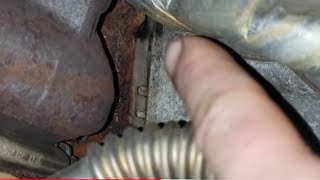
The Ford Transit's 3.5L EcoBoost engine is a twin-turbocharged, direct-injection (GDI) platform. This design makes the intake plumbing more complex and subjects it to positive pressure (boost) and vacuum. The plastic and rubber components of the charge pipes, intercooler, and intake ducts can become brittle and crack over time due to constant heat and pressure cycles, making them common failure points for air leaks. A hissing sound under acceleration 🎬 Watch: Hear what a typical EcoBoost intake leak sounds like is a frequent symptom reported by owners, pointing directly to a leak in the pressurized intake tract.
Generation note: The 2015-2024 Ford Transit is part of the first generation (V363) in North America. While there have been facelifts and powertrain updates, the fundamental design of the turbocharged intake system that makes it susceptible to this code remains consistent across these model years. The first generation of the 3.5L EcoBoost was used until 2016, with the second generation being introduced in 2017, featuring a dual-injection system and other updates. A third generation arrived in 2021 with further revisions. However, the core principle of a pressurized intake tract prone to leaks remains.
Symptoms You May Notice
- Check Engine Light is on
- Rough or fluctuating idle
- Hesitation or surging during acceleration
- Reduced engine power and poor performance
- Hissing or whistling sounds from the engine bay, especially under load/acceleration
- Decreased fuel economy
- Stalling at low speeds
- Replacing the MAF sensor. A P2281 code indicates the system is *reacting* to a leak, not that the sensor itself is bad. The PCM has determined the MAF reading is illogical compared to other sensors, pointing to a leak. While a dirty MAF can cause lean codes like P0171/P0174, it's rarely the direct cause of P2281.
Most Likely Causes
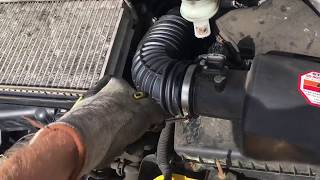
- Cracked or disconnected intake pipes/hoses 🔴 High Probability The plastic and rubber components in the turbocharged intake system are under constant stress from heat and pressure, leading to cracks over time. The flexible rubber/silicone boots that connect pipe sections, especially at the throttle body, are a very common failure point.
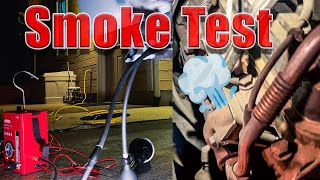
How to confirm: Visually inspect all intake ducting between the air filter box and the throttle body for obvious cracks, tears, or loose connections. A smoke test is the most definitive way to find small 🎬 See how to perform a smoke test on a Transit or hidden leaks. Applying soapy water to suspected areas and looking for bubbles while the engine is running can also help identify a leak.
Typical fix: Replace the damaged section of the intake piping. Ensure all clamps are properly tightened.
Est. part cost: $75-$250 - Loose or broken hose clamps 🟡 Medium Probability Vibrations and temperature cycles can cause clamps to loosen over time. They are often overlooked during routine service or not properly tightened after a filter change or other maintenance.
How to confirm: Physically check every clamp on the intake tract, from the MAF sensor, through the intercooler piping, to the throttle body. Ensure they are secure.
Typical fix: Tighten any loose clamps or replace any that are stripped or broken.
Est. part cost: $5-$20 - Leaking PCV (Positive Crankcase Ventilation) system hose ⚪ Low Probability PCV hoses are made of rubber and can become brittle and crack, creating an unmetered air leak. On a related Ford F-150 with a similar engine, a P2282 code (leak after throttle body) was traced to a bad PCV valve, indicating the entire PCV system is a potential leak source.
How to confirm: Inspect the PCV hoses for cracks or disconnection. A smoke test will also reveal leaks in the PCV system.
Typical fix: Replace the faulty PCV hose or valve.
Est. part cost: $30-$100
Rare But Worth Checking
- Cracked intercooler: While less common, the intercooler itself can develop cracks or leaks at the end tanks, especially on higher-mileage vehicles. This would be a significant air leak under boost.
- Leaking throttle body gasket: The gasket sealing the throttle body to the intake manifold can fail, creating a leak. This is more likely if the throttle body has been removed previously.
- Damaged mechanical vacuum pump: On some Ford models including the Transit, a damaged mechanical vacuum pump can be a source of air leaks that may contribute to this code.
Diagnosis Steps
- Read Codes: Use an OBD-II scanner to confirm P2281 is the primary code. Note any other codes present, like P0171, P0174, or P2282.
- Visual Inspection: Carefully inspect the entire air intake path from the air filter housing to the throttle body. Pay close attention to the flexible rubber couplers at connection points for splits and tears, and check plastic pipes for visible cracks.
- Check Clamps: Manually check that all hose clamps on the intake and intercooler piping are tight.
- Perform a Smoke Test: This is the most effective step. A smoke machine forces low-pressure smoke into the intake system downstream of the MAF sensor. Smoke will escape from the location of any leak, making it easy to pinpoint even small cracks that are not visible.
- Listen for Leaks: With the engine running, listen for an audible hissing or whistling sound. It may be more pronounced when an assistant revs the engine, building boost pressure.
- Inspect PCV System: Check all PCV hoses and connections for cracks or damage, as they are a known source of unmetered air leaks.
- Check Live Data: Using an advanced scanner, monitor short-term (STFT) and long-term (LTFT) fuel trims. High positive numbers (e.g., >10%) at idle that decrease as RPMs increase strongly confirm an unmetered air leak.
Parts You'll Likely Need
- Engine Air Intake Hose / Charge Pipe
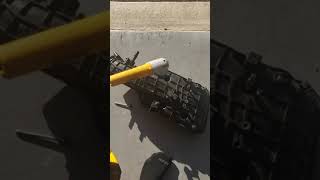
(OEM #FL3Z-9B659-B (Note: This is for F-150 5.0L, verify specific Transit part number))— This is the most common failure point. 🎬 Watch this guide on how to replace an intake hose The plastic and rubber materials crack from heat and pressure cycles in the EcoBoost engine. While FL3Z-9B659-B is a frequently cited intake hose for Ford trucks, it's listed for the 5.0L F-150. The specific part number for a Transit will vary by year and configuration, but the failure mode is identical.
Trusted brands: Motorcraft, Dorman
OEM price range: $150-$250
Aftermarket price range: $75-$150 - Hose Clamp — Clamps can loosen over time due to vibration and temperature changes, or they can break during removal/installation.
OEM price range: $5-$15
Aftermarket price range: $2-$10
Related Codes That Often Appear With This One
- P0171 — System Too Lean (Bank 1) - This code often appears with P2281 because the unmetered air leak creates a lean air-fuel mixture.
- P0174 — System Too Lean (Bank 2) - Similar to P0171, this indicates a lean condition on the second bank of the V6 engine, caused by the same air leak.
- P2282 — Air Leak Between Throttle Body and Intake Valves - This is a close relative of P2281, but it points to a leak *after* the throttle body, such as a leaking intake manifold gasket or a bad PCV valve.
- P0101 — Mass Air Flow (MAF) Circuit Range/Performance - This is a more general parent code for P2281. It indicates the MAF sensor's readings are irrational, but P2281 is the more specific diagnosis where the PCM has concluded the cause is an air leak.
Technical Service Bulletins (TSBs) & Recalls
- TSB 19-2091: Addresses water entering the engine compartment and saturating the air filter on some 2015-2018 Transit vehicles, which can cause various drivability issues and DTCs.
Platform-Specific Known Issues
- A Ford Technical Service Bulletin (TSB 19-2091) for 2015-2018 Transit models addresses water intrusion into the engine compartment, which can saturate the air filter and affect sensors. While not a direct cause of P2281, a wet or damaged air filter could lead to related diagnostic confusion or prompt inspection of the intake system where a leak might be found.
Mechanic-Grade Diagnostic Values
- MAF Sensor Reading (Grams/Second) at Idle — expected: A general rule of thumb is that the g/s reading at idle should be close to the engine's displacement in liters. For the 3.5L EcoBoost, a reading around 3.5 g/s is expected.. Failure: A reading significantly lower than expected (e.g., <3.0 g/s) can indicate unmetered air is entering after the sensor, which is the classic cause for P2281. A reading that is flat and does not fluctuate slightly is a sign of a failing sensor.
- MAF Sensor Reading (Grams/Second) under Acceleration — expected: The g/s reading should increase linearly and smoothly as engine RPM increases. Doubling the engine RPM should roughly double the MAF g/s reading.. Failure: If the g/s reading rises too slowly, it can indicate an air leak downstream of the sensor. If the reading is erratic, drops out, or 'flat-lines' during acceleration, the sensor itself is likely faulty.
- MAF Sensor Signal Voltage at Idle — expected: Should be less than 1.0 volt at a stable idle.. Failure: A voltage significantly higher than 1.0V at idle (e.g., 1.7V) indicates the sensor is reporting much more airflow than is actually present, or the sensor is faulty.
- Intake Air Temperature (IAT) Sensor Resistance — expected: On a similar Ford Transit, a known good sensor (part of the MAF assembly) had a resistance of 12.7k Ohms at an ambient temperature of around 10°C (50°F).. Failure: A faulty sensor in the same conditions read only 3.2k Ohms, causing incorrect air density calculations and contributing to MAF-related codes.
Hidden / Shadow Codes Worth Checking
- P2281-6C: This is a Ford-specific sub-code or 'symptom byte' that may accompany the main P2281 code. While the exact meaning of the '-6C' suffix is not publicly documented, its presence on a Ford Fiesta with the same code definition points to a more detailed fault record stored in the PCM, visible with dealer-level scan tools like Ford IDS. (see via Ford Integrated Diagnostic System (IDS) or high-end professional scanners with manufacturer-specific capabilities.)
Scan Tool Commands That Help
- Ford IDS (Integrated Diagnostic System): Datalogger / Live Data Recording — This function is critical for diagnosing intermittent issues. A technician can record PIDs (Parameter IDs) like MAF (g/s), Short Term Fuel Trim (SHRTFT), Long Term Fuel Trim (LONGFT), and Throttle Position (TP) during a test drive to capture the exact moment the fault occurs. Graphing the MAF signal against RPM and throttle position can reveal if the sensor reading is lagging or dropping out, confirming a leak or a faulty sensor.
Wiring & Ground Locations
- MAF Sensor Connector — On the intake air tube, immediately after the air filter housing.. The connector itself or its wiring can become damaged, corroded, or loose, leading to an incorrect signal from the MAF sensor. A visual inspection of the pins for corrosion and the harness for chafing is a key diagnostic step. On a similar Ford platform, the wire colors are typically Red (12V+ Power), Black/White (Chassis Ground), Tan/Light Blue (Signal Ground from PCM), and Blue/Red (MAF Signal to PCM).
Real Owner Repair Stories
- YouTube channel TECNICENTRO CARDAEWOO (2012 Ford Fiesta SE (demonstrates a common failure pattern applicable to other Fords)) — Check Engine Light with code P2281-6C, indicating an air leak between the MAF and throttle body.
❌ Tried (didn't work) Visual inspection for leaks in hoses and intake manifold, which revealed nothing.
✅ What actually fixed it The root cause was a tiny, almost invisible particle from a low-quality aftermarket air filter that had detached and stuck to the MAF sensor's hot wire filament. This contamination caused the sensor to misread the airflow, triggering the P2281 code even though no physical leak existed. Cleaning the MAF sensor filament resolved the code. - Ford Transit Forum user (2015 Ford Transit Mk8 (Euro model)) — Engine goes into limp mode, Check Engine Light is on with MAF-related codes.
❌ Tried (didn't work) Checking all intake pipes for leaks, which showed no issues.
✅ What actually fixed it The Air Charge Temperature (ACT) sensor, located on the intercooler outlet, was faulty. It was reading incorrectly compared to the ambient temperature, causing the PCM to miscalculate air density and log a MAF fault. Replacing the faulty ACT sensor, which had a resistance of 3.2k Ohms instead of the new part's 12.7k Ohms, fixed the problem.
"I Checked Everything" — The Actual Cause
- In one documented case on a similar Ford vehicle, the P2281 code was present but no leak could be found with a smoke test. The actual cause was a contaminated MAF sensor filament, where a small particle from a cheap air filter had stuck to the hot wire, causing it to misread airflow.
- A faulty EVAP (Evaporative Emission) purge valve can stick open, creating an unmetered air leak *after* the throttle body, which can sometimes confuse the PCM and contribute to or be misdiagnosed in relation to a P2281 code. This is an internal leak from the fuel tank vapor system into the intake manifold, which a smoke test of the main intake tract would not find. Testing involves checking for vacuum on the valve's intake manifold port at idle, when it should be closed.
Model Year Variations Within This Range
- 2015-2016: These early model year Transits use the first-generation 3.5L EcoBoost engine. By 2013, this engine was updated with larger turbos and an electronic blow-off valve compared to the earliest (2011-2012) F-150 versions.
- 2017-2020: These Transits feature the second-generation 3.5L EcoBoost. This engine was significantly overhauled with a new dual fuel-injection system (port and direct), revised cylinder heads, and larger turbochargers with electronic wastegates. While the fundamental cause of P2281 (air leak) is the same, some specific components in the intake tract may have different part numbers or designs.
- 2021-2024: These models use the third-generation 3.5L EcoBoost, which included revisions to the block, heads, cam phasers, and a higher-pressure direct-injection system. Part numbers for intake components are more likely to differ from the first-generation models.
Diagnostic Flowchart
Other Known Issues on This Vehicle
Issues unrelated to this code that are worth knowing about as an owner of this generation:
- Timing Chain Stretch & Cam Phaser Rattle 🔴 High — Common on first-generation (pre-2017) engines, especially between 70k-120k miles. Causes a distinct rattle on cold startup. Less common but still present on second-gen engines. (Ref: TSB 15-0131, TSB 17-0026, TSB 23-2143)
- Intake Valve Carbon Buildup 🟠 Medium — A systemic issue with all gasoline direct injection (GDI) engines, including the 3.5L EcoBoost. Buildup becomes significant over 80k-100k miles, causing reduced performance, rough idle, and misfires.
- Leaking Turbo Coolant Fittings 🟠 Medium — Common on pre-2017 models, often appearing after 100k miles. The O-rings in the quick-connect fittings for the turbo coolant lines degrade, causing a slow coolant leak that is difficult and expensive to access and repair.
- Excessive Oil Consumption 🟠 Medium — Affects certain high-output 3.5L EcoBoost engines, particularly from 2018-2020. Can be caused by PCV system issues or valve cover design. (Ref: TSB 20-2423, TSB 20-2132)
Used vs. New Parts: Buying Guide for This Vehicle
When a used part is the smart pick: Used parts can be a cost-effective option for larger, hard-plastic components of the intake system, such as the main air filter box assembly or rigid sections of charge piping that are less prone to wear. If a specific bracket or connector is broken on your original part, a used assembly from a junkyard can be a smart buy.
Donor-vehicle mileage cap: roughly under 80000 miles for the part to have meaningful remaining life.
What to inspect on the donor part:
- For any plastic or rubber part, inspect carefully for hairline cracks, especially around mounting points and connection flanges.
- Check rubber couplers for any signs of dry rot, swelling, or oil contamination.
- Ensure all mounting tabs and connector clips are intact and not brittle.
- If buying an intercooler, look for bent fins (minor is okay) and signs of impact or damage to the end tanks.
OEM-only on this vehicle (don't cheap out):
- Mass Airflow (MAF) Sensor: While aftermarket sensors are available, they are a frequent source of incorrect readings and repeat issues. Given the sensor's criticality, using a genuine Motorcraft part is highly recommended to ensure accurate data for the PCM.
- EVAP Purge Valve: Owners of various Ford EcoBoost vehicles have reported premature failures with aftermarket purge valves, sometimes within months. Sticking with an OEM Motorcraft part is the safest bet for longevity.
Aftermarket brands forum-validated for this vehicle:
- Dorman: Often produces reliable replacement intake hoses and plastic components that are widely available.
Brands owners have reported issues with on this vehicle:
- Unbranded/white-box MAF sensors and electronic components from online marketplaces are a significant gamble and often lead to further diagnostic headaches.
Real Owner Stories
Aggregated from forums and TSBs cited above. Mileages and costs reflect what owners reported in those sources.
2019 Ford F-150 3.5L EcoBoost
Symptoms: Check Engine Light with the related code P2282.
What fixed it: The problem was ultimately caused by a bad PCV valve, creating an unmetered air leak.
Source hint: Ford F150 Forum - Code P2282?
Ford Transit 3.5L EcoBoost
Symptoms: A hissing noise under load and a noticeable loss of power.
What fixed it: The diagnosis confirmed a split inlet manifold (intake plenum).
Source hint: Ford Transit Forum - Hissing noise! lost Turbo pressure?
Ford Transit
Symptoms: A sudden, loud hissing noise that was dependent on engine revs and load.
What fixed it: The issue was diagnosed as a split hose between the turbo and throttle body.
Source hint: Ford Transit Forum - Air Hissing Turbo Noise from Mk7
Related OBD-II Codes
Frequently Asked Questions
I'm hearing a hissing sound from my Transit's engine when I accelerate. Is this related to the P2281 code?
What is the most common part that fails on the 3.5L EcoBoost to cause a P2281 air leak?
My scanner shows high positive fuel trims along with P2281. What does that mean?
Is there a TSB for my 2017 Ford Transit that could be related to this code?
What is the most effective way to find the exact location of the air leak?
My friend's F-150 had a similar problem. Are the intake parts on my Transit the same?
Helpful Videos
We Have This Part in Stock



The information in this article is provided for general reference and educational purposes only. Vehicle specifications, procedures, and part compatibility can vary by production date, trim level, and region. Always consult your vehicle's factory service manual and verify part numbers before purchasing or performing repairs. Safety-critical components such as airbags, seat belts, and braking systems should be installed by a qualified professional.
- Ford Transit:
- 🎬 Helpful Videos
- 🛍️ Shop This Part
- What's Unique About the 2015-2024 Ford Transit
- Symptoms You May Notice
- Most Likely Causes
- Rare But Worth Checking
- Diagnosis Steps
- Parts You'll Likely Need
- Related Codes That Often Appear With This One
- Technical Service Bulletins (TSBs) & Recalls
- Platform-Specific Known Issues
- Mechanic-Grade Diagnostic Values
- Hidden / Shadow Codes Worth Checking
- Scan Tool Commands That Help
- Wiring & Ground Locations
- Real Owner Repair Stories
- "I Checked Everything" — The Actual Cause
- Model Year Variations Within This Range
- Diagnostic Flowchart
- Other Known Issues on This Vehicle
- Used vs. New Parts: Buying Guide for This Vehicle
- Real Owner Stories
- 2019 Ford F-150 3.5L EcoBoost
- Ford Transit 3.5L EcoBoost
- Ford Transit
- Related OBD-II Codes
- Frequently Asked Questions
- 🎟️ Get 5% Off