

P1437 on 2002-2016 Volkswagen Phaeton: Air Suspension Calibration and Fixes
On a VW Phaeton, P1437 almost always means the air suspension's ride height calibration is lost. This is often caused by a failed ride height sensor or its brittle plastic link. The fix is to replace the faulty sensor and/or link and then perform a suspension calibration with a VAG-specific scan tool like VCDS.
- P1437 on a Phaeton is an air suspension code, not an engine code. It means the system's calibration data is lost.
- The most frequent cause is a small, broken plastic link on one of the four ride height sensors, which is a cheap part but requires a full system recalibration to fix.
- A VAG-specific scan tool (like VCDS) is mandatory to perform the calibration procedure.
- Check for this issue on platform mates like the Bentley Continental GT and Audi A8 before assuming it's unique to the Phaeton.
What's Unique About the 2002-2016 Volkswagen Phaeton

The Volkswagen Phaeton was equipped with a sophisticated adaptive air suspension as a standard feature, a complex system for its time. This system relies on precise calibration to function. Unlike many vehicles where P1xxx codes point to the engine, on the Phaeton, P1437 points directly to this signature suspension system. The fault often arises not from a major component failure, but from the loss of 'basic settings' or a failure in a small but critical part, like a plastic sensor link, which then requires a full system recalibration using specialized tools.
Symptoms You May Notice

- Suspension warning light illuminated on the instrument cluster (yellow car icon with up/down arrows).
- Vehicle sitting too low, often unevenly or 'squatting' at one end.
- Vehicle sitting too high, sometimes at only one end.
- A 'CAR TOO LOW DO NOT DRIVE' message may appear.
- Extremely harsh and bumpy ride quality.
- Inability to change suspension height or firmness using the in-car controls; buttons may be unresponsive or greyed out.
- The air suspension compressor may run excessively or not at all.
- Malfunction of related systems that use height data, such as adaptive headlights (cornering light error) and adaptive cruise control (ACC).
- Replacing the air suspension compressor when the actual fault is a simple leak or a bad sensor link.
- Assuming the entire suspension control module is bad without first attempting to recalibrate the system.
- Interpreting the code as an EGR valve problem due to generic OBD-II reader definitions.
Most Likely Causes

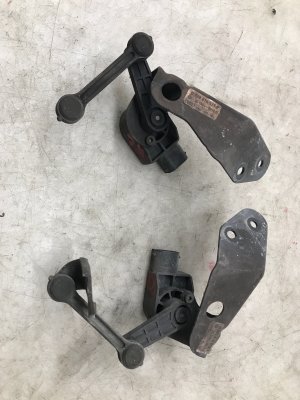
- Failed Ride Height Level Sensor or Linkage 🔴 High Probability The plastic connecting rods that link the sensor to the control arm become brittle over time. The ball joint corrodes, seizes, and eventually the plastic arm breaks or pops off, causing the sensor to give an out-of-range reading. This is a very common point of failure.
How to confirm: Visually inspect the sensor and its linkage at all four corners of the vehicle. Look for broken plastic arms or disconnected links. A scan tool can also show live data from each sensor; jacking up one corner of the car should show a corresponding change in the sensor's value in the measuring blocks.
Typical fix: Replace the faulty ride height sensor and/or its connecting link. The link is often not sold separately from the sensor, though some owners fabricate their own metal links for durability.
Est. part cost: $50-$150 - Lost or Corrupted Calibration Data 🔴 High Probability This can happen after a battery replacement or disconnection, a failed attempt to modify suspension height with a scan tool, or after replacing other suspension components without performing a recalibration. The control module simply 'forgets' its settings.
How to confirm: The presence of code 01437 with the description 'No or Incorrect Basic Setting / Adaptation' is the primary confirmation, especially if no physical damage to sensors is found.
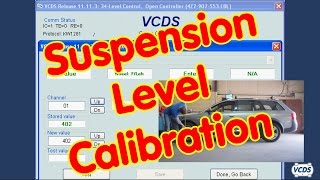
Typical fix: Perform the Suspension Level Control Calibration procedure using a VAG-specific scan tool like VCDS. 🎬 Watch: A step-by-step guide to the VCDS calibration process.
Est. part cost: $0 - Air Leak in a Strut or Line 🟡 Medium Probability The rubber air springs (bellows) can develop cracks and leaks with age, preventing the system from holding pressure. If the car cannot reach the target height required for calibration, the procedure will fail and can trigger this fault.
How to confirm: Listen for hissing noises near the wheels after the engine is off. Spray soapy water on the air struts and line connections; bubbling indicates a leak. A common test is to measure ride height, let the car sit for 24 hours, and measure again to see which corner has dropped.
Typical fix: Replace the leaking air strut assembly. 🎬 See this walkthrough for installing a new front air strut. If a strut has failed, it's possible for shock oil to contaminate the system, potentially requiring replacement of the valve block and air supply unit.
Est. part cost: $400-$900 per strut - Failing Air Suspension Compressor ⚪ Low Probability If there are leaks in the system, the compressor works overtime to compensate, leading to premature wear and failure.
How to confirm: If the compressor runs constantly but the vehicle doesn't lift, or if it doesn't run at all (and the fuse/relay are good), it may be weak or failed. A pressure output test can be done with a scan tool.
Typical fix: Replace the air suspension compressor and its associated relay.
Est. part cost: $300-$700
Rare But Worth Checking
- Water Ingress in Control Module Area: The Level Control Module (J197) is located in the trunk on the right side, behind the trim. While this area is generally dry, on other VAG platforms, water ingress from clogged plenum or sunroof drains can cause severe electrical issues. On the Phaeton, this is less likely for the suspension module but can kill the KESSY (immobilizer) module in the front passenger footwell, which can cause its own set of complex electrical faults.
Diagnosis Steps

- Connect a VAG-compatible scan tool (like VCDS) to the vehicle.
- Access the '34 - Level Control' module.
- Read fault codes. Confirm the presence of 01437 - 'Control Position not Learned'.
- Visually inspect all four ride height level sensors and their plastic connecting links. Pay close attention to the front links, which are a common failure point due to corrosion of the ball joint.
- If a sensor or link is broken, replace it. The car will need to be recalibrated after replacement.
- If no physical damage is found, attempt the 'Suspension Level Control Calibration' procedure. This requires the engine to be running, all doors closed, and the car on a perfectly level surface.
- The procedure involves entering a security access code (31564), then going to 'Adaptation - 10'.
- You will measure the distance in millimeters from the center of the wheel to the fender lip for each corner and enter these values into channels 1 through 4 (Front Left, Front Right, Rear Left, Rear Right).
- Finally, you save the calibration by entering a '1' in channel 5.
- If the calibration fails or the vehicle won't lift to the correct height, investigate for air leaks or a weak compressor before trying again. A calibration can also fail if another module on the CAN bus is malfunctioning.
Parts You'll Likely Need
- Ride Height Level Sensor
(OEM #Front Left: 3D0941285E / 3D0941285D; Front Right: 3D0941286E / 3D0941286D; Rear: 4E0616571D / 4E0616571E (Note: Rear sensors may be shared with Audi A8))— This is the most common hardware failure that leads to the P1437 code. The sensor's integrated plastic link breaks or the ball joint seizes, providing an impossible reading to the control module.
Trusted brands: Bosch, HELLA, VEMO, A-Premium
OEM price range: $120-$200
Aftermarket price range: $40-$90 - Air Suspension Strut Assembly — A leaking air strut prevents the system from holding pressure, which can cause the calibration procedure to fail and may trigger level-related faults.
Trusted brands: Bilstein, Arnott, Aerosus
OEM price range: $1500-$2100
Aftermarket price range: $400-$900
Related Codes That Often Appear With This One
- 01781 — This code for 'Vehicle Extremely Un-Level' often accompanies 01437, as the loss of calibration leads to a physically uneven vehicle stance that the module recognizes as implausible.
- 01575 — This code for 'Control Switched Off' is a direct result of the control module detecting a critical fault (like lost calibration) and disabling the system as a failsafe.
- 01770 — This code for the Level Control Pump Temperature Sensor (G290) can appear if the compressor has been overworked due to leaks, leading to overheating.
Technical Service Bulletins (TSBs) & Recalls
- TSB 2011550 / 43-08-01: This Technical Service Bulletin is mentioned in forums in relation to suspension faults. It may involve a software update
Platform-Specific Known Issues
- DIY Metal Sensor Links: Due to the high failure rate of the OEM plastic sensor links, some owners on forums like VWVortex have documented fabricating their own replacement links from metal (e.g., small threaded rods and ball joints). This provides a much more durable and permanent repair compared to replacing with another plastic part that is likely to fail again.
Mechanic-Grade Diagnostic Values
- Ride Height Sensor Pinout Voltage — expected: Pin 1: ~5V (Reference Voltage from J197), Pin 3: ~0V (Ground from J197). Failure: No 5V reference or no ground indicates a wiring harness or control module issue, not a sensor failure.
- VCDS Live Data - Measuring Block Group 002 (Level Control) — expected: Shows current height sensor values in millimeters for each corner (FL, FR, RL, RR). Values should change smoothly when jacking a corner.. Failure: A value that is stuck, jumps erratically, or reads 0 or 255 indicates a failed sensor or broken linkage.
- VCDS Live Data - Measuring Block Group 005 (Level Control) — expected: Field 1: System Status (0=OK), Field 2: Compressor Status (0=Off, 1=On), Field 3: Accumulator Pressure (in bar).. Failure: System Status '1' (Not OK) confirms a fault. Compressor status stuck 'On' with no height change suggests a leak or weak compressor. Low accumulator pressure can also indicate leaks.
- VCDS Adaptation - Default Ride Height Values — expected: After a successful calibration, the stored values should be approximately 407 mm (front) and 401 mm (rear) for a Rest of World (RoW) spec Phaeton.. Failure: If the system cannot achieve or maintain a height close to these values during calibration, it will often fail and set the 01437 fault.
Hidden / Shadow Codes Worth Checking
- 01437-005: This is a common suffix to the main fault code. The '005' specifies the fault type as 'No or Incorrect Basic Setting / Adaptation'. It explicitly confirms the issue is lost calibration data, which is the most direct indicator for this fault. (see via A VAG-specific scan tool like VCDS will display the code with this suffix. Generic OBD-II readers will typically only show 'P1437'.)
Scan Tool Commands That Help

- VCDS (or equivalent VAG tool): Output Tests (Function 03) in Level Control Module 34 — Use this to individually test components if calibration fails. You can command the compressor to run, and cycle each of the four corner valves and the accumulator valve. This helps isolate a faulty valve block or compressor from a wiring issue or leak.
- VCDS (or equivalent VAG tool): Basic Settings (Function 04) - Groups 020-025 — These commands are used to manually bleed or charge the system (pressure accumulator, front axle, rear axle). This is useful for diagnostics or after replacing a component like a strut or compressor to ensure the system is properly primed before attempting calibration.
Wiring & Ground Locations
- J197 Control Module — In the luggage compartment (trunk), on the right side, behind the trim panel.. This is the brain of the system. All sensor inputs and component outputs run through it. A corroded connector pin at this module can mimic a failed sensor and cause the 01437 code.
- Ground Point 51 — In the luggage compartment, right side.. This is a primary ground connection for the J197 control module. Corrosion or a loose connection at this ground point can cause erratic behavior of the entire level control system, leading to communication errors or lost adaptation.
- Ride Height Sensor Connector (e.g., G78 Front Left) — At each wheel, connected to the sensor body.. This is a 3-pin connector. Pin 1 is 5V supply, Pin 2 is the signal wire, and Pin 3 is the ground. Testing for voltage at these pins can quickly determine if a sensor has failed or if the fault lies in the wiring harness going back to the J197 module.
Real Owner Repair Stories
- Ross-Tech Forum User (2013 VW Phaeton) — Code 01437 appeared after accidentally entering the calibration routine. Calibration kept failing with an 'Invalid Value' error for the right front wheel, despite the measured height being correct.
❌ Tried (didn't work) Repeatedly entering the correct measured height value., Checking sensor live data, which showed smooth operation.
✅ What actually fixed it The user discovered a slight bend in the metal bracket that holds the right front height sensor to the subframe. This bend caused the sensor's 'absolute height' reading in VCDS Measuring Block Group 5 to be significantly different from the left side, even though the physical ride height was correct. After straightening the bracket, the absolute values were closer, and the calibration was completed successfully. - Ross-Tech Forum User (2005 VW Phaeton) — Suspension fault 01437 appeared after attempting to lower the car with VCDS. The adaptation process would not complete, with the status stuck on 'Wait'.
❌ Tried (didn't work) Waiting for over 30 minutes for the 'Wait' status to change., Re-entering values which were then rejected as 'Invalid'.
✅ What actually fixed it The user realized they had left the air conditioning and headlights running during the procedure. On the second attempt, they turned off all major electrical consumers. The calibration then worked perfectly. The theory is that high electrical load can cause minor voltage fluctuations that the sensitive control module dislikes during the calibration/write process. - Ross-Tech Forum User (VW Phaeton) — Car was on bump stops at the front, rear was high in the air. Multiple suspension faults including 01437.
❌ Tried (didn't work) Attempting calibration, which would fail with a 'lower limit exceeded' error.
✅ What actually fixed it The root cause was a combination of issues from a previous owner. First, the left-side battery was dead (5 volts). After replacing the battery, a VCDS check showed the front left level sensor was giving bad readings. Upon inspection, the sensor's linkage was broken and had been crudely zip-tied in place. Replacing the failed sensor and its linkage allowed the car to be raised and lowered via basic settings, and the calibration could then be completed.
When the Usual Fixes Don't Work
- In one documented case, a user replaced a leaking aftermarket air strut with another aftermarket strut and found that the calibration would not complete, repeatedly setting the 01437 fault. The issue was resolved by installing a high-quality OEM-equivalent strut (from Arnott or Bilstein). This suggests the control module is sensitive to the specific response characteristics of the strut's internal valving, and some cheaper aftermarket units may not behave within the expected parameters, making calibration impossible.
OEM Part Supersession History
3D0941285D→3D0941285E— Likely a minor internal revision for improved durability or sealing.
Heads up: These parts are generally considered directly interchangeable.3D0941286D→3D0941286E— Likely a minor internal revision for improved durability or sealing.
Heads up: These parts are generally considered directly interchangeable.4E0616571D / 4E0616571E→4E0907503C— Significant redesign, indicated by the change in part number format. This part is shared with the Audi A8 (D3).
Heads up: While they may physically fit, using the wrong revision (e.g., an early sensor on a late car with updated module software) could potentially cause communication or calibration issues. It is critical to match the part to the vehicle's VIN.
Model Year Variations Within This Range
- 2002-2016: While the core suspension hardware is consistent, the J197 control module received several software updates over the Phaeton's production life. A vehicle that has never been updated may have software with bugs that were fixed in later versions. If calibration fails and all hardware is confirmed good, checking for an available software update for the Level Control module with a dealer-level tool (like ODIS) is a valid diagnostic step.
Diagnostic Flowchart
Real Owner Stories
Aggregated from forums and TSBs cited above. Mileages and costs reflect what owners reported in those sources.
Volkswagen Phaeton
Symptoms: Multiple system warnings triggered on the dash due to a suspension fault.
What fixed it: Identified that the corroded ball joint on the ride height sensor linkage had detached. Reconnecting/replacing the linkage resolved the fault.
Source hint: YouTube: "VW Phaeton - Part 8 - Big Issue, Easy Fix"
Volkswagen Phaeton
Symptoms: Suspension Level Control problem with the 01437 fault code present.
What fixed it: Used VCDS live data while jacking up the car to test the functionality of each level sensor, successfully pinpointing the faulty corner.
Source hint: VWVortex Forum: "Suspension Level Control problem"
Audi A6/S6 C6 (Related Platform)
Symptoms: Calibration failed repeatedly and the car raised uncontrollably when checking the low level.
What fixed it: Replaced a failed sensor link, which allowed the air suspension calibration procedure to complete successfully.
Source hint: AudiWorld Forum: "Cannot calibrate air suspension"
Volkswagen Phaeton
Symptoms: OEM plastic sensor links became brittle and failed repeatedly, causing out-of-range sensor readings.
What fixed it: Fabricated custom replacement links from metal (threaded rods and ball joints) for a permanent, durable repair.
Source hint: VWVortex Forum (via Vehicle Specific Issues: DIY Metal Sensor Links)
Related OBD-II Codes
Frequently Asked Questions
Does TSB 2011550 / 43-08-01 apply to my 2002-2016 Volkswagen Phaeton for this suspension code?
Why did my Phaeton trigger code 01437 after I replaced the battery?
Can I buy just the replacement plastic linkage for my Phaeton's ride height sensor?
What is the security access code needed to recalibrate the Phaeton's air suspension in VCDS?
My Phaeton is showing a cornering light error along with the suspension warning. Are they related?
How do I measure the ride height during the VCDS calibration procedure?
Helpful Videos
We Have This Part in Stock


The information in this article is provided for general reference and educational purposes only. Vehicle specifications, procedures, and part compatibility can vary by production date, trim level, and region. Always consult your vehicle's factory service manual and verify part numbers before purchasing or performing repairs. Safety-critical components such as airbags, seat belts, and braking systems should be installed by a qualified professional.
- Volkswagen Phaeton:
- 🎬 Helpful Videos
- 🛍️ Shop This Part
- What's Unique About the 2002-2016 Volkswagen Phaeton
- Symptoms You May Notice
- Most Likely Causes
- Rare But Worth Checking
- Diagnosis Steps
- Parts You'll Likely Need
- Related Codes That Often Appear With This One
- Technical Service Bulletins (TSBs) & Recalls
- Platform-Specific Known Issues
- Mechanic-Grade Diagnostic Values
- Hidden / Shadow Codes Worth Checking
- Scan Tool Commands That Help
- Wiring & Ground Locations
- Real Owner Repair Stories
- When the Usual Fixes Don't Work
- OEM Part Supersession History
- Model Year Variations Within This Range
- Diagnostic Flowchart
- Real Owner Stories
- Volkswagen Phaeton
- Volkswagen Phaeton
- Audi A6/S6 C6 (Related Platform)
- Volkswagen Phaeton
- Related OBD-II Codes
- Frequently Asked Questions
- 🎟️ Get 5% Off