

OBD-II Code C1044: Rear Right Wheel Speed Signal Performance
What C1044 means, why it triggers, and how to fix it
- Code C1044 indicates an erratic signal from the right rear wheel speed sensor, which immediately disables your ABS and stability control systems.
- Before buying a $50-$150 replacement sensor, spend 10 minutes cleaning the magnetic sensor tip and checking the wheel bearing for physical play.
- If the C1044 code returns immediately after replacing the sensor, the root cause is likely a failing $200-$450 wheel hub bearing assembly.
- On Suzuki Grand Vitara models (2008-2012), C1044 is a known $400-$800 internal ABS module failure, not a wheel-level sensor issue.
What Does C1044 Mean?

Trouble code C1044 means your Anti-lock Brake System (ABS) module detects an irregular or implausible signal from the right rear wheel speed sensor. The computer compares all four wheel speeds and expects steady, predictable signals. When the right rear signal drops out, becomes erratic, or mismatches the others while driving, the computer flags a performance problem and triggers this code.
Technical definition: The SAE/OBD-II definition for C1044 is "Right Rear Tone Wheel Performance" or "Abnormality in periodical signal for RR wheel speed sensor." The ABS Module detects periodic drops or implausible signals from the right rear wheel speed sensor circuit that are not severe enough to be a complete circuit failure (like codes C102B or C1035).
Can I Drive With C1044?
Yes, But With Caution. Yes, but your Anti-lock Braking (ABS), Traction Control (TCS), and Electronic Stability Control (ESC) systems are disabled. Your standard brakes function normally, but the risk of wheel lock-up and skidding during emergency braking or in slippery conditions increases significantly. Address this safety-critical issue promptly, as you lose features designed to maintain vehicle control in emergencies.
Common Causes

- Dirty or Debris-Covered Tone Wheel or Wheel Speed Sensor (Very Common) — Brake dust, rust, or road grime accumulates on the tone wheel or the tip of the wheel speed sensor. This physically blocks or distorts the magnetic field, preventing a clean reading and causing signal dropouts.
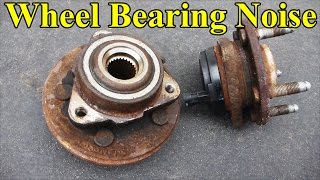
- Failing Wheel Bearing (Common) — A worn wheel bearing causes excessive "play" in the wheel hub. 🎬 Watch: How to check for wheel bearing play and noise. This constantly changes the distance (air gap) between the sensor and the tone wheel, leading to a fluctuating signal the ABS module flags as a performance fault.
- Damaged or Corroded Tone Wheel / Magnetic Encoder (Common) — The tone wheel (often part of the hub bearing) suffers cracked teeth, rust swelling, or damage to the embedded magnetic encoder ring. Bringing a strong magnet near the hub seal also permanently scrambles the magnetic poles.
- Damaged or Corroded Wiring Harness (Common) — Exposed wiring harnesses chafe, fray, or corrode, especially near suspension components. This causes an intermittent open or short in the circuit, leading to an erratic signal.
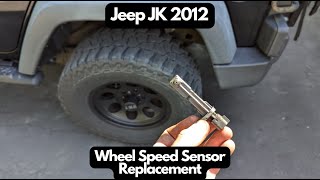
- Broken or Rotted Sensor Retaining Clip (Less Common) — On Jeep, Dodge, and Chrysler models, the metal clip holding the sensor rusts and breaks. The sensor becomes loose, creating an excessive air gap and causing the signal to drop out. 🎬 See this walkthrough for replacing a Jeep rear speed sensor.
- Faulty Right Rear Wheel Speed Sensor (Less Common) — The sensor fails internally due to age, heat, or moisture intrusion. While less common for a 'performance' code than physical hub issues, an internal failure produces a noisy signal.
- Incorrect Tire Size or Significant Pressure Difference (Rare) — If the right rear tire is a different size or has significantly lower air pressure, it rotates at a different speed. The ABS module interprets this consistent rotational difference as a performance fault.
Symptoms

- ABS and Traction/Stability Warning Lights Illuminated — The ABS, Traction Control (TCS), and Electronic Stability Control (ESC) lights illuminate and stay on because these systems disable themselves when they lose accurate wheel speed data.
- ABS Activates Incorrectly at Low Speeds — You feel the brake pedal pulsate or hear the ABS pump running at low speeds (under 10 mph). A weak signal falsely makes the ABS module think a wheel is locking up.
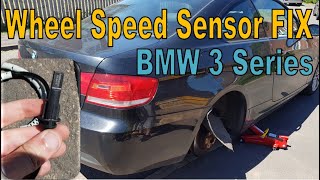
- Vehicle Juddering or Losing Power When Turning — On vehicles like BMWs, an erratic signal tricks the stability control system into thinking the car is skidding. The system applies brakes or cuts engine power to correct the phantom skid, causing a juddering feeling. 🎬 Watch: How to fix BMW wheel speed sensor issues.
- Erratic Speedometer Readings — On vehicles using rear wheel speed sensors to calculate vehicle speed, a faulty signal causes the speedometer to behave erratically or drop to zero intermittently.
Diagnostic Flowchart
Tap your situation to follow the diagnostic path that matches what you're seeing on this code.
Common Fixes & Costs
- Clean Wheel Speed Sensor and Tone Ring — Parts: $5-$15, Labor: $100-$150, ~1.0 hr book time (DIY)
- Replace Right Rear Wheel Hub Bearing Assembly — Parts: $100-$450, Labor: $250-$450, ~2.5 hr book time (Intermediate)
- Replace Right Rear Wheel Speed Sensor — Parts: $25-$250, Labor: $100-$200, ~1.2 hr book time (DIY)
- Repair or Replace Wiring Harness Section — Parts: $10-$50, Labor: $150-$350, ~2.0 hr book time (Intermediate)
- Replace ABS Control Module (Suzuki specific) — Parts: $400-$800, Labor: $150-$300, ~2.0 hr book time (Professional)
Used vs. New Parts: Buying Guide
When a used part is worth it: For a wheel speed sensor, a used OEM part from a low-mileage vehicle is a cost-effective alternative. For a wheel hub bearing assembly, buying used is strongly discouraged as it is a critical wear item.
Donor-vehicle mileage cap: roughly under 60000 miles for the part to have meaningful remaining life.
Donor quality checklist:
- Verify the part number exactly.
- Ensure the wiring pigtail and connector are free of corrosion.
- Avoid parts from vehicles in the Rust Belt.
- Obtain a part with a return policy.
Decision logic:
- If The failed part is the wheel hub bearing assembly. → Always buy new. The risk and high labor cost of premature failure outweigh savings from a used part.
- If The failed part is the wheel speed sensor and the vehicle is older. → A used OEM sensor is viable if budget is the main concern. A new aftermarket sensor is often a better balance of cost and reliability.
- If The part is for a high-performance or newer vehicle. → Buy new OEM or a high-quality aftermarket equivalent (e.g., Bosch, NTK, Timken, SKF).
Warranty tradeoff: Used parts typically have a 30-90 day warranty. New aftermarket parts offer 1-year to limited lifetime warranties. New OEM parts carry a 12-month manufacturer's warranty.
Worst-case if a used part fails: $400-$600 if a used hub bearing fails shortly after installation, requiring a second labor charge and a new part.
What Happens If You Wait — Timeline
- 0-2 weeks: Code C1044 sets. ABS and Traction Control warning lights illuminate. Stability systems are disabled. No other symptoms are noticeable. (MPG impact: 0%% · Added cost: $0 (Safety risk is the primary concern))
- 2 weeks - 3 months: If caused by a failing wheel bearing, a faint humming or grinding noise begins, noticeable at certain speeds or when turning. (MPG impact: 0-2%% · Added cost: $0-$50 in wasted fuel)
- 3-6 months: Wheel bearing noise becomes a loud growl. The bearing develops excessive play, causing uneven tire wear and stressing brake components. (MPG impact: 2-5%% · Added cost: $150-$400 (prematurely worn tire and brake rotor damage))
- 6+ months: Catastrophic bearing failure. The bearing seizes or collapses, causing severe wheel wobble and potential damage to the hub, steering knuckle, and axle shaft. (MPG impact: N/A% · Added cost: $1,000-$2,500+ (replacement of hub, knuckle, axle, and brakes))
Cost of Not Fixing It
- Immediate: Loss of ABS, traction control, and stability control. Increased risk of skidding and loss of control in emergency braking or slippery conditions. (Added cost: N/A (Safety Risk))
- 0-3 months: If caused by a bad wheel bearing, continued driving leads to uneven tire wear and potential damage to brake components due to wheel wobble. (Added cost: $150-$300 (for a new tire))
- 3+ months: Catastrophic failure of a severely worn wheel bearing damages the wheel hub, steering knuckle, or axle. The wheel could seize or detach from the vehicle. (Added cost: $1000-$2500+ (for hub, knuckle, axle, and brake repairs))
Diagnosis Steps

- Verify Code & Live Data (Scan Tool)
Use an ABS-capable OBD-II scanner to confirm C1044. Monitor live data for all four wheel speed sensors while driving slowly in a straight line. Watch 'Wheel Speed Sensor - RR'. If its speed drops to zero, fluctuates wildly, or lags behind the others, you confirmed the fault location.
Tools: OBD-II Scanner (with ABS and live data capability) (Beginner) - Visual Inspection & Cleaning (Hub Area)
Safely raise the right rear of the vehicle and remove the wheel. Inspect the sensor, wiring, and tone ring for damage, corrosion, or metallic debris. Ensure the sensor is not loose. Clean the sensor tip and tone ring thoroughly with brake cleaner and a soft brush.
Tools: Jack, jack stands, lug wrench, flashlight, brake cleaner, soft brush (Intermediate) - Check for Wheel Bearing Play
With the wheel off the ground, grasp the hub at the 12 and 6 o'clock positions and wiggle it. Repeat at 3 and 9 o'clock. If you feel looseness, hear a clunk, or feel grinding when spinning the hub, the wheel bearing is worn and requires replacement.
Tools: Hands (Intermediate) - Check Wiring Harness Integrity
Disconnect the harness at the sensor and ABS module. Use a multimeter to check for continuity on both wires (< 1 ohm) and check for shorts to ground. Flex and wiggle the harness while testing to uncover intermittent breaks.
Tools: Digital Multimeter with long leads (Advanced) - Check Tire Pressure and Condition
Ensure all tires are inflated to the recommended pressure. Check for mismatched tire sizes on the rear axle, which causes wheels to rotate at different speeds and triggers performance codes.
Tools: Tire pressure gauge (Beginner) - [PRO TIP] Test Sensor Resistance and Voltage
For a 2-wire passive sensor, measure resistance between the pins (typically 800-2,500 Ohms). OL or 0 Ohms means a failed sensor. Switch to AC Volts, reconnect, and spin the wheel. You should see at least 100mV AC. For active sensors, back-probe for 5V/12V power, ground, and a toggling signal voltage while spinning.
Tools: Digital Multimeter, back-probe kit, service manual (Advanced) - [PRO TIP] Analyze Signal with an Oscilloscope
This is the definitive test. Back-probe the sensor's signal and ground wires. Spin the wheel. Look for a clean AC sine wave (passive) or digital square wave (active). Missing waves, 'hash', or dropouts indicate a damaged tone ring or failing sensor.
Tools: Oscilloscope, back-probe kit (Advanced)
When This Code Triggers (Freeze-Frame Conditions)
- Vehicle Speed: 15-70 mph (The fault is detected during steady driving, not necessarily during braking events.)
- Wheel Speed Comparison: > 5 mph difference (The code sets when the right rear wheel speed signal intermittently differs from the other three wheels.)
- System Voltage: 11-14 Volts (Normal operating voltage; the code is not caused by low system voltage.)
- Brake Pedal Status: Not Applied (A performance fault is identified during normal driving when the ABS module compares wheel speeds.)
Related Codes
- C0040 — Generic SAE code for 'Right Front Wheel Speed Sensor Circuit.' The diagnostic process is identical to C1044, just on a different wheel.
- C102B — Indicates a hard electrical fault (open, short, high resistance) in the Right Rear Wheel Speed Sensor Circuit. If both codes are present, fix the C102B circuit fault first.
- C1035 — Similar to C102B, this points to a detectable electrical failure in the circuit. Use a multimeter to find the open or short causing C1035 before worrying about performance glitches.
- C121C — Generic code for 'Torque Request Signal Denied.' The PCM logs this when the traction control system detects a fault (C1044) and cannot trust wheel speed data. Fix C1044, and C121C resolves automatically.
Climate & Environmental Factors
- Rust Belt / High Humidity / Winter Climates: Road salt and moisture accelerate corrosion of the tone ring, wiring connectors, and sensor retaining clips. Rust swells the tone ring, altering the air gap, and causes retaining clips to fail.
- Off-Road Use / Dusty Environments: Off-road vehicles get mud and water in the wheel hub area, contaminating the sensor. Suspension flex and trail hazards stretch or snag the sensor's wiring harness.
How to Talk to a Mechanic About This Code
Say this: "I have an ABS light on and my scanner shows code C1044 for 'Right Rear Wheel Speed Signal Performance'. Since this is a performance code, please have the technician check the wheel bearing for play, the tone ring for debris, and the wiring harness for issues before recommending a new sensor."
This signals you understand the common causes are often not the sensor itself. It encourages a thorough diagnosis of the entire circuit rather than just replacing the cheapest part.
Avoid saying:
- 'My ABS light is on, can you fix it?'
- 'Just replace the right rear wheel speed sensor.'
- 'Do whatever you think is best.'
Questions to ask before authorizing the repair:
- Did you find any play in the right rear wheel bearing?
- What was the condition of the tone ring and sensor? Was there debris or corrosion?
- Did you test the wiring harness for continuity and shorts?
- What specific tests led you to this recommended repair?
- What is the warranty on the parts and labor?
Where to Take It: Dealer vs Independent vs Chain
- Dealer:
Recommended for Suzuki models where C1044 points to the ABS module. Overkill for most common causes.
Best for: Vehicles under warranty, Known manufacturer-specific quirks (like the Suzuki ABS module failure), Complex electrical issues requiring manufacturer-specific tools
Downsides: Highest labor rates, often 1.5-2x more than independent shops, Defaults to replacing larger, more expensive assemblies (Typical cost: +50% vs. baseline) - Independent Shop:
Best fit for most C1044 scenarios. A good independent shop properly diagnoses the wheel-level issue cost-effectively.
Best for: Out-of-warranty vehicles where cost is a factor, Diagnosing common faults like bad wheel bearings, damaged wiring, or dirty tone rings
Downsides: Quality varies. Vet shops by looking for ASE certifications and positive reviews mentioning electrical work. (Typical cost: +0% vs. baseline) - Chain Shop:
Use with caution. Acceptable if you already diagnosed the problem yourself and just need a hub replaced, but avoid for initial diagnosis.
Best for: Simple, clear-cut part replacements like tires or brake pads
Downsides: Technician skill varies dramatically; lacks advanced diagnostic tools (like oscilloscopes)., High pressure to sell parts leads to replacing the sensor without proper diagnosis. (Typical cost: -10% vs. baseline)
When to Walk Away From the Repair
If the estimated repair cost exceeds 40-50% of the car's private-party market value, carefully consider your options.
- Car worth $4000, fix is $1800: Walk away. The repair cost is 45% of the car's value and is likely to be followed by other age-related repairs.
- Car worth $12000, fix is $850: Fix it. The repair is only about 7% of the vehicle's value and is critical for safety.
- Car worth $2500, fix is $700: Borderline. This is 28% of the car's value. If the car is otherwise reliable, the repair is reasonable. Get a second opinion.
What Scan Tool You Need for This Code

Minimum: An OBD-II scanner that reads and clears codes from the ABS module and displays live data for all four wheel speed sensors.
A basic $20 engine code reader cannot access the ABS (Chassis) control module. It won't see the C1044 code, clear it, or display the live wheel speed sensor data required to see the signal drop out.
Budget: BlueDriver Bluetooth Pro (~$99) — Pairs with a smartphone app to read and clear ABS codes. It graphs live data from all four wheel speed sensors simultaneously, allowing you to see the right rear sensor dropping out.
Mid-range: Autel MaxiCOM MK808S / Topdon ArtiDiag900 Lite (~$350-450) — Tablet-based tools with full system diagnostics. They offer superior live data graphing and bidirectional control to command the ABS module and pump for testing and brake bleeding.
Professional: Autel MaxiCOM MK900BT / Foxwell NT809 (~$500-800) — Offers faster hardware, broader vehicle coverage, and robust bidirectional controls. Essential for diagnosing a wide variety of makes and performing ECU coding for module replacements.
Rent vs buy: Auto parts stores offer Loan-A-Tool programs, but their free readers typically only read engine codes. Buying a budget pick like the BlueDriver is often more economical than paying for a single hour of shop diagnostic time.
How to Clear the Code After You Fix It
- Perform the physical repair (e.g., replace sensor, clean tone ring).
- Use an ABS-capable OBD-II scan tool to erase the C1044 fault code from the ABS module.
- Perform the ABS drive cycle to verify the repair.
Drive cycle (~10 minutes): Drive the vehicle in a straight line and exceed 15 mph to trigger the ABS module self-test. Drive for 5-10 minutes with gentle turns to confirm the ABS light does not return.
Readiness monitors affected: None directly. ABS codes are chassis codes (C-codes) and do not affect emissions readiness monitors.
Watch out for:
- Using a basic code reader that cannot access or clear ABS codes.
- Not test driving the vehicle after clearing the code; the light returns immediately if the fault persists.
- Forgetting to clear the code after the repair and assuming the light goes off on its own.
Will This Fail Emissions / State Inspection?
No — by itself this code doesn't fail OBD inspection (but it can keep readiness monitors from setting, which causes a separate fail).
- California: An illuminated ABS light causes failure of the mandatory safety inspection.
- New York: An illuminated ABS warning light is grounds for the vehicle to fail the annual safety inspection.
- Texas: Texas state inspection rules explicitly state that an illuminated ABS lamp will not be a cause for rejection during the safety inspection.
Most Commonly Affected Vehicles
- Jeep Wrangler (JK) (2007-2018) — Highly susceptible to wiring harness damage and sensor contamination from off-road use. The sensor wire stretches near the frame.
- Jeep Compass / Patriot (2007-2017) — The sensor's metal retaining clip rusts away, allowing the sensor to become loose and create an excessive air gap.
- Dodge Caliber (2007-2012) — Shares the same platform and common ABS faults as the Jeep Compass/Patriot. Rear wheel bearing failure is a frequent cause.
- Mitsubishi Outlander, Lancer (2007-2013) — Uses a magnetic encoder in the wheel bearing that fails, becomes contaminated with metallic debris, or is damaged during service.
- Suzuki Grand Vitara (2008-2012) — CRITICAL: On these models, C1044 almost always indicates an internal failure of the ABS control module, NOT a wheel speed sensor issue.
- BMW 1-Series, 3-Series (E8x, E9x) (2004-2013) — A failing sensor or corroded reluctor ring causes significant juddering while turning, as the DSC system misinterprets the erratic signal as a skid.
- Chevrolet Impala, Malibu, Equinox (2004-2016) — Known for wiring harness issues where sensor wires chafe and break inside the loom near suspension components.
- Hyundai / Kia Santa Fe, Sorento (2011-2017) — Issues point towards a failure of the complete hub and bearing assembly, which contains the magnetic encoder ring.
Manufacturer-Specific Notes
- Suzuki: On Grand Vitara models (2008-2012), C1044 specifically indicates a 'Master Cylinder Cut Solenoid Valve Circuit No. 2 Failure' within the ABS control module, requiring module repair.
- Jeep/Dodge/Chrysler: The rear tone ring is integral to the wheel bearing assembly. The sensor retaining clip is highly prone to rusting and failing, causing a loose sensor.
- Mitsubishi: Uses a magnetic encoder integrated into the wheel bearing seal. These are sensitive to damage from improper installation, metallic debris, and strong magnets.
- General Motors (Chevrolet, GMC): The wheel speed sensor wiring harness chafes through where it passes near suspension components. A 'wiggle test' of the harness is crucial.
- BMW: A failing sensor or corroded reluctor ring causes a 'juddering' sensation when turning at low speeds as the DSC system aggressively applies brakes to correct a non-existent skid.
Real Owner Stories
2010 Jeep Compass with C1044
ABS and Traction Control lights came on. Owner noticed the sensor retaining clip on the right rear wheel rusted and broke, allowing the sensor to become loose.
What they tried:
- Initially replaced the wheel speed sensor, but the code returned because the new sensor was also not held tightly against the hub.
Outcome: The owner fabricated a new bracket to hold the sensor securely in place. After clearing the codes, the lights stayed off. This solved the problem without replacing the entire hub assembly.
Lesson: On Jeep/Dodge/Chrysler models, always check the sensor's metal retaining clip. A rusted or broken clip is a primary cause of C1044, and replacing the sensor won't fix the underlying excessive air gap.
2009 Suzuki Grand Vitara with C1044 and C1061
ABS and ESP lights illuminated. A local garage quoted nearly $4,000 for a new ABS module from the dealer.
What they tried:
- Owner sought advice online and discovered that C1044 on this specific model points to an internal ABS module failure, not a wheel sensor.
Outcome: The owner sent the original ABS module to a specialized electronics repair service for rebuilding. The repaired module fixed the problem for a fraction of the cost.
Lesson: For Suzuki owners, C1044 is almost certainly an internal ABS module fault ('Master Cylinder Cut Solenoid Valve Circuit'). Do not diagnose the wheel speed sensor; seek a professional module repair service immediately.
2016 Jeep Wrangler (JK) with C1044 and C1035
ABS and traction control lights came on, and the ABS physically activated (pulsated the brakes) for a few seconds when starting to drive. A shop quoted $1,700 to replace both rear sensors and axle assemblies.
What they tried:
- The owner replaced only the right rear wheel speed sensor themselves, costing about $35.
Outcome: Replacing the single sensor resolved all codes and symptoms. The lights went out and the incorrect ABS activation stopped.
Lesson: A 'performance' code (C1044) accompanied by a 'circuit' code (C1035) is often a simple sensor failure. Start with the least expensive parts before agreeing to major component replacements.
2014 Jeep JK Unlimited after replacing sensor
Owner had C102B, C1032, and C1049 codes for the rear passenger tire. They replaced the sensor and connector, fixing the issue for a week before the lights returned.
What they tried:
- The owner removed the new sensor and found it covered in metal shavings.
Outcome: The metal shavings indicated the wheel bearing was disintegrating, contaminating the magnetic sensor tip. The actual problem was the bad wheel bearing/hub assembly.
Lesson: If you replace a wheel speed sensor and the code returns, check the sensor tip for metallic debris. Metal shavings are a definitive sign the wheel bearing is the root cause.
How to Prevent This Code From Triggering
- Regular Undercarriage Washing (Monthly, especially in winter (Rust Belt)) — Removes road salt and grime that cause corrosion on the tone ring, sensor body, wiring connectors, and retaining clips.
- Inspect Harness During Brake/Tire Service (Every time wheels are off.) — Taking 30 seconds to visually inspect the sensor wiring for chafing, stretching, or heat damage prevents on-road failures.
Frequently Asked Questions
Can I just replace the wheel speed sensor to fix C1044?
You can, but it rarely fixes C1044. This 'performance' code is usually caused by a dirty tone ring, bad wheel bearing, or wiring fault. Inspect the tone ring and check for bearing play before spending money on parts.
What is the most common mistake when diagnosing C1044?
The biggest mistake is immediately replacing the wheel speed sensor without checking for wheel bearing play. The second is ignoring manufacturer-specific definitions, like Suzuki models where C1044 indicates an internal ABS module failure.
The sensor and tone ring look clean. What's next?
Check the wheel bearing for any play or looseness, as this constantly alters the sensor's air gap. If the bearing is tight, test the wiring harness for continuity and shorts. Finally, use an oscilloscope to view the live signal waveform for hidden glitches.
My car judders and feels like it's losing power when I turn. Is that related to C1044?
Yes, especially on BMWs. The stability control system misinterprets the faulty wheel speed signal as a skid. It attempts to correct this phantom skid by aggressively applying brakes or cutting engine power.
Will my brakes fail if I have a C1044 code?
Your standard hydraulic brakes continue to work normally. However, your ABS and traction control are disabled. In a panic stop or on slippery roads, your wheels can lock up, increasing your risk of skidding.
How do I clear the C1044 code?
Use an OBD-II scanner with ABS capabilities to clear the code. If you haven't fixed the root cause, the ABS module detects the fault during its next self-test (usually above 15 mph) and the light returns.
What is a tone ring versus a magnetic encoder?
A tone ring is a physical metal gear with teeth. A magnetic encoder is a smooth ring embedded in the wheel bearing seal containing invisible north and south magnetic poles. Both provide the rotational data the wheel speed sensor reads.
Can a weak battery cause a C1044 code?
A weak battery causes random electronic glitches, but rarely triggers an isolated wheel speed performance code like C1044. Voltage drops during startup might trigger general ABS faults, but they typically clear once the alternator charges the system.
Key Takeaways
- Code C1044 indicates an erratic signal from the right rear wheel speed sensor, which immediately disables your ABS and stability control systems.
- Before buying a $50-$150 replacement sensor, spend 10 minutes cleaning the magnetic sensor tip and checking the wheel bearing for physical play.
- If the C1044 code returns immediately after replacing the sensor, the root cause is likely a failing $200-$450 wheel hub bearing assembly.
- On Suzuki Grand Vitara models (2008-2012), C1044 is a known $400-$800 internal ABS module failure, not a wheel-level sensor issue.
Helpful Videos

The information in this article is provided for general reference and educational purposes only. Vehicle specifications, procedures, and part compatibility can vary by production date, trim level, and region. Always consult your vehicle's factory service manual and verify part numbers before purchasing or performing repairs. Safety-critical components such as airbags, seat belts, and braking systems should be installed by a qualified professional.
- 🎬 Helpful Videos
- What Does C1044 Mean?
- Can I Drive With C1044?
- Common Causes
- Symptoms
- Diagnostic Flowchart
- Common Fixes & Costs
- Used vs. New Parts: Buying Guide
- What Happens If You Wait — Timeline
- Cost of Not Fixing It
- Diagnosis Steps
- When This Code Triggers (Freeze-Frame Conditions)
- Related Codes
- Climate & Environmental Factors
- How to Talk to a Mechanic About This Code
- Where to Take It: Dealer vs Independent vs Chain
- When to Walk Away From the Repair
- What Scan Tool You Need for This Code
- How to Clear the Code After You Fix It
- Will This Fail Emissions / State Inspection?
- Most Commonly Affected Vehicles
- Manufacturer-Specific Notes
- Real Owner Stories
- 2010 Jeep Compass with C1044
- 2009 Suzuki Grand Vitara with C1044 and C1061
- 2016 Jeep Wrangler (JK) with C1044 and C1035
- 2014 Jeep JK Unlimited after replacing sensor
- How to Prevent This Code From Triggering
- Frequently Asked Questions
- Can I just replace the wheel speed sensor to fix C1044?
- What is the most common mistake when diagnosing C1044?
- The sensor and tone ring look clean. What's next?
- My car judders and feels like it's losing power when I turn. Is that related to C1044?
- Will my brakes fail if I have a C1044 code?
- How do I clear the C1044 code?
- What is a tone ring versus a magnetic encoder?
- Can a weak battery cause a C1044 code?
- Key Takeaways
- 🎟️ Get 5% Off