

P0868 on 2009-2020 Dodge Journey: Low Transmission Fluid Pressure Causes and Fixes
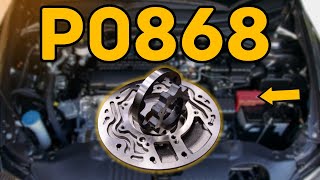
On a Dodge Journey, code P0868 almost always means the transmission fluid is low, dirty, or the filter is clogged. This starves the transmission pump, causing low pressure. Start by checking the fluid level and condition; a fluid and filter service costs around $150-$300 and often resolves the issue. In many cases, simply replacing the fluid and filter is the fix.
- P0868 on a Dodge Journey is a serious code that should be addressed immediately to prevent severe transmission damage.
- The most likely and cheapest fix is a transmission fluid and filter change. Always use Mopar ATF+4 fluid.
- The lack of a dipstick means fluid checks should be done by a qualified mechanic.
- If you own a 2016 Dodge Journey, check if your vehicle is covered by Safety Recall S44 for a faulty transmission oil pump.
- A whining noise from the transmission is a strong indicator of a fluid starvation problem (clogged filter or failing pump).
What's Unique About the 2009-2020 Dodge Journey

Most Dodge Journeys in this year range use a 62TE 6-speed automatic transmission which does not have a traditional dipstick for checking fluid, making it difficult for owners to monitor the fluid level. A special tool (like the Dorman 917-327) is required to check the level. 🎬 Watch: How to check fluid levels without a dipstick. These transmissions are also known for torque converter wear, which sheds friction material that can clog the filter, leading directly to fluid starvation and the P0868 code. A whining noise when the engine is cold is a classic symptom of this fluid starvation on the Journey and other vehicles with the 62TE.
Symptoms You May Notice
- Check Engine Light illuminated
- Transmission overheating, possibly with a burning smell
- Vehicle enters 'limp mode' (stuck in one gear)
- Harsh, delayed, or slipping gear shifts
- A distinct whining or grinding noise from the transmission, especially when cold
- Vehicle may feel like it shifts into neutral between gears
- Intermittent or complete loss of acceleration
- Replacing the Transmission Control Module (TCM) first. TCM failure is very rare and should only be considered after all mechanical and hydraulic causes have been ruled out.
- Assuming the entire transmission needs to be replaced immediately. Often, a simple service, a new filter, or a solenoid pack can resolve the issue for a fraction of the cost.
Most Likely Causes

- Low or Degraded Transmission Fluid 🔴 High Probability The lack of a dipstick makes it easy for fluid levels to drop unnoticed due to minor leaks from axle seals or cooler lines. The fluid itself also breaks down over time, becoming contaminated with debris and losing its hydraulic properties.
How to confirm: A technician must check the fluid level using a special service tool (e.g., Dorman 917-327) with the transmission at a specific temperature (typically between 150-170°F). The fluid should be bright red and clear, not brown, black, or burnt-smelling.
Typical fix: Perform a transmission service, which includes draining the old fluid, replacing the filter, and refilling with the correct specification of fluid (Mopar ATF+4). Using any other fluid type is not recommended and can cause damage.
Est. part cost: $60-$120 - Clogged Transmission Filter 🔴 High Probability The 62TE's torque converter normally sheds friction material over its life, which is then caught by the filter. If the fluid and filter are not changed at recommended intervals (typically every 60,000 miles for heavy use), this debris can completely block the filter, starving the oil pump for fluid.
How to confirm: This is typically found during a transmission service when the pan is dropped. The pan may contain excessive metallic or clutch material debris. Clogged valve body screens are another indicator.
Typical fix: Replace the transmission filter and fluid. If debris is excessive, further diagnosis of the torque converter may be needed. The Mopar filter was updated to part number 5179267AC 🎬 See this step-by-step transmission filter and fluid change guide. from the original 68018555AA.
Est. part cost: $15-$50 - Failing Transmission Oil Pump 🟡 Medium Probability A recall (S44 / NHTSA 16V-461) was issued for improperly manufactured oil pumps on 2016 models that could fail suddenly. The recall states a dimensional variance in the pump rotor pocket could cause the rotors to seize or break, leading to a complete loss of hydraulic pressure and motive power. Pumps on other years can also wear out, especially if run with low or dirty fluid.
How to confirm: A technician performs a line pressure test using a pressure gauge connected to the transmission's test port. Pressure readings will be below specifications across all gear ranges. A whining noise that changes with engine RPM 🎬 Watch this first if you hear a transmission whining noise. is a strong indicator.
Typical fix: Replace the transmission oil pump. This is a labor-intensive job that requires removing the transmission from the vehicle.
Est. part cost: $200-$400 - Faulty Valve Body or Solenoid Pack 🟡 Medium Probability Solenoids within the valve body can stick or fail electronically, and small passages or screens can become clogged with debris, preventing proper pressure regulation. This is a known weak point on the 62TE transmission.
How to confirm: A professional scan tool can command individual solenoids and monitor pressure response. The valve body can also be visually inspected for stuck valves or clogged screens when removed. One owner in Colombia resolved a persistent P0868 by replacing the solenoid pack.
Typical fix: Replace the solenoid pack or the entire valve body assembly. Sometimes just cleaning the valve body screens can resolve the issue.
Est. part cost: $250-$600 - Defective Transmission Fluid Pressure Sensor/Transducer ⚪ Low Probability
How to confirm: A technician can test the sensor's voltage output to see if it corresponds with actual measured line pressure. If the pressure is good but the sensor reads low, the sensor is faulty. This is often a last resort after confirming fluid, filter, and pump are all healthy.
Typical fix: Replace the transmission fluid pressure sensor. This sensor is often located on the valve body, requiring removal of the transmission pan.
Est. part cost: $40-$100
Rare But Worth Checking
- Internal Transmission Leak: Cracked components or failed internal seals (like the spinning rings in the compounder on early 62TE models) can cause a loss of pressure that won't be visible externally. This usually requires a full transmission rebuild to correct. An updated compounder design prevents the rings from spinning and wearing out the housing.
- Damaged Wiring or Connectors: While less common, wiring to the transmission pressure sensor or main connector can become damaged or corroded, leading to false low-pressure signals. A visual inspection of the harness is always a good step.
Diagnosis Steps
- Scan the TCM for any other related trouble codes, such as P0944 or P1745.
- Check the transmission fluid level and condition using the proper procedure for the 62TE transmission. The vehicle must be running, in neutral, and the fluid at operating temperature (150-170°F).
- If fluid is low, inspect for external leaks from the pan gasket, axle seals, or cooler lines.
- If the fluid level is correct but the fluid is dark, burnt, or full of debris, drop the transmission pan.
- Inspect the pan for excessive clutch material or metal shavings. A fine gray film is normal, but chunks are not.
- Replace the transmission filter and pan gasket, and refill with Mopar ATF+4 fluid.
- If the problem persists, perform a line pressure test with a mechanical gauge to verify if the pressure is actually low or if it's a sensor issue.
- If pressure is confirmed low, further diagnosis of the oil pump and valve body is required. This is an invasive, professional-level job.
- If pressure is good, test the wiring and signal from the transmission fluid pressure sensor. Replace the sensor if it is faulty.
Parts You'll Likely Need
- Automatic Transmission Filter Kit
(OEM #5179267AC (supersedes 68018555AA))— This is the most common fix, as a clogged filter is a primary cause of low fluid pressure in the 62TE transmission.
Trusted brands: Mopar, Wix, Fram, ATP
OEM price range: $30-$50
Aftermarket price range: $15-$30 - Mopar ATF+4 Automatic Transmission Fluid
(OEM #68218057AC (quart), 68218058AC (gallon))— This is the required fluid for the 62TE transmission. Using the wrong fluid type will cause shifting problems and damage.
Trusted brands: Mopar, Valvoline ATF+4, Castrol ATF+4
OEM price range: $10-$15 per quart
Aftermarket price range: $8-$12 per quart
Related Codes That Often Appear With This One
- P0740 — Torque Converter Clutch Circuit/Open. This often appears with P0868 if torque converter debris is the root cause, affecting both the TCC and overall line pressure. NHTSA ODI #11120197 describes a case where this code appeared alongside P0868 and P0732 on a related Dodge platform.
- P0944 — Hydraulic Pressure Unit Loss of Pressure. This is a more generic code for pressure loss and is often seen alongside the more specific P0868, pointing strongly to a fluid supply or pump issue. An owner reported in NHTSA ODI #11683914 that their dealership found both P0944 and P0868 while the transmission was slipping in first gear.
- P1745 — Transmission Line Pressure Too High For Too Long. While seemingly contradictory, this can be set along with P0868 when the TCM is struggling to regulate erratic pressure, sometimes overshooting the target after a low-pressure event, eventually triggering limp mode.
Technical Service Bulletins (TSBs) & Recalls

- NHTSA Recall 16V-461 / Mopar S44: Addresses a potential for the transaxle oil pump to fail due to improper manufacturing, leading to a sudden loss of hydraulic pressure. Affects certain 2016 model year Dodge Journey vehicles.
Platform-Specific Known Issues
- Recall S44 / NHTSA 16V-461: Affects certain 2016 Dodge Journey models with the 3.6L engine. An improperly manufactured transaxle oil pump can fail, causing a loss of hydraulic pressure and motive power. The fix is a dealer-installed replacement of the oil pump.
- NHTSA ODI #11680414 notes that owners have reported P0868 low pressure issues on vehicles manufactured in 2014, suggesting the symptoms addressed in the 2016 recall may be present in other production years.
Mechanic-Grade Diagnostic Values

- Line Pressure Test - Park/Neutral — expected: 70-135 PSI. Failure: Pressure below 70 PSI indicates a pump, filter, or major leak issue.
- Line Pressure Test - Reverse — expected: 230-260 PSI. Failure: Significantly lower pressure points to internal seal or clutch circuit leaks.
- Line Pressure Test - Drive (OD-1 through OD-4) — expected: 70-180 PSI. Failure: Pressure below 70 PSI indicates a pump, filter, or leak issue.
- Solenoid Resistance (e.g., Low/Reverse, Underdrive, Overdrive, Direct, 2-4) — expected: 1.6 - 1.8 Ohms (approx. 2 Ohms). Failure: A reading that is significantly higher (e.g., 7.2 Ohms) or open (OL) indicates a failed solenoid coil.
- Pressure Switch Resistor Resistance (e.g., OD, 2-4, DC, L/R, LC) — expected: approx. 300 Ohms. Failure: An open or shorted reading indicates a failed pressure switch.
- Line Pressure Solenoid (VFS) Resistance — expected: 4.8 - 5.1 Ohms (approx. 5 Ohms). Failure: A reading outside this range indicates a faulty line pressure control solenoid.
Scan Tool Commands That Help
- Appcar DiagFCA, AlfaOBD, WiTECH: Clear VLP Counters — After replacing the valve body, solenoid pack, or transmission, this function must be run to reset the Variable Line Pressure counters in the TCM. Failure to do so can result in continued limp mode or harsh shifting even with new parts.
- Appcar DiagFCA, AlfaOBD, WiTECH: Quick Learn — After clearing VLP counters or any major transmission repair, this procedure allows the TCM to relearn clutch fill volumes and shift points. It requires following on-screen prompts to shift the vehicle through gears while stationary.
Wiring & Ground Locations
- Engine Harness Chafe Point (Recall H21) — On early model year Journeys, the engine wiring harness could rub against the transaxle mount.. Damage to the harness could short circuits related to transmission sensors or power, potentially causing erratic behavior or false codes. A visual inspection of the harness in this area is warranted, especially on 2009-2010 models.
- Connector C101 — A main vehicle harness connector, often located in the engine bay.. A documented case showed that a poor pin fit within this connector caused intermittent voltage loss to the transmission controls, resulting in limp mode. While it may set a P0562 (System Voltage Low), the symptoms mimic a primary transmission fault and can be easily missed.
- Transmission Solenoid / TRS Assembly Connector — The main 23-way electrical connector on the transmission case.. This is the primary connection point for all electronic controls. All resistance checks for the solenoid pack are performed at the pins of this connector, and it should be inspected for corrosion or damage.
Real Owner Repair Stories
- YouTube user comment, Appcar DiagFCA video (2014 Dodge Grand Caravan (same 62TE transmission)) — Vehicle stuck in limp mode with P0868 and P1745 codes active. Hard shift into Reverse and Drive.
❌ Tried (didn't work) Clearing codes with a basic scanner did not resolve limp mode.
✅ What actually fixed it Used Appcar DiagFCA software with a Vgate VlinkerFS OBD2 adapter to access the transmission module. Running the 'Clear VLP Counters' function, followed by the 'Quick Learn' procedure, successfully cleared the codes, took the vehicle out of limp mode, and resolved the harsh shifting. - NHTSA ODI #11443161 — An owner reported that while driving, the transmission started making a grinding noise. The fault code for this was P0868, and the vehicle required towing to a dealership for inspection and repairs.
- NHTSA ODI #11580539 — An owner of a related Dodge model reported that the transmission went bad after throwing multiple codes including P0868, P1790, P083B, P0736, and P0733.
OEM Part Supersession History
Various (pre-2012 design)→Updated Compounder Low Clutch Drum— The original drum allowed two Teflon sealing rings to spin freely, which would wear away the aluminum lands of the drum over time, causing a major internal pressure leak and loss of reverse gear.
Heads up: The updated drum uses non-rotating, tabbed sealing rings. When rebuilding an early 62TE, it is critical to replace the original-style drum with the updated version to prevent a repeat failure.68080261AB, ...AE, ...AF→68080261AG— Standard revision updates to the transmission wiring harness for the 2.4L engine with the 4-speed automatic. While not for the 62TE, it shows a history of wiring updates on the platform.
Model Year Variations Within This Range
- 2009-2010: V6 models used a 3.5L V6 engine paired with the 62TE transmission. These early models are more likely to have the original compounder drum design prone to wear.
- 2011-2019: The 2011 model year facelift introduced the 3.6L Pentastar V6, which became the standard V6 engine paired with the 62TE. Models from ~2012 onwards are more likely to have the updated compounder drum with non-rotating sealing rings.
- 2020: The V6 engine and 62TE transmission were discontinued. All 2020 models used the 2.4L I4 engine with a 4-speed automatic, making P0868 on a 62TE impossible for this model year.
Diagnostic Flowchart
Other Known Issues on This Vehicle
Issues unrelated to this code that are worth knowing about as an owner of this generation:
- Premature Brake and Rotor Wear 🔴 High — Extremely common on 2009-2012 models, with owners reporting replacement needed as early as 12,000-30,000 miles. Less frequent on later models after a caliper upgrade. (Ref: Dodge issued TSBs extending the brake warranty for 2009-2010 models to 3yr/36k miles.)
- 3.6L Pentastar Rocker Arm/Lifter Failure 🔴 High — Common across the 3.6L engine line, often presenting as a distinct 'ticking' sound from the top of the engine. Can occur from 70,000 miles onward. (Ref: A class-action lawsuit was filed regarding this issue, alleging a known defect.)
- Interior Water Leaks 🟠 Medium — Frequently reported by owners, with common sources being improperly sealed body seams near the firewall/A-pillar, clogged sunroof drains, or leaking roof rack seals, leading to soaked carpets.
- Uconnect System Malfunctions 🟡 Low — Widespread complaints of the Uconnect system freezing, Bluetooth connectivity dropping or failing to pair, and unresponsive screens. (Ref: Software updates were released, but many owners report persistent issues. Some resolve it by replacing the Bluetooth module.)
- Electrical Problems / Faulty TIPM 🔴 High — Common in earlier models (2009-2012), causing a wide range of bizarre issues like no-start conditions, dead battery, flickering lights, and malfunctioning accessories. (Ref: Multiple recalls were issued for related electrical components like the wireless ignition node (WIN).)
- Plastic Coolant System Components Cracking 🟠 Medium — Plastic heater hose tees and thermostat housings are known to become brittle and crack, causing coolant leaks. This is especially noted on the 2.4L engine.
Used vs. New Parts: Buying Guide for This Vehicle
When a used part is the smart pick: A complete, used transmission assembly from a verified low-mileage donor vehicle (e.g., a rear-end collision) can be a cost-effective alternative to a full rebuild, especially if the cause is a major internal mechanical failure like a damaged compounder or pump.
Donor-vehicle mileage cap: roughly under 80000 miles for the part to have meaningful remaining life.
What to inspect on the donor part:
- Verify the donor vehicle's year to get the newest possible design (ideally 2012+ for the updated compounder).
- If possible, check the transmission fluid from the donor. It should be reddish and not smell burnt.
- Look for a vehicle service history that indicates regular maintenance.
- Inspect the case for any cracks, damage, or signs of previous, leaky repairs.
OEM-only on this vehicle (don't cheap out):
- Transmission Fluid Pressure Sensor/Transducer
- Transmission Fluid (Mopar ATF+4 or licensed equivalent ONLY)
Aftermarket brands forum-validated for this vehicle:
- Rostra (for solenoid packs)
- Wix, Mopar (for transmission filters)
- Valvoline, Castrol (for licensed ATF+4 fluid)
Brands owners have reported issues with on this vehicle:
- Unbranded, generic solenoid packs from online marketplaces like eBay or Amazon are frequently reported by mechanics to have high initial failure rates or short service lives.
Real Owner Stories
Aggregated from forums and TSBs cited above. Mileages and costs reflect what owners reported in those sources.
2016 Dodge Journey 3.6L
Symptoms: A sudden loss of hydraulic pressure and motive power.
What fixed it: A dealer-installed replacement of the transaxle oil pump under a recall.
Source hint: NHTSA Recall 16V-461 / Mopar S44
Dodge Journey (unspecified year)
Symptoms: A persistent P0868 code that would not clear with other repairs.
What fixed it: Replacing the transmission solenoid pack.
Source hint: opinautos.com/us/dodge/journey/defects/p0868-check-engine
Related OBD-II Codes
Frequently Asked Questions
Is there a recall for the transmission on my 2016 Dodge Journey related to code P0868?
Why can't I find a dipstick to check the transmission fluid on my Dodge Journey?
What is the correct type of transmission fluid for my Dodge Journey?
My Journey is stuck in one gear and the check engine light is on. Is this a symptom of P0868?
I'm replacing the transmission filter. Is there an updated part number I should use?
I hear a whining noise from the transmission. Could this be related to the P0868 code?
Helpful Videos

We Have This Part in Stock


The information in this article is provided for general reference and educational purposes only. Vehicle specifications, procedures, and part compatibility can vary by production date, trim level, and region. Always consult your vehicle's factory service manual and verify part numbers before purchasing or performing repairs. Safety-critical components such as airbags, seat belts, and braking systems should be installed by a qualified professional.
- Dodge Journey:
- 🎬 Helpful Videos
- 🛍️ Shop This Part
- What's Unique About the 2009-2020 Dodge Journey
- Symptoms You May Notice
- Most Likely Causes
- Rare But Worth Checking
- Diagnosis Steps
- Parts You'll Likely Need
- Related Codes That Often Appear With This One
- Technical Service Bulletins (TSBs) & Recalls
- Platform-Specific Known Issues
- Mechanic-Grade Diagnostic Values
- Scan Tool Commands That Help
- Wiring & Ground Locations
- Real Owner Repair Stories
- OEM Part Supersession History
- Model Year Variations Within This Range
- Diagnostic Flowchart
- Other Known Issues on This Vehicle
- Used vs. New Parts: Buying Guide for This Vehicle
- Real Owner Stories
- 2016 Dodge Journey 3.6L
- Dodge Journey (unspecified year)
- Related OBD-II Codes
- Frequently Asked Questions
- 🎟️ Get 5% Off