

P0771 on 2003-2008 Toyota Corolla: Shift Solenoid 'E' Causes and Fixes
On a 2003-2008 Toyota Corolla, code P0771 usually means the torque converter lock-up solenoid (Shift Solenoid 'E') is failing or the transmission fluid is low or dirty. This prevents the transmission from locking up at highway speeds, causing high RPMs. A fluid and filter change or solenoid replacement is the most common fix.
- P0771 on your Corolla almost always means the torque converter isn't locking up on the highway, causing high RPMs and poor gas mileage.
- The first and easiest step is to check your transmission fluid. If it's low or dirty, a fluid and filter change might fix the problem.
- The most likely failed part is the lock-up solenoid (Shift Solenoid 'E'), which is located inside the transmission oil pan.
- This is a DIY-possible job for an intermediate mechanic, but because it involves the transmission, seeking professional help is a safe bet to avoid costly mistakes.
- Do not immediately assume you need a new transmission; the fix is often a sub-$200 part.
What's Unique About the 2003-2008 Toyota Corolla

The 9th generation Corolla uses a reliable A245E/A246E automatic transmission. For this specific model, the P0771 code is very frequently tied to the torque converter lock-up solenoid. While the code is generic, on this platform it almost always points to a lack of lock-up, leading to higher RPMs on the highway. The issue is often the solenoid itself becoming clogged with debris from aging fluid or failing electrically, rather than a more complex internal transmission failure. This is a very common issue for high-mileage Corollas of this generation.
Symptoms You May Notice
- Higher than normal RPMs at highway speeds (e.g., above 3000 RPM at 65 mph)
- Check Engine Light is on
- Noticeable decrease in fuel economy
- Transmission may feel like it's slipping or not shifting into the final gear
- Harsh or delayed shifts in some cases
- Transmission overheating, especially on long trips
- Replacing the entire transmission when only a fluid change or a single solenoid was needed.
- Replacing the shift solenoid without first checking the fluid level and condition, which is a cheaper and easier first step.
- Confusing the lock-up solenoid (Solenoid 'E' / SR) with other shift solenoids on the valve body.
Most Likely Causes

- Low or Dirty Transmission Fluid 🔴 High Probability Over time, fluid breaks down and collects clutch material and metal shavings, which can clog the fine passages and screens within the solenoids.
How to confirm: Check the transmission fluid dipstick after the car has been driven for 15 minutes to get the fluid to operating temperature. The fluid should be bright red and clear, not brown, black, or smelling burnt. The level should be between the 'hot' marks.
Typical fix: Perform a transmission fluid and filter change. This is often called a 'drain and fill'. A full flush is sometimes recommended if the fluid is very dirty.
Est. part cost: $50-$100 - Faulty Shift Solenoid 'E' (Lock-Up Solenoid) 🔴 High Probability The solenoid can fail electrically (coil burns out) or mechanically (plunger gets stuck) from age and contamination. It is a known wear item on the A245E/A246E transmission.
How to confirm: After dropping the transmission pan, locate the solenoid on the valve body. Test its resistance with a multimeter. For this Toyota, it should be between 11 and 15 ohms. If the resistance is out of spec, the solenoid is bad. You can also apply 12V to the solenoid pins to see if it 'clicks'.
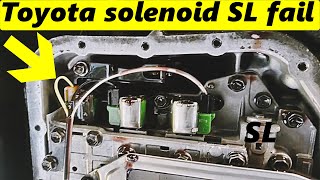
Typical fix: Replace the faulty shift solenoid. This part is located inside the transmission oil pan and is held by a small bolt and bracket. 🎬 See this walkthrough on how to replace the shift solenoid.
Est. part cost: $70-$200 - Clogged Transmission Valve Body Passages 🟡 Medium Probability Sludge and debris from old fluid can create blockages in the small channels of the valve body, preventing fluid from reaching the solenoid or the torque converter lock-up clutch.
How to confirm: This is difficult to confirm without disassembly. It's usually suspected after a new solenoid fails to fix the problem. Inspecting the valve body for sludge during solenoid replacement is a key step.
Typical fix: Remove and professionally clean the valve body, or replace it entirely. Sometimes a transmission flush can clear minor blockages.
Est. part cost: $300-$700 - Damaged Wiring or Connectors ⚪ Low Probability
How to confirm: Visually inspect the wiring harness leading to the transmission for any signs of damage, corrosion, or loose connections. Perform a continuity test from the ECM connector to the transmission connector.
Typical fix: Repair or replace the damaged section of the wiring harness.
Est. part cost: $20-$150
Rare But Worth Checking
- Failing Torque Converter: The internal lock-up clutch within the torque converter itself can fail mechanically. This is a major repair requiring transmission removal and is usually suspected only after all other solenoid and hydraulic-related causes are ruled out.
- Faulty Engine Control Module (ECM): It is very rare for the ECM to be the cause. The driver circuit that controls the solenoid can fail, but this should be the absolute last item to consider. There is a known TSB for a harsh shift and P2716 on 2005-2007 models that involves ECM replacement, but this is a different issue.
Diagnosis Steps
- Check Transmission Fluid: Verify the fluid level is correct and the fluid is clean and red. If it's low, brown, or smells burnt, start with a fluid and filter change.
- Scan for Codes: Use an OBD-II scanner to confirm P0771 and check for any other related transmission codes.
- Inspect Wiring: Visually inspect the external wiring harness and connector going to the transmission for any obvious damage or corrosion.
- Drop Transmission Pan: Safely support the vehicle, drain the transmission fluid, and remove the oil pan (typically 10mm bolts) to access the valve body. The pan bolts should be torqued to approximately 48 in-lbs (4 ft-lbs) upon reinstallation.
- Identify and Test Solenoid: Locate Shift Solenoid 'E' (TCC/Lock-up/SR solenoid) on the valve body. Disconnect it and measure the resistance across its two pins. 🎬 Watch: How to test and replace the torque converter solenoid. It should be between 11-15 ohms. If it's an open circuit (infinite resistance) or shorted (zero resistance), it's bad.
- Test Solenoid Operation (Optional): You can carefully apply a 12V power source to the solenoid's pins. You should hear a distinct 'click' as it actuates. No click means it's mechanically stuck.
- Replace Parts: If the solenoid fails testing, replace it (Part No. 35250-12030) along with the transmission filter and pan gasket. Reinstall the pan and refill with the correct Toyota Type T-IV transmission fluid. Do NOT use Toyota WS fluid in this transmission.
- Advanced Diagnosis: If the solenoid and wiring test good, the problem may be a clogged valve body or a failing torque converter, which typically requires professional diagnosis.
Parts You'll Likely Need

- Automatic Transmission Control Solenoid (Shift Solenoid 'E' / TCC Lock-Up)
(OEM #35250-12030)— This is the solenoid that directly controls the torque converter lock-up function. It is the most common part to fail, either electrically or by getting clogged with debris.
Trusted brands: Toyota (OEM), Aisin, Denso, Standard Motor Products (SMP), Rostra
OEM price range: $250-$350
Aftermarket price range: $70-$150 - Automatic Transmission Filter Kit
(OEM #35330-0W020)— Should always be replaced when the transmission pan is removed. A clogged filter can cause fluid starvation and pressure issues.
Trusted brands: Wix, Beck/Arnley, ATP, Toyota (OEM)
OEM price range: $40-$60
Aftermarket price range: $20-$40 - Toyota Type T-IV Automatic Transmission Fluid
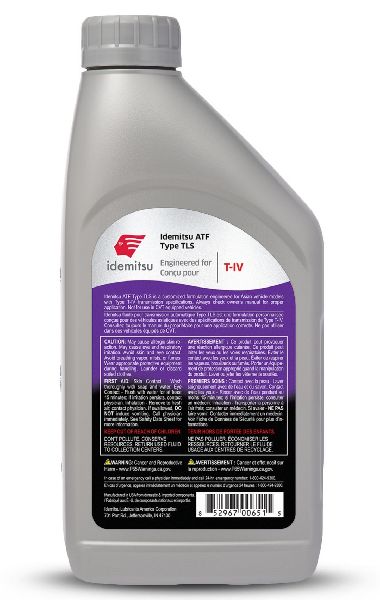
(OEM #00279-000T4)— Using the correct fluid is critical for transmission health. The A245E/A246E transmission specifically requires T-IV fluid. Using WS or other universal fluids can cause shifting problems. A drain and fill requires approximately 4-5 quarts.
Trusted brands: Toyota OEM, Idemitsu (TLS), Aisin (T-IV)
OEM price range: $10-$15 per quart
Aftermarket price range: $8-$12 per quart
Related Codes That Often Appear With This One
- P0770 — P0770 is a general malfunction code for the same Shift Solenoid 'E' circuit. P0771 is more specific, indicating a 'Stuck Off' performance issue. They often point to the same root cause.
- P0741 — P0741 refers to 'Torque Converter Clutch Circuit Performance or Stuck Off'. This code is very closely related and points to the same system (TCC lock-up) 🎬 Watch this step-by-step guide to fixing the P0741 code fast. and often the same solenoid.
Technical Service Bulletins (TSBs) & Recalls
- While no specific TSB for P0771 on this model is widely cited, TSB TC009-06 addresses a harsh 2-3 shift on 2005-2007 models with code P2716, which involves an ECM replacement. This is a separate issue but shows that ECM-related transmission faults are possible on this platform.
Platform-Specific Known Issues
- This P0771 issue is extremely common on high-mileage 9th generation Corollas, as well as their platform mates, the Toyota Matrix and Pontiac Vibe with the 1.8L engine. It is often one of the first major powertrain issues these otherwise reliable cars will experience.
- Some owners on forums report successfully cleaning the original solenoid and its small filter screen with brake cleaner or carburetor cleaner as a temporary or even long-term fix, though replacement is the recommended repair.
Mechanic-Grade Diagnostic Values

- Shift Solenoid 'E' (SR/TCC/Lock-Up) Coil Resistance — expected: 11 - 15 Ohms at 20°C (68°F). Failure: A reading of infinite resistance (open circuit) or near-zero resistance (short circuit) indicates a failed solenoid coil.
Scan Tool Commands That Help
- Toyota Techstream: Active Test: SHIFT — To manually command the lock-up solenoid (and other shift solenoids) on and off while the vehicle is stationary or at low speed. This is a critical step to determine if the fault is with the solenoid itself (it doesn't 'click' when commanded), the wiring, or the ECM's driver circuit, potentially saving the labor of dropping the transmission pan for initial diagnosis.
Wiring & Ground Locations
- ECM Connector E7, Pin 29 (SL) — The Engine Control Module (ECM) is located behind the right side of the dashboard, below the glove box. Pin 29 on connector E7 is for the lock-up solenoid, often labeled 'SL' in wiring diagrams.. A technician can back-probe this pin to check for the command signal (voltage) from the ECM when lock-up should be engaged. A lack of signal points towards the ECM, while a signal present with no lock-up points towards the wiring or solenoid.
- Ground Points EB and EC — Ground points located on the engine block, at the left rear of the engine.. The transmission and its sensors rely on a clean engine ground. A loose or corroded ground strap at these locations can cause a variety of intermittent electrical faults and erratic behavior in transmission components, including solenoids.
Real Owner Repair Stories
- Synthesized from common forum reports on ToyotaNation and Reddit. (High-mileage (typically 150,000+ miles) 2003-2008 Toyota Corolla/Matrix.) — Classic P0771 symptoms: Check Engine Light on and engine RPMs are too high at highway speeds (no torque converter lock-up).
❌ Tried (didn't work) Performing a transmission drain and fill; the code returned., Replacing the lock-up solenoid with a very cheap, unbranded aftermarket part from an online marketplace. The code either returned immediately or the new solenoid failed within a few months.
✅ What actually fixed it The problem was resolved by replacing the faulty solenoid with a high-quality, reputable brand part, specifically a genuine Toyota (OEM), Aisin, or Rostra solenoid. The key takeaway from many owner experiences is that the cost savings of a cheap solenoid are often negated by having to do the labor-intensive job twice.
Model Year Variations Within This Range
- 2003-2008: This generation uses either the A245E or A246E automatic transaxle. They are functionally identical for the P0771 repair and use the same lock-up solenoid. The primary differences are internal gear ratios and, on some early A245E models, the use of a throttle body cable for line pressure control versus a solenoid on the A246E. This difference does not affect the diagnosis or repair of the lock-up solenoid circuit.
Diagnostic Flowchart
Other Known Issues on This Vehicle
Issues unrelated to this code that are worth knowing about as an owner of this generation:
- Excessive Oil Consumption (1ZZ-FE Engine) 🔴 High — Very common in 2000-2005 models. Caused by piston rings with insufficient oil return holes getting clogged, leading to oil burning. (Ref: Toyota issued TSB EG021-05 in the US to address this, which involved replacing the pistons under an extended warranty, but this has long since expired.)
- Leaking Timing Chain Tensioner O-Ring 🟡 Low — Common on high-mileage engines. The rubber o-ring on the tensioner housing becomes hard and brittle, causing a persistent oil leak on the back of the engine.
- Starter Failure 🟠 Medium — Fairly common after 100,000 miles. The starter motor may fail to engage, resulting in a no-crank, no-start condition.
- Stripped Cylinder Head Bolt Threads (2003-2004) 🔴 High — A known issue primarily on 2003-2004 models where the head bolt threads in the engine block can pull out, causing head gasket failure. Repair requires installing threaded inserts (e.g., Time-Serts).
- Faulty Variable Valve Timing (VVT) Solenoid 🟡 Low — The VVT solenoid or its filter screen can become clogged, leading to a rough idle, stalling, and check engine lights. It's a relatively easy and inexpensive part to replace.
Used vs. New Parts: Buying Guide for This Vehicle
When a used part is the smart pick: A complete, low-mileage used valve body assembly from a junkyard can be a smart choice if the problem is suspected to be a clogged passage or internal valve body wear, and not just the solenoid. This is often cheaper than a new valve body from the dealer.
Donor-vehicle mileage cap: roughly under 120000 miles for the part to have meaningful remaining life.
What to inspect on the donor part:
- If possible, check the donor vehicle's history for regular maintenance.
- Fluid from the donor transmission should be reddish and not smell burnt.
- Inspect the electrical connector pins on the harness for any corrosion or physical damage.
OEM-only on this vehicle (don't cheap out):
- While not strictly 'OEM-only', using a genuine Toyota (35250-12030) or OEM-supplier (Aisin) solenoid is strongly recommended. Many forum-documented repair failures stem from using low-quality, unbranded aftermarket solenoids.
Aftermarket brands forum-validated for this vehicle:
- Aisin (often the original equipment manufacturer)
- Denso
- Rostra
Brands owners have reported issues with on this vehicle:
- Unbranded 'no-name' solenoids from online marketplaces like Amazon or eBay are frequently reported by owners to fail prematurely or be dead-on-arrival.
Real Owner Stories
Aggregated from forums and TSBs cited above. Mileages and costs reflect what owners reported in those sources.
2003-2008 Toyota Corolla 1.8L — ~175000 miles
Symptoms: Higher than normal RPMs at highway speeds and the Check Engine Light was on.
What fixed it: Successfully cleaning the original solenoid and its small filter screen with brake cleaner or carburetor cleaner as a temporary or even long-term fix.
Source hint: vehicle_specific_issues
Related OBD-II Codes
Frequently Asked Questions
What type of transmission fluid should I use for my 2005 Corolla to fix a P0771 code?
I have a Pontiac Vibe with a P0771 code. Is this guide applicable to my car?
What is the correct resistance for the lock-up solenoid (Solenoid 'E') on my 2003-2008 Corolla?
Is there a Toyota TSB that specifically addresses the P0771 code on my 2007 Corolla?
I'm replacing the solenoid myself. What is the part number and what are the torque specs for the transmission pan bolts?
I've heard you can just clean the solenoid instead of replacing it. Is this a reliable fix for the P0771 code?
Helpful Videos


We Have This Part in Stock


The information in this article is provided for general reference and educational purposes only. Vehicle specifications, procedures, and part compatibility can vary by production date, trim level, and region. Always consult your vehicle's factory service manual and verify part numbers before purchasing or performing repairs. Safety-critical components such as airbags, seat belts, and braking systems should be installed by a qualified professional.
- Toyota Corolla:
- 🎬 Helpful Videos
- 🛍️ Shop This Part
- What's Unique About the 2003-2008 Toyota Corolla
- Symptoms You May Notice
- Most Likely Causes
- Rare But Worth Checking
- Diagnosis Steps
- Parts You'll Likely Need
- Related Codes That Often Appear With This One
- Technical Service Bulletins (TSBs) & Recalls
- Platform-Specific Known Issues
- Mechanic-Grade Diagnostic Values
- Scan Tool Commands That Help
- Wiring & Ground Locations
- Real Owner Repair Stories
- Model Year Variations Within This Range
- Diagnostic Flowchart
- Other Known Issues on This Vehicle
- Used vs. New Parts: Buying Guide for This Vehicle
- Real Owner Stories
- 2003-2008 Toyota Corolla 1.8L — ~175000 miles
- Related OBD-II Codes
- Frequently Asked Questions
- 🎟️ Get 5% Off