

P0762 on 2001-2007 GMC Sierra with Allison 1000: Shift Solenoid 'C' Stuck On Causes and Fixes
This code indicates that Shift Solenoid 'C' (also called '3') inside your Allison transmission is stuck in the 'on' position. The most common fix is to replace the faulty solenoid, which is located on the valve body inside the transmission pan. Expect to pay around $30-$60 for a single OEM solenoid, but it's highly recommended to replace all shift solenoids at once.
- P0762 on a 2001-2007 Sierra with the Allison 1000 points directly to a problem with Shift Solenoid 'C' being stuck on.
- The most likely fix is replacing the solenoid itself. The OEM part number is 29536833.
- This is not a simple DIY job for beginners as it requires removing the transmission pan and working on the internal valve body.
- Due to the significant labor involved, it is cost-effective and preventative maintenance to replace all similar shift solenoids (C, D, and E) at the same time.
- Always check the transmission fluid level and condition first, as low or contaminated fluid can cause or contribute to this code.
What's Unique About the 2001-2007 GMC Sierra

The Allison 1000 is a robust, electronically controlled transmission known for its durability in heavy-duty Sierra trucks. Unlike lighter-duty transmissions, issues are often related to the electronic controls, like solenoids, rather than catastrophic mechanical failure. The solenoids can fail with age or become stuck due to fine metallic debris in the fluid. Owners often find this code appears after a fluid service if contaminants are dislodged and get into the valve body. It's crucial to know that this year range includes both the 5-speed (2001-2005) and the 6-speed (2006-2007) versions, which have different valve bodies but appear to use the same shift solenoid part.
Generation note: The 2001-2007 year range covers two generations of the Allison 1000 transmission. The 2001-2005 models are equipped with a 5-speed transmission (RPO code M74). The 2006-2007 models received the updated 6-speed version. While the valve bodies and internal wiring may differ slightly, the primary C/D/E shift solenoids are the same part number across these years.
Symptoms You May Notice

- Transmission stuck in one gear (limp mode, often 3rd or 4th).
- Harsh, erratic, or delayed shifts.
- Check Engine Light or transmission warning light is on.
- Transmission slipping between gears.
- Reduced fuel economy.
- Inability to shift into certain gears or no shift at all.
- Unusual whining or clunking sound during attempted shifts.
- Replacing only the transmission fluid and filter without addressing the solenoid. If the solenoid is electrically bad or mechanically stuck, a fluid change alone will not fix it.
- Replacing a pressure control solenoid (like the 'A-Trim' solenoid, P/N 29533074) instead of the correct shift solenoid. P0762 specifically points to Shift Solenoid 'C'.
- Immediately replacing the valve body or entire transmission without first testing the solenoids and wiring, which are the most common and least expensive failure points.
Most Likely Causes

- Failed Shift Solenoid 'C' 🔴 High Probability Solenoids are electro-mechanical parts that wear out over time. The internal plunger can bind from debris or wear, or the coil can develop an electrical fault. TSB PIP5060 directly mentions a binding armature on the shift solenoid as a primary cause.
How to confirm: After accessing the valve body, the solenoid can be tested with a multimeter for correct resistance (typically 20-30 ohms for Allison solenoids). If the resistance is out of spec, it has failed. A binding plunger may not show up on an electrical test and may require physical inspection or testing.
Typical fix: Replace the faulty shift solenoid. It is highly recommended to replace all C, D, and E shift solenoids at the same time since the labor to access them is the same.
Est. part cost: $30 - $60 for one OEM solenoid. - Dirty or Low Transmission Fluid 🟡 Medium Probability Contaminants or metallic debris in the fluid can travel into the valve body and physically jam the solenoid's small internal valve, causing it to stick. Overheated fluid loses its lubricating properties, accelerating wear and debris creation.
How to confirm: Check the transmission fluid dipstick for level and condition. If the fluid is dark, burnt-smelling, or has visible particles, it is contaminated. Dropping the pan will reveal the extent of the debris on the magnet.
Typical fix: Perform a complete fluid and filter change using Allison-approved fluid (e.g., TES-295 or DEXRON-VI). If the solenoid is stuck due to debris, it may still need to be replaced.
Est. part cost: $100 - $200 for fluid and filter. - Internal Wiring or Connector Issue ⚪ Low Probability The internal wiring harness operates in a harsh environment of heat and fluid. Over time, insulation can become brittle, or connectors can become loose, causing a short or poor connection. The external TCM connector on 5-speed models is also a known issue, where pins can back out causing intermittent faults.
How to confirm: Visually inspect the internal transmission harness and connectors for damage or corrosion while the pan is off. Check for continuity from the TCM connector to the solenoid. Inspect the main TCM connector for backed-out pins.
Typical fix: Repair the damaged wire or replace the internal harness. Reseat and secure pins in the external TCM connector.
Est. part cost: $150 - $300 for a new internal harness.
Rare But Worth Checking
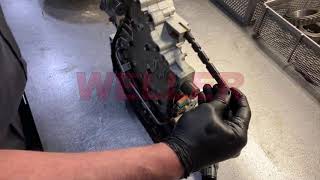
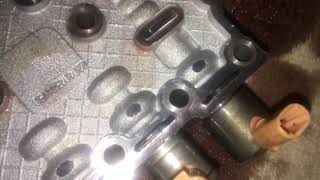
- Sticking Valve in Valve Body: Debris can cause a valve within the valve body itself to stick, not just the solenoid. Allison valve bodies are known for long shift valves that can seize in their bores. If new solenoids don't fix the issue, the valve body should be removed, disassembled, and thoroughly cleaned, or repaired 🎬 See how to remove the valve body to fix stuck valves with oversized valves.
- Faulty Transmission Control Module (TCM): In rare cases, the driver circuit within the TCM can fail, keeping the solenoid energized. This is uncommon and should only be considered after all other possibilities are exhausted. A technician noted that 98% of Allison issues are electrical, but often related to wiring, not the module itself.
Diagnosis Steps
- Check the transmission fluid level and condition. A low level or burnt, dirty fluid indicates a need for service and can be a contributing factor.
- Use a scan tool to confirm P0762 is the primary code and check for any other transmission-related codes.
- Safely raise the vehicle and inspect the external transmission wiring harness and connectors for any visible damage or corrosion. Pay special attention to the main TCM connector on 5-speed models for backed-out pins.
- Drain the transmission fluid and remove the transmission pan. Inspect the pan magnet for excessive metal debris, which could indicate a more severe internal problem.
- Locate Shift Solenoid 'C' on the valve body. Visually inspect its connector and wiring.
- Disconnect the solenoid and test its resistance with a multimeter. A typical reading for an Allison shift solenoid is between 20 and 30 ohms. An open circuit or a reading outside the specified range confirms a failed solenoid.
- If the solenoid tests good electrically, the issue is likely mechanical (sticking) or a blockage in the valve body. TSB PIP5060 suggests testing the pressure switches before replacing the solenoid.
- Replace the solenoid (it is highly recommended to replace C, D, and E solenoids as a set).
- If replacing the solenoid does not resolve the issue, the valve body may need to be removed, disassembled, and cleaned, paying close attention to the shift valves for any binding.
- Reinstall the pan with a new gasket and filter. Refill with the correct type and amount of transmission fluid (Allison TES-295 or DEXRON-VI).
- Clear the trouble codes and perform a test drive, allowing the transmission to complete an adaptive learning cycle.
Parts You'll Likely Need

- Shift Solenoid C/D/E
(OEM #29536833)— This is the direct cause of the P0762 code when the solenoid itself fails. It is the same part for solenoids C, D, and E, and fits a wide range of Allison 1000 transmissions from 2001-2019.
Trusted brands: ACDelco, Allison (Genuine), Rostra
OEM price range: $30-$60
Aftermarket price range: $25-$50 - Allison Transmission Filter Kit (Internal and External)
(OEM #29542833 (example kit))— A new internal filter and pan gasket are required anytime the transmission pan is removed. An external spin-on filter should also be changed.
Trusted brands: ACDelco, Allison, Merchant Automotive
OEM price range: $40-$70
Aftermarket price range: $20-$40 - Automatic Transmission Fluid — The transmission must be refilled with fresh fluid meeting Allison specifications (e.g., TES-295 or DEXRON-VI depending on the year/service history) after the repair. A standard pan drop requires approximately 8-9 quarts.
Related Codes That Often Appear With This One
- P0761 — This code is for 'Shift Solenoid C Stuck Off'. It's common to see related 'stuck on' and 'stuck off' codes for the same solenoid as it begins to fail intermittently. TSB PIP5060 lists both codes together.
- P0751, P0756 — These are codes for Shift Solenoids 'A' and 'B'. If there is widespread contamination in the valve body or an electrical issue with the harness, multiple solenoid codes can appear at once.
- P0752, P0757 — These are the 'Stuck On' equivalents for Solenoids A and B. Seeing them with P0762 strongly suggests a systemic issue like fluid contamination, a valve body problem, or a wiring harness fault.
Technical Service Bulletins (TSBs) & Recalls

- PIP5060: Service Engine Soon Light Illuminated, No Shift, Wrong Gear Starts, Range Inhibit, with DTCs P0752, P0757, P0762, P0751, P0756, or P0761. This TSB notes the cause may be a binding shift solenoid armature and provides diagnostic steps.
- Bulletin #PIE0371A: This manufacturer bulletin addresses vehicles exhibiting a Check Engine Light, delayed shifts, and/or a transmission stuck in gear when DTC P0762 is set along with other shift solenoid codes.
Mechanic-Grade Diagnostic Values

- Shift Solenoid 'C' (also D, E) resistance — expected: 20 - 30 Ohms. Failure: A reading of infinite Ohms (open circuit), zero Ohms (short circuit), or a value outside the specified range.
- Transmission Speed Sensor (Input, Turbine, Output) AC Voltage — expected: 150mV - 15V (Varies with RPM). Failure: No voltage or voltage that doesn't change with RPM, indicating a failed sensor.
- Transmission Fluid Temperature (TFT) - Live Data — expected: 175 - 225 °F (Normal Operating Temp). Failure: Extremely high temperatures can indicate internal slipping or cooling issues, which contribute to solenoid failure.
Scan Tool Commands That Help

- Tech2 / GDS2 / Professional Bidirectional Scanner: Solenoid Active Test / Output Control — Use this to command Shift Solenoid 'C' on and off while monitoring its status PID. If the status does not change with the command, it helps isolate the fault to the solenoid, wiring, or TCM driver.
- Tech2 / GDS2 / Professional Bidirectional Scanner: Live Data Monitoring (PIDs: Shift Solenoid C Command, Shift Solenoid C Status) — During a test drive, compare the commanded state to the actual reported status. For P0762, you will likely see the 'Status' PID remain 'On' even when the 'Command' PID is 'Off'.
Real Owner Repair Stories
- Agtruckservices on YouTube (Freightliner with Allison 2000 series (similar architecture)) — Transmission stuck in safe mode (3rd gear), codes P0757 and P0762 present.
❌ Tried (didn't work) Initially suspected internal solenoid or valve body failure.
✅ What actually fixed it The mechanic found water inside the main external transmission connector. Cleaning the water and corrosion from the connector pins resolved both trouble codes without replacing any parts. - DuramaxDiesels.com forum discussion (Duramax with Allison 1000) — After a transmission build, got a P0762 code and the transmission was stuck in 4th gear.
❌ Tried (didn't work) Replacing the solenoid did not fix the issue.
✅ What actually fixed it The root cause was identified as the E-shift valve physically sticking in its bore within the valve body. The user freed it manually, but it stuck again. The final fix discussed by experienced builders was to carefully service the valve body bore, sometimes with specialized reaming tools (like from Sonnax), to free the sticking valve. Sanding the valve was noted to cause permanent damage.
When the Usual Fixes Don't Work
- While P0762 directly names Shift Solenoid 'C', experienced technicians report that the root cause is often not the solenoid itself. In one documented case, the code was resolved by cleaning water and corrosion out of the main external transmission connector, which was causing an electrical fault. In another scenario common to the Allison, the mechanical shift valve that the solenoid actuates can become stuck in its bore within the valve body. In this case, replacing the solenoid will not fix the problem; the valve body itself must be serviced or replaced. These examples show that a thorough diagnosis of external wiring and internal mechanical components is critical before replacing the solenoid.
OEM Part Supersession History
29536833→N/A— This part number has remained consistent for a long period.
Heads up: Part number 29536833 is widely compatible for the C, D, and E shift solenoids across the entire 2001-2007 range and beyond, up to 2019 models. No significant supersession issues are noted that would cause incompatibility within this vehicle's year range.
Model Year Variations Within This Range

- 2001-2003: These early 5-speed models use a valve body with 6 solenoids.
- 2004-2005: These later 5-speed models use a valve body with 7 solenoids. The extra 'G' solenoid was added to reduce pump whine at idle by lowering line pressure in Park and Neutral.
- 2006-2007: These 6-speed models feature significant changes. The 'Trim Solenoids' were renamed 'Pressure Control Solenoids,' and the external Neutral Safety Switch (NSBU) was replaced with an Internal Mode Switch (IMS) located on the valve body.
Diagnostic Flowchart
Other Known Issues on This Vehicle
Issues unrelated to this code that are worth knowing about as an owner of this generation:
- LB7 (2001-2004) Fuel Injector Failure 🔴 High — Very common, often occurring between 100,000-150,000 miles. Failure is due to internal cracking and seal issues. (Ref: Special Coverage Adjustment 04039B extended warranty to 7 years/200,000 miles, but has since expired.)
- Transfer Case Pump Rub 🔴 High — A design flaw in the NP261HD and NP263HD transfer cases where the oil pump rubs against the magnesium rear case half, eventually wearing a hole and causing fluid loss. Affects most 1998-2007 GM 4x4 trucks.
- Neutral Safety Back-Up (NSBU) Switch Failure 🟠 Medium — Common on 2001-2004 5-speed models. The switch is prone to water intrusion and wear, causing no-start conditions, incorrect gear display, and limp mode.
- LLY (2004.5-2005) Engine Overheating 🟠 Medium — These engines have a restrictive turbo inlet and smaller radiator/fan compared to later models, leading to overheating when towing heavy loads, especially in warm climates.
- Instrument Cluster Gauge Failure 🟡 Low — Very common across the GMT800 platform. Stepper motors for the speedometer, tachometer, and other gauges fail, causing erratic or inoperative readings. (Ref: GM had a special policy for replacement, but it has long expired.)
- Head Gasket Failure (LB7) 🔴 High — More common on early LB7 engines, especially when power levels are increased. The original head bolts can stretch, leading to gasket leaks.
Used vs. New Parts: Buying Guide for This Vehicle
When a used part is the smart pick: A used complete valve body assembly might be considered if the original is damaged beyond repair (e.g., cracked casting) and a remanufactured unit is not in the budget. However, this is risky as used valve bodies may have the same wear-related issues.
Donor-vehicle mileage cap: roughly under 100000 miles for the part to have meaningful remaining life.
What to inspect on the donor part:
- If possible, check the fluid from the donor vehicle; it should be reddish and not smell burnt.
- Inspect the external connectors for corrosion, bent pins, or damage.
- Ask for any available service history on the donor vehicle.
OEM-only on this vehicle (don't cheap out):
- Shift Solenoids
- Internal Wiring Harness
- Transmission Control Module (TCM)
Aftermarket brands forum-validated for this vehicle:
- Rostra (Solenoids and Wiring Harnesses)
- TransGo (Valve body upgrade/shift kits)
- Sonnax (Valve body repair components)
Real Owner Stories
Aggregated from forums and TSBs cited above. Mileages and costs reflect what owners reported in those sources.
2001-2007 GMC Sierra with Allison 1000
Symptoms: Transmission had a stuck E-shift valve, causing shifting problems.
What fixed it: The owner removed the valve body to access and clean the stuck E-shift valve, finding a small piece of debris that was causing the issue.
Source hint: YouTube video titled 'Allison 1000 e valve stuck removal of valve body - YouTube'
2001-2007 GMC Sierra with Duramax Diesel
Symptoms: Experiencing issues related to a sticking E-shift valve, which can trigger codes like P0762.
What fixed it: A forum user suggested that using a Sonnax upgraded spring and bore sizing tool can be a more permanent solution for sticking valves than just cleaning them.
Source hint: DuramaxDiesels.com forum thread titled 'P0762 | DuramaxDiesels.com'
2001-2007 GMC Sierra with Duramax Diesel
Symptoms: Vehicle displayed 'Shift Range Inhibited' messages and had erratic gear engagement, which was initially confused with an internal transmission problem.
What fixed it: The problem was traced to a failing Neutral Safety Back-Up (NSBU) switch, not an internal transmission fault like a stuck solenoid.
Source hint: DuramaxDiesels.com forum thread titled 'NSBU Symptoms | DuramaxDiesels.com'
Related OBD-II Codes
Frequently Asked Questions
TSB PIP5060 is mentioned for code P0762. What does it say is the likely cause for my Sierra's Allison transmission?
My mechanic says the solenoid tests fine with a multimeter. What else could cause P0762?
I'm replacing Shift Solenoid 'C' myself. Is there anything else I should do while I have the transmission pan off?
What type of transmission fluid should I use to refill my Allison 1000 after the repair?
I have a 2004 GMC Sierra with the Duramax. Are there other common, non-transmission issues I should know about?
The diagnosis steps mention checking the TCM connector. What's the specific issue with it on these trucks?
Does this P0762 information apply to my 2006 Chevrolet Silverado 2500HD?
Helpful Videos
We Have This Part in Stock



The information in this article is provided for general reference and educational purposes only. Vehicle specifications, procedures, and part compatibility can vary by production date, trim level, and region. Always consult your vehicle's factory service manual and verify part numbers before purchasing or performing repairs. Safety-critical components such as airbags, seat belts, and braking systems should be installed by a qualified professional.
- GMC Sierra:
- 🎬 Helpful Videos
- 🛍️ Shop This Part
- What's Unique About the 2001-2007 GMC Sierra
- Symptoms You May Notice
- Most Likely Causes
- Rare But Worth Checking
- Diagnosis Steps
- Parts You'll Likely Need
- Related Codes That Often Appear With This One
- Technical Service Bulletins (TSBs) & Recalls
- Mechanic-Grade Diagnostic Values
- Scan Tool Commands That Help
- Real Owner Repair Stories
- When the Usual Fixes Don't Work
- OEM Part Supersession History
- Model Year Variations Within This Range
- Diagnostic Flowchart
- Other Known Issues on This Vehicle
- Used vs. New Parts: Buying Guide for This Vehicle
- Real Owner Stories
- 2001-2007 GMC Sierra with Allison 1000
- 2001-2007 GMC Sierra with Duramax Diesel
- 2001-2007 GMC Sierra with Duramax Diesel
- Related OBD-II Codes
- Frequently Asked Questions
- 🎟️ Get 5% Off