

OBD-II Code P0756: Shift Solenoid 'B' Performance / Stuck Off
What P0756 means, why it triggers, and how to fix it for good
- Check your transmission fluid first; low or dirty fluid causes over 50% of P0756 codes, not a failed solenoid.
- Search for Technical Service Bulletins (TSBs) before buying parts, as vehicles like the 2017+ Ford F-150 have known $2,000+ valve body defects triggering this code.
- Expect harsh 2-3 shifts, poor acceleration, and the vehicle locking into 'limp mode' (usually 2nd or 3rd gear) to prevent further damage.
- Stop driving immediately; pushing a transmission in limp mode overheats the fluid within 30 miles and turns a $300 solenoid fix into a $5,000 rebuild.
What Does P0756 Mean?

The Powertrain Control Module (PCM) detected a failure with the 'B' shift solenoid, a small electronic valve directing hydraulic fluid to change gears (usually the 2-3 shift). 'Stuck Off' means the PCM commanded the solenoid to open, but the expected gear ratio change never occurred, indicating the transmission failed to execute the shift.
Technical definition: The SAE/OBD-II definition is "Shift Solenoid 'B' Performance or Stuck Off." The PCM or Transmission Control Module (TCM) detects a discrepancy between the commanded state of shift solenoid 'B' and the resulting gear ratio. The module compares engine speed, input speed sensor (ISS) data, and output speed sensor (OSS) data; a mismatch between the commanded gear and the calculated ratio triggers the code.
Can I Drive With P0756?

no_not_recommended. Do not drive the vehicle. Most vehicles immediately enter 'limp mode,' locking the transmission into 2nd or 3rd gear. This causes dangerously poor acceleration and forces high RPMs at highway speeds, overheating the transmission fluid within 20 to 30 miles. Continued driving exponentially increases clutch wear, turning a $300 solenoid repair into a $5,000 complete transmission rebuild.
Common Causes

- Low or Contaminated Transmission Fluid (Very Common) — Insufficient fluid causes low hydraulic pressure, preventing the solenoid from actuating the shift valve. Dirty, burnt, or contaminated fluid clogs the microscopic passages in the solenoid or valve body, causing the valve to jam.
- Clogged Transmission Filter or Valve Body Passages (Very Common) — Debris from normal clutch wear or metal shavings clogs the transmission filter, starving the hydraulic system of pressure. This debris directly jams the solenoid's internal plunger.
- Failed Shift Solenoid 'B' (Common) — The solenoid's internal electromagnetic coil shorts out, or its mechanical valve jams. This physically prevents it from directing fluid flow as commanded by the TCM.
- Sticking Valve in the Valve Body (Common) — The solenoid moves a corresponding valve (e.g., the 2-3 shift valve). Wear or debris causes this valve to stick in its bore within the valve body. The solenoid fires correctly, but the valve it controls refuses to move.
- Internal Mechanical Failure (Common) — In transmissions like Ford's 10R80, this code indicates a slipped sleeve inside the CDF clutch drum. In GM's 6L80, a failing torque converter sheds debris that destroys the hydraulic circuits.
- Damaged Wiring or Connectors (Less Common) — The wiring harness leading to the transmission degrades from heat and vibration. Corroded connector pins at the solenoid or the TCM create an open circuit, preventing the activation signal from reaching the solenoid.
- Faulty Transmission Control Module (TCM) (Rare) — The internal driver circuit responsible for sending the voltage signal to the solenoid burns out. This requires replacing or reprogramming the control module.
Symptoms

- Harsh, Delayed, or Failed Shifts — Expect a noticeable clunk, flare (engine revs between gears), or long pause during the 2-3 shift. The vehicle often refuses to upshift past 2nd gear.
- Vehicle Enters 'Limp Mode' — The transmission locks into a single gear (usually 2nd or 3rd) to prevent catastrophic damage, severely limiting acceleration and top speed.
- Check Engine and Transmission Warning Lights — The PCM illuminates the Check Engine Light (MIL) and a transmission-specific warning light (like a gear icon or wrench) on the dashboard.
- Transmission Slipping or Overheating — The engine revs high, but the car fails to accelerate. Friction from slipping clutches generates extreme heat, triggering a transmission over-temp warning.
- Decreased Fuel Economy — Because the transmission cannot reach overdrive gears, the engine runs at highly inefficient RPMs, drastically reducing gas mileage.
Diagnostic Flowchart
Tap your situation to follow the diagnostic path that matches what you're seeing on this code.
Common Fixes & Costs
- Transmission Fluid and Filter Change — Parts: $50-$150, Labor: $100-$300, ~1.5 hr book time (DIY)
- Replace Shift Solenoid 'B' — Parts: $25-$120, Labor: $250-$500, ~3 hr book time (Intermediate)
- Replace Shift Solenoid Pack/Assembly — Parts: $100-$450, Labor: $300-$700, ~3.5 hr book time (Intermediate)
- Replace Transmission Valve Body — Parts: $400-$1000, Labor: $400-$1200, ~4.5 hr book time (Professional)
- Transmission Rebuild or Replacement — Parts: $1500-$3500, Labor: $2500-$5000, ~12 hr book time (Professional)
Used vs. New Parts: Buying Guide
When a used part is worth it: For an individual solenoid on a vehicle over 15 years old, a used part from a low-mileage donor saves money. Never buy a used valve body for modern transmissions (Ford 10R80, Subaru CVT) due to guaranteed internal wear.
Donor-vehicle mileage cap: roughly under 80000 miles for the part to have meaningful remaining life.
Donor quality checklist:
- Verify the donor vehicle was rear-ended, not scrapped for transmission failure.
- Match part numbers exactly; solenoids look identical but have different internal resistance specs.
Decision logic:
- If The part is a valve body for a modern transmission → Buy new OEM or a remanufactured unit with a warranty. Used units are guaranteed to fail.
- If The part is an individual solenoid and the vehicle is over 10 years old → A used part is acceptable, but a new aftermarket part costs only slightly more and includes a warranty.
- If The vehicle is a daily driver → Buy new OEM. The $400 labor cost to replace a failed used part negates any initial savings.
Warranty tradeoff: Used parts offer a 30-day part-only warranty. New aftermarket parts offer 1-year warranties. If a used part fails, you pay the $400 labor charge twice.
Worst-case if a used part fails: $800. Paying labor twice plus the cost of a second part.
What Happens If You Wait — Timeline
- 0-2 weeks: Check Engine Light illuminates. Shifting feels slightly delayed (firm 2-3 shift) but remains drivable. (MPG impact: 0-5%% · Added cost: $0)
- 2 weeks - 1 month: Transmission enters 'limp mode' intermittently, locking into 3rd gear. Fluid overheats during long drives, accelerating breakdown. (MPG impact: 5-15%% · Added cost: $300. Harsh engagements shed clutch material, contaminating the fluid and requiring a valve body cleaning.)
- 1-3 months: Vehicle permanently stuck in limp mode. Fluid burns, hardening internal rubber seals and glazing clutch packs. (MPG impact: 15-25%% · Added cost: $1,500. Heat and debris destroy the valve body and clutch packs. Simple fixes are no longer viable.)
- 3+ months: Catastrophic failure. Transmission slips severely or fails to engage any gear. Hard parts warp from extreme heat. (MPG impact: N/A (undrivable)% · Added cost: $4,000+. Requires a complete transmission rebuild or replacement.)
Cost of Not Fixing It
- 0-1 month: 15% drop in fuel economy due to limp mode locking out overdrive gears. Increased stress on the engine cooling system. (Added cost: Extra fuel costs.)
- 1-3 months: Accelerated wear on internal clutch packs from slipping. Transmission fluid overheats, breaks down, and destroys internal rubber seals. (Added cost: $500 - $1,500. A simple solenoid fix escalates to requiring a full valve body replacement due to heat damage.)
- 3+ months: Catastrophic internal transmission failure. Slipping clutches warp metal components and destroy planetary gears. The transmission seizes completely. (Added cost: $4,000 - $8,500. Requires a complete transmission rebuild or replacement.)
Diagnosis Steps
- Check Transmission Fluid Level and Condition
With the engine warm and running, pull the transmission dipstick. The fluid must be at the 'Full' mark and bright red. Low, brown, or burnt-smelling fluid is a critical failure indicator. For sealed transmissions, remove the fill plug on a lift at the specified temperature.
Tools: Rag, owner's manual, fluid pump (for sealed units) (Beginner) - Scan for Codes & Review Freeze Frame Data
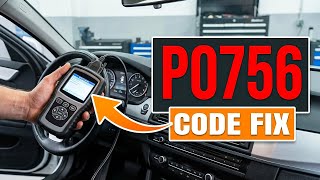
Use an OBD-II scanner to confirm P0756 and check for related codes (e.g., P0732). Review freeze-frame data to identify the exact vehicle speed, engine RPM, and fluid temperature when the shift failed.
Tools: OBD-II Scanner (Beginner) - Research Vehicle-Specific TSBs
Search for Technical Service Bulletins (TSBs) for your specific VIN. Manufacturers frequently document specific mechanical failures causing this code, saving hours of misdiagnosis.
Tools: Internet access, VIN (Beginner) - Command the Solenoid with a Scan Tool
Use a bidirectional scan tool to command Solenoid 'B' ON and OFF with the engine off. Listen closely for an audible 'click' from the transmission pan. No click confirms a mechanically stuck solenoid or a dead circuit.
Tools: Bidirectional OBD-II Scanner (Advanced) - Analyze Live Data PIDs for Gear Ratio Mismatch
Monitor Input Speed Sensor (ISS), Output Speed Sensor (OSS), and Commanded Gear PIDs while driving. When the TCM commands 3rd gear, the ISS/OSS ratio must change instantly. A delayed or missing ratio change confirms internal slipping or a stuck valve.
Tools: Advanced OBD-II Scanner (Advanced) - Inspect External Wiring and Connectors
Disconnect the main electrical harness at the transmission case. Inspect for corroded pins, bent terminals, or transmission fluid leaking into the connector (capillary action), which shorts the solenoid signals.
Tools: Flashlight, electrical contact cleaner (Intermediate) - Drop the Transmission Pan & Inspect for Debris
Drain the fluid through a paint strainer. Remove the pan and inspect the magnet. Fine black clutch dust is normal; large metal chunks or brass shavings indicate catastrophic internal failure, rendering solenoid replacement useless.
Tools: Socket set, drain pan, paint strainer (Intermediate) - Test the Shift Solenoid Circuit
With the pan removed, unplug Solenoid 'B'. Measure the resistance across its two pins using a multimeter. Compare to OEM specs (typically 11-30 Ω). Infinite resistance means an open coil; near-zero means a shorted coil. Replace if out of spec.
Tools: Multimeter, repair manual (Advanced) - Check Solenoid Voltage and PWM Signal
Backprobe the solenoid connector at the TCM. When commanded ON, verify 12V reaches the circuit. For Pulse Width Modulated (PWM) solenoids, use an oscilloscope to verify the duty cycle. Missing voltage dictates a wiring or TCM repair.
Tools: Multimeter, Oscilloscope, Wiring Diagram (Advanced) - Perform a Hydraulic Pressure Test
Connect a 300-PSI pressure gauge to the transmission's line pressure test port. Compare idle and wide-open-throttle pressures to OEM specs. Low pressure confirms a failing pump, clogged filter, or massive internal leak.
Tools: Transmission pressure gauge set (Professional)
When This Code Triggers (Freeze-Frame Conditions)
- Engine Coolant Temp: 180-210°F (Fully warmed up and at operating temperature.)
- RPM: 1500-2500 RPM (During a commanded 2-3 shift under light to moderate acceleration.)
- Engine Load: 25-60% (Steady cruise or gentle acceleration when the shift is expected.)
- Vehicle Speed: 25-45 mph (The typical speed range where a 2-3 or similar upshift occurs.)
Related Codes
- P0755 — Shift Solenoid 'B' Malfunction. Indicates a purely electrical circuit problem (open or short). P0756 means the circuit is electrically intact, but the mechanical shift failed.
- P0757 — Shift Solenoid 'B' Stuck On. The exact opposite of P0756. The solenoid refuses to close, meaning a gear fails to disengage when commanded.
- P0732 — Gear 2 Incorrect Ratio. Appears alongside P0756 because the failed solenoid prevented the shift, causing the speed sensors to detect the wrong gear ratio. P0732 is the symptom; P0756 is the cause.
- P0700 — Transmission Control System Malfunction. A generic request from the TCM to the PCM to illuminate the Check Engine Light. It provides zero diagnostic value and always accompanies P0756.
Climate & Environmental Factors
- Cold Weather: Sub-zero temperatures thicken transmission fluid, drastically increasing hydraulic resistance. This prevents a borderline-weak solenoid from moving its valve, triggering P0756 on cold starts. The code often clears once the fluid reaches 150°F.
- High Heat: Extreme heat thins transmission fluid, destroying its lubricating properties. This accelerates internal wear, creates debris, and causes erratic solenoid operation.
How to Talk to a Mechanic About This Code
Say this: "I have a P0756 code on my [Vehicle] and I'm experiencing [harsh 2-3 shifting/limp mode]. Please start by checking the fluid condition, dropping the pan to inspect for debris, and checking for relevant TSBs. I need an estimate for the full diagnosis before authorizing parts."
This proves you understand P0756 is a symptom, not the root cause. It forces the shop to follow a logical diagnostic process (fluid, debris, TSBs) rather than blindly replacing the solenoid.
Avoid saying:
- 'My transmission is acting weird, can you fix it?' (Invites expensive guesswork).
- 'Just replace the shift solenoid.' (You are dictating a repair that likely won't fix the root cause).
- 'Can you quote a P0756 fix over the phone?' (Reputable shops cannot quote internal transmission repairs without physical diagnosis).
Questions to ask before authorizing the repair:
- Was there any metal debris or clutch material in the transmission pan?
- Did you command the solenoid with a bidirectional scan tool, and did it click?
- Did you check for Technical Service Bulletins related to this code for my specific VIN?
- If recommending a valve body, do you perform the required adaptive learning reset in-house?
Where to Take It: Dealer vs Independent vs Chain
- Dealer:
Mandatory for vehicles under 10 years old with known manufacturer defects, as they possess the required software and TSB access.
Best for: Vehicles under powertrain warranty., Modern vehicles with known TSBs (e.g., Ford 10R80, Subaru CVTs)., Repairs requiring proprietary software for adaptive learning resets.
Downsides: Highest labor rates., Often defaults to replacing the entire transmission rather than repairing a valve body. (Typical cost: +40% vs. baseline) - Independent Shop:
Best overall choice for out-of-warranty vehicles, provided they are a dedicated transmission specialist, not a general mechanic.
Best for: Out-of-warranty vehicles., Dedicated transmission specialty shops with rebuilding expertise.
Downsides: May lack dealer-level software for programming new modules on 2018+ vehicles. (Typical cost: +0% vs. baseline) - Chain Shop:
AVOID. The risk of misdiagnosis or being sold an unnecessary $4,000 rebuild is extremely high.
Best for: Simple fluid and filter changes.
Downsides: Technicians are rarely transmission specialists., High pressure to upsell unnecessary flushes., Outsource major repairs to third parties with massive markups. (Typical cost: -10% vs. baseline)
When to Walk Away From the Repair
If the estimated repair cost exceeds 50% of the car's private-party value, sell or trade the vehicle.
- Car worth $5000, fix is $3500: Walk away. A $3,500 rebuild on a $5,000 car is a catastrophic financial investment.
- Car worth $15000, fix is $2400: Fix it. The repair is 16% of the vehicle's value, well below the threshold.
- Car worth $4000, fix is $400: Fix it. A $400 solenoid and fluid service is a reasonable expense to keep the car running.
What Scan Tool You Need for This Code

Minimum: A scanner capable of reading manufacturer-specific transmission codes and viewing live data PIDs (Input/Output Speed, Commanded Gear).
A $20 code reader only displays 'P0756'. It cannot show the live gear ratio mismatch data or command the solenoid to test its mechanical function, forcing you to guess.
Budget: BlueDriver Pro Scan Tool (~$100) — Connects via Bluetooth. Reads transmission codes and graphs live sensor data, critical for verifying gear ratio mismatches.
Mid-range: Foxwell NT510 Elite (~$150) — Offers bidirectional control. Allows you to command the shift solenoid ON/OFF to listen for a mechanical 'click', instantly proving if the valve is jammed.
Professional: Autel MaxiCOM MK808 (~$450) — Professional tablet scanner. Executes the mandatory 'Transmission Adaptive Values Learn' procedure required after replacing a valve body on modern vehicles.
Rent vs buy: Auto parts stores scan codes for free but lack bidirectional tools. If replacing the solenoid yourself, buying a $150 bidirectional scanner is mandatory for testing.
How to Clear the Code After You Fix It
- Use an OBD-II scan tool to clear P0756 and related codes.
- Perform a 'Transmission Adaptive Values Learn' or 'Fast Learn' procedure using a bidirectional scan tool (mandatory for Ford and GM).
- Execute a specific drive cycle to allow the TCM to relearn shift points.
Drive cycle (~20 minutes): Warm the vehicle to operating temperature. Drive in stop-and-go traffic, allowing the transmission to shift through all gears with light throttle. Drive at a steady 55-65 mph for 10 minutes. Perform three gentle accelerations from a dead stop.
Readiness monitors affected: Comprehensive Component Monitor
Before emissions retest: drive at least 50 miles to fully set monitors.
Watch out for:
- Disconnecting the battery fails to clear adaptive transmission values on vehicles built after 2010.
- Skipping the adaptive learn procedure after replacing a solenoid guarantees continued harsh shifting and immediate code return.
Will This Fail Emissions / State Inspection?
Yes — this code typically fails an OBD-II emissions inspection.
- California: An illuminated Check Engine Light results in an automatic failure. All OBD-II readiness monitors must be 'Ready'.
- New York: Any diagnostic trouble code triggering the MIL, including P0756, causes an automatic OBD-II inspection failure.
- Texas: In emissions-testing counties, an active P0756 code fails the OBD portion of the state inspection.
Most Commonly Affected Vehicles
- Ford F-150, Expedition, Ranger, Mustang (2017-2023) — On the 10R80 transmission, P0756 indicates a faulty main control valve body or a slipped CDF clutch drum sleeve (TSBs 23-2250, 24-2046). Replacing the solenoid fails; repairs require a $2,000+ valve body or full rebuild.
- Chevrolet / GMC Silverado, Sierra, Tahoe, Suburban (2006-2017) — On the 4L60-E, the 2-3 shift valve wears out its aluminum bore in the valve body, causing pressure loss. On the 6L80, torque converter failure sheds metal that destroys the solenoids.
- Honda Accord, Odyssey, Pilot (2003-2017) — Triggered by internal clutch pack wear that contaminates the fluid and clogs the linear solenoid screens. Performing 3 consecutive drain-and-fills often resolves early-stage codes.
- Chrysler / Dodge / Ram Town & Country, Grand Caravan, Ram 1500 (2008-2016) — Caused by a faulty solenoid pack in the 62TE transmission. The solenoids are replaced as a single block unit.
- Toyota Sienna, Corolla, Matrix, 4Runner (2004-2015) — Triggered by a mechanically stuck solenoid. Diagnosis requires checking solenoid resistance (11-15 Ω is the standard spec). Toyota transmissions are robust, making a simple solenoid swap highly successful.
- Subaru Impreza, Forester, Outback (2012-2016) — On TR580 CVTs, this code indicates a failure of the torque converter lock-up solenoid. The entire valve body must be replaced as a unit.
Manufacturer-Specific Notes
- Ford: On 10R80 transmissions, P0756 is a documented symptom of a slipped sleeve in the CDF clutch drum causing massive internal hydraulic leaks. Do not replace the solenoid; the transmission requires a major teardown per TSB 24-2046.
- General Motors (GM): In 4L60-E transmissions, a worn 2-3 shift valve bore triggers P0756 even with a brand-new solenoid. Shops must ream the bore and install an oversized aftermarket valve (like Sonnax) to restore hydraulic pressure.
- Honda: Honda linear solenoids feature external mesh screens that clog with clutch material. Removing the solenoid and cleaning these screens with brake cleaner often cures the code without buying new parts.
- Toyota: Modern Toyotas lack a transmission dipstick. Fluid level checks require bringing the ATF to a precise temperature (usually 104°F-113°F) using a scan tool and opening a specific overflow plug.
Real Owner Stories
2018 Ford F-150 with 10R80 at 75K miles
Check engine light illuminated with harsh 2-3 shifts. Downshifts felt like being rear-ended.
What they tried:
- A general repair shop scanned P0756 and replaced shift solenoid 'B'. The code returned within 50 miles.
Outcome: The owner visited a Ford dealer. The dealer referenced TSB 23-2123, diagnosing a faulty main control valve body. The valve body was replaced and adaptive learning reset for $2,400. The issue was resolved.
Lesson: On modern transmissions, solenoid codes are symptoms of larger mechanical defects. Always check TSBs to avoid paying for useless solenoid replacements.
2010 Honda Odyssey at 140K miles
Transmission flared between 2nd and 3rd gear. P0756 triggered, and the van refused to shift past 2nd gear when cold.
What they tried:
- The DIY owner checked the fluid, finding it dark and burnt. He performed three consecutive drain-and-fills with Honda DW-1 ATF.
Outcome: After the third flush, the fluid ran bright red. The owner cleared the code, and shifting returned to normal. The $90 fix has lasted over a year.
Lesson: Contaminated fluid is the leading cause of solenoid codes on Hondas. A thorough fluid flush is the cheapest, most effective first step.
2008 Chevy Silverado with 4L60-E at 185K miles
Lost 3rd and 4th gear, stuck in limp mode. Codes P0756 and P0732 present.
What they tried:
- Owner replaced shift solenoid 'B' and the fluid. The problem persisted. He dropped the valve body and found the 2-3 shift valve jammed in its bore.
Outcome: A transmission shop reamed the worn bore and installed a Sonnax oversized valve kit. Reinstalling the repaired valve body restored all gears.
Lesson: High-mileage GM 4L60-E transmissions suffer from valve body bore wear that mimics a bad solenoid. If a new solenoid fails, inspect the physical shift valve.
How to Prevent This Code From Triggering
- Change transmission fluid and filter every 30,000-60,000 miles. (Every 30,000 miles for severe service (towing); 60,000 miles for normal driving.) — Clean fluid maintains hydraulic pressure. Degraded fluid causes valves to stick and overheat, the #1 cause of transmission failure.
- Use only OEM-specified transmission fluid. (Every fluid change.) — Modern transmissions require specific friction modifiers. Universal fluids alter hydraulic pressure, triggering performance codes like P0756.
- Install an auxiliary transmission cooler. (One-time installation for towing vehicles.) — Heat kills transmissions. A cooler keeps fluid near 175°F, preventing breakdown and extending solenoid life.
- Come to a complete stop before shifting from Drive to Reverse. (Daily habit.) — Shifting while moving slams internal components, shedding metal debris that clogs solenoids.
Frequently Asked Questions
Will replacing Shift Solenoid B always fix code P0756?
No. The most common causes are low fluid, dirty fluid, or clogged hydraulic passages. On modern vehicles like the Ford F-150, the code points to a catastrophic internal drum failure, making a solenoid replacement useless.
What is the most common misdiagnosis for P0756?
Immediately replacing the shift solenoid without checking the fluid level or researching vehicle-specific TSBs. This wastes hundreds of dollars when a simple fluid top-off or a known valve body update was the actual fix.
What does 'Shift Solenoid B' do?
It is an electronically controlled valve that routes pressurized hydraulic fluid to engage or disengage specific clutch packs, typically controlling the shift between 2nd and 3rd gear.
How much does it cost to fix P0756?
Costs range from $150 for a fluid change to $620 for a solenoid replacement. Valve body replacements average $1,500, while major internal repairs on transmissions like the Ford 10R80 exceed $4,000.
Can I just clear the P0756 code?
You can clear it, but it returns the moment the transmission attempts the faulty shift again. Clearing the code does not fix the physical hydraulic blockage or electrical failure.
What happens if I ignore the P0756 code?
Ignoring the code forces the transmission to slip and overheat. A problem fixable with a $150 fluid change quickly escalates into a $5,000 complete transmission replacement.
Are shift solenoid A and B the same part?
No. While they look identical and sit next to each other, they control entirely different hydraulic circuits and gear sets. They have separate wiring and are commanded independently by the TCM.
Can I fix P0756 myself?
A fluid and filter change is a manageable DIY job. However, replacing a solenoid requires dropping the pan, working in a surgically clean environment, and often using a bidirectional scanner to relearn shift adaptations.
Key Takeaways
- Check your transmission fluid first; low or dirty fluid causes over 50% of P0756 codes, not a failed solenoid.
- Search for Technical Service Bulletins (TSBs) before buying parts, as vehicles like the 2017+ Ford F-150 have known $2,000+ valve body defects triggering this code.
- Expect harsh 2-3 shifts, poor acceleration, and the vehicle locking into 'limp mode' (usually 2nd or 3rd gear) to prevent further damage.
- Stop driving immediately; pushing a transmission in limp mode overheats the fluid within 30 miles and turns a $300 solenoid fix into a $5,000 rebuild.
Helpful Videos




The information in this article is provided for general reference and educational purposes only. Vehicle specifications, procedures, and part compatibility can vary by production date, trim level, and region. Always consult your vehicle's factory service manual and verify part numbers before purchasing or performing repairs. Safety-critical components such as airbags, seat belts, and braking systems should be installed by a qualified professional.
- 🎬 Helpful Videos
- What Does P0756 Mean?
- Can I Drive With P0756?
- Common Causes
- Symptoms
- Diagnostic Flowchart
- Common Fixes & Costs
- Used vs. New Parts: Buying Guide
- What Happens If You Wait — Timeline
- Cost of Not Fixing It
- Diagnosis Steps
- When This Code Triggers (Freeze-Frame Conditions)
- Related Codes
- Climate & Environmental Factors
- How to Talk to a Mechanic About This Code
- Where to Take It: Dealer vs Independent vs Chain
- When to Walk Away From the Repair
- What Scan Tool You Need for This Code
- How to Clear the Code After You Fix It
- Will This Fail Emissions / State Inspection?
- Most Commonly Affected Vehicles
- Manufacturer-Specific Notes
- Real Owner Stories
- 2018 Ford F-150 with 10R80 at 75K miles
- 2010 Honda Odyssey at 140K miles
- 2008 Chevy Silverado with 4L60-E at 185K miles
- How to Prevent This Code From Triggering
- Frequently Asked Questions
- Will replacing Shift Solenoid B always fix code P0756?
- What is the most common misdiagnosis for P0756?
- What does 'Shift Solenoid B' do?
- How much does it cost to fix P0756?
- Can I just clear the P0756 code?
- What happens if I ignore the P0756 code?
- Are shift solenoid A and B the same part?
- Can I fix P0756 myself?
- Key Takeaways
- 🎟️ Get 5% Off