

OBD-II Code P0761: Shift Solenoid 'C' Performance / Stuck Off
The Ultimate Guide to What P0761 Means, Why It Triggers, and How to Fix It for Good
- Check your transmission fluid first; dark, burnt fluid or metal shavings indicate a catastrophic failure requiring a $3,000+ rebuild, making a simple solenoid replacement a waste of money.
- Do not blindly replace Shift Solenoid 'C', as 60% of P0761 codes stem from upstream issues like damaged wiring, clogged valve bodies, or failing torque converters.
- If you own a 2017-2023 Ford with a 10R80 transmission, check TSB 23-2123; P0761 usually requires a complete valve body replacement rather than a single solenoid fix.
- Stop driving immediately if the transmission locks into 'limp mode' (usually 3rd gear), as continuing to drive overheats the transmission and guarantees permanent clutch damage.
What Does P0761 Mean?
The Transmission Control Module (TCM) detected a performance problem with Shift Solenoid 'C'. This small, electronically controlled valve directs transmission fluid to execute gear changes. The code triggers when the computer commands the solenoid 'on', but electrical feedback or gear ratio monitoring confirms the solenoid remained 'off' or the shift failed.
Technical definition: The official SAE/OBD-II definition is "Shift Solenoid 'C' Performance or Stuck Off". This indicates the Transmission Control Module (TCM) detected that the actual state of Shift Solenoid 'C' does not match the commanded state. The TCM monitors this by observing the resulting gear ratio or through an internal electrical feedback circuit.
Can I Drive With P0761?
Yes, But With Caution. You can drive, but doing so is dangerous. Your transmission will likely shift violently, lock into a single gear (limp mode), or fail to accelerate, creating a severe safety risk. On Ford 10R80 transmissions, this causes a dangerous downshift from 10th to 1st gear at highway speeds. Driving with contaminated fluid (common in GM 6L80s) circulates metal debris, escalating a $1,500 repair into a $4,000+ rebuild.
Common Causes
- Low, Dirty, or Contaminated Transmission Fluid (Very Common) — The most frequent cause. Low fluid prevents proper hydraulic pressure, while dirty fluid clogs passages and sticks solenoids. Fluid contaminated with metal shavings from internal wear is a major hidden cause that requires immediate investigation.
- Internal Transmission Mechanical Failure (Common Specific Models) — A critical, often misdiagnosed issue. On Ford 10R80 transmissions (2017+), a failing CDF clutch drum or valve body is the culprit. On GM 6L80 transmissions (2011-2015), a failing torque converter contaminates the system, clogging new solenoids instantly.
- Faulty Shift Solenoid 'C' (Common) — The solenoid fails electrically (open/shorted coil) or mechanically (sticking plunger, clogged screen) due to age, heat, or debris.
- Wiring or Connector Issues (Common) — Heat, road debris, or vibrations damage the external wiring harness. Connectors corrode or suffer bent pins, interrupting the signal. The internal harness inside the transmission pan also becomes brittle over time.
- Faulty Transmission Valve Body (Less Common) — The hydraulic control center. Internal passages or small spool valves clog with sludge, preventing fluid movement even if the solenoid works perfectly.
- Failing or Clogged Internal Transmission Filter (Less Common) — A severely clogged internal filter restricts fluid flow to the pump, starving the system of operating pressure and mimicking a solenoid failure.
- Faulty TCM or Outdated Software (Rare) — The computer controlling the transmission fails, specifically the driver circuit for solenoid 'C', or requires an OEM software update to fix shifting logic. This usually triggers other codes and is a last-resort diagnosis.
Symptoms
- Harsh, Erratic, or Delayed Shifting — The car bangs into gear, hesitates before shifting, or refuses to shift into a specific gear (often the 2-3 or 3-4 shift).
- Transmission Stuck in Gear or 'Limp Mode' — The transmission enters a fail-safe mode, locking into a single gear (often 2nd or 3rd) to prevent damage, resulting in poor acceleration and high highway RPMs.
- Check Engine Light / Transmission Warning Light — The computer illuminates the Malfunction Indicator Lamp or a specific transmission warning light on the dashboard.
- Transmission Overheating — Increased friction from slipping clutches or incorrect fluid pressure causes the transmission to run hot, triggering an overheat warning.
- Decreased Fuel Economy — Inefficient shifting forces the engine to work harder, consuming more fuel.
Diagnostic Flowchart
Tap your situation to follow the diagnostic path that matches what you're seeing on this code.
Common Fixes & Costs
- Transmission Fluid and Filter Change — Parts: $50-$120, Labor: $100-$250, ~1.5 hr book time (Intermediate)
- Replace Shift Solenoid 'C' — Parts: $30-$150, Labor: $150-$400, ~3 hr book time (Professional)
- Replace Transmission Valve Body — Parts: $300-$1200, Labor: $300-$1000, ~3.5 hr book time (Professional)
- Replace or Repair Wiring Harness — Parts: $20-$200, Labor: $100-$300, ~2.5 hr book time (Professional)
- Transmission Rebuild or Replacement — Parts: $2000-$4500+, Labor: $800-$1500, ~10 hr book time (Professional)
Used vs. New Parts: Buying Guide
When a used part is worth it: Used valve bodies are only advisable if sourced from a low-mileage vehicle scrapped for non-drivetrain reasons. For individual solenoids, always buy new.
Donor-vehicle mileage cap: roughly under 50000 miles for the part to have meaningful remaining life.
Donor quality checklist:
- Verify the donor vehicle's mileage and salvage reason.
- Avoid parts with unknown maintenance history; internal contamination is the biggest risk.
- Match the part number exactly, as valve bodies are specific to year ranges and software versions.
Decision logic:
- If The required part is a single, accessible solenoid → Always buy new. The cost savings are minimal and not worth the labor risk.
- If The required part is a complete valve body or TEHCM → Favor a new or professionally remanufactured unit with a warranty.
- If Budget is the absolute primary concern on a low-value vehicle → A low-mileage used valve body is a gamble, but cost-effective if you accept premature failure risks.
Warranty tradeoff: Salvage yard parts offer 30-90 day warranties covering only the part. New/remanufactured units offer 1-3 year warranties covering parts and sometimes labor.
Worst-case if a used part fails: $600-$1500. If a used part fails, you pay for labor a second time plus a new part.
What Happens If You Wait — Timeline
- 0-1 month: Check Engine Light illuminates. Occasional hesitation or firm shifts occur under load. Vehicle intermittently enters 'limp mode'. (MPG impact: 3-5%% · Added cost: $0-50 in wasted fuel. The problem is likely contained to a fluid issue or a failing solenoid.)
- 1-3 months: Shifting becomes noticeably harsh or delayed. The transmission slips, causing RPM flares. Limp mode is frequent. The transmission runs hotter. (MPG impact: 5-10%% · Added cost: $500-$1,500. Excess heat breaks down clutch material and contaminates fluid, damaging the valve body.)
- 3-6 months: Severe shifting problems. The vehicle gets stuck in one gear permanently. The pan fills with clutch material. Valve body passages clog. (MPG impact: 10-15%% · Added cost: $1,500-$2,500. A simple part swap is impossible. The valve body is damaged, and clutch packs are worn. An overhaul is required.)
- 6+ months: Catastrophic failure. The vehicle fails to move. Widespread contamination destroys the torque converter, pump, valve body, and clutches. (MPG impact: 15-25%+% · Added cost: $4,000-$6,000+. The only solution is a complete transmission replacement.)
Cost of Not Fixing It
- 0-1 Month: Decreased fuel economy (5-10%), harsh shifting, and limp mode engagement. The vehicle is a safety risk due to unpredictable acceleration. (Added cost: Negligible, besides increased fuel consumption.)
- 1-6 Months: Slipping and harsh shifts cause excessive heat, wearing out clutches and bands. Contaminated fluid damages the valve body and other solenoids. (Added cost: $500 - $1,500. A simple fix escalates into a valve body replacement.)
- 6+ Months: Catastrophic internal failure. Clutch material and metal shavings contaminate the entire hydraulic system, torque converter, and cooler. (Added cost: $3,500 - $6,000+. The transmission requires a complete rebuild or replacement.)
Diagnosis Steps
- Check Transmission Fluid Level and Condition
With the engine warm and running in Park or Neutral, check the fluid dipstick. It must be reddish-pink and not smell burnt. Dark brown/black fluid or glittery metal particles indicate a serious internal problem (like torque converter failure) that a solenoid replacement will not fix.
Tools: Rag, Owner's Manual (Beginner) - Scan for Codes & Review Freeze Frame Data
Use an OBD-II scanner to confirm P0761 and check for related codes (e.g., P0700, P0751, P0741). Review the freeze-frame data to see the vehicle's operating conditions when the code set.
Tools: OBD-II Scanner (Beginner) - Inspect External Wiring and Connectors
Visually inspect the external wiring harness running to the transmission for melting, chafing, or corrosion. Unplug the main connector and check for bent pins, moisture, or a poor ground connection.
Tools: Flashlight, Electrical contact cleaner (Intermediate) - Test Solenoid Resistance at the Connector
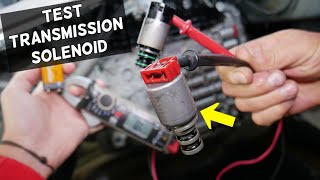
Disconnect the transmission connector. Identify the pins for Shift Solenoid 'C' and measure resistance. Infinity (OL) indicates an open circuit; near zero indicates a short. GM 4L60-E on/off solenoids read 20-40 ohms; GM 6L80 PWM solenoids read 3-8 ohms. Consult your factory service manual.
Tools: Multimeter, Vehicle-specific wiring diagram (Advanced) - Command the Solenoid with a Bi-Directional Scan Tool
Use a professional scan tool to command the 'C' solenoid on and off with the engine running. Listen for an audible 'click' from the transmission pan. A click confirms mechanical function. No click points to a failed solenoid, wiring issue, or TCM driver fault.
Tools: Advanced Bi-directional Scan Tool (Advanced) - Analyze Live Data PIDs
Monitor live data PIDs for Shift Solenoid 'C'. Observe the commanded state vs. actual state, duty cycle, and voltage. If the TCM commands the solenoid 'On' but the feedback sensor shows no change, it isolates the problem to the hydraulic circuit or sensor.
Tools: Advanced Bi-directional Scan Tool (Advanced) - Perform a Solenoid Amperage Draw Test
Measure the solenoid's current draw to catch intermittent issues. Wire a multimeter in series (set to Amps) and command the solenoid on. Compare the reading to spec (typically 0.75-1.25 amps). Low readings mean high resistance; high readings mean a partial short.
Tools: Multimeter with Amperage function/Amp Clamp, Wiring Diagram (Professional) - Check TCM Power and Ground
Back-probe the TCM connector to verify battery voltage (11.8-12.5V) and a solid ground (near 0V). A voltage drop exceeding 0.5 volts causes erratic operation and false solenoid codes. Do this before condemning the TCM.
Tools: Multimeter, Wiring Diagram (Professional) - Perform a Transmission Line Pressure Test
Connect a fluid pressure gauge to the transmission test port. Measure pressure at idle in each gear and during a brief stall test. Low pressure indicates a failing pump or major leak; high pressure indicates a blockage or faulty pressure regulator.
Tools: Transmission Pressure Gauge Kit (0-400 PSI), Service Manual (Professional) - Inspect Internal Components and Pan
If external tests pass, remove the transmission pan. Inspect the solenoid, internal wiring harness, and look for metal debris. A pan full of metallic 'glitter' confirms a catastrophic mechanical failure requiring a rebuild.
Tools: Socket set, Drain pan, Gasket scraper, Torque wrench (Advanced)
When This Code Triggers (Freeze-Frame Conditions)
- Engine Coolant Temp: 180-200°F (82-93°C) (The engine has reached full operating temperature. The code rarely sets on a cold engine.)
- RPM: 1500-2500 RPM (During cruise, light acceleration, or when a command to shift (e.g., 3-4) is expected.)
- Engine Load: 30-60% (Triggers under moderate load, such as accelerating to merge onto a highway or climbing a grade.)
- Vehicle Speed: 35-55 mph (Occurs in the speed range where the transmission commands the gear shift involving solenoid 'C'.)
Related Codes
- P0760 — P0760 is an electrical circuit fault (open/short) for Solenoid 'C'. P0761 is a performance code set when the circuit is fine, but the gear change fails. P0760 is strictly electrical; P0761 is hydraulic, mechanical, or intermittent.
- P0762 — The exact opposite of P0761, indicating Solenoid 'C' is 'Stuck On'. P0761 causes a failure to shift into a gear, while P0762 causes a harsh bind-up, feeling like two gears are engaged at once.
- P0751 — Shift Solenoid 'A' Performance. Seeing multiple solenoid codes together points to a common root cause like low fluid, a failing valve body, or a bad ground, rather than multiple simultaneous solenoid failures.
- P0700 — A generic informational code telling the ECM to illuminate the Check Engine Light. You must scan the TCM to retrieve the specific code (P0761) that triggered it.
Climate & Environmental Factors
- Cold Weather: Cold temperatures increase fluid viscosity, making it harder to flow. This causes delayed engagement, harsh shifts, and increased strain on solenoids, potentially logging a temporary P0761 code.
- High Humidity / Water Exposure: Driving through deep puddles forces moisture into external transmission connectors. This corrodes pins, increases electrical resistance, and disrupts the solenoid signal.
- High Altitude: Lower air density affects engine load, causing the TCM to adjust shift strategies. If the transmission is borderline (degraded fluid or sticky solenoid), these changes trigger a performance code.
How to Talk to a Mechanic About This Code
Say this: "I have a P0761 code on my [Year, Make, Model]. I'd like to schedule a diagnostic. Please start by checking the fluid condition and inspecting for related TSBs, especially for the valve body or torque converter, before recommending a solenoid replacement."
This signals you understand P0761 is often a symptom of a larger issue. It directs the shop to perform crucial, non-invasive diagnostic steps first, preventing a quick and potentially wrong diagnosis.
Avoid saying:
- 'My transmission is acting weird.'
- 'My check engine light is on, can you just fix it?'
- 'I think I need a new shift solenoid C.'
Questions to ask before authorizing the repair:
- What was the condition of the transmission fluid? Was there any metal or clutch material in the pan?
- Did you check for any Technical Service Bulletins (TSBs) related to this code for my specific vehicle?
- If you are recommending a solenoid replacement, what tests did you perform to rule out a wiring issue or a problem in the valve body?
- What is the warranty on the parts and labor for this repair?
Where to Take It: Dealer vs Independent vs Chain
- Dealer:
Recommended if your vehicle is under warranty or is a newer Ford/GM model with known TSBs. For out-of-warranty vehicles, they are an expensive but reliable option.
Best for: Vehicles under powertrain warranty., Known complex issues on newer cars (e.g., Ford 10R80 valve body problems)., When manufacturer-specific software updates or relearn procedures are required.
Downsides: Highest labor rates and part costs., Quick to replace large, expensive assemblies rather than diagnose component-level faults. (Typical cost: +50% vs. baseline) - Independent Shop:
Best overall fit for out-of-warranty vehicles, IF you choose a reputable transmission specialist. Their ability to diagnose component-level faults saves money.
Best for: Out-of-warranty vehicles where cost is a major factor., Diagnosing common transmission problems on well-established models.
Downsides: Quality varies dramatically; a good transmission specialist is hard to find., May lack the latest manufacturer-specific tools for brand-new models. (Typical cost: +0% vs. baseline) - Chain Shop:
AVOID for P0761 diagnosis. This code requires specialized knowledge beyond the scope of a general-purpose chain shop.
Best for: Simple fluid and filter changes, assuming they use the correct OEM fluid.
Downsides: Not equipped or trained for in-depth transmission diagnostics., High risk of misdiagnosis and being sold an unnecessary transmission replacement. (Typical cost: -10% vs. baseline)
When to Walk Away From the Repair
If the estimated transmission repair cost exceeds 50% of the car's current market value, seriously consider replacing the vehicle.
- Car worth $5000, fix is $2800: Walk away. The repair cost is over 50% of the car's value. It is not a sound investment.
- Car worth $15000, fix is $3500: Fix it. The repair is significant but well under the 50% threshold, and cheaper than replacing the vehicle.
- Car worth $8000, fix is $4000: Borderline. This is the 50% mark. Get a second opinion and evaluate the car's overall condition before deciding.
What Scan Tool You Need for This Code
Minimum: A scanner that reads manufacturer-specific transmission codes and views live transmission data PIDs (solenoid commanded state, fluid temperature).
A basic $20 code reader only shows the P0761 code. It cannot access live data to see if the computer is commanding the solenoid, nor can it perform bi-directional tests, leading to unnecessary part replacements.
Budget: BlueDriver Pro Scan Tool (~$100) — Reads and clears transmission codes, provides freeze-frame data, and displays live transmission data PIDs. Good for initial diagnosis.
Mid-range: Foxwell NT510 Elite (~$180) — Offers full-system diagnostics. Views live data streams for solenoids and performs bi-directional tests (commanding the solenoid to click), a critical diagnostic step for P0761.
Professional: Autel MaxiCOM MK808 / MK906BT (~$500-1200) — Provides full OEM-level bidirectional control, advanced data PIDs, and transmission-specific relearn procedures. This is the tool a professional shop uses.
Rent vs buy: Renting is not viable as rental tools are basic code readers. To properly diagnose P0761 yourself, you need a mid-range tool with bi-directional capabilities. Buying the Foxwell NT510 Elite is a worthwhile investment.
How to Clear the Code After You Fix It
- Reconnect battery if disconnected.
- Use an OBD-II scan tool to erase P0761 and related codes.
- Perform a complete transmission drive cycle to allow the TCM to relearn shift adapts.
Drive cycle (~30 minutes): Start cold and idle for 3 minutes. Drive in stop-and-go traffic for 15 minutes, shifting through all gears. Drive for 10 minutes at a steady highway speed (55 mph). Allow the vehicle to cool completely.
Readiness monitors affected: Comprehensive Component Monitor, Catalyst Monitor, Evaporative System Monitor
Before emissions retest: drive at least 100 miles to fully set monitors.
Watch out for:
- Disconnecting the battery clears the ECM but not the TCM, erasing learned memory and making shifting temporarily worse.
- The code returns immediately if the root cause (contaminated fluid, mechanical fault) wasn't repaired.
- Testing before readiness monitors are set to 'Ready' results in an automatic emissions failure.
Will This Fail Emissions / State Inspection?
Yes — this code typically fails an OBD-II emissions inspection.
- California: An illuminated Check Engine Light is an automatic failure. All monitors must be 'Ready' before a re-test, requiring 100+ miles of driving.
- New York: Any active transmission fault code illuminating the Check Engine Light results in an automatic OBD-II failure.
- Texas: In the 17 emissions-testing counties, an active P0761 code causes an automatic failure.
Most Commonly Affected Vehicles
- Ford F-150, Expedition, Ranger, Transit (2017-2023) — On 10R80 10-speed transmissions, P0761 indicates a faulty main control valve body or a hydraulic leak from the CDF clutch drum (TSBs 23-2123 and 24-2176). A solenoid replacement will not fix it.
- Chevrolet / GMC Silverado, Sierra, Suburban, Tahoe (2011-2015) — On 6L80 transmissions, P0761 is caused by debris from a failing torque converter contaminating the TEHCM. Code P0741 confirms this issue.
- Honda Odyssey, Accord, Pilot (2002-2010) — Dirty fluid or failing external transmission fluid pressure switches mimic solenoid failure. Replacing pressure switches is the best first step.
- Acura MDX, TL (2003-2007) — Susceptible to solenoid codes due to fluid breakdown and failing 3rd/4th gear pressure switches.
- Lexus IS250, GX460 (2006-2012) — Caused by intermittent electrical faults in the solenoid or early-stage valve body contamination. Solenoids are replaced as a pack.
- Toyota Sienna, Camry, RAV4 (2004-2013) — Solenoid failures occur as vehicles age. Replacement is straightforward if there is no internal contamination.
- Nissan Altima, Maxima, Qashqai (2007-2017) — On CVTs, solenoid codes point to valve body issues. The valve body is replaced as a complete assembly.
- Subaru Legacy, Outback (2008-2014) — On the 5EAT transmission, the scan tool's 'Solenoid C' designation may not match the physical label. Cross-reference with a service manual to avoid replacing the wrong part.
Manufacturer-Specific Notes
- Ford: On 10R80 transmissions, P0761 indicates sticking valves in the main control valve body or a hydraulic leak from the CDF clutch drum (TSB 23-2123). Replacing the solenoid fails; valve body replacement is required.
- General Motors: On 6L80/6L90 transmissions, P0761 is a classic symptom of torque converter failure. Shed material clogs the TEHCM. Replacing the TEHCM without replacing the torque converter leads to repeat failure.
- Honda/Acura: On 5-speed automatics, solenoid codes are frequently caused by failing external fluid pressure switches. Replacing the 3rd and 4th gear pressure switches resolves the issue cheaply.
- Subaru: On CVT models, shift solenoids are integrated into the valve body and not sold separately. P0761 necessitates replacing the entire valve body and performing a computer relearn procedure.
Real Owner Stories
2012 Honda Odyssey at 115K miles - Easy Fix
Check Engine Light illuminated with P0761. The transmission shifted harshly between 2nd and 3rd gear. No other codes present.
Outcome: The code cleared and did not return. Shifting returned to normal. Total cost was $150.
Lesson: On Honda/Acura models, old fluid and failing external pressure switches mimic solenoid failures. Attempt this cheaper repair before dropping the pan.
2014 Chevy Silverado 1500 (6L80) at 95K miles - Misdiagnosis Story
Truck developed a highway shudder, threw P0761, and entered limp mode (stuck in 3rd gear).
Outcome: A transmission specialist dropped the pan and found grey metallic debris. They diagnosed a failing torque converter clutch. The new TEHCM was already clogged. The final repair required a new torque converter, another TEHCM, and a system flush, costing an additional $2,800.
Lesson: On GM 6L80 transmissions, P0761 with a shudder indicates torque converter failure. Replacing solenoids without addressing contamination guarantees repeat failure.
2018 Ford F-150 (10R80) at 70K miles - Unusual Root Cause
Truck shifted erratically and banged into gear. Threw P0761 alongside P0751 and P0756.
Outcome: The dealership identified a known main control valve body issue (TSB 23-2123). They replaced the entire valve body assembly under warranty, permanently fixing the issue.
Lesson: On Ford 10R80 transmissions, P0761 is a symptom of valve body or CDF clutch drum failure. Check TSBs before assuming a single solenoid is at fault.
How to Prevent This Code From Triggering
- Regular Transmission Fluid and Filter Changes (Every 30,000-60,000 miles, or per owner's manual.) — Clean fluid maintains hydraulic pressure, lubricates parts, and removes heat. Old fluid allows debris buildup, the #1 cause of solenoid failure.
- Install an Auxiliary Transmission Cooler (One-time installation for towing or hot climates.) — Heat destroys transmissions. A cooler keeps fluid at optimal temperatures, preventing breakdown and extending the life of solenoids and clutches.
- Allow a Brief Warm-Up Period (Daily, especially in cold weather.) — Cold fluid is thick and strains the pump and solenoids. Idling for 30-60 seconds lets fluid circulate before the transmission is placed under load.
- Use the Correct Type of Transmission Fluid (Every time fluid is added or changed.) — Modern transmissions require specific formulations. Using the wrong fluid damages seals, causes clutch slippage, and destroys solenoids.
- Come to a Complete Stop Before Shifting Gears (Daily driving habit.) — Shifting from Drive to Reverse while rolling forces internal clutches to act as brakes, causing extreme stress and premature wear.
Frequently Asked Questions
Will changing my transmission fluid fix a P0761 code?
It fixes the issue only if the root cause is low, old, or slightly dirty fluid. If the code stems from an electrical failure, mechanical blockage, or severe metal contamination, new fluid provides only a temporary band-aid. Always inspect the old fluid for metal shavings before assuming a flush will work.
What is the most common misdiagnosis for P0761?
The most common mistake is replacing the 'C' solenoid without investigating the root cause. Technicians often find the code returns because the underlying problem was actually contaminated fluid from a failing torque converter (GM) or a faulty valve body (Ford). Always inspect the fluid and pan for debris before replacing parts.
Can I just replace the one bad solenoid?
Yes, if diagnostics confirm the single solenoid is the only fault. However, many solenoids are integrated into a single pack or the valve body itself. Given the heavy labor involved in dropping the transmission pan, mechanics strongly recommend replacing the entire solenoid pack preventatively.
What does shift solenoid C actually do?
Shift Solenoid 'C' is a hydraulic valve controlled by the Transmission Control Module (TCM). It opens and closes to direct pressurized fluid, which applies or releases specific clutch packs to change gears. Depending on the transmission, this solenoid typically controls the engagement of 3rd, 4th, or 5th gear.
Why did the code come back after I replaced the solenoid?
If the code returns, the solenoid was a symptom rather than the root cause. Upstream issues like contaminated fluid from a failing torque converter will immediately clog a brand-new solenoid. It also indicates known mechanical flaws, such as CDF clutch drum leaks on Ford 10R80 transmissions.
Can a bad ground cause a P0761 code?
Yes. Transmission solenoids require a clean 12V power supply and a solid ground to function correctly. A corroded ground strap causes erratic voltage drops, leading to unpredictable solenoid operation and false performance codes.
How much should it cost to diagnose a P0761 code?
Most independent shops charge a diagnostic fee between $125 and $185. This covers scanning the TCM, checking fluid condition, inspecting external wiring, and performing basic bi-directional scan tool tests. Advanced diagnostics requiring transmission pan removal will add 1 to 2 hours of labor.
Key Takeaways
- Check your transmission fluid first; dark, burnt fluid or metal shavings indicate a catastrophic failure requiring a $3,000+ rebuild, making a simple solenoid replacement a waste of money.
- Do not blindly replace Shift Solenoid 'C', as 60% of P0761 codes stem from upstream issues like damaged wiring, clogged valve bodies, or failing torque converters.
- If you own a 2017-2023 Ford with a 10R80 transmission, check TSB 23-2123; P0761 usually requires a complete valve body replacement rather than a single solenoid fix.
- Stop driving immediately if the transmission locks into 'limp mode' (usually 3rd gear), as continuing to drive overheats the transmission and guarantees permanent clutch damage.
Helpful Videos

The information in this article is provided for general reference and educational purposes only. Vehicle specifications, procedures, and part compatibility can vary by production date, trim level, and region. Always consult your vehicle's factory service manual and verify part numbers before purchasing or performing repairs. Safety-critical components such as airbags, seat belts, and braking systems should be installed by a qualified professional.
- 🎬 Helpful Videos
- What Does P0761 Mean?
- Can I Drive With P0761?
- Common Causes
- Symptoms
- Diagnostic Flowchart
- Common Fixes & Costs
- Used vs. New Parts: Buying Guide
- What Happens If You Wait — Timeline
- Cost of Not Fixing It
- Diagnosis Steps
- When This Code Triggers (Freeze-Frame Conditions)
- Related Codes
- Climate & Environmental Factors
- How to Talk to a Mechanic About This Code
- Where to Take It: Dealer vs Independent vs Chain
- When to Walk Away From the Repair
- What Scan Tool You Need for This Code
- How to Clear the Code After You Fix It
- Will This Fail Emissions / State Inspection?
- Most Commonly Affected Vehicles
- Manufacturer-Specific Notes
- Real Owner Stories
- 2012 Honda Odyssey at 115K miles - Easy Fix
- 2014 Chevy Silverado 1500 (6L80) at 95K miles - Misdiagnosis Story
- 2018 Ford F-150 (10R80) at 70K miles - Unusual Root Cause
- How to Prevent This Code From Triggering
- Frequently Asked Questions
- Will changing my transmission fluid fix a P0761 code?
- What is the most common misdiagnosis for P0761?
- Can I just replace the one bad solenoid?
- What does shift solenoid C actually do?
- Why did the code come back after I replaced the solenoid?
- Can a bad ground cause a P0761 code?
- How much should it cost to diagnose a P0761 code?
- Key Takeaways
- 🎟️ Get 5% Off