

OBD-II Code P0752: Shift Solenoid 'A' Stuck On
The Ultimate Guide to Meaning, Causes, and Fixes for P0752
- P0752 indicates Shift Solenoid 'A' is mechanically or hydraulically stuck open, forcing the transmission into a 2nd or 3rd gear limp mode.
- Stop driving immediately; continuing to drive with P0752 overheats the transmission fluid and turns a $300 solenoid fix into a $4,000+ complete rebuild.
- Check your transmission fluid first, as dirty or degraded fluid is the #1 cause of a stuck solenoid valve.
- On 2017+ Ford vehicles with the 10R80 transmission, P0752 almost always requires a $1,500+ valve body replacement rather than a simple solenoid swap.
What Does P0752 Mean?
P0752 indicates the Powertrain Control Module (PCM) or Transmission Control Module (TCM) detects Shift Solenoid 'A' is stuck in the 'on' (open) position. This solenoid is an electronically controlled valve that directs transmission fluid flow to change gears. When stuck on, it continuously flows fluid when it should be off, disrupting hydraulic commands and forcing the transmission to shift harshly or lock into one gear.
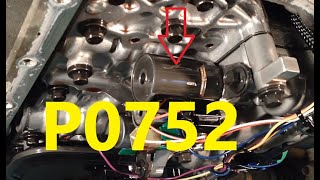
Technical definition: The SAE/OBD-II definition is "Shift Solenoid 'A' Stuck On". 🎬 Watch: A breakdown of the causes and fixes for P0752. The PCM/TCM sets this code when it detects a mismatch between the commanded gear and the actual gear ratio. The computer calculates the ratio using the engine speed sensor and transmission output speed sensor. When the actual ratio fails to match the expected ratio for the commanded gear, the module concludes Shift Solenoid 'A' remains functionally 'on' despite being commanded 'off'.
Can I Drive With P0752?
No — Do Not Drive. Do not drive. The transmission enters a fail-safe 'limp mode,' locking into a single gear. This causes dangerously poor acceleration and high RPMs at speed. Continued driving causes a cascade failure, overheating the transmission fluid and destroying clutch packs, the torque converter, and the valve body. This turns a $300 solenoid repair into a $4,000+ transmission rebuild.
Common Causes
- Low, Dirty, or Contaminated Transmission Fluid (Very Common) — This is the leading cause. Degraded fluid loses hydraulic properties, while fluid contaminated with clutch material clogs the fine passages within the solenoid or valve body, causing the mechanical valve to physically stick open. A clogged transmission filter exacerbates this by starving the system of pressure.
- Faulty Shift Solenoid 'A' (Very Common) — The solenoid itself fails mechanically (the internal plunger sticks) or electrically (the internal wire coil shorts, keeping the solenoid permanently energized).
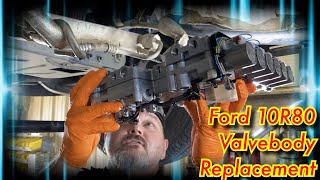
- Defective Transmission Valve Body (Common) — The valve body is the hydraulic brain of the transmission. Its intricate channels become blocked with debris, or its mechanical valves stick. On modern Ford vehicles with the 10R80 transmission, a defective valve body is the primary cause of this code, not the individual solenoid.
- Wiring or Connector Issues (Less Common) — An electrical short-to-power in the wiring harness continuously supplies 12V to the solenoid, forcing it on. Corrosion or bent pins at the main transmission connector also cause this condition.
- Internal Mechanical Failure (Less Common) — Internal failures trigger this code by creating false ratio errors. For example, in GM 4L60E transmissions, a broken transmission band causes a gear ratio error the computer misinterprets as a stuck-on solenoid.
- Faulty Transmission Control Module (TCM) (Rare) — A shorted output driver within the TCM sends a continuous 'on' signal to the solenoid. Diagnose this only after exhausting all fluid, wiring, and solenoid tests.
- Incorrect Software or Calibration (Rare) — Outdated TCM firmware incorrectly flags a P0752 code due to overly sensitive fault triggers. Manufacturers release software updates to correct this shifting logic.
Symptoms
- Vehicle Enters 'Limp Mode' — The TCM forces the transmission into a single gear (usually 2nd or 3rd) to prevent catastrophic damage. This results in sluggish acceleration and extremely high engine RPMs at highway speeds.
- Check Engine Light is On — The Malfunction Indicator Lamp (MIL) illuminates immediately. Some vehicles also trigger a separate transmission-specific warning light or dashboard message.
- Erratic or Failed Shifting — Shifts are jarring, delayed, or fail completely. The vehicle lurches when downshifting to a stop or refuses to upshift out of first gear.
- Transmission Slipping — Engine RPMs flare up between shifts, but vehicle speed does not increase proportionally, indicating the next gear failed to engage.
- Transmission Overheating — Constant hydraulic pressure and slipping components generate excessive heat, triggering a dashboard temperature warning and burning the transmission fluid.
- Decreased Fuel Economy — Driving stuck in an inefficient gear forces the engine to work harder, dropping fuel mileage by 20% to 40%.
- Commanded vs. Actual Gear Mismatch (scan-tool only — no driver-felt sign) — Live scan tool data shows the TCM commanding a specific gear, but the actual gear ratio reported by the speed sensors does not match.
Diagnostic Flowchart
Tap your situation to follow the diagnostic path that matches what you're seeing on this code.
Common Fixes & Costs
- Transmission Fluid and Filter Change — Parts: $75-$200, Labor: $150-$300, ~1.5 hr book time (Intermediate)
- Replace Shift Solenoid 'A'
— Parts: $25-$120, Labor: $250-$500, ~2.5 hr book time
(Professional)
Chevrolet Silverado (4L60E/6L80E): OEM 24230298 (ACDelco) (Alt: Rostra 52-0534)
Honda Accord/CR-V: OEM 28400-PRP-004 (Alt: Standard Motor Products TCS56) - Replace Transmission Valve Body
— Parts: $400-$1,200, Labor: $350-$600, ~4.5 hr book time
(Professional)
Ford F-150 (10R80): OEM HL3Z-7A100-B (Alt: Remanufactured OEM units) - Replace Shift Solenoid Pack
— Parts: $150-$650, Labor: $250-$500, ~3 hr book time
(Professional)
Chrysler/Dodge (62TE): OEM 68376696AA (Alt: Sonnax 44956-01K) - Repair Wiring or Replace TCM — Parts: $5-$50 (wiring) or $500-$1,500 (TCM), Labor: $150-$500, ~2 hr book time (Professional)
Used vs. New Parts: Buying Guide
When a used part is worth it: A used valve body from a low-mileage, accident-totaled vehicle is a cost-effective option for older cars where repair costs exceed vehicle value. Never buy a used individual solenoid.
Donor-vehicle mileage cap: roughly under 60000 miles for the part to have meaningful remaining life.
Donor quality checklist:
- Verify the donor vehicle's VIN to confirm it wasn't scrapped for transmission failure.
- Avoid components with heavy corrosion or signs of burnt fluid.
- Ensure the part number is an exact match and does not require locked VIN programming.
Decision logic:
- If The part is an inexpensive, individual shift solenoid → Buy new. Cost savings for a used solenoid are minimal compared to the labor cost if it fails.
- If The part is a complete valve body or TEHCM assembly costing over $800 new → A used or remanufactured unit is reasonable, provided it includes a warranty.
- If The vehicle is less than 10 years old and has under 100k miles → Prioritize a new or professionally remanufactured part to maintain reliability.
Warranty tradeoff: Used parts offer a 30-90 day warranty covering only the part, not the expensive installation labor. New aftermarket and remanufactured parts carry 1-year to lifetime warranties.
Worst-case if a used part fails: $500-$1200 if a used part fails after installation, due to repeated labor charges.
What Happens If You Wait — Timeline
- 0-100 miles: Code P0752 sets. Transmission enters 'limp mode,' locking into 2nd or 3rd gear. Acceleration is severely limited. (MPG impact: 15-30%% · Added cost: $0)
- 100-500 miles: Excessive slipping and high RPMs rapidly overheat the transmission fluid. Fluid loses lubricating properties, accelerating wear on clutches and seals. (MPG impact: 20-40%% · Added cost: $200-$400 (Cost of a fluid flush, which is now insufficient to fix the emerging damage))
- 500-1,500 miles: Clutch packs burn out from constant slipping. Debris circulates through the transmission, scoring the valve body and clogging other solenoids. (MPG impact: 30-50%% · Added cost: $1,800-$3,500 (Damage requires a valve body replacement and partial rebuild))
- 1,500+ miles: Catastrophic failure. The torque converter and planetary gear sets are destroyed by heat and debris. The transmission is scrap. (MPG impact: >50%% · Added cost: $4,000-$8,000+ (Full transmission replacement required))
Cost of Not Fixing It
- Immediate (0-100 miles): Vehicle stuck in 'limp mode' (2nd or 3rd gear), causing extremely poor acceleration and high RPMs at speed. Creates a significant safety hazard. (Added cost: 0)
- Short-Term (100-500 miles): Transmission fluid overheats due to excessive slipping. Overheated fluid loses lubricating properties, accelerating wear on all internal components. (Added cost: $200-$400 (for a transmission fluid flush, which may not solve the underlying damage))
- Medium-Term (500-2,000 miles): Permanent damage to clutch packs, bands, and seals. The valve body warps or its channels become scored by debris. (Added cost: $1,500-$3,500 (for a valve body replacement and potential clutch pack service))
- Long-Term (2,000+ miles): Catastrophic transmission failure. The torque converter, planetary gear sets, and hydraulic pump are destroyed. (Added cost: $4,000-$8,000+)
Diagnosis Steps
- Scan Codes, Freeze Frame & Check TSBs
Use an OBD-II scanner to confirm P0752 and document freeze frame data. Search for Technical Service Bulletins (TSBs) for your specific make and model. Manufacturers often release bulletins for known issues (e.g., Ford's 10R80 valve body), saving hours of diagnostic time.
Tools: OBD-II Scanner, Internet Access (Beginner) - Check Transmission Fluid Level & Condition
Check the fluid via the dipstick or check plug. The level must be exact. Fluid should be bright red/pink. Brown, black, or burnt-smelling fluid indicates severe contamination. Grittiness rubbed between your fingers points to internal metal failure.
Tools: Rag, Gloves (Beginner) - [PRO TIP] Command the Solenoid with a Bi-Directional Scan Tool
Use a professional scan tool to perform a 'Solenoid Actuation Test'. Command Solenoid 'A' on and off while listening near the transmission pan. A faint 'click' confirms the electrical circuit works. If it clicks but the code persists, the valve is mechanically stuck. If it doesn't click, suspect wiring or a dead solenoid coil.
Tools: Bi-Directional Scan Tool (Advanced) - [PRO TIP] Analyze Live Scan Tool Data
Monitor 'Commanded Gear' vs. 'Actual Gear' and 'Shift Solenoid A State' during a test drive. For P0752, the TCM commands the solenoid 'Off', but the gear ratio remains incorrect, proving the solenoid is functionally stuck 'On'. Watch Transmission Fluid Temperature (TFT) for rapid overheating.
Tools: Advanced OBD-II Scan Tool (Advanced) - Inspect External Wiring and Connectors
Visually inspect the wiring harness leading to the transmission. Look for chafed wires, melted insulation near the exhaust, and corrosion or bent pins inside the main transmission connector. A short-to-power here mimics a stuck solenoid.
Tools: Flashlight, Mirror (Intermediate) - Test Solenoid Resistance at the Connector
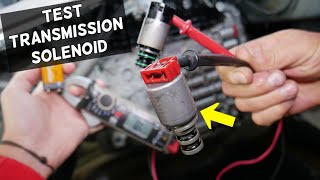
Identify the pins for Shift Solenoid 'A' at the transmission connector using a wiring diagram. Measure resistance with a multimeter. An out-of-spec reading confirms an electrical fault. Correct resistance means the fault is mechanical (stuck valve). General ranges: GM 6L80 On/Off: 20-40 ohms. Ford 10R80: 5.0-5.4 ohms. Honda Linear: 12-25 ohms.
Tools: Digital Multimeter (DVOM), Vehicle-Specific Wiring Diagram (Advanced) - Test Solenoid Circuit Voltage
With the transmission connector disconnected and key on (engine off), check for voltage on the power supply wire to the solenoid. A constant 12V indicates a short-to-power in the harness. Readings outside the expected range point to a wiring or TCM issue.
Tools: Digital Multimeter (DVOM), Vehicle-Specific Wiring Diagram (Advanced) - Drop the Transmission Pan for Visual Inspection
Drain the fluid and remove the pan to access the valve body and solenoids. Inspect the pan magnet. A light metallic paste is normal; large metal chunks or heavy clutch material indicate a severe mechanical failure requiring a full rebuild.
Tools: Socket Set, Drain Pan, Gasket Scraper (Advanced) - Bench-Test or Replace the Solenoid
Remove the solenoid and apply a fused 12V power source and ground to its pins. It should click sharply. However, since P0752 indicates a mechanical sticking issue, a clicking solenoid can still be faulty under hydraulic pressure. If all wiring and fluid checks pass, replace the solenoid.
Tools: Socket Set, Fused Jumper Wires, 12V Power Source (Advanced)
When This Code Triggers (Freeze-Frame Conditions)
- Engine Coolant Temp: 180-210°F (82-99°C) (Vehicle is at full operating temperature.)
- Engine RPM: 1500-2500 RPM (During a commanded upshift or downshift under light to moderate acceleration.)
- Vehicle Speed: 25-55 mph (40-88 km/h) (Steady cruising or during acceleration when a shift is expected.)
- Transmission Fluid Temperature: 160-220°F (71-104°C) (Normal operating range; the fault is detected when fluid is warm and at its intended viscosity.)
Related Codes
- P0751 — The direct opposite code: 'Shift Solenoid 'A' Performance/Stuck Off'. Seeing both codes together strongly suggests an intermittent mechanical problem (debris causing random sticking) rather than an electrical short.
- P0700 — A generic 'Transmission Control System Malfunction' code. It tells the main engine computer the TCM stored a fault. It always accompanies specific codes like P0752 to illuminate the Check Engine Light.
- P0753 — Indicates a purely electrical failure ('Shift Solenoid 'A' Electrical'). P0752 is a functional fault, while P0753 is a circuit fault. A multimeter test easily distinguishes them.
- P0729, P0731, P0732 — These are 'Incorrect Gear Ratio' symptom codes. The stuck-on solenoid (P0752) prevents the correct hydraulic state, causing the ratio error. Fix P0752 first.
Climate & Environmental Factors
- Cold Weather: Extreme cold thickens transmission fluid, increasing hydraulic resistance. This makes a borderline solenoid stick, triggering P0752 on cold starts. The code often clears once the transmission reaches operating temperature.
- High Temperature / Heavy Towing: Sustained high temperatures from towing or hot climates break down transmission fluid and overheat solenoid coils. This increases electrical resistance and causes internal components to expand and bind.
- High Humidity / Water Intrusion: Moisture penetrates weathered connector seals after driving through high water. This causes corrosion on the solenoid pins, leading to a short or erratic voltage the TCM interprets as a stuck valve.
How to Talk to a Mechanic About This Code
Say this: "I have a P0752 Shift Solenoid 'A' Stuck On code and the vehicle is in limp mode. Please start by checking the fluid condition, inspecting the external wiring, and checking for any relevant TSBs before recommending internal repairs."
This directs the technician to perform a logical diagnosis rather than immediately quoting a solenoid replacement. It shows you're an informed customer, reducing the likelihood of being oversold.
Avoid saying:
- 'My transmission is acting weird.' (Too vague, invites expensive guesses)
- 'Just replace the shift solenoid.' (You might pay for a part you don't need)
- 'Do whatever you think is best.' (Gives up all control over the diagnostic process and cost)
Questions to ask before authorizing the repair:
- What were the results of the fluid, wiring, and TSB checks?
- Did you command the solenoid with a bi-directional scan tool? What were the results?
- Is the recommended repair to fix the solenoid, the valve body, or the control module?
- If the repair requires replacing the valve body or TCM, does the new part require programming?
- What is the warranty on the parts and labor for this specific repair?
Where to Take It: Dealer vs Independent vs Chain
- Dealer:
Recommended for warranty work or if a known TSB points to a complex, programming-intensive fix. Otherwise, compare quotes with a specialist.
Best for: Vehicles still under powertrain warranty., Very new models where independent shops lack data., Repairs requiring mandatory manufacturer-specific programming.
Downsides: Highest labor rates, often 50-100% more than an independent shop., Defaults to replacing large, expensive assemblies rather than attempting smaller repairs. (Typical cost: +75% vs. baseline) - Independent Shop:
A gamble. Only use if you are confident they have a technician with strong transmission diagnostic experience.
Best for: Vehicles with a straightforward, confirmed external solenoid failure., Customers with a long-term, trusted relationship with the mechanic.
Downsides: Lacks specialized diagnostic tools (pressure gauges, advanced scanners) for deep transmission work., May not be aware of make-specific pattern failures for this code. (Typical cost: -10% vs. baseline) - Chain Shop:
AVOID for diagnosis and repair of this code. The risk of misdiagnosis is extremely high.
Best for: Simple fluid exchanges (only if they use the correct OEM-spec fluid).
Downsides: Technicians are not equipped or trained for internal transmission diagnosis., High pressure to upsell services; a P0752 code leads to recommendations for unnecessary transmission replacements. (Typical cost: -20% vs. baseline)
When to Walk Away From the Repair
If the estimated repair cost exceeds 50% of the car's private-party value, seriously consider selling or trading it in instead of repairing it.
- Car worth $15000, fix is $1800: Fix it. The repair cost is 12% of the vehicle's value and is a smart investment to keep a good car running.
- Car worth $5000, fix is $2800: Borderline. The repair is over 50% of the car's value. Get a second opinion. If the rest of the car is in excellent shape, it might be worth it. Otherwise, walk away.
- Car worth $3000, fix is $3500: Walk away. The repair cost is more than the car is worth. Do not sink money into this repair.
What Scan Tool You Need for This Code
Minimum: A scanner that reads manufacturer-specific transmission codes and streams live data PIDs, such as Transmission Fluid Temperature (TFT) and commanded gear.
A basic $20 code reader only confirms the P0752 code. It cannot read live data to see *why* the code set, nor can it perform bi-directional tests needed for a real diagnosis.
Budget: BlueDriver Pro / Basic Foxwell or Autel models (~$100) — Reads P0752 and streams live data from the transmission module. Allows you to monitor fluid temperature and see if the commanded gear matches the actual gear.
Rent vs buy: Rent a basic reader only to confirm the code. For P0752, diagnosis is impossible without live data and bi-directional controls. You must buy a mid-range scanner at minimum to DIY.
How to Clear the Code After You Fix It
- Use an OBD-II scan tool to erase trouble codes from the TCM/PCM.
- Perform a transmission adaptive pressure relearn procedure using a bi-directional scanner if a solenoid or valve body was replaced.
- Perform a complete drive cycle to run readiness monitors.
Drive cycle (~20 minutes): 1) Cold start and idle for 3 minutes. 2) Accelerate to 55-65 mph and hold steady for 10 minutes. 3) Perform light accelerations and decelerations to shift through all gears. 4) Stop and idle. 5) Repeat city driving, ensuring multiple shifts.
Readiness monitors affected: Comprehensive Component Monitor (CCM), Transmission
Before emissions retest: drive at least 50 miles to fully set monitors.
Watch out for:
- Disconnecting the battery clears the code but fails to reset adaptive learn values, causing poor shifting.
- The code returns immediately if the mechanical or electrical fault remains unfixed.
- Failing to perform the adaptive relearn procedure on modern transmissions triggers new fault codes.
Will This Fail Emissions / State Inspection?
Yes — this code typically fails an OBD-II emissions inspection.
- California: An active P0752 code constitutes an automatic failure. The Check Engine Light must be off, and all readiness monitors must be 'Ready'.
- New York: The NYS inspection includes an OBD-II scan. Any active powertrain code, including P0752, results in an inspection failure.
- Texas: In the 17 counties requiring emissions testing, an illuminated Check Engine Light and active P0752 code causes an OBD inspection failure.
Most Commonly Affected Vehicles
- Ford F-150, Ranger, Expedition, Mustang, Transit, Explorer (2017-2023) — Extremely common on 10R80 10-speed transmissions. The root cause is frequently a faulty main control valve body or internal CDF clutch drum leak. Ford issued multiple TSBs (e.g., 23-2250) advising valve body overhaul.
- Chevrolet / GM Silverado, Tahoe, Malibu, Equinox (2001-2019) — Common in 4L60E and 6L80 transmissions. On 6-speed models, the TCM and solenoids are part of a single TEHCM assembly inside the pan, making repair expensive.
- Honda Accord, Civic, CR-V, Odyssey (2011-2017) — Often caused by contaminated fluid. Linear solenoids are located on the exterior of the transmission case, making them significantly easier and cheaper to replace.
- Dodge / Ram / Chrysler Ram 1500, Grand Caravan, Charger, 300 (2008-2017) — Frequently caused by a faulty solenoid pack in 6-speed automatic transmissions (65RFE, 68RFE). The entire pack is replaced as a unit.
- Nissan Altima, Maxima, Rogue (2010-2018) — On CVT models, this code points to a failing solenoid within the valve body. CVT repairs are specialized and require replacing the entire valve body assembly.
- Subaru Outback, Forester, Impreza (2010-2017) — Occurs in both traditional automatics and CVTs. The cause is a failing solenoid in the valve body, requiring replacement of the entire assembly.
Manufacturer-Specific Notes
- Ford: On 10R80 transmissions, do not assume the solenoid is the cause. Ford TSBs point to the main control valve body as the primary culprit. The fix involves overhauling or replacing the entire valve body.
- Honda: On many popular models, linear shift solenoids are bolted to the outside of the transmission case. They can be replaced in under an hour without dropping the pan, saving hundreds in labor.
- General Motors (GM): In 6-speed transmissions (6L80), the TCM is integrated with the valve body into a single TEHCM unit. A failed solenoid driver requires replacing and programming this entire expensive assembly.
- Volkswagen / Audi: Use a scanner that reads manufacturer-specific codes. On some VW models, generic scanners misinterpret P0752 as 'Lost Communication With Cruise Control Module', leading to severe misdiagnosis.
Real Owner Stories
2018 Ford F-150 with 10R80 Transmission at 75K miles
Vehicle exhibited harsh shifting, triggered the Check Engine Light with P0752, and got stuck in gear.
Outcome: The technician found sticking valves within the valve body. The entire valve body assembly was replaced with an updated part, and the TCM was reprogrammed. The warranty repair resolved all issues.
Lesson: On modern Ford trucks, P0752 is almost always a valve body issue, not an individual solenoid. Always check for TSBs (like TSB 23-2250) before assuming a simple solenoid swap will work.
2012 Honda Accord at 110K miles
Check Engine Light illuminated, and the transmission shifted erratically, slipping between gears.
Outcome: The owner replaced the external 'A' solenoid (part # 28400-PRP-004) in under an hour. The $100 repair fixed the code and restored smooth shifting.
Lesson: For many Hondas, shift solenoids are external and easy to replace. If fluid is dirty, the solenoid is likely clogged, making replacement a highly cost-effective DIY fix.
2014 Chevy Silverado with 6L80 Transmission at 130K miles
Truck suddenly entered limp mode, stuck in 3rd gear, with P0752 and P0700 codes active.
Outcome: A transmission specialist diagnosed a failing TEHCM (Transmission Electro-Hydraulic Control Module). The integrated TCM had a faulty driver for solenoid 'A'. Replacing and programming the entire TEHCM assembly ($1,500) permanently fixed the issue.
Lesson: Misdiagnosis is common. On GM 6-speed vehicles, the TEHCM circuit board fails, not the solenoid itself. A recurring P0752 after a solenoid replacement points to the TEHCM or valve body.
How to Prevent This Code From Triggering
- Change transmission fluid and filter regularly (Every 30,000-60,000 miles, or per manufacturer spec.) — Clean fluid maintains correct hydraulic pressure and prevents sludge from clogging the narrow passages in the solenoids and valve body.
- Install an auxiliary transmission cooler (One-time installation for towing or hot climates.) — Reduces fluid temperature by 20-50°F, preventing fluid breakdown and protecting solenoid coils from heat damage. Costs $150-$250.
- Practice smooth driving habits (Daily habit) — Avoiding aggressive acceleration and hard braking reduces sudden pressure spikes and mechanical stress on internal solenoids.
- Come to a complete stop before shifting from Drive to Reverse (Every time you shift direction) — Prevents extreme shock load on transmission bands and clutches, reducing the creation of damaging metal debris.
- Use only the manufacturer-specified transmission fluid (Every fluid service) — Incorrect fluid causes chemical incompatibilities that damage seals and lacks the correct frictional properties, leading to solenoid failure.
Frequently Asked Questions
What is the most common misdiagnosis for P0752?
The most common mistake is immediately replacing Shift Solenoid 'A' without a full diagnosis. Technicians often find the true cause is contaminated fluid, a clogged valve body passage, or a wiring issue. On modern Fords, replacing only the solenoid is almost always the wrong fix.
Can a bad battery or low voltage cause a P0752 code?
Yes, indirectly. Low system voltage from a failing battery or alternator causes the Transmission Control Module (TCM) to behave erratically, setting false codes. Always ensure the battery is healthy and the charging system works correctly before starting complex transmission diagnostics.
Will changing the transmission fluid fix a P0752 code?
It might. If the solenoid sticks due to dirty or contaminated fluid, a complete fluid and filter change sometimes frees it up. However, if the solenoid failed electrically or there is a larger mechanical problem, a fluid change will not fix it.
Why is checking for TSBs important for P0752?
Technical Service Bulletins (TSBs) are manufacturer documents detailing known common problems. For P0752, a TSB saves you from costly misdiagnosis by pointing directly to a known issue, such as the Ford 10R80 valve body failure. Always check for TSBs before starting repairs.
What happens if I get P0752 right after a transmission fluid change?
This happens for a few reasons. The new fluid dislodges debris that clogs the solenoid, the wrong fluid type was used, or the fluid level is incorrect. It is also possible the issue was pre-existing and the service just made it apparent.
Does P0752 appear on manual transmission vehicles?
No. P0752 is exclusive to automatic and CVT transmissions. It relates to electro-hydraulic shift solenoids, which manual transmissions do not use.
Can I fix a P0752 code myself?
A DIY fluid and filter change is feasible for an experienced home mechanic. Diagnosing and replacing internal components like solenoids or the valve body is an advanced job requiring specialized tools. Given the risk of causing more damage, stop DIY efforts and consult a transmission specialist if a fluid change fails.
What is the worst-case scenario with a P0752 code?
The worst-case scenario is a catastrophic internal transmission failure, such as a damaged clutch pack or cracked valve body. Ignoring the code and continuing to drive guarantees this outcome. This requires a complete transmission rebuild or replacement costing $4,000 to $8,000.
My scanner shows P0752 and other solenoid codes. What does that mean?
Multiple solenoid codes appearing at once rarely means all solenoids failed simultaneously. It strongly points to a systemic problem like major fluid contamination, a failing valve body, or a faulty TCM. Focus on the main power/ground circuits and overall hydraulic pressure first.
Key Takeaways
- P0752 indicates Shift Solenoid 'A' is mechanically or hydraulically stuck open, forcing the transmission into a 2nd or 3rd gear limp mode.
- Stop driving immediately; continuing to drive with P0752 overheats the transmission fluid and turns a $300 solenoid fix into a $4,000+ complete rebuild.
- Check your transmission fluid first, as dirty or degraded fluid is the #1 cause of a stuck solenoid valve.
- On 2017+ Ford vehicles with the 10R80 transmission, P0752 almost always requires a $1,500+ valve body replacement rather than a simple solenoid swap.
Helpful Videos

The information in this article is provided for general reference and educational purposes only. Vehicle specifications, procedures, and part compatibility can vary by production date, trim level, and region. Always consult your vehicle's factory service manual and verify part numbers before purchasing or performing repairs. Safety-critical components such as airbags, seat belts, and braking systems should be installed by a qualified professional.
- 🎬 Helpful Videos
- What Does P0752 Mean?
- Can I Drive With P0752?
- Common Causes
- Symptoms
- Diagnostic Flowchart
- Common Fixes & Costs
- Used vs. New Parts: Buying Guide
- What Happens If You Wait — Timeline
- Cost of Not Fixing It
- Diagnosis Steps
- When This Code Triggers (Freeze-Frame Conditions)
- Related Codes
- Climate & Environmental Factors
- How to Talk to a Mechanic About This Code
- Where to Take It: Dealer vs Independent vs Chain
- When to Walk Away From the Repair
- What Scan Tool You Need for This Code
- How to Clear the Code After You Fix It
- Will This Fail Emissions / State Inspection?
- Most Commonly Affected Vehicles
- Manufacturer-Specific Notes
- Real Owner Stories
- 2018 Ford F-150 with 10R80 Transmission at 75K miles
- 2012 Honda Accord at 110K miles
- 2014 Chevy Silverado with 6L80 Transmission at 130K miles
- How to Prevent This Code From Triggering
- Frequently Asked Questions
- What is the most common misdiagnosis for P0752?
- Can a bad battery or low voltage cause a P0752 code?
- Will changing the transmission fluid fix a P0752 code?
- Why is checking for TSBs important for P0752?
- What happens if I get P0752 right after a transmission fluid change?
- Does P0752 appear on manual transmission vehicles?
- Can I fix a P0752 code myself?
- What is the worst-case scenario with a P0752 code?
- My scanner shows P0752 and other solenoid codes. What does that mean?
- Key Takeaways
- 🎟️ Get 5% Off