

P0757 on 2018-2025 Ford Expedition: Shift Solenoid 'B' Stuck On Causes and Fixes
On a 2018-2025 Ford Expedition with the 10R80 transmission, P0757 often indicates a serious internal transmission issue, not just a simple solenoid failure. The most likely causes are a faulty main control valve body or a damaged internal component like the CDF drum or one-way clutch, as noted in multiple Ford Technical Service Bulletins. This is not a simple DIY fix and requires professional diagnosis and service, often leading to a valve body replacement or a more extensive transmission overha
- P0757 on a 2018-2025 Expedition is a serious code that indicates a problem with the 10-speed 10R80 transmission.
- Do not drive the vehicle. You risk getting stranded and causing more severe, expensive damage to the transmission.
- The cause is very likely a faulty main control valve body or a major internal mechanical failure like a damaged one-way clutch, as documented by Ford TSBs.
- This is not a simple DIY repair. The vehicle needs to be diagnosed and repaired by a qualified transmission specialist.
- The first diagnostic step a shop will take is to check the fluid and drop the pan to look for debris, which will determine if the fix is a valve body replacement or a full transmission rebuild.
What's Unique About the 2018-2025 Ford EXPEDITION
The 2018-2025 Ford Expedition uses the 10R80 10-speed automatic transmission, which is known for specific issues that can trigger P0757. Unlike a simple solenoid swap on other vehicles, Ford has issued multiple Technical Service Bulletins (TSBs) for this platform that link this code to more complex failures. A widely documented weak point is the CDF clutch drum, where a sleeve can move out of position, causing hydraulic leaks and erratic shifting. Another common failure is the main control valve body, where valves can stick. Owner experiences frequently confirm that the fix is rarely just one solenoid, but rather a more involved transmission repair like a valve body replacement or a partial rebuild to address the CDF drum.
Diagnostic Flowchart
Tap your situation to follow the diagnostic path that matches what you're seeing on this vehicle.
Symptoms You May Notice
- Inability to upshift past second or third gear.
- Harsh or delayed shifts between gears, sometimes feeling like a clunk. 🎬 Watch: A professional diagnostic process for harsh shifting issues.
- Delayed engagement when shifting into Drive or Reverse.
- Illuminated Malfunction Indicator Lamp (Check Engine Light).
- Transmission may enter "limp mode," locking it in a single gear.
- Vehicle feels like it's slipping out of gear or flaring (RPMs rise without acceleration) between shifts.
- Loud thud or bang during acceleration, followed by service warnings.
- Replacing only the 'B' shift solenoid. On the 10R80 transmission, the solenoids are integral to the valve body. The issue is often with the valve body itself, a leaking CDF drum, or another internal mechanical part, so replacing a single component is usually not the correct fix and may not even be possible.
Most Likely Causes
- Faulty Main Control Valve Body 🔴 High Probability Multiple Ford TSBs (like 23-2123 and 22-2428) cite issues with the 10R80 valve body causing a wide range of shift codes, including P0757, due to sticking internal valves. Debris from normal wear can cause valves to bind, leading to hydraulic pressure loss and incorrect solenoid operation.
How to confirm: A technician will drop the transmission pan to inspect for debris. A scan tool can command the solenoid on and off, but a mechanical bind within the valve body may not show up on an electrical test. The diagnostic procedure in TSBs often leads to valve body overhaul or replacement if other causes are ruled out.
Typical fix: Replacement of the entire main control valve body assembly, which includes all the shift solenoids. 🎬 See this walkthrough on replacing the 10R80 valve body. The new unit must be programmed to the vehicle using a dealer-level scan tool.
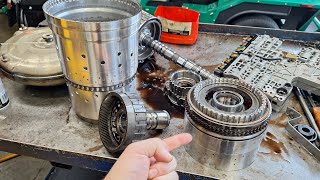
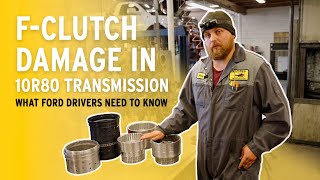
Est. part cost: $800-$1500 - Damaged or Failed CDF Clutch Drum Assembly 🔴 High Probability A well-documented failure point in the 10R80 is the CDF drum. A bushing/sleeve inside the drum can slide out of place, uncovering hydraulic passages and causing severe fluid pressure leaks. This directly leads to erratic shifting, slipping, and can trigger P0757 among other codes.
How to confirm: This is a major internal failure. Diagnosis requires partial transmission teardown to physically inspect the CDF drum. Excessive metal shavings or gray clutch material in the pan is a strong indicator of this type of internal damage.
Typical fix: The transmission must be partially disassembled to replace the CDF clutch drum with an updated part that has a machined lip to prevent the sleeve from moving. 🎬 Watch: See a teardown of the CDF drum bushing failure. This is often part of a larger transmission overhaul.
Est. part cost: $300-$600 for the drum itself, but labor is the primary cost. - Damaged One-Way Clutch (OWC) 🟡 Medium Probability Ford TSB 26-2112 specifically links P0757 with a damaged OWC on these vehicles, especially when the symptom is being stuck in second gear.
How to confirm: This is a major internal failure. Diagnosis requires transmission removal and teardown to physically inspect the clutch. It is often diagnosed in conjunction with a failed CDF drum.
Typical fix: The transmission must be removed from the vehicle, disassembled, and the one-way clutch assembly must be replaced. This is a complete transmission overhaul.
Est. part cost: $200-$400 for the clutch component itself, but labor is the primary cost. - Low or Contaminated Transmission Fluid 🟡 Medium Probability While not unique to this platform, the 10R80 is sensitive to fluid level and condition. Burnt or debris-filled fluid can cause solenoids and valves to stick.
How to confirm: Check the transmission fluid level and condition. The fluid should be at the correct level and reddish in color, not dark brown, black, or smelling burnt. The presence of fine gray or black material indicates clutch or drum wear.
Typical fix: Perform a transmission fluid drain and fill or a complete fluid exchange using the correct Motorcraft MERCON ULV fluid. Replace the transmission filter. However, if significant debris is present, this is a temporary fix at best, as the damage is already done.
Est. part cost: $150-$300 for fluid and a filter.
Rare But Worth Checking
- Wiring Harness or Connector Issue: While less common because the components are internal, damage to the transmission's internal wiring harness can cause a short or open circuit, leading to this code. An intermittent connection at an external ground point can also cause erratic behavior.
- Faulty Powertrain Control Module (PCM) or Transmission Control Module (TCM): This is very rare and should only be considered after all other possibilities, including mechanical and hydraulic failures, have been exhaustively ruled out. Sometimes a software update is required per a TSB.
Diagnosis Steps
- Check and verify the transmission fluid level and condition. Ensure it is clean, at the proper level, and does not smell burnt.
- Use a professional-grade scan tool to check for any other transmission-related trouble codes.
- Review the specific Technical Service Bulletins (TSBs) for this vehicle and code, paying close attention to TSB 26-2112 (OWC failure), TSB 24-2176 (Valve Body/CDF Drum), and TSB 22-2428 (Valve Body/CDF Drum).
- Drop the transmission pan to inspect for excessive metal debris or clutch material. The presence of significant debris points to a serious internal mechanical failure like the CDF drum or OWC.
- Inspect the main control valve body for any visible signs of damage or sticking valves. Follow TSB procedures for valve body inspection and cleaning.
- If heavy debris is found or symptoms align with TSB 26-2112 (stuck in 2nd gear), the transmission will likely need to be removed and disassembled to inspect for internal damage to the one-way clutch and/or CDF drum.
- If no significant debris is found and the fluid is clean, the issue is most likely the main control valve body, which should be replaced as an assembly per TSB guidelines.
Parts You'll Likely Need
- Transmission Main Control Valve Body Assembly
(OEM #JL3Z-7A100-B (verify by VIN, part number may be superseded by JL3Z-7A100-D or others))— This is the most common fix for electronic and hydraulic shift faults in the 10R80 transmission, as documented in multiple TSBs.
Trusted brands: Motorcraft
OEM price range: $900-$1500
Aftermarket price range: $600-$1200 - CDF Clutch Drum Assembly — A common point of failure causing hydraulic leaks and numerous shift codes. Replacement with an updated drum is required if the internal sleeve has shifted.
Trusted brands: Motorcraft
OEM price range: $300-$600 - One-Way Clutch (OWC) — Specifically cited in TSB 26-2112 as a cause for P0757 when the vehicle will not shift past second gear.
Trusted brands: Motorcraft
OEM price range: $200-$400
Related Codes That Often Appear With This One
- P2701 — This code for 'Transmission Friction Element B Apply Time Range/Performance' is specifically mentioned alongside P0757 in TSB 26-2112, pointing towards a mechanical clutch issue.
- P0751, P0756, P0761, P0766, etc. — These are codes for other shift solenoids. When multiple solenoid codes appear together, it strongly suggests a systemic problem like a faulty valve body, low fluid, or a clogged filter, rather than multiple individual solenoid failures.
- P0733 — This code for 'Gear 3 Incorrect Ratio' can appear alongside valve body or CDF drum issues, as noted by owners who have had TSB-related repairs.
Technical Service Bulletins (TSBs) & Recalls
- TSB 26-2112: Notes that P0757 with an inability to shift past second gear may be due to a damaged one-way clutch (OWC), requiring a transmission overhaul.
- TSB 24-2176: Addresses harsh/delayed shifts and numerous DTCs (including P0757) by pointing to software issues, sticking valves in the main control body, or axial movement of the CDF clutch cylinder sleeve.
- TSB 23-2250: Similar to 24-2176, this TSB provides a diagnostic procedure for harsh shifts and DTCs, leading to either a PCM reprogram, valve body overhaul, or CDF drum inspection/replacement.
- TSB 24-2254, 26-2046, 25-2023, 22-2428: Earlier or related versions of TSBs that also group P0757 with other shift codes and point towards valve body or internal transmission issues.
Platform-Specific Known Issues
- Ford has issued multiple TSBs regarding the 10R80 transmission's performance, including harsh/delayed shifts and engagement issues linked to a wide array of DTCs, including P0757. The common prescribed fix is often related to overhauling or replacing the main control valve body.
- TSB 26-2112 provides a direct link between DTC P0757 (and P2701), symptoms of being unable to shift past second gear, and a physically damaged one-way clutch (OWC) inside the transmission.
- TSBs like 24-2176 and 23-2250 point to either sticking valves in the main control body or axial movement of the CDF clutch cylinder sleeve as the primary causes for a host of shifting problems and DTCs.
Mechanic-Grade Diagnostic Values
- Shift Solenoid (A-F) Resistance — expected: 5.0 - 5.4 Ohms at 68°F (20°C). Failure: A reading outside of this range indicates a faulty solenoid coil.
- Line Pressure Control (LPC) Solenoid Current — expected: Inversely proportional operation. Low/no current (50 mA) results in full line pressure. High current (850 mA) results in very low pressure.. Failure: This is diagnostic logic; a technician commands current with a scan tool and watches for the corresponding pressure change.
- Torque Converter Clutch (TCC) Solenoid Current — expected: Directly proportional operation. Low/no current (50 mA) results in very low pressure. High current (850 mA) results in high pressure.. Failure: This is diagnostic logic; a technician commands current with a scan tool and watches for the corresponding pressure change.
Scan Tool Commands That Help
- Ford IDS, FORScan, or equivalent professional scan tool: Clear Transmission Adaptive Tables / Reset KAM — This must be performed after any transmission repair, including valve body replacement or fluid changes, to erase the old learned shift parameters. Failing to do this can result in continued poor shift quality.
- Ford IDS (or equivalent with programming capability): Program Solenoid Strategy / Characterization Data — This is mandatory when replacing the main control valve body. The new valve body comes with a unique identification number/strategy that must be programmed into the TCM for proper solenoid operation.
- N/A - This is a physical driving procedure: Adaptive Learning Drive Cycle — This must be performed immediately after clearing the adaptive tables to allow the TCM to relearn the transmission's characteristics and ensure smooth shifting. The procedure involves a specific sequence of light acceleration, braking, and shifting between Drive, Neutral, and Reverse.
Wiring & Ground Locations
- Main Engine/PCM Ground Strap — On F-150s with the same powertrain, a key ground strap is located to the right of the PCM and connects to the back of the passenger side cylinder head.. A common issue is the ground screw being tight without properly securing the electrical lug, leading to an intermittent ground. This can cause a host of unpredictable electronic issues, including erratic transmission behavior.
- Transmission Internal Wiring Harness Connector Tool — Used at the transmission case to disconnect the main internal harness.. A special tool (Ford SST 307-746) is required to properly disconnect the internal harness connector from the case without causing damage during valve body service.
- Transmission Case Connector Pin B1 — Pin B1 on the internal transmission harness connector.. This pin, with a Brown-White wire, is the ground control for Shift Solenoid D according to a partial pinout. While not Solenoid B, it demonstrates the type of specific wiring information available for targeted electrical diagnosis.
Real Owner Repair Stories
- YouTube channel 'EJ's GUITARS & MUSIC' (2018 Ford F-150 4WD with 10R80 Transmission) — A violent, hard shift between 1st and 3rd gear on light acceleration. Intermittently would go into second and then neutral.
❌ Tried (didn't work) Initial diagnosis was inconclusive between the valve body or a more severe internal failure.
✅ What actually fixed it The owner opted to take a chance on replacing the main control valve body assembly rather than the entire transmission. The video documents the replacement process, which resolved the issue. - Reddit user in r/f150 (Ford F-150 with 10R80 transmission) — Clunking and poor shifting.
❌ Tried (didn't work) A full transmission replacement.
✅ What actually fixed it The user reported being on their second transmission, which then required a new valve body after only 7,000 miles. This highlights that the valve body can be a failure point even in replacement transmission units.
OEM Part Supersession History
JL3Z-7A100-B→JL3Z-7A100-D— Ford often updates parts to improve reliability. Given the number of TSBs related to sticking valves in the 10R80 valve body, it is likely the new part has design or manufacturing improvements.
Heads up: The new part number should be a direct replacement, but it is critical to program the new valve body's solenoid strategy to the vehicle's TCM.
Model Year Variations Within This Range
- 2018 models built on or before 20-Nov-2017: TSB 20-2117, which addresses a sticking TCC valve in the main control valve body, lists different part numbers for early 2018 models versus later builds (e.g., JL3Z-7A100-C for column shift vs. JL1Z-7A100-A for electronic shift). This indicates part variations in the first model year of this generation.
Helpful Videos

We Have This Part in Stock



The information in this article is provided for general reference and educational purposes only. Vehicle specifications, procedures, and part compatibility can vary by production date, trim level, and region. Always consult your vehicle's factory service manual and verify part numbers before purchasing or performing repairs. Safety-critical components such as airbags, seat belts, and braking systems should be installed by a qualified professional.
- Ford EXPEDITION:
- 🎬 Helpful Videos
- 🛍️ Shop This Part
- What's Unique About the 2018-2025 Ford EXPEDITION
- Diagnostic Flowchart
- Symptoms You May Notice
- Most Likely Causes
- Rare But Worth Checking
- Diagnosis Steps
- Parts You'll Likely Need
- Related Codes That Often Appear With This One
- Technical Service Bulletins (TSBs) & Recalls
- Platform-Specific Known Issues
- Mechanic-Grade Diagnostic Values
- Scan Tool Commands That Help
- Wiring & Ground Locations
- Real Owner Repair Stories
- OEM Part Supersession History
- Model Year Variations Within This Range
- 🎟️ Get 5% Off