

P0751 on 2018-2023 Ford Expedition: Shift Solenoid 'A' Causes and Fixes
On a 2018-2023 Ford Expedition, code P0751 is almost always a symptom of a deeper issue within the 10R80 transmission, not just a bad solenoid. The most common cause is an internal mechanical failure related to the CDF clutch drum, where a bushing walks out of place, causing a loss of hydraulic pressure and harsh shifts. This is a complex, expensive repair requiring transmission removal and teardown, and is well-documented in Ford Technical Service Bulletins.
- P0751 on a 2018-2023 Expedition is a serious code that points to a probable internal mechanical failure, not just a simple sensor.
- The most likely cause is a known defect with the 10R80 transmission's CDF clutch drum, which requires a partial transmission rebuild to fix.
- Do not accept a simple solenoid replacement or software flash as a final fix if harsh shifting persists; this indicates the mechanical issue has not been addressed.
- Reference Ford TSBs 24-2176 and 22-2428 when discussing the issue with a service advisor or mechanic.
- This is not a DIY repair. It requires specialized tools, expertise, and is very labor-intensive.
What's Unique About the 2018-2023 Ford EXPEDITION
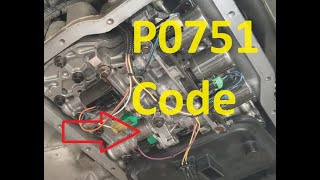
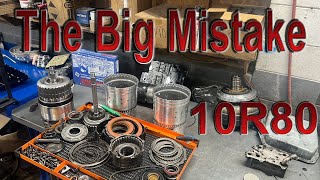
The 2018-2023 Expedition uses the Ford-GM co-designed 10R80 10-speed automatic transmission, which is known for a specific pattern of failure. Multiple Ford Technical Service Bulletins (TSBs) like TSB 22-2428 and 23-2250 confirm that symptoms like harsh shifting and codes like P0751 🎬 Watch: Why your Ford slams into gear and how to fix it. are often due to a design flaw in the CDF clutch drum. An internal bushing/sleeve can 'walk' or move axially, blocking critical fluid passages. This means simply replacing the 'A' solenoid or the valve body often fails to fix the problem, as the root cause is a mechanical failure requiring a partial transmission rebuild with an updated CDF drum.
Diagnostic Flowchart
Tap your situation to follow the diagnostic path that matches what you're seeing on this vehicle.
Symptoms You May Notice
- Harsh, abrupt, or "slamming" gear shifts, especially into 3rd, 4th, or 5th gear.
- Delayed engagement when shifting from Park to Drive or Reverse, often with a loud clunk.
- Hesitation or RPM flare (engine revs up by ~500 RPM) between shifts, followed by a harsh engagement.
- Transmission gets stuck in one gear (e.g., 4th or 7th) or enters limp mode.
- Illuminated Check Engine Light or flashing Tow/Haul light.
- Loud "clunking" or grinding noises during shifts.
- Feeling of being "rear-ended" when the transmission finally engages a gear.
- Vehicle struggles to accelerate or lugs at low speeds, refusing to downshift without significant throttle input.
- Transmission running hot, with temperatures exceeding 220-240°F in normal driving.
- Replacing only the Shift Solenoid 'A' or the entire valve body. This fails to address the underlying pressure loss from the CDF drum, and the harsh shifting will return.
- Performing only a PCM/TCM software update or adaptive learning reset. This may temporarily mask the symptoms by adjusting shift pressures, but it will not fix the underlying mechanical failure and the problem will worsen.
- A simple transmission fluid flush. While dirty fluid can cause issues, it's a symptom, not the root cause of the P0751 code in this context.
Most Likely Causes
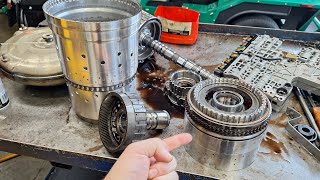
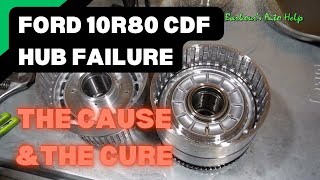
- CDF Clutch Cylinder Sleeve Failure 🔴 High Probability This is a well-documented pattern failure in early Ford 10R80 transmissions. Due to a design flaw, the press-fit bushing inside the CDF drum can move or 'walk' under heat and pressure cycles, partially blocking hydraulic passages for C, D, and F clutches. This causes a pressure loss that triggers the solenoid performance codes.
How to confirm: This requires a transmission teardown to physically inspect the CDF drum. A technician can see the bushing has moved and exposed oil passages that should be covered. Pressure tests may point to an internal leak, but visual confirmation is definitive. Excessive metal shavings in the pan are another strong indicator.
Typical fix: The transmission must be removed and partially disassembled to replace the CDF clutch drum with an updated part (Ford part JL3Z-7H351-B). This revised part has a machined lip or wall that physically prevents the bushing from walking out.
Est. part cost: $150-$300 for the drum itself, but this repair is labor-intensive. - Sticking Valves in the Main Control Valve Body 🟡 Medium Probability Debris from the failing CDF drum or normal wear can contaminate the valve body, causing valves to stick and leading to erratic pressure control. Ford TSBs acknowledge this as a potential cause and often recommend valve body replacement in conjunction with the CDF drum.
How to confirm: After removing the valve body, a technician can inspect the valves for free movement. Often, this is diagnosed by replacing the valve body after a CDF drum replacement fails to resolve all symptoms, or as a preventative measure during the main repair.
Typical fix: Replacement of the main control valve body assembly (e.g., Ford part JL3Z-7A100-C or JL3Z-7A100-B). Some shops may attempt to clean it, but replacement with a new or remanufactured unit is more common and reliable.
Est. part cost: $700-$1500 for a new OEM valve body. - Low or Contaminated Transmission Fluid ⚪ Low Probability While this can cause issues on any automatic transmission, it's rarely the root cause on the 10R80 given the known mechanical issues. However, fluid contaminated with clutch material or metal from the failing drum will accelerate valve body wear and other problems. A transmission tech on Reddit noted that even in failed units, the fluid condition is often surprisingly good.
How to confirm: Check the transmission fluid level and condition. These transmissions do not have a traditional dipstick, so it must be checked at a shop via a standpipe in the transmission pan at a specific temperature.
Typical fix: A fluid and filter change is part of the larger repair but will not fix the underlying mechanical issue on its own. Use only the specified Motorcraft MERCON ULV fluid.
Est. part cost: $150-$300 for fluid and filter service.
Rare But Worth Checking
- Failed Shift Solenoid 'A': While the code directly names the solenoid, it's rarely the true root cause on this platform. It fails because of pressure loss or contamination from other failing parts. Replacing only the solenoid is a common misdiagnosis that results in the problem returning quickly.
- Faulty Powertrain/Transmission Control Module (PCM/TCM) or Software: Corrupted software can cause shifting issues. Ford has issued multiple software updates (as outlined in TSBs) to improve shift strategy and adaptive learning. This is usually the first, and least invasive, step a dealer will try, but it cannot fix the mechanical CDF drum flaw.
Diagnosis Steps
- Verify the concern: Road test the vehicle to confirm the harsh shifts, delayed engagement, or other symptoms, noting which gears are problematic.
- Scan for codes: Use a professional scan tool to retrieve all DTCs from the TCM/PCM. Note all codes present, as a cluster of codes (P0751, P0756, P2700, etc.) is a strong pointer to the pattern failure.
- Check for TSBs: Check for any open Technical Service Bulletins related to the transmission for this specific VIN. TSBs 24-2176, 23-2250, and 22-2428 are highly relevant and outline the entire diagnostic tree.
- Check fluid level and condition: This must be done by a qualified technician as there is no dipstick. The level is checked via a standpipe in the transmission pan at a specific temperature. Look for excessive metal 'glitter' or debris.
- Update Software: If not already done, update the PCM/TCM to the latest calibration as recommended by Ford. This is a required first step but will not fix a mechanical issue.
- Perform Hydraulic Pressure/Vacuum Tests: As outlined in the TSBs, a technician can perform specific tests to check for internal hydraulic leaks in the CDF clutch circuits, which would point towards the CDF drum or valve body issue.
- Transmission Teardown: If tests indicate an internal leak, the final step is to remove and disassemble the transmission for inspection of the main control valve body and, most importantly, the CDF clutch cylinder for a migrated bushing.
Parts You'll Likely Need
- CDF Clutch Cylinder / Drum Assembly
(OEM #JL3Z-7H351-B)— This is the most common point of failure. The original design allows a sleeve to move, causing hydraulic leaks. The updated part number (JL3Z-7H351-B) has a machined retaining lip to prevent this movement and is the definitive fix.
Trusted brands: Motorcraft (OEM)
Related Codes That Often Appear With This One
- P0756 — Points to Shift Solenoid 'B' performance. Both codes often appear together as the underlying hydraulic issue from the CDF drum affects multiple clutch circuits.
- P0761 — Points to Shift Solenoid 'C' performance, for the same reason as P0756.
- P2700, P2701, P2702, P2703, P2704, P2705 — These are friction element or clutch apply time/range performance codes. They indicate the TCM is seeing a delay or error in clutch engagement, which is a direct result of the hydraulic leak caused by the slipped CDF drum sleeve.
- P0729, P0731-P0736 — These are gear ratio error codes. They get triggered when the TCM commands a shift and does not see the expected change in gear ratio, a direct result of the pressure loss from the failing CDF drum.
Technical Service Bulletins (TSBs) & Recalls
- TSB 24-2176: Mentions P0751 with harsh/delayed shifts due to software, valve body, or CDF clutch cylinder sleeve issues.
- TSB 22-2428: Superseded by newer bulletins but identifies the same root causes: software, valve body, and CDF clutch cylinder sleeve movement.
- TSB 23-2152: Predecessor to 24-2176, also linking P0751 to harsh shifts.
- TSB 25-2023: Predecessor to 24-2176, also linking P0751 to harsh shifts.
- TSB 26-2046: Predecessor to 24-2176, also linking P0751 to harsh shifts.
Platform-Specific Known Issues
- A series of Ford Technical Service Bulletins (TSBs), including TSB 24-2176, TSB 23-2250, and TSB 22-2428, explicitly address the harsh shifting, delayed engagement, and the cluster of DTCs including P0751 on 2018-2023 Expeditions.
- The root cause is identified in these TSBs as axial movement of the CDF clutch cylinder sleeve, which blocks hydraulic passages and causes pressure loss. The TSBs provide a step-by-step diagnostic procedure for technicians.
- Vehicles built after August 15, 2022 are noted in TSBs as being less likely to require CDF drum replacement, implying they were built with the updated part from the factory.
Mechanic-Grade Diagnostic Values
- Shift Solenoid 'A' through 'F' Resistance — expected: The six shift solenoids (A-F) are mechanical and do not have a standard resistance test value through the connector like older solenoids. They are tested via bidirectional scan tool commands.. Failure: Failure is determined by hydraulic pressure tests and performance, not electrical resistance.
- Line Pressure Control (LPC) Solenoid Current — expected: Inversely proportional; provides full pressure with low current (~50 mA) and low pressure with high current (~850 mA).. Failure: Current readings outside of this range or that don't correspond to commanded pressure indicate a fault.
- Torque Converter Clutch (TCC) Solenoid Current — expected: Directly proportional; provides low pressure with low current (~50 mA) and high pressure with high current (~850 mA).. Failure: Current readings that do not match the commanded state suggest a solenoid or wiring issue.
- Transmission Fluid Temperature (TFT) — expected: Typically 175-225°F during normal operation.. Failure: Consistently running above 210°F in normal driving suggests internal slipping or a failing torque converter.
Scan Tool Commands That Help
- Ford IDS (Integrated Diagnostic Software): Transmission Characterization/Solenoid IDN — This function is mandatory after replacing the main control valve body. It requires entering the 13-digit solenoid body strategy number and 12-digit solenoid body identification number from the new part into the PCM/TCM. Failure to perform this programming will result in severe shifting problems.
- Ford IDS (Integrated Diagnostic Software): Adaptive Learning Drive Cycle — After any major transmission repair, including CDF drum or valve body replacement, the adaptive learning tables must be reset and a specific drive cycle must be performed. This allows the TCM to relearn clutch fill times and pressures. Skipping this can lead to persistent harsh shifts.
- Ford IDS or equivalent professional scan tool: Live Data PID Monitoring (SSA_AMP, SSB_AMP, etc.) — During a road test, a technician can monitor the commanded amperage for each shift solenoid (SSA for Solenoid A, etc.) to verify the TCM is commanding the solenoid to activate. This helps differentiate between a command issue and a mechanical/hydraulic issue.
Wiring & Ground Locations
- Transmission Case Connector — The main electrical connector on the side of the 10R80 transmission case. It is a lever-lock style connector.. This is the primary connection point for all solenoids and sensors within the transmission. A loose connection, corrosion on pins, or damage to the harness here can cause P0751 and other transmission codes.
- PCM/TCM Grounds — On the firewall of the engine compartment. There are typically one or two ground studs where the PCM and other modules are grounded.. A poor ground for the Powertrain Control Module (PCM) or Transmission Control Module (TCM) can cause erratic voltage signals and incorrect operation of the transmission solenoids, potentially triggering performance codes like P0751.
- Main Battery/Body Ground — The main battery ground is typically located on the frame rail in the engine bay, just in front of the washer fluid reservoir. There is also a critical body-to-frame ground strap near the passenger door post.. A corroded or loose main ground can affect the entire vehicle's electrical system, including the sensitive electronics that control the transmission, leading to a variety of difficult-to-diagnose issues.
Real Owner Repair Stories
- Ford Expedition Forum (2019 Expedition Max Platinum, 59k miles) — Rough shifting between 4th & 5th and sometimes 5th & 6th.
❌ Tried (didn't work) The initial CDF drum replacement did not immediately resolve all shifting issues.
✅ What actually fixed it The dealership advised that the transmission's adaptive learning requires up to 500 miles to fully calibrate to the new components. The user was advised to drive the vehicle and allow time for the system to relearn shift pressures. Another user in the same thread confirmed that after their repair, shifts were initially clunky but improved over a couple of tanks of fuel as the adaptive learning process completed. - Ford Expedition Forum (2018 Expedition, 70k miles) — Initial CDF drum failure. After rebuild, vehicle would not shift to 5th when cold and would slam into 6th gear.
❌ Tried (didn't work) First rebuild at 70k miles where the dealer replaced the CDF drum with another original-spec drum (before the updated part was widely available), plus the torque converter, valve body, and main oil pump.
✅ What actually fixed it The user's experience highlights a critical point: replacing the failed CDF drum with another part of the same flawed design can lead to repeat failures. The ultimate fix requires the updated CDF drum (JL3Z-7H351-B). This user was facing a second rebuild due to the initial repair using a non-updated part.
OEM Part Supersession History
HL3Z-7H351-A, JL3Z-7H351-A→JL3Z-7H351-B— The original CDF clutch drum designs were prone to an internal sleeve 'walking' out of position, causing a hydraulic pressure leak. The 'B' revision adds a machined lip that physically prevents the sleeve from moving, providing a permanent mechanical fix to the problem.HL3Z-7A100-A→HL3Z-7A100-B— Revisions to the main control valve body assembly often address improvements in valve materials, solenoid design, or software compatibility.
Heads up: When replacing a valve body, it is critical to use the Ford IDS scan tool to program the new 13-digit solenoid body strategy and 12-digit identification number into the TCM. A new valve body will not function correctly without this programming step.
Model Year Variations Within This Range
- 2018-2022: Vehicles built on or before August 15, 2022, are more likely to have the original, failure-prone CDF clutch drum design. Vehicles built after this date are more likely to have the updated JL3Z-7H351-B drum from the factory, significantly reducing the probability of this specific failure mode.
Helpful Videos


We Have This Part in Stock



The information in this article is provided for general reference and educational purposes only. Vehicle specifications, procedures, and part compatibility can vary by production date, trim level, and region. Always consult your vehicle's factory service manual and verify part numbers before purchasing or performing repairs. Safety-critical components such as airbags, seat belts, and braking systems should be installed by a qualified professional.
- Ford EXPEDITION:
- 🎬 Helpful Videos
- 🛍️ Shop This Part
- What's Unique About the 2018-2023 Ford EXPEDITION
- Diagnostic Flowchart
- Symptoms You May Notice
- Most Likely Causes
- Rare But Worth Checking
- Diagnosis Steps
- Parts You'll Likely Need
- Related Codes That Often Appear With This One
- Technical Service Bulletins (TSBs) & Recalls
- Platform-Specific Known Issues
- Mechanic-Grade Diagnostic Values
- Scan Tool Commands That Help
- Wiring & Ground Locations
- Real Owner Repair Stories
- OEM Part Supersession History
- Model Year Variations Within This Range
- 🎟️ Get 5% Off