

P0740 on 2008-2017 Volvo XC60: Torque Converter Clutch Circuit Malfunction Explained
P0740 on a 2008-2017 Volvo XC60 almost always indicates a problem inside the automatic transmission, most commonly a failing Torque Converter Clutch (TCC) solenoid or a worn valve body. This is a complex repair, and professional service is highly recommended.
- P0740 on a 2008-2017 XC60 points to an internal transmission problem, not a simple sensor fix.
- The most common cause is a failed Torque Converter Clutch (TCC) solenoid located on the valve body.
- A worn valve body is a very common secondary cause if a new solenoid doesn't fix the issue.
- Always start diagnosis by checking the transmission fluid level and condition. Use only the manufacturer-specified fluid (JWS 3309 or equivalent).
- This is not a beginner-friendly DIY repair. Accessing the solenoid and valve body is complex and requires precision.
- Ignoring this code can lead to transmission overheating and catastrophic failure.
What's Unique About the 2008-2017 Volvo XC60
The first-generation Volvo XC60 often uses an Aisin-Warner automatic transmission (such as the TF-80SC/TF-81SC). These transmissions are known for issues related to the valve body and the solenoids that control hydraulic pressure. Over time, transmission fluid breakdown can lead to wear within the valve body bores or cause solenoids to fail, making a P0740 code more likely to be an internal transmission component failure rather than a simple external wiring problem. The wear in the valve body channels causes hydraulic pressure to leak, preventing the solenoids from properly actuating the lock-up clutch.
Symptoms You May Notice
- Check Engine Light is on
- Vehicle may enter 'limp mode,' getting stuck in a single gear
- Shuddering or vibration at highway speeds, similar to driving over rumble strips 🎬 Watch: Real-world example of this highway shudder
- Engine RPMs are higher than usual at cruising speeds
- Decrease in fuel economy
- Harsh or delayed gear shifts
- Transmission overheating or a burning smell
- Stalling when coming to a stop
- Replacing the entire transmission when only a solenoid or valve body is needed.
- Assuming it's an engine misfire when the sensation is actually a transmission shudder.
- Replacing only the TCC solenoid when the valve body itself is worn, leading to a recurring P0740 code.
Most Likely Causes
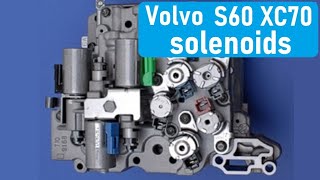
- Faulty Torque Converter Clutch (TCC) Solenoid 🔴 High Probability The Aisin transmissions used in this XC60 generation are known for solenoid failures as they age, often due to contamination from old fluid. The TCC solenoid (often referred to as the SLU solenoid in Aisin terminology) is a frequent point of failure.
How to confirm: A mechanic can use a professional scan tool to command the TCC solenoid on and off while monitoring transmission data for TCC slip. The solenoid's electrical resistance can also be tested with a multimeter and compared to the manufacturer's specification (e.g., around 5.6 Ohms).
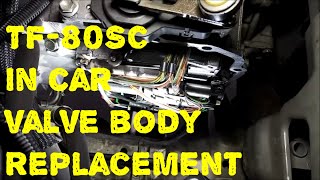
Typical fix: Replace the TCC solenoid. This requires removing the transmission oil pan and valve body to access the solenoid. 🎬 Watch: How to replace the valve body in-car A common Volvo part number for this solenoid is 30681205.
Est. part cost: $60-$250 - Worn Transmission Valve Body 🟡 Medium Probability The hydraulic passages and bores within the Aisin valve body can wear over time from contaminated fluid, causing pressure losses that prevent the TCC from engaging properly. This is a well-documented issue with the TF-80SC transmission family.
How to confirm: This is typically diagnosed after a TCC solenoid replacement does not fix the issue. A technician may perform hydraulic pressure tests on the transmission or use a specialized tool to check for vacuum leaks in the valve body channels.
Typical fix: Replace or rebuild the transmission valve body. Rebuild kits with oversized valves and reamers are available from brands like Sonnax to correct wear in the bores.
Est. part cost: $400-$1200 - Low or Dirty Transmission Fluid 🟡 Medium Probability
How to confirm: Check the transmission fluid level and condition via the dipstick (if equipped) or service plug. The fluid should be at the correct level, pink/red in color, and not have a burnt smell. Dark or burnt fluid indicates internal wear and contamination.
Typical fix: Perform a transmission fluid drain and fill or a complete fluid flush using the correct specification fluid (e.g., JWS 3309 or equivalent). A simple drain and fill may not be sufficient if the fluid is heavily contaminated. 🎬 See this step-by-step TF80 fluid service walkthrough
Est. part cost: $80-$200 for fluid
Rare But Worth Checking
- Internal Torque Converter Failure: The internal clutch mechanism of the torque converter itself can wear out, shedding material that contaminates the fluid and prevents lock-up. This is a major repair that often necessitates transmission removal. In some cases, a bad torque converter is the root cause even when the code points to the solenoid circuit.
- Wiring Harness Damage: While less common than internal failures on this platform, wiring leading to the transmission could be damaged, causing an open or short in the TCC solenoid circuit. Corrosion or loose pins at the main transmission connector can also trigger this code.
- Faulty Transmission Control Module (TCM): In very rare cases, the TCM itself can fail or have a software glitch, preventing it from correctly controlling the TCC solenoid. Sometimes a software update from the dealer can resolve unexpected transmission behavior.
Diagnosis Steps
- Verify the code with a quality OBD-II scanner that can also read Volvo-specific codes (e.g., TCM-002F).
- Check the transmission fluid level and condition. If the fluid is low, dark, or smells burnt, address this first as it indicates internal wear.
- Use an advanced scan tool to monitor live data from the TCM, specifically the torque converter slip speed, TCC solenoid command state, and line pressure.
- Inspect the transmission wiring harness and connectors for any visible damage, corrosion, or loose connections.
- Perform an electrical test of the TCC solenoid circuit. Using a multimeter, check the solenoid's resistance through the transmission connector to see if it's within spec (e.g., ~5.6 ohms). Also check for proper voltage and ground at the connector.
- If electrical checks are good, the next step is to access the transmission's internal components. This usually involves removing the transmission pan.
- Inspect and test the TCC solenoid directly.
- If the solenoid is functional, the issue likely lies with the valve body (worn bores, stuck valves) or the torque converter itself, requiring more in-depth professional diagnosis.
Parts You'll Likely Need
- Torque Converter Clutch (TCC) Solenoid
(OEM #30681205)— This solenoid is the most frequent failure point for a P0740 code on this vehicle, as it directly controls the lock-up function.
Trusted brands: Genuine Volvo, Rostra, Aisin
OEM price range: $150-$250
Aftermarket price range: $60-$120 - Automatic Transmission Valve Body
(OEM #31259596)— If the TCC solenoid replacement doesn't resolve the issue, a worn valve body is the next most likely cause due to known issues with these Aisin transmissions.
Trusted brands: Genuine Volvo, Sonnax (rebuild kits), RevMax
OEM price range: $800-$1900
Aftermarket price range: $400-$900 - Automatic Transmission Fluid (JWS 3309 Spec)
(OEM #1161640)— Correct and clean fluid is essential for transmission health. Any internal repair will require draining and refilling the fluid. Using the wrong fluid type is a common cause of issues in these transmissions.
Trusted brands: Genuine Volvo, Mobil 3309, Idemitsu TLS, Aisin T-IV
OEM price range: $20-$25 per quart
Aftermarket price range: $8-$15 per quart
Related Codes That Often Appear With This One
- P0700 — This is a generic code indicating that the Transmission Control Module (TCM) has stored a fault. It acts as a 'check engine light' for the transmission system and will almost always appear with a specific code like P0740.
- P0733 — This code for 'Gear 3 Incorrect Ratio' is sometimes seen with P0740, indicating more widespread internal transmission problems, often related to severe valve body wear or clutch pack failure.
Platform-Specific Known Issues
- Owner Experience with TCM-002F: An owner of a 2003 Volvo XC70 with the related Aisin transmission experienced the 'Transmission Service Required' message and limp mode. The dealer diagnosed the Volvo-specific code TCM-002F and immediately recommended a new transmission. The owner noted the issue occurred in heavy rain, suggesting a potential electrical connection issue as a possibility before committing to a full replacement.
- Valve Body Replacement as the Ultimate Fix: On a VolvoXC.com forum, an owner with a D5 XC90 experiencing the TCM-002f code and limp mode ultimately had to replace the valve body to resolve the issue after a simple fluid change did not work. This highlights that for many, the valve body is the true root cause.
Mechanic-Grade Diagnostic Values
- TCC (SLU) Solenoid Resistance — expected: 5.6 Ohms. Failure: A reading significantly higher or lower than 5.6 Ohms, or an open circuit (infinite resistance) between the pins. There should also be an open circuit from either pin to the solenoid body.
Hidden / Shadow Codes Worth Checking
- TCM-002F: Lock-up function Slipping or not engaged. This is the manufacturer-specific code that directly corresponds to the generic P0740 and provides a more precise definition of the fault detected by the TCM. (see via Volvo's VIDA diagnostic software or a compatible high-end professional scanner that can read manufacturer-specific codes.)
Scan Tool Commands That Help
- Volvo VIDA (Vehicle Information & Diagnostics for Aftersales): Control Module Adaptation / Resetting Adaptation — This function is critical after replacing the TCC solenoid or the entire valve body. The TCM stores learned values to compensate for wear in the old parts. Resetting the adaptation clears these values and forces the TCM to relearn the shift characteristics with the new components, preventing harsh shifts or persistent codes.
- Volvo VIDA (Vehicle Information & Diagnostics for Aftersales): Transmission Adaptation Drive Cycle — After resetting the adaptation values, a specific, guided test drive must be performed. VIDA puts the transmission into a special learning mode, and the technician must perform a series of gentle accelerations and decelerations at specific RPMs to allow the TCM to properly learn the engagement points of the new components. The instrument cluster's general warning lamp will flash to indicate when a specific adaptation has been successfully learned.
Real Owner Repair Stories
- volvoXC.com forum user (2004 Volvo XC90 D5) — 'Transmission Service Required' message, limp mode, and fault code TCM-002f, especially when decelerating from speeds over 50 mph.
❌ Tried (didn't work) A partial transmission fluid drain and fill.
✅ What actually fixed it A TCM software upgrade performed by a Volvo dealer. A technical note existed for this code on 2003 models, and applying it to the 2004 vehicle resolved the problem completely. - volvoXC.com forum user (2003 Volvo XC70, 193k miles) — 'Service Transmission' message, limp mode (stuck in 3rd gear), and code TCM-002F. The issue only occurred on the freeway at speeds above 50 mph, specifically after shifting into 5th gear.
❌ Tried (didn't work) Clearing codes (they would return under the specific conditions).
✅ What actually fixed it The user found they could prevent the code and limp mode by using the manual shift mode and keeping the transmission in 4th gear on the freeway. While not a 'fix,' this diagnostic step strongly isolated the problem to the 5th gear circuit or the torque converter lock-up function which is most active in the highest gear. - Volvo Forums user (2007 Volvo S60 2.5T, 130k miles) — Code TCM-002F. Transmission ran perfectly when cold, but once warmed up, it experienced shift flares, banging into gear, and shuddering on acceleration.
❌ Tried (didn't work) Two separate transmission fluid drain and fills provided only a 5-10% improvement.
✅ What actually fixed it The owner removed and thoroughly cleaned the valve body. The internal filters were almost completely blocked with ferrous material. After cleaning and reinstallation, a TCM adaptation was performed using VIDA. This fixed most issues, but a persistent 2-3 shift flare remained, suggesting the linear solenoids themselves were likely contaminated or worn beyond what cleaning could fix. The next step planned was to replace the solenoids.
Model Year Variations Within This Range
- 2008-2017: While the TF-80SC transmission was used broadly, it's critical to note that valve bodies are not always interchangeable between different car manufacturers using this transmission. For example, a valve body from a Ford or Mazda with a TF-80SC/TF-81SC will not work in a Volvo, as the hydraulic and electric parts are different. Always source a Volvo-specific valve body.
Diagnostic Flowchart
Other Known Issues on This Vehicle
Issues unrelated to this code that are worth knowing about as an owner of this generation:
- Excessive Oil Consumption (T6 and Drive-E Engines) 🔴 High — Common in 2011-2012 T6 and 2015-2016 2.0L Drive-E engines. Can start around 50,000-60,000 miles. Caused by piston ring design issues. (Ref: Volvo issued an extended warranty program (P10207 + P10186) for some VEP4 engines covering this issue for up to 8 years/100,000 miles.)
- PCV / Oil Trap System Failure 🟠 Medium — Common failure on many Volvo engines of this era, often occurring between 60,000-100,000 miles. A clogged system can cause high crankcase pressure, leading to oil leaks and a distinct whistling noise.
- Premature Accessory Drive Belt Tensioner Wear 🔴 High — A known issue, particularly on 2010-2011 models. Failure can cause a rattling/chirping noise. If the belt breaks or comes off, it can get ingested by the timing belt, causing catastrophic engine damage. (Ref: Recall REC-001456 (Volvo recall R29424) was issued for early wear on the auxiliary belt tensioner on 2010-2011 models.)
- Power Steering System Faults 🟠 Medium — Owners report whining noises, fluid leaks, and intermittent loss of power steering assist. Often caused by an incorrect assembly of the high-pressure line to the steering gear.
- Infotainment and Electrical Glitches 🟡 Low — A common complaint across many model years, involving screen freezes, battery drain, and other minor electrical 'gremlins'. Often requires software updates to resolve.
Used vs. New Parts: Buying Guide for This Vehicle
When a used part is the smart pick: A used valve body from a reputable dismantler can be a cost-effective option if it comes from a low-mileage, documented donor vehicle that did not have transmission issues. It is a gamble, as the reason the donor car is in the junkyard is unknown. A used TCC solenoid is generally not recommended due to the low cost of a new aftermarket part and the high labor involved in accessing it.
Donor-vehicle mileage cap: roughly under 80000 miles for the part to have meaningful remaining life.
What to inspect on the donor part:
- Verify the exact year and model of the donor vehicle to ensure compatibility.
- Ask for the donor vehicle's VIN to check its history if possible.
- Inspect the electrical connectors for any signs of corrosion, damage, or oil contamination.
- Look at the fluid passages for any signs of heavy sludge or metallic debris, which would indicate a more severe failure in the donor transmission.
OEM-only on this vehicle (don't cheap out):
- Transmission Control Module (TCM) - While not a common failure, if needed, it must be a new or specially prepared unit that can be programmed to the specific vehicle's VIN.
Aftermarket brands forum-validated for this vehicle:
- Sonnax (for valve body rebuild kits and oversized valves)
- RevMax (for remanufactured valve bodies)
- Rostra (for replacement solenoids)
Brands owners have reported issues with on this vehicle:
- Unbranded, generic valve bodies or solenoids from online marketplaces can have poor quality control and may fail prematurely.
Real Owner Stories
Aggregated from forums and TSBs cited above. Mileages and costs reflect what owners reported in those sources.
2003 Volvo XC70
Symptoms: The vehicle displayed a 'Transmission Service Required' message and entered limp mode. The owner noted the issue occurred during heavy rain.
What fixed it: The dealer recommended a full transmission replacement after diagnosing code TCM-002F, though the owner suspected an electrical connection issue due to the weather conditions.
Source hint: vehicle_specific_issues: Owner Experience with TCM-002F
Volvo XC90 D5
Symptoms: The vehicle triggered the TCM-002f code and entered limp mode.
What fixed it: A transmission fluid change was attempted but failed to resolve the issue; the valve body ultimately had to be replaced to fix the code.
Source hint: vehicle_specific_issues: Valve Body Replacement as the Ultimate Fix
1999 Volvo S80
Symptoms: The vehicle triggered a P0740 code.
What fixed it: The owner identified the Volvo-specific code TCM-002F and replaced the TCC solenoid using part number 30681205.
Source hint: forum_citations: Volvo Forums - P0740 - Torque Converter Clutch Solenoid
Related OBD-II Codes
Frequently Asked Questions
What is the Volvo-specific equivalent code for P0740 on my XC60?
Is there a specific part number for the TCC solenoid if I want to replace it myself?
My XC60 is shuddering at highway speeds; could this be related to the P0740 code?
Does the 2010-2011 XC60 have any recalls that might be confused with transmission issues?
Can I just change the transmission fluid to fix the TCM-002F code?
What transmission model is in my XC60 that is prone to these TCC failures?
Helpful Videos




We Have This Part in Stock


The information in this article is provided for general reference and educational purposes only. Vehicle specifications, procedures, and part compatibility can vary by production date, trim level, and region. Always consult your vehicle's factory service manual and verify part numbers before purchasing or performing repairs. Safety-critical components such as airbags, seat belts, and braking systems should be installed by a qualified professional.
- Volvo XC60:
- 🎬 Helpful Videos
- 🛍️ Shop This Part
- What's Unique About the 2008-2017 Volvo XC60
- Symptoms You May Notice
- Most Likely Causes
- Rare But Worth Checking
- Diagnosis Steps
- Parts You'll Likely Need
- Related Codes That Often Appear With This One
- Platform-Specific Known Issues
- Mechanic-Grade Diagnostic Values
- Hidden / Shadow Codes Worth Checking
- Scan Tool Commands That Help
- Real Owner Repair Stories
- Model Year Variations Within This Range
- Diagnostic Flowchart
- Other Known Issues on This Vehicle
- Used vs. New Parts: Buying Guide for This Vehicle
- Real Owner Stories
- 2003 Volvo XC70
- Volvo XC90 D5
- 1999 Volvo S80
- Related OBD-II Codes
- Frequently Asked Questions
- 🎟️ Get 5% Off