

P0740 on 1998-2012 Toyota Camry: Torque Converter Clutch Circuit Fixes
P0740 on a Toyota Camry indicates an electrical fault with the torque converter clutch (TCC) solenoid circuit. The most common fixes are replacing the TCC solenoid (often called 'Solenoid SL' or 'Solenoid DSL' by Toyota) or addressing low/dirty transmission fluid. The solenoid can be tested for resistance before replacement. Expect to pay $250-$500 for a solenoid replacement.
- P0740 is an electrical circuit code for the torque converter clutch solenoid.
- Always check the transmission fluid level and condition first; it's the easiest and cheapest potential fix.
- The most likely failed part is the TCC solenoid itself, which is located inside the transmission oil pan.
- Driving with this code can lead to transmission overheating and more severe damage.
- For 2012 models, investigate if a transmission software update has been performed, as it can address related symptoms.
What's Unique About the 1998-2012 Toyota Camry

For the 1998-2012 Toyota Camry, the P0740 code is a straightforward electrical circuit fault. This vehicle range spans multiple generations and transmissions (e.g., A541E, U241E, U140E, U660E), but the primary cause is consistently a failed TCC/lock-up solenoid ('SL' or 'DSL' solenoid) located in the valve body. Unlike much later models which may have software-related fixes for similar codes, the issue on these Camrys is almost always a physical part failure. Testing the solenoid's resistance is a key diagnostic step; for many common transmissions in this range, the expected value is between 11 and 15 ohms.
Generation note: This range covers the Camry XV20 (1998-2001), XV30 (2002-2006), and XV40 (2007-2011/2012) generations. Key transmission differences exist: XV20 V6 often used the A541E, XV30 4-cyl used the U241E, XV30 V6 used the U140E, and later XV40 V6 models used the U660E 6-speed. While the fundamental causes are similar, the specific TCC solenoid part number and fluid type (Toyota T-IV vs. WS) will vary by the transmission model. The U660E in XV40 models may also have software updates available to fix shifting issues that could be misdiagnosed as a P0740-related hardware fault.
Symptoms You May Notice
- Check Engine Light is on
- Reduced fuel economy
- Engine RPM is higher than normal at highway speeds
- A sensation of the transmission 'slipping' or flaring between shifts
- Vehicle may shudder or vibrate when holding a steady speed between 40-50 mph, sometimes described as driving over rumble strips.
- Engine may stall when coming to a stop (if the solenoid fails in the 'on' position)
- Overdrive (O/D) OFF light may flash
- Replacing the entire transmission when only a $150 solenoid was needed.
- Replacing the torque converter before properly testing the solenoid and its circuit. The P0740 code specifically points to an electrical circuit issue, not a mechanical 🎬 Watch: Understanding the causes and fixes for the P0740 code. failure of the converter clutch itself.
- Replacing the TCC solenoid when the actual problem is a broken wire in the internal or external harness.
Most Likely Causes

- Faulty Torque Converter Clutch (TCC) Solenoid 🔴 High Probability The solenoid is an electronic part located inside the hot transmission fluid that wears out over time from heat cycles and constant use, leading to an internal open or short in its coil.
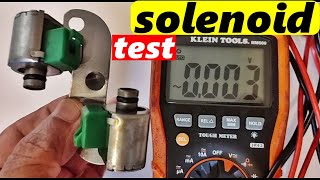
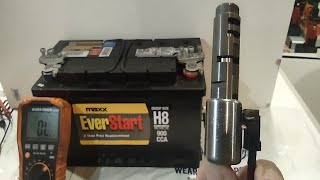
How to confirm: After dropping the transmission pan, the solenoid can be tested with a multimeter. For many A-series and U-series transmissions in this era, the resistance should be between 11-15 Ohms. A reading of 0 (short) or infinite/OL (open) confirms failure. You can also briefly apply 12V power to the solenoid to listen for an audible click.
Typical fix: Replace the TCC solenoid (often referred to as Solenoid SL or DSL). This requires removing the transmission pan and sometimes the valve body. 🎬 See this walkthrough on how to replace the transmission solenoid.
Est. part cost: $80-$250 - Low or Dirty Transmission Fluid 🔴 High Probability Neglected maintenance is common on older vehicles. Burnt or debris-filled fluid can clog the fine mesh screen on the solenoid itself, preventing it from operating correctly, or cause it to stick.
How to confirm: Check the transmission fluid dipstick (if equipped) or inspection plug. The fluid should be at the correct level, pink/red in color, and not smell burnt. Brown or black fluid with metal shavings indicates a more severe internal problem.
Typical fix: Perform a transmission fluid drain-and-fill. A full flush is sometimes recommended, but a simple drain-and-fill is often sufficient and safer for high-mileage transmissions. Use only the specified Toyota ATF (T-IV or WS).
Est. part cost: $50-$200 - Damaged Wiring or Connectors 🟡 Medium Probability The wiring harness leading to the transmission can be damaged by road debris, heat, or corrosion. The internal harness, which sits in the fluid, can also become brittle and fail.
How to confirm: Visually inspect the external wiring harness to the transmission. Test for continuity from the ECM/TCM connector to the transmission connector pins for the TCC solenoid circuit using a wiring diagram. If external wiring is good, the internal harness should be checked when the pan is off.
Typical fix: Repair the broken/shorted wire or replace the damaged connector. Sometimes the entire internal harness must be replaced.
Est. part cost: $20-$150 - Worn Torque Converter ⚪ Low Probability While less common than a solenoid failure for a P0740 *circuit* code, the internal lock-up clutch inside the torque converter can wear out, especially on high-mileage vehicles. This typically sets a P0741 performance code but can be related.
How to confirm: This is a diagnosis of exclusion. If the fluid, solenoid, and all wiring are confirmed good but symptoms persist, the torque converter itself is the likely culprit. A mechanic may use a scan tool to monitor TCC slip RPM to confirm.
Typical fix: Replace the entire torque converter, which requires removing the transmission from the vehicle.
Est. part cost: $450-$800
Rare But Worth Checking
- Faulty Engine Control Module (ECM/TCM): This is very rare. The driver circuit within the ECM that controls the solenoid can fail. Before replacing the ECM, all other possibilities (fluid, solenoid, wiring, torque converter) must be exhaustively ruled out.
Diagnosis Steps

- Check and verify the code with an OBD-II scanner.
- Inspect the transmission fluid level and condition. If it's low, dark, or smells burnt, service the fluid first.
- Visually inspect the external transmission wiring harness for any obvious damage, corrosion, or loose connections.
- Using a wiring diagram, test for power and ground at the transmission connector for the TCC solenoid circuit.
- If external wiring is okay, the next step is to test the TCC solenoid itself. This requires draining the fluid and removing the transmission oil pan.
- Disconnect the solenoid and test its resistance with a multimeter set to Ohms. Compare the reading to the specification (typically 11-15 Ohms for U140E, 11-13 Ohms for U241E). An open (OL) or shorted (0 Ohms) reading confirms a bad solenoid.
- If the solenoid tests good, check for continuity in the internal transmission wiring harness between the main connector and the solenoid.
- If the solenoid and all wiring are confirmed to be good, the issue may be a worn torque converter (though this usually sets P0741) or, in very rare cases, the ECM. Professional diagnosis is recommended at this stage.
Parts You'll Likely Need

- Torque Converter Clutch Solenoid (Lock-Up Solenoid)
(OEM #Varies by transmission (e.g., 35280-30050, 85420-20110). Must verify with VIN.)— This is the most common part to fail electrically, directly causing the P0740 circuit code.
Trusted brands: Toyota (OEM), Aisin, Rostra, Transtar
OEM price range: $200-$300
Aftermarket price range: $80-$180 - Transmission Filter and Pan Gasket Kit — This must be replaced whenever the transmission pan is removed to service the solenoid.
Trusted brands: Wix, ATP, Fram
OEM price range: $40-$70
Aftermarket price range: $20-$40 - Toyota Automatic Transmission Fluid — The correct type of fluid is required. Use Type T-IV for older models (most XV20/XV30) and Toyota WS (World Standard) for newer models (most XV40). Check your owner's manual or dipstick.
Trusted brands: Toyota OE, Idemitsu (OEM supplier), Valvoline MaxLife ATF (compatible)
OEM price range: $10-$15 per quart
Aftermarket price range: $8-$12 per quart
Related Codes That Often Appear With This One
- P0741 — P0741 indicates 'Torque Converter Clutch Circuit Performance or Stuck Off'. While P0740 is a purely electrical circuit fault, P0741 means the computer commanded lock-up but didn't see the expected RPM drop. A failing solenoid can cause either or both codes.
Technical Service Bulletins (TSBs) & Recalls
- T-SB-0122-20 (Rev2): Addresses P07407E on 2018+ models with 8-speed transmissions via an ECM logic update. This TSB is NOT applicable to the 1998-2012 models but is often cited, causing confusion. It applies to a completely different generation of transmission (UA80E).
- T-SB-0018-18: Also addresses P07407E on 2018 models with an ECM logic modification and is not relevant to the 1998-2012 vehicle range.
Platform-Specific Known Issues
- Owner Experience: 2000 Camry V6 (A541E) DIY Solenoid Replacement: An owner on ToyotaNation with a 2000 Camry V6 documented a successful DIY repair for P0740. The symptoms were a check engine light and a noticeable shudder. After dropping the transmission pan, they tested the TCC (SL) solenoid and found it had an open circuit (infinite resistance). After replacing the solenoid with a new one that tested within the 11-15 ohm spec, clearing the codes, and refilling with fluid, the code and shudder were resolved.
- Owner Experience: 2005 Camry Shudder (U241E): A Reddit user with a 2005 Camry described the classic symptom of a shudder when lightly accelerating between 40-50 mph. This is a common symptom of the torque converter clutch trying to engage but failing, often due to a faulty TCC solenoid.
Documented NHTSA Reports
- NHTSA ODI #11712764: An owner of a similar Toyota model reported that the vehicle felt unsafe when pulling into traffic or intersections due to delayed acceleration, with diagnostic trouble code P0740 (Torque Converter Clutch Actuator Stuck On) retrieved.
- NHTSA ODI #11709274: A manufacturer report notes P0740 (Torque Converter Clutch Circuit/Open) occurring alongside multiple pressure control solenoid performance codes and throttle position sensor issues.
Mechanic-Grade Diagnostic Values
- TCC (DSL) Solenoid Resistance (U140E Transmission) — expected: 11 - 15 Ohms. Failure: A reading of 0 Ohms (short) or infinite/OL (open) indicates a failed solenoid.
- TCC (DSL) Solenoid Resistance (U241E Transmission) — expected: 11 - 13 Ohms. Failure: A reading of 0 Ohms (short) or infinite/OL (open) indicates a failed solenoid.
Scan Tool Commands That Help
- Toyota Techstream: Active Test: 'Control the Lock-Up' — This bidirectional command allows the technician to manually command the TCC solenoid on and off to verify its operation and check for a corresponding RPM drop, helping to isolate the fault between the solenoid, wiring, and the torque converter itself.
- Toyota Techstream (or other professional scan tool): Utility: 'Reset Memory' — After replacing a transmission component like a solenoid or the entire transmission, this function should be used to clear the ECM's learned shift adaptations. This is required for the transmission to relearn shifting behavior with the new parts.
Wiring & Ground Locations
- Ground Point ED (1MZ-FE V6) — On the rear side of the surge tank (intake manifold) in the engine compartment.. A poor engine or sensor ground can cause erratic electrical signals and false trouble codes. This is a key ground point for the engine wiring harness on early V6 models (approx. 1998-2001).
- Harness Ground (2GR-FE V6) — On the side of the cylinder head, directly underneath the throttle body.. This is a primary grounding point for the engine harness on later V6 models (approx. 2007-2012). A loose or corroded connection here can affect multiple sensors and actuators, including those for the transmission.
Real Owner Repair Stories
- ToyotaNation Forum User (2004 Toyota Camry LE (4-Cylinder, U241E)) — Check Engine Light with code P0740, accompanied by a noticeable shudder/vibration when driving at a steady speed around 40-50 MPH.
❌ Tried (didn't work) Initially suspected a more complex transmission issue.
✅ What actually fixed it The owner dropped the transmission pan, identified the lock-up (TCC) solenoid, and tested its resistance, which was found to be out of spec (open circuit). They replaced only the faulty solenoid, installed a new pan gasket and filter, and refilled with Toyota T-IV fluid. This completely resolved the shudder and the P0740 code.
When the Usual Fixes Don't Work
- While P0740 is defined as a 'circuit malfunction' pointing towards the solenoid or wiring, at least one experienced mechanic has noted that in their personal experience, the code has frequently been the result of an internal mechanical failure of the torque converter itself. This can be confusing because a mechanical failure (like a worn-out clutch lining) should theoretically set a performance code like P0741. However, it suggests that if the solenoid and wiring test perfectly, the torque converter should be considered a strong suspect before replacing the ECM.
OEM Part Supersession History
35280-50020→35280-30050— Standard part revision and update by the manufacturer.
Heads up: The new part number (35280-30050) is the correct replacement for the old one.
Model Year Variations Within This Range
- 2002-2006: The U140E (V6) and U241E (I4) transmissions were common. While the TCC solenoid looks similar, their electrical characteristics can differ. For example, the TCC (DSL) solenoid resistance for the U140E is 11-15 Ohms, while for the U241E it is 11-13 Ohms. Using the wrong solenoid, even if it physically fits, can cause immediate shifting problems or limp mode.
- 2007-2012: V6 models often used the U660E 6-speed automatic. While P0740 is still possible, these transmissions are more complex and can suffer from drivability issues (like shudders or flares) that are fixed with an ECM/TCM software update (reflash). A technician should always check for available TSBs and software updates for these symptoms before replacing hard parts.
Diagnostic Flowchart
Used vs. New Parts: Buying Guide for This Vehicle
When a used part is the smart pick: For this repair, using used parts is generally not recommended for the electronic solenoids themselves due to their high failure rate and unknown history. However, a used external wiring harness or a complete, low-mileage used transmission from a reputable salvage yard can be a cost-effective solution if the problem is determined to be more than just a single solenoid.
Donor-vehicle mileage cap: roughly under 100000 miles for the part to have meaningful remaining life.
What to inspect on the donor part:
- For a complete transmission, ask for vehicle history to confirm mileage.
- Check the color and smell of the fluid from the donor transmission's cooler lines; it should be reddish and not smell burnt.
- Inspect external connectors on any used part for corrosion, bent pins, or brittle plastic.
OEM-only on this vehicle (don't cheap out):
- Torque Converter Clutch Solenoid
Aftermarket brands forum-validated for this vehicle:
- Aisin (often the Original Equipment Manufacturer for Toyota)
Brands owners have reported issues with on this vehicle:
- Unbranded, 'white-box' solenoids from online marketplaces are a significant gamble and frequently fail prematurely.
Real Owner Stories
Aggregated from forums and TSBs cited above. Mileages and costs reflect what owners reported in those sources.
2000 Camry V6
Symptoms: A check engine light was on with a noticeable shudder.
What fixed it: The owner dropped the transmission pan, tested the TCC (SL) solenoid, and found it had an open circuit. Replacing the solenoid and refilling the fluid resolved the code and the shudder.
Source hint: Owner Experience: 2000 Camry V6 (A541E) DIY Solenoid Replacement
2005 Camry
Symptoms: The user described a classic shudder when lightly accelerating between 40-50 mph.
What fixed it: The source identifies the issue as a common torque converter lock-up problem, often caused by a faulty TCC solenoid, but does not detail the final repair performed.
Source hint: Owner Experience: 2005 Camry Shudder (U241E)
1999 Camry V6
Symptoms: Owner reported diagnostic trouble codes P0740 and P0770.
What fixed it: The issue was resolved by following a DIY guide for testing and replacing the lock-up solenoid.
Source hint: ToyotaNation Forum: '[DIY] Transmission Solenoid Replacement (P0740, P0770)'
Related OBD-II Codes
Frequently Asked Questions
What is the correct resistance for the TCC solenoid on my 1998-2012 Camry?
What causes the 'driving over rumble strips' feeling in my Camry between 40-50 mph?
Can a simple transmission fluid change fix a P0740 code?
I saw TSB T-SB-0122-20 mentioned for P0740. Does this apply to my 2005 Camry?
My engine stalls when I come to a stop. Could this be related to P0740?
Are parts for this P0740 issue on my Camry shared with other Toyota models?
Helpful Videos

Used OEM Parts in Stock


New Aftermarket Parts Available

The information in this article is provided for general reference and educational purposes only. Vehicle specifications, procedures, and part compatibility can vary by production date, trim level, and region. Always consult your vehicle's factory service manual and verify part numbers before purchasing or performing repairs. Safety-critical components such as airbags, seat belts, and braking systems should be installed by a qualified professional.
- Toyota Camry:
- 🎬 Helpful Videos
- 🛍️ Shop This Part
- What's Unique About the 1998-2012 Toyota Camry
- Symptoms You May Notice
- Most Likely Causes
- Rare But Worth Checking
- Diagnosis Steps
- Parts You'll Likely Need
- Related Codes That Often Appear With This One
- Technical Service Bulletins (TSBs) & Recalls
- Platform-Specific Known Issues
- Documented NHTSA Reports
- Mechanic-Grade Diagnostic Values
- Scan Tool Commands That Help
- Wiring & Ground Locations
- Real Owner Repair Stories
- When the Usual Fixes Don't Work
- OEM Part Supersession History
- Model Year Variations Within This Range
- Diagnostic Flowchart
- Used vs. New Parts: Buying Guide for This Vehicle
- Real Owner Stories
- 2000 Camry V6
- 2005 Camry
- 1999 Camry V6
- Related OBD-II Codes
- Frequently Asked Questions
- 🎟️ Get 5% Off