

P0716 on 2013-2017 Honda Accord CVT: Input Speed Sensor Causes and Fixes
On a 2013-2017 Honda Accord with a CVT, code P0716 most often points to a faulty Input/Turbine Speed Sensor. This can cause harsh shifting, hesitation, a blinking 'D' light, and limp mode. Replacing the correct sensor is the most common fix, costing around $50-$120 for the part. There are two main speed sensors (input and output), and proper diagnosis is key.
- P0716 on a 2013-2017 Accord CVT is an electrical code for the Input Speed Sensor, not necessarily a major transmission failure.
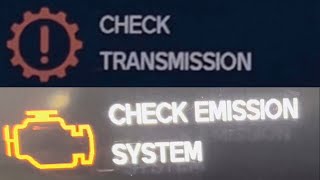
- Symptoms include a Check Engine Light, blinking 'D' light, and poor shifting performance.
- The most common cause is a faulty input speed sensor, followed by wiring issues.
- Diagnosis should involve checking live sensor data with a scan tool before replacing parts.
- Always use genuine Honda HCF-2 fluid if a transmission fluid service is performed.
What's Unique About the 2012-2017 Honda Accord

The vehicle range specified (2012-2017) primarily covers the 9th generation Honda Accord (2013-2017), which was the first generation to pair the 4-cylinder K24W engine with a Continuously Variable Transmission (CVT). The 2012 model was an 8th generation car and did not use a CVT, making this guide specific to 2013-2017 4-cylinder models. For this platform, issues with the transmission speed sensors are a known failure point that can mimic more severe internal transmission faults. It's crucial to diagnose this electrical issue correctly to avoid unnecessary and expensive transmission repairs, as symptoms like a blinking 'D' light and limp mode can be alarming.
Generation note: The specified range of 2012-2017 covers two generations. The 2012 model is the final year of the 8th generation Accord, which did not offer a CVT. The 2013-2017 models are the 9th generation, which introduced the CVT for 4-cylinder engines. This guide is only applicable to the 2013-2017 models equipped with the CVT.
Symptoms You May Notice

- Check Engine Light is on
- Blinking 'D' (Drive) indicator light
- Harsh, erratic, or delayed shifting
- Vehicle enters 'limp mode' (reduced power and limited gear ratios)
- Hesitation or poor acceleration
- Reduced fuel economy
- Inability to shift out of Park (in some cases)
- Replacing the entire transmission. Because the symptoms involve poor shifting and a blinking 'D' light, some may assume the entire CVT has failed. P0716 is an electrical code, and the root cause is most often a simple, inexpensive sensor or wiring issue. 🎬 See how a simple sensor check can save you thousands.
- Replacing only the input sensor when the output sensor was the actual cause, or vice-versa.
Most Likely Causes

- Faulty Input/Turbine Speed Sensor 'A' 🔴 High Probability Sensors are electronic components that operate in a high-heat environment and can fail over time due to internal degradation. This is a common failure point for this transmission.
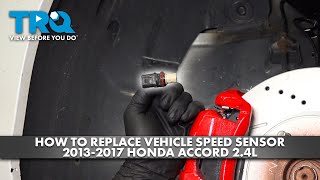
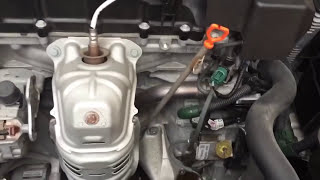
How to confirm: Use a professional scan tool to monitor live data from the input speed sensor. If the readings are erratic, drop to zero, or don't correlate with engine RPM while driving, the sensor is likely faulty. The sensor is located on the outside of the transmission housing, often requiring removal of the air filter box for access. 🎬 Watch this step-by-step guide on replacing the speed sensor.
Typical fix: Replace the Input/Turbine Speed Sensor. The OEM part number is typically 28820-RJ2-003 (also called Pick Up Assembly). Always verify with your VIN.
Est. part cost: $50 - $120 - Faulty Output/Drive Pulley Speed Sensor 🟡 Medium Probability Similar to the input sensor, the output sensor can also fail due to heat and age. A fault in the output sensor can cause the PCM to receive conflicting data when compared to the input sensor, sometimes triggering a P0716 code.
How to confirm: Monitor live data for both input and output speed sensors simultaneously. If the input sensor reads steady with engine RPM but the output sensor is erratic or zero while the vehicle is moving, the output sensor is the likely culprit.
Typical fix: Replace the Output/Drive Pulley Speed Sensor. The OEM part number is typically 28810-RJ2-003. Always verify with your VIN.
Est. part cost: $50 - $110 - Damaged Wiring or Loose Connectors 🟡 Medium Probability The wiring harness to the transmission is exposed to heat, vibration, and potential corrosion, which can lead to open circuits, shorts, or poor connections at the sensor or PCM.
How to confirm: Visually inspect the wiring harness leading to both speed sensors for any signs of damage, chafing, or corrosion. Check the connectors for a secure fit and clean terminals. A multimeter can be used to test for continuity and voltage between the sensor connector and the PCM.
Typical fix: Repair the damaged section of the wire or clean/replace the connector.
Est. part cost: $10 - $50 - Low or Deteriorated Transmission Fluid (HCF-2) ⚪ Low Probability Honda TSB 17-017 explicitly states that deteriorated fluid can cause judder and other issues due to premature breakdown under high heat. While not a direct cause of an electrical code like P0716, extremely dirty or low fluid can cause erratic hydraulic operation, leading to slippage or performance issues that may indirectly contribute to irrational sensor readings.
How to confirm: Check the transmission fluid level and condition. The fluid should be light in color and clear, not dark brown, black, or have a burnt smell. Use only Honda HCF-2 fluid.
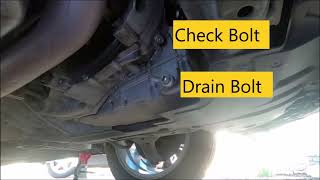
Typical fix: Perform a transmission fluid drain and fill (or multiple, to flush the system) using only Honda HCF-2 fluid. 🎬 Follow this DIY walkthrough to change your CVT fluid correctly. This is often recommended as a first step if the fluid condition is poor.
Est. part cost: $60 - $150 (for fluid)
Rare But Worth Checking
- Faulty Powertrain Control Module (PCM) or Transmission Control Module (TCM): This is a very rare cause. The PCM/TCM should only be considered after all other possibilities, including both sensors and all wiring, have been thoroughly ruled out. Honda has released software updates for related transmission issues, which a dealer would need to perform.
Diagnosis Steps

- Connect a professional OBD-II scanner to verify the P0716 code and check for any other related codes.
- View the freeze frame data to see the vehicle's operating conditions when the code was set.
- Use the scanner to monitor live data from BOTH the Input Speed Sensor and Output Speed Sensor while driving. Compare the input speed to the engine RPM; it should follow closely. Look for signal dropouts or erratic readings from either sensor.
- Inspect the transmission fluid level and condition. Ensure it is clean, at the proper level, and is the correct Honda HCF-2 type.
- Visually inspect the wiring harnesses and connectors for both the input and output speed sensors. Look for any signs of damage, corrosion, or loose connections.
- If wiring and fluid are okay, but a sensor signal is faulty, replace the corresponding sensor (Input or Output).
- After replacement, clear the code using the scanner and perform a complete drive cycle to ensure the problem is resolved.
Parts You'll Likely Need
- Transmission Input/Turbine Speed Sensor
(OEM #28820-RJ2-003)— This is the most common failure point for the P0716 code, as the sensor's internal electronics can fail over time.
Trusted brands: Honda Genuine Parts, NTK/NGK, Standard Motor Products
OEM price range: $80-$120
Aftermarket price range: $50-$90 - Transmission Output/Drive Pulley Speed Sensor
(OEM #28810-RJ2-003)— This is the second most likely sensor to fail and can cause similar symptoms or contribute to the code being set.
Trusted brands: Honda Genuine Parts, NTK/NGK
OEM price range: $70-$110
Aftermarket price range: $45-$80 - Honda HCF-2 CVT Fluid
(OEM #08200-HCF2)— If the diagnosis reveals that the transmission fluid is old, dirty, or low, it must be replaced with the specific fluid required for Honda CVTs to prevent judder and other performance issues.
Trusted brands: Honda Genuine Parts
OEM price range: $15-$25 per quart
Related Codes That Often Appear With This One
- P0717 (Input/Turbine Speed Sensor 'A' Circuit No Signal)
- P0718 (Input/Turbine Speed Sensor 'A' Circuit Intermittent)
- P0721 (Output Speed Sensor Circuit Range/Performance)
Technical Service Bulletins (TSBs) & Recalls
- Acura/Honda TSB 17-017: Details how deteriorated transmission fluid can cause a judder between 20-60 mph. The fix involves a software update and a transmission fluid flush. This confirms the platform's sensitivity to fluid condition.
- Acura/Honda TSB 19-033: While this specific TSB applies to 2016-18 Civics, it addresses software miscalculations causing misfires and other issues, showing a pattern of Honda using software updates to fix driveability problems that could be misdiagnosed as component failure.
- Bulletin #A19-124: Notes that the transmission may experience intermittent harsh or jerky upshifts during steady acceleration, or the MIL may illuminate with DTC P0716.
- Bulletin #A19-004: Describes an issue where a miscalculation in the TCM software causes the MIL to come on with DTC P0716 for the input shaft speed sensor during downshifts from 9th or 8th gear to 7th gear or lower.
Platform-Specific Known Issues
- Honda Service Bulletin 17-017 addresses a judder from the torque converter on these models caused by deteriorated transmission fluid and provides a software update to better manage fluid temperature. While not directly for P0716, it highlights the sensitivity of this transmission to fluid condition and the use of software updates by Honda to correct transmission behavior.
Mechanic-Grade Diagnostic Values
- Reference Voltage at Input Speed Sensor Connector — expected: Approximately 5 Volts. Failure: Significantly lower or no voltage indicates an open or short in the VCC line from the PCM.
- Ground Wire Continuity — expected: Continuity to ground (near 0 ohms). Failure: High resistance or an open circuit (OL) indicates a break in the ground wire or a poor connection at the G101 ground point.
- Sensor Internal Resistance — expected: Not specified in publicly available documents for this part.. Failure: Testing modern Hall-effect sensors with an ohmmeter is not the recommended procedure; testing involves checking for a proper voltage signal with a voltmeter or oscilloscope.
Scan Tool Commands That Help
- Honda Diagnostic System (HDS) or equivalent: CVT Start Clutch Calibration — This procedure is required after disconnecting the battery, replacing the transmission, or replacing the valve body. It relearns the clutch engagement point. While not mandatory for just a sensor swap, it is a critical related procedure for ensuring smooth operation after any significant transmission service.
- Honda Diagnostic System (HDS) or equivalent: Clear DTCs — This should be performed after the repair is completed to reset the system and turn off the check engine light before performing a verification drive cycle.
Wiring & Ground Locations

- PCM (Powertrain Control Module) — In the engine compartment, located in the center, near the firewall and next to the main fuse box.. The PCM receives the signal from the speed sensor. All wiring tests (voltage, continuity) will terminate at the PCM connectors.
- G101 — This is a primary ground for the engine control system. On 4-cylinder models, it is typically located on the driver's side of the intake manifold plenum or on the thermostat housing.. A poor connection at G101 can cause intermittent and difficult-to-diagnose electrical issues for multiple sensors, including the transmission speed sensors. The PCM relies on this solid ground reference.
- Interior Fuse Box — Located on the driver's side, under the dashboard to the left of the steering column.. Contains fuses related to the ECU/PCM. A blown fuse here could cause a no-communication issue with the PCM, preventing diagnosis.
Real Owner Repair Stories
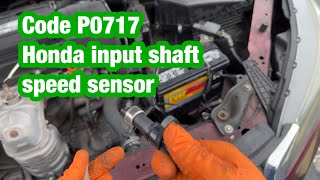
- YouTube channel 'Alex The Best Mechanic' (2015 Honda Accord (CVT)) — Check engine light with code P0717 (No Signal from Input Speed Sensor).
❌ Tried (didn't work) The previous mechanic cleared the code but could not locate the part to replace it.
✅ What actually fixed it The input speed sensor was replaced. The mechanic noted that for the CVT model, the sensor can be accessed and replaced from the top of the engine bay after removing the air intake components, which is easier than accessing it from underneath the vehicle.
Documented NHTSA Reports
- NHTSA ODI #11489573 reports that abnormal TCM adaptation values or a software miscalculation can cause the MIL to illuminate with DTC P0716, often accompanied by harsh or jerky upshifts.
- NHTSA ODI #11541723 describes a dangerous situation while maneuvering through traffic where a P0716 code was stored; the owner was informed of a TSB for the issue that was no longer in effect.
- NHTSA ODI #11451395 details an incident on the highway where permanent transmission codes P0716 and P0700 were stored, though technicians initially struggled to pinpoint the exact root cause.
OEM Part Supersession History
28820-RJ2-003→N/A— This part number has remained consistent and fits a wide range of Honda models from 2013 through 2025, indicating a stable design with no major revisions or supersessions.
Model Year Variations Within This Range
- 2016-2017: The 2016 model year introduced a significant mid-cycle refresh with updated styling and interior technology. However, the 2.4L engine and CVT powertrain, including the speed sensors and their diagnostics, remained unchanged from the 2013-2015 models.
Diagnostic Flowchart
Other Known Issues on This Vehicle
Issues unrelated to this code that are worth knowing about as an owner of this generation:
- Starter Motor Failure 🔴 High — Commonly reported between 35,000 and 100,000 miles. Symptoms include a no-crank or single-click condition after multiple attempts. (Ref: TSB 16-002 (for V6 models) describes a grinding noise at startup and requires starter replacement and torque converter repositioning.)
- VTC Actuator Rattle on Cold Start 🟠 Medium — A very common issue on K24 'Earth Dreams' engines. A brief, loud metallic rattle or grind for 1-2 seconds upon cold startup. Caused by a worn locking pin in the VTC actuator. (Ref: Honda TSBs 16-012 and 16-088 address this for other models with the same engine family, confirming the issue. The only fix is replacing the VTC actuator.)
- CVT Start Clutch Judder / Shudder 🔴 High — Widespread on 2013-2015 models, less so on 2016-2017. Felt as a vibration or shake when accelerating from a stop or at low speeds (20-40 mph). (Ref: Honda extended the warranty for 2013-2015 models. TSB 17-017 addresses judder caused by deteriorated fluid and provides a software update.)
- Weak Battery / Electrical Issues 🟡 Low — The stock battery in 4-cylinder models is often cited as being undersized, leading to premature failure and various electrical gremlins. (Ref: A recall was issued for the 12-volt battery sensor on some models.)
Used vs. New Parts: Buying Guide for This Vehicle
When a used part is the smart pick: For this specific repair, purchasing a used sensor from a junkyard is not recommended. It is an inexpensive electronic component critical to transmission function. The age and history of a used sensor are unknown, and the cost savings do not outweigh the risk of premature failure and repeated labor.
Donor-vehicle mileage cap: roughly under 15000 miles for the part to have meaningful remaining life.
What to inspect on the donor part:
- If buying used is unavoidable, source from the lowest-mileage vehicle possible.
- Inspect the connector for any corrosion or broken plastic locking tabs.
- Ensure the O-ring is present and not flattened or cracked, though it should always be replaced anyway.
OEM-only on this vehicle (don't cheap out):
- CVT Fluid (Honda HCF-2). Using any other type of fluid can cause judder, overheating, and rapid transmission failure.
Aftermarket brands forum-validated for this vehicle:
- NTK (NGK): Widely considered to be the original equipment manufacturer (OEM) for many Honda sensors. Offers OEM quality without the dealer markup.
- Standard Motor Products (SMP): A reputable aftermarket brand that offers a reliable, budget-friendly alternative to OEM.
Brands owners have reported issues with on this vehicle:
- Unbranded, 'white-box' parts from online marketplaces. These often have high failure rates, even if they appear physically identical or come in counterfeit 'genuine' packaging.
Real Owner Stories
Aggregated from forums and TSBs cited above. Mileages and costs reflect what owners reported in those sources.
2014 Honda Accord Sport CVT
Symptoms: blinking 'D' light, check engine light, and the car going into limp mode.
What fixed it: replacing the input shaft speed sensor.
Source hint: driveaccord.net - '2014 Accord Sport CVT issue P0716'
Related OBD-II Codes
Frequently Asked Questions
My 2014 Accord's 'D' (Drive) light is blinking. What does this mean?
I was told TSB 17-017 might apply to my Accord's transmission issue. Is it a fix for P0716?
What is the correct transmission fluid for my 2012-2017 Accord with a CVT?
I need to replace the input speed sensor for code P0716. What's the part number?
How can I determine if the input or the output speed sensor is the one that failed?
Is the P0716 code causing my Accord to be in 'limp mode'?
Helpful Videos
Used OEM Parts in Stock


New Aftermarket Parts Available

The information in this article is provided for general reference and educational purposes only. Vehicle specifications, procedures, and part compatibility can vary by production date, trim level, and region. Always consult your vehicle's factory service manual and verify part numbers before purchasing or performing repairs. Safety-critical components such as airbags, seat belts, and braking systems should be installed by a qualified professional.
- Honda Accord:
- 🎬 Helpful Videos
- 🛍️ Shop This Part
- What's Unique About the 2012-2017 Honda Accord
- Symptoms You May Notice
- Most Likely Causes
- Rare But Worth Checking
- Diagnosis Steps
- Parts You'll Likely Need
- Related Codes That Often Appear With This One
- Technical Service Bulletins (TSBs) & Recalls
- Platform-Specific Known Issues
- Mechanic-Grade Diagnostic Values
- Scan Tool Commands That Help
- Wiring & Ground Locations
- Real Owner Repair Stories
- Documented NHTSA Reports
- OEM Part Supersession History
- Model Year Variations Within This Range
- Diagnostic Flowchart
- Other Known Issues on This Vehicle
- Used vs. New Parts: Buying Guide for This Vehicle
- Real Owner Stories
- 2014 Honda Accord Sport CVT
- Related OBD-II Codes
- Frequently Asked Questions
- 🎟️ Get 5% Off