

P0606 on 2009-2016 Toyota Venza: ECM Processor Fault Causes and Fixes
On a 2009-2016 Toyota Venza, code P0606 almost always points to a faulty Air/Fuel Ratio (O2) sensor, not a failed Engine Control Module (ECM). An intermittent short in the sensor's heater circuit tricks the ECM into thinking it has an internal error. Technicians strongly advise replacing the suspect O2 sensor before considering a costly ECM replacement.
- Do not replace the Engine Control Module (ECM) for a P0606 code until you have ruled out a faulty oxygen sensor.
- The most likely cause is a failing Air/Fuel Ratio (upstream O2) or Oxygen (downstream O2) sensor sending an erratic signal.
- If other sensor codes (like P0138 or P0037) are present, fix them first; the P0606 will likely disappear.
- A key diagnostic step is to graph live O2 sensor data and wiggle the wiring harness to look for a voltage spike or signal dropout.
- This issue is common across many Toyota and Lexus vehicles from this era that share the same engines and control systems.
What's Unique About the 2009-2016 Toyota Venza
On this generation of Toyota vehicles, including the Venza and its platform mates like the Camry, RAV4, and Highlander, the P0606 code has a well-documented history of being a 'ghost' code. The engine's computer is highly sensitive to erratic voltage signals from its sensors. A momentary short or open circuit in an Air/Fuel Ratio (A/F) or Oxygen (O2) sensor's heater element can send a voltage spike that the ECM misinterprets as an internal processor failure. Mechanics and Toyota specialists on professional networks like iATN strongly advise against the immediate replacement of the ECM, as the root cause is almost always a much cheaper sensor.
Symptoms You May Notice
- Check Engine Light is on
- VSC (Vehicle Stability Control) and TRAC (Traction Control) lights are on
- Engine may stall unexpectedly
- Engine may run rough or misfire
- Difficulty starting the engine or a no-start condition
- Noticeable decrease in fuel economy
- Erratic automatic transmission shifting
- Replacing the Engine Control Module (ECM) without first testing the oxygen sensors. This is a very expensive and common mistake for this specific code on Toyota vehicles.
Most Likely Causes
- Failing Air/Fuel Ratio Sensor or Oxygen (O2) Sensor 🔴 High Probability The ECM logic on this platform is sensitive to intermittent voltage spikes from sensor heater circuits, which it misinterprets as an internal fault. This is a widely documented issue across Toyota's lineup from this era.
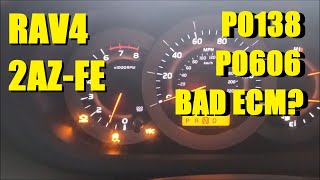
How to confirm: Scan for other codes; P0138, P0037, or other sensor codes 🎬 Watch: How to diagnose if P0138 is triggering your P0606 code. strongly point to this cause. Use a professional scan tool to graph live O2 sensor voltage and impedance data. Wiggle the sensor wiring harness to see if you can induce a voltage spike or dropout, which is a classic diagnostic technique for this issue. Check freeze-frame data for an out-of-range sensor reading (e.g., impedance jumping to thousands of Ohms) at the exact moment the P0606 code was set.
Typical fix: Replace the faulty Air/Fuel Ratio (upstream) or Oxygen (downstream) sensor. Always address any sensor-specific codes first, clear the computer, and perform a drive cycle to see if the P0606 code returns.
Est. part cost: $80-$250 - Poor Battery Health or Charging System Malfunction ⚪ Low Probability
How to confirm: Test the battery's voltage and load capacity. With the engine running, use a multimeter to check the alternator's output at the battery terminals; it should be stable and typically between 13.5 and 14.5 volts. Low voltage during cranking or voltage spikes from a bad alternator can trigger various processor faults.
Typical fix: Replace the weak battery or faulty alternator.
Est. part cost: $150-$600 - Damaged Wiring or Poor Ground Connection ⚪ Low Probability
How to confirm: Visually inspect the wiring harnesses to the ECM and oxygen sensors for any signs of corrosion, chafing, or rodent damage. Check that the main ECM ground connections to the chassis and engine block are clean and tight. A poor ground can cause unpredictable electrical issues that may trigger a P0606.
Typical fix: Repair the damaged section of the wiring harness or clean/tighten the ground connections.
Est. part cost: $10-$300
Rare But Worth Checking
- Internal ECM Failure: This is the least likely cause. It should only be considered after all other possibilities, especially the oxygen sensors, have been exhaustively ruled out. The factory service manual may incorrectly point to this as the first step, a mistake that can lead to a costly and unnecessary repair.
Diagnosis Steps
- Scan for all stored Diagnostic Trouble Codes (DTCs). If any codes related to Air/Fuel or Oxygen sensors are present (e.g., P0138, P0037), diagnose and repair them first. Clear the codes and perform a drive cycle to see if P0606 returns.
- If P0606 is the only code, use a professional scan tool to view the freeze-frame data. Look for any abnormal sensor readings that occurred at the exact moment the code was set, paying close attention to O2 sensor impedance and voltage values.
- Graph the live data for all O2/A-F sensors, watching both voltage and internal impedance/resistance if available. The signals should be stable and within specification.
- While graphing the data, carefully wiggle the wiring harnesses for each O2 sensor from the sensor to the engine bay. If you see a sudden spike or dropout on the graph, you have likely found the faulty sensor or wire. This is a proven diagnostic step.
- Inspect the battery, terminals, and charging system. Ensure battery voltage is above 12.4V with the engine off and between 13.5-14.5V with the engine running.
- Visually inspect the ECM wiring and ground points for any obvious damage, corrosion, or looseness.
- Only after confirming all sensors, wiring, and voltage supplies are perfect should an ECM replacement be considered.
Parts You'll Likely Need
- Air/Fuel Ratio Sensor / Oxygen Sensor
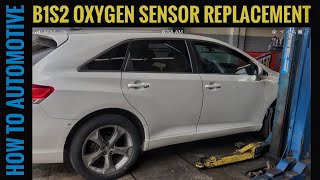
(OEM #Varies by engine and position. Examples: 2.7L 1AR-FE Upstream (A/F): 89467-0T020; Denso 234-9089. 3.5L 2GR-FE Upstream (A/F): Denso 234-9052. 🎬 See this walkthrough for installing a new Bank 2 Sensor 1. Downstream (O2): Denso 234-4209 (Universal), Denso 234-4306 (Exact Fit).)— This is the most common root cause of a P0606 code on this vehicle due to intermittent electrical faults in the sensor's heater circuit.
Trusted brands: Denso (OEM supplier), Bosch
OEM price range: $180-$250
Aftermarket price range: $80-$150
Related Codes That Often Appear With This One
- P0138 — This code for 'O2 Sensor Circuit High Voltage (Bank 1 Sensor 2)' is a strong indicator that the downstream oxygen sensor is the root cause of the P0606 fault.
- P0037 — Indicates a fault in the heater circuit of an oxygen sensor, which is a common trigger for the voltage spike that the ECM misinterprets as a P0606 error.
- VSC and TRAC Lights — On many Toyotas, when a critical engine code like P0606 is set, the ECU will automatically disable the Vehicle Stability Control and Traction Control systems as a precaution, illuminating their warning lights.
Technical Service Bulletins (TSBs) & Recalls
- T-SB-0001-10 Rev: States that a P0606 (ECM/PCM Processor) DTC may be present due to incorrect Oxygen Sensor operation and may appear alongside A/F sensor signal codes.
- T-SB-0050-22: Notes that on some Toyota models, the Control Module Processor Unexpected Operation (P0606) can be caused by computer logic that requires modification to reduce the possibility of the MIL illuminating.
- T-SB-0015-13: Addresses a 'pop' noise from the steering column during low-speed turns on 2009-2013 Venzas by applying special grease.
- T-SB-0094-11: Addresses excessive oil consumption on the related 2AZ-FE engine, not directly applicable to Venza engines but relevant to the platform's engine family history.
Platform-Specific Known Issues
- Real-World Repair Story: A technician on the iATN network reported a vehicle with a P0606 code where the factory manual's only step was 'Replace ECM'. Instead of replacing the computer, the technician graphed the O2 sensor data and wiggled the harness for the Bank 2 Sensor 2. This action caused a visible glitch on the scanner, proving the sensor was faulty. Replacing the O2 sensor fixed the car and the P0606 code did not return.
Mechanic-Grade Diagnostic Values
- Air/Fuel (A/F) Sensor Heater Resistance — expected: 1.8 to 3.4 Ω at 20°C (68°F) for some Toyota models. Another source cites 0.8 - 1.4 ohms.. Failure: A reading of thousands of Ohms, or an open circuit (infinite resistance), indicates a failed heater element. This is the most common trigger for a false P0606.
- Freeze Frame Data Analysis — expected: Stable A/F and O2 sensor readings.. Failure: Look for a momentary, drastic jump in sensor resistance (into the thousands of Ohms) or a voltage spike that lasts for only one or two data frames. This is the 'glitch' the ECM misinterprets.
- A/F Sensor Signal Voltage (KOEO) — expected: With Key On, Engine Off, you should have ~3.0V on the AF1 wire and ~3.3V on the AF2 wire at the harness connector.. Failure: If these voltages are not present, it points to a wiring issue or a fault in the ECM's reference voltage supply.
- ECM Ground Circuit Resistance — expected: Below 1 Ω.. Failure: Resistance higher than 1 Ω between the ECM connector ground pin (e.g., E1) and the chassis body ground indicates a poor ground connection, which can cause erratic ECM behavior.
Hidden / Shadow Codes Worth Checking
- Mode $06 Data: Mode $06 is not a specific code but a diagnostic mode that shows the results of non-continuous monitor self-tests. For a P0606, a technician would look at the Test ID (TID) and Component ID (CID) related to the ECM's internal processor checks. A failing value that hasn't yet met the threshold to set a code can indicate an impending problem. It can also be used to view misfire counts per cylinder, which might point to an ignition coil causing electrical noise that triggers the P0606. (see via A professional scan tool capable of displaying Mode $06 data. The specific TIDs and CIDs for Toyota's processor self-check require OEM documentation to interpret correctly.)
Scan Tool Commands That Help
- Toyota Techstream: Active Test > Control the A/F Sensor Heater — This bidirectional command allows a technician to manually switch the A/F sensor heater on and off. It's used to verify the integrity of the heater relay, wiring, and power supply, helping to isolate the fault specifically to the sensor itself if the rest of the circuit works.
- Toyota Techstream: Freeze Frame Data Analysis — Essential for diagnosing P0606. The freeze frame captures a snapshot of all sensor data at the exact moment the fault was recorded. For this code, you are specifically looking for a momentary out-of-spec reading from an O2 or A/F sensor, such as resistance jumping to thousands of ohms for a single frame.
Wiring & Ground Locations
- ECM Ground Wires (E1) — The main ground wires for the ECM are typically located on the engine block or cylinder head. On the 2GR-FE V6, there are multiple ground points on the engine itself. A wiring diagram is essential for locating the specific pins on the ECM connector (e.g., Pin 81 on connector B30).. A loose or corroded ECM ground is a known cause of various processor faults, including P0606. The ECM relies on a stable ground reference; without it, internal voltage monitoring can become erratic, mimicking an internal failure.
- Engine-to-Chassis Ground Strap — A braided metal strap connecting the engine block or transmission to the vehicle's firewall or frame rail.. While not directly connected to the ECM, a corroded or broken main ground strap can cause all vehicle electronics to seek ground through alternative, high-resistance paths. This can create electrical noise and voltage instability that may trigger a sensitive P0606 code.
Real Owner Repair Stories
- iATN (International Automotive Technicians Network) (Toyota vehicle (model not specified, but platform behavior is consistent)) — Check Engine Light with code P0606.
❌ Tried (didn't work) Following the factory service manual, which immediately recommended 'Replace ECM'.
✅ What actually fixed it The technician graphed the rear O2 sensor data on a scan tool and wiggled the wiring harness for Bank 2, Sensor 2. This induced a visible glitch in the sensor's data stream. Replacing the faulty O2 sensor resolved the P0606 code. - Reddit user, r/MechanicAdvice (2007 Toyota Camry V6 (2GR-FE engine, same family as Venza V6)) — Check Engine Light, flashing CEL, engine misfire at idle. Codes P0305 (Cylinder 5 Misfire) and P0606 were present.
❌ Tried (didn't work) Replaced ignition coils for cylinders 1, 3, and 5., Resetting the code, which would return shortly after.
✅ What actually fixed it The user's post details the initial diagnosis. While the final fix isn't posted by the original author, the combination of a specific cylinder misfire (P0305) and the P0606 code strongly suggests the root cause was the failing ignition coil on cylinder 5. A bad coil can create significant electrical noise or a voltage drain that the ECM misinterprets as an internal processor fault. The correct repair path is to resolve the misfire code first, which often eliminates the P0606. - NHTSA ODI #10384313 (Toyota RAV4) — An owner reported the Check Engine, VSC, and Traction lights were on with a P0606 code. The dealer replaced the ECM under warranty, but the same lights and fault codes recurred just 10 minutes later.
- NHTSA ODI #10325896 (Toyota Corolla) — An owner experienced the engine cutting out and stalling while driving. Diagnostic codes P0606 and P0456 were retrieved, and the issue was initially diagnosed as an ECM failure.
- NHTSA ODI #10551666 (Toyota Corolla) — A report describes a vehicle failing to start where codes P0606 and P0303 (misfire) were found on the computer.
OEM Part Supersession History
89661-0T040, 89661-0T060, 89661-0T061, 89661-0T062→89661-0T063— Standard revision and update by the manufacturer.89661-0T160→89661-0T161— Standard revision and update by the manufacturer.
Heads up: ECM part numbers are highly specific to engine, drivetrain (FWD/AWD), and year. The wrong part number will not function.
Model Year Variations Within This Range
- 2009-2016: The specific ECM part number changes based on the engine (2.7L vs 3.5L), drivetrain (FWD vs AWD), and model year. For example, a 2011 2.7L FWD ECM uses numbers like 89661-0T05x, while a 2010 3.5L uses 89661-0T020, and a 2013-2014 3.5L AWD uses 89661-0T16x. It is critical to match the part number exactly when replacing an ECM.
Diagnostic Flowchart
Other Known Issues on This Vehicle
Issues unrelated to this code that are worth knowing about as an owner of this generation:
- VVT-i Oil Line Leak/Rupture (2GR-FE V6) 🔴 High — Common enough for Toyota to issue a Limited Service Campaign (LSC). The rubber portion of the hose degrades, causing a potentially catastrophic oil leak. (Ref: Limited Service Campaign (LSC) covering various models including Venza platform-mates.)
- Steering Column Pop or Rattle Noise 🟡 Low — A popping or rattling noise may occur during low-speed turns. Common on 2009-2013 models. (Ref: T-SB-0015-13 details a procedure to apply grease to the tilt lever mechanism to fix a pop. T-SB-0005-11 addresses a rattle noise.)
- Excessive Oil Consumption (1AR-FE & 2AZ-FE I4) 🟠 Medium — Some 4-cylinder engines, particularly the related 2AZ-FE, were known for excessive oil consumption due to piston ring design. The Venza's 1AR-FE is from the same family. (Ref: T-SB-0094-11 was issued for the 2AZ-FE engine, which is not in the Venza but indicates a known issue in the engine family.)
- Melting or Cracking Dashboard 🟡 Low — Under prolonged heat and sun exposure, some dashboards can become sticky, melt, or crack, causing glare. (Ref: A previous warranty enhancement program covered this for many Toyota models of this era.)
Used vs. New Parts: Buying Guide for This Vehicle
When a used part is the smart pick: For an ECM replacement, a used module from a reputable salvage yard is a very sensible, cost-effective option, provided it is the exact same part number and is properly reprogrammed to the vehicle. For the primary fix (O2 sensor), used parts are never recommended.
Donor-vehicle mileage cap: roughly under 150000 miles for the part to have meaningful remaining life.
What to inspect on the donor part:
- Verify the part number on the used ECM is an exact match to the original.
- Ensure the donor vehicle was not involved in a flood or fire.
- Check connectors for any signs of corrosion, bent pins, or physical damage.
- Buy from a seller that offers a warranty and guarantees the part is functional.
OEM-only on this vehicle (don't cheap out):
- Engine Control Module (ECM) - While used OEM is good, avoid aftermarket 'rebuilt' ECMs from unknown brands, as their quality control can be inconsistent. Stick with original Toyota/Denso parts, new or used.
Aftermarket brands forum-validated for this vehicle:
- Denso (for Air/Fuel and Oxygen Sensors - they are the OEM supplier)
- NTK (for Air/Fuel and Oxygen Sensors)
Brands owners have reported issues with on this vehicle:
- Unbranded, 'white box' oxygen sensors from online marketplaces. They frequently fail prematurely or have incorrect heater resistance, which will cause the P0606 code to return.
Real Owner Stories
Aggregated from forums and TSBs cited above. Mileages and costs reflect what owners reported in those sources.
2009-2016 Toyota Venza
Symptoms: The vehicle was throwing a P0606 code. While the factory manual suggested replacing the ECM immediately, a technician noticed erratic data on the scan tool.
What fixed it: The technician graphed the O2 sensor data and wiggled the wiring harness for the Bank 2 Sensor 2. This revealed a glitch in the sensor; replacing the O2 sensor resolved the P0606 without needing a new ECM.
Source hint: iATN (International Automotive Technicians Network) - 'Toyota P0606 - Don't replace the ECM'
Related OBD-II Codes
Frequently Asked Questions
My 2012 Venza has a popping noise when I turn the steering wheel at low speeds; is this related to the P0606 code?
The dealership says I need a new ECM for my Venza. Is there anything else I should check first?
Can a weak battery cause the P0606 code on a 2009-2016 Venza?
Is the excessive oil consumption mentioned in T-SB-0094-11 a concern for my Venza's engine?
Why are my VSC and TRAC OFF lights on along with the Check Engine light?
Helpful Videos

We Have This Part in Stock


The information in this article is provided for general reference and educational purposes only. Vehicle specifications, procedures, and part compatibility can vary by production date, trim level, and region. Always consult your vehicle's factory service manual and verify part numbers before purchasing or performing repairs. Safety-critical components such as airbags, seat belts, and braking systems should be installed by a qualified professional.
- Toyota Venza:
- 🎬 Helpful Videos
- 🛍️ Shop This Part
- What's Unique About the 2009-2016 Toyota Venza
- Symptoms You May Notice
- Most Likely Causes
- Rare But Worth Checking
- Diagnosis Steps
- Parts You'll Likely Need
- Related Codes That Often Appear With This One
- Technical Service Bulletins (TSBs) & Recalls
- Platform-Specific Known Issues
- Mechanic-Grade Diagnostic Values
- Hidden / Shadow Codes Worth Checking
- Scan Tool Commands That Help
- Wiring & Ground Locations
- Real Owner Repair Stories
- OEM Part Supersession History
- Model Year Variations Within This Range
- Diagnostic Flowchart
- Other Known Issues on This Vehicle
- Used vs. New Parts: Buying Guide for This Vehicle
- Real Owner Stories
- 2009-2016 Toyota Venza
- Related OBD-II Codes
- Frequently Asked Questions
- 🎟️ Get 5% Off