

P0563 on 2014-2017 Mazda 6: System Voltage High Causes and Fixes
P0563 means your Mazda 6's charging system voltage is dangerously high, often exceeding 15.0V. The most common cause is a failed internal voltage regulator, requiring alternator replacement. On models with the i-ELOOP system, a failing capacitor is also a likely and expensive culprit. Expect costs from $700-$950 for a standard alternator replacement, and potentially over $2,000 for i-ELOOP component repairs. Driving is not recommended as over-voltage can destroy expensive electronics.
- P0563 means your car is overcharging, which is a serious risk to all electronics. Do not drive the vehicle.
- First, confirm if your car has the optional i-ELOOP system, as this drastically changes the diagnosis and cost.
- The most likely cause is a bad alternator (on any model) or a bad i-ELOOP capacitor (on equipped models).
- Ensure the correct Q85 EFB battery is installed. Using the wrong battery type can cause this code and other dangerous electrical problems.
- Due to the complexity and risk, especially with i-ELOOP, professional diagnosis and repair are strongly recommended.
What's Unique About the 2014-2017 Mazda 6
The 2014-2017 Mazda 6 is unique because of the optional i-ELOOP regenerative braking system. Models with i-ELOOP use a special variable-voltage alternator (capable of producing up to 25 volts) and a large capacitor to store energy, making the charging system more complex than the standard version. A failure of the i-ELOOP capacitor is a known issue that can cause voltage instability and is a likely cause for this code on equipped models, in addition to the more common alternator failure. It is critical to identify if your car has i-ELOOP, as the parts (alternator, capacitor, battery) and diagnostic procedures are different and not interchangeable.
Symptoms You May Notice
- Check Engine Light is on
- Battery warning light is on (often red)
- Headlights and interior lights are unusually bright, flickering, or pulsating
- Engine may stall or have trouble starting
- On i-ELOOP models, "i-ELOOP Inspection Required" or "Charging System Malfunction" message on the dash
- On i-ELOOP models, engine idle may fluctuate, judder, or vibrate when stopped
- Erratic behavior from electronic accessories (radio, power windows, A/C panel)
- Transmission may not shift properly or enter a limp mode
- Replacing the battery without testing the alternator first.
- On i-ELOOP models, replacing the expensive Q85 battery when the i-ELOOP capacitor is the actual cause of the voltage instability.
- Installing an incorrect battery type (e.g., standard lead-acid or even some AGM types like Optima Yellowtop) on a vehicle that requires a Q85 EFB battery, which can cause persistent 'Battery Management System Malfunction' warnings or other electrical issues.
Most Likely Causes
- Faulty Alternator / Internal Voltage Regulator 🔴 High Probability This is the most common failure point for charging systems on most modern vehicles. The internal regulator fails, causing the alternator to produce excessive voltage.
How to confirm: With the engine running, use a multimeter to measure the voltage across the battery terminals. A reading consistently above 15.0 volts confirms an overcharging condition, pointing to a faulty alternator. Mazda's specific trigger for P0563 is a voltage reading of more than 16V.
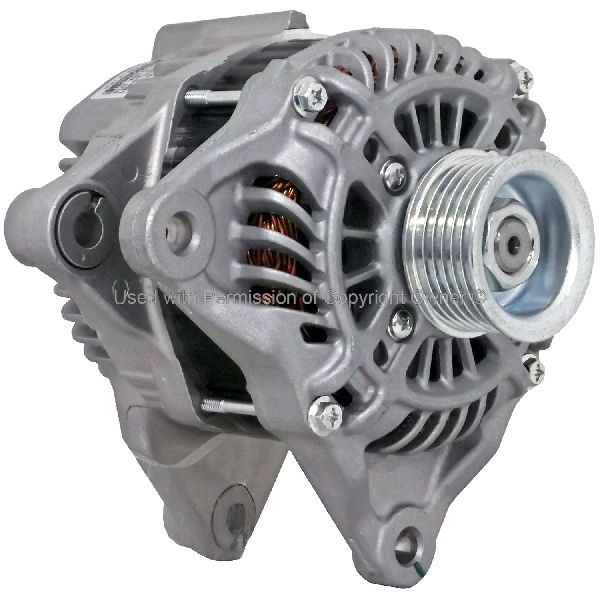
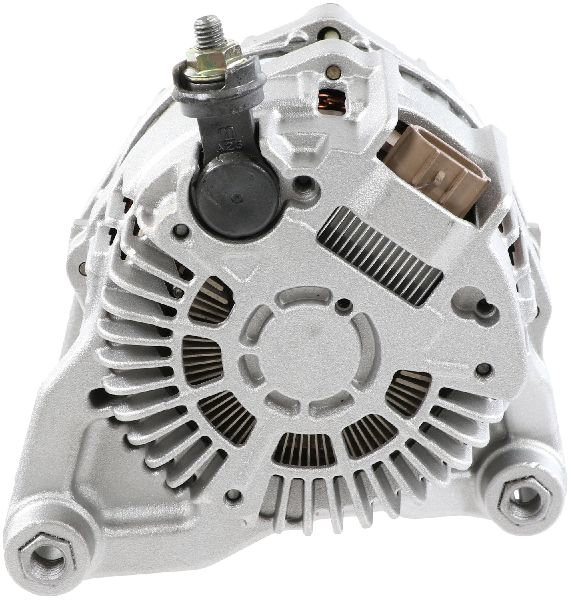
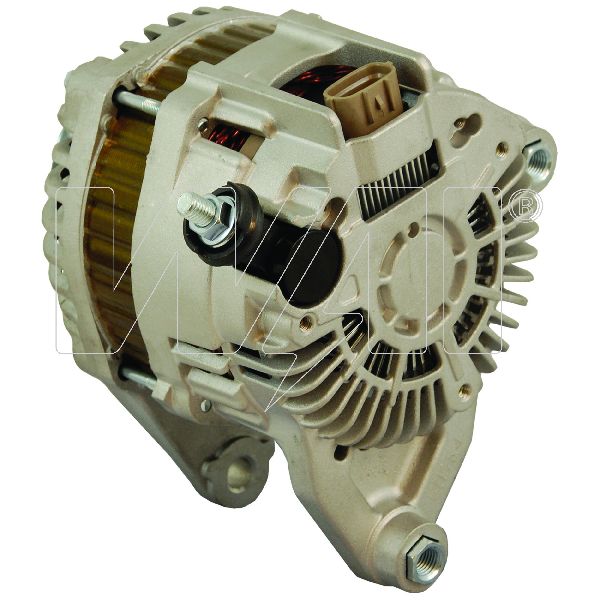
Typical fix: Replace the entire alternator assembly. Note: The alternator for standard models (e.g., Mitsubishi PE18-18-300) is different from the variable-voltage alternator used in i-ELOOP models (e.g., Mitsubishi QK5A-18-300); they are not interchangeable.
Est. part cost: $400-$700 - Failing i-ELOOP Capacitor 🟡 Medium Probability This only applies to models with the i-ELOOP system. These capacitors are a known failure point as the vehicle ages (typically 6-7+ years), leading to voltage instability and charging system warnings.
How to confirm: Diagnosis is complex and best left to a professional. It involves checking for i-ELOOP specific codes (like P1794), monitoring system data with an advanced scan tool, and potentially disconnecting the capacitor to see if voltage stabilizes. A Reddit user noted their mechanic confirmed the issue by disconnecting the capacitor and observing stable voltage.
Typical fix: Replace the i-ELOOP capacitor. This is an expensive part and requires specific procedures for safe handling and system recalibration.
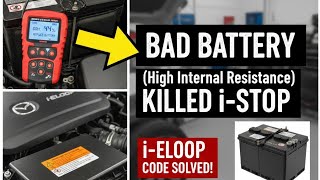
Est. part cost: $850-$1200 - Incorrect or Failing Battery 🟡 Medium Probability Mazda 6 models with i-Stop and i-ELOOP require a specific Q85 Enhanced Flooded Battery (EFB). Using a conventional lead-acid or even a standard AGM battery can cause severe electrical problems and system instability. A failing battery with high internal resistance can also cause voltage regulation issues.
How to confirm: Verify the installed battery is the correct Q85 EFB type. Perform a load test on the battery at an auto parts store or with a dedicated tester. A battery that fails a load test should be replaced. A professional scan tool can also measure the battery's internal resistance.
Typical fix: Replace the battery with the correct OEM-specified Q85 EFB battery. After replacement, the system may require an initialization or adaptation procedure using a scan tool to inform the Battery Management System of the new battery.
Est. part cost: $250-$500
Rare But Worth Checking
- Corroded or Loose Wiring/Grounds: A poor connection at the battery terminals, alternator, or a chassis ground can cause high resistance and lead to erroneous voltage readings by the PCM. Always check the basics first.
- Faulty Powertrain Control Module (PCM): This is very rare. The PCM's internal voltage sensing circuit can fail, causing it to misread the system voltage. This should only be considered after all other possibilities have been exhaustively ruled out.
Diagnosis Steps
- Identify Your System: Determine if your Mazda 6 has the i-ELOOP system. This is often indicated on a badge or within the vehicle's infotainment system menus. This is the most critical first step.
- Check for Other Codes: Use an OBD-II scanner to check for any other stored codes, especially i-ELOOP specific codes like P1794.
- Measure System Voltage: With the engine running, use a multimeter to measure the DC voltage directly at the positive and negative battery terminals. A reading consistently above 15.0V confirms an overcharging condition. The specific threshold for this code on a Mazda is greater than 16.0V.
- Inspect Battery and Terminals: Check that the battery terminals are clean and tight. Verify that the correct battery type (Q85 EFB for i-Stop/i-ELOOP models) is installed.
- Load Test the Battery: Have the battery professionally load-tested to rule it out as a cause, even if it's the correct type.
- Inspect Alternator and Wiring: Visually inspect the alternator, its drive belt, and all related wiring for damage, corrosion, or loose connections.
- Professional Diagnosis (Especially for i-ELOOP): If the basics check out, especially on an i-ELOOP model, professional diagnosis is required. A technician can monitor live data from the charging system using the Mazda M-MDS tool and safely test the variable-voltage alternator, capacitor, and DC-DC converter to pinpoint the fault.
Parts You'll Likely Need
- Alternator (Standard, non-i-ELOOP)
(OEM #PE18-18-300)— The most common cause of P0563 is a failed internal voltage regulator within the alternator.
Trusted brands: Mitsubishi (OEM), Denso, TYC, Duralast
OEM price range: $500-$700
Aftermarket price range: $250-$450 - Alternator (Variable Voltage, for i-ELOOP)
(OEM #QK5A-18-300)— The specific alternator required for i-ELOOP models, which can fail and cause overcharging.
Trusted brands: Mitsubishi (OEM)
OEM price range: $600-$850 - i-ELOOP Capacitor
(OEM #GKH8-67-ZC0D)— A known failure point on i-ELOOP equipped models that causes voltage instability.
Trusted brands: Mazda (OEM)
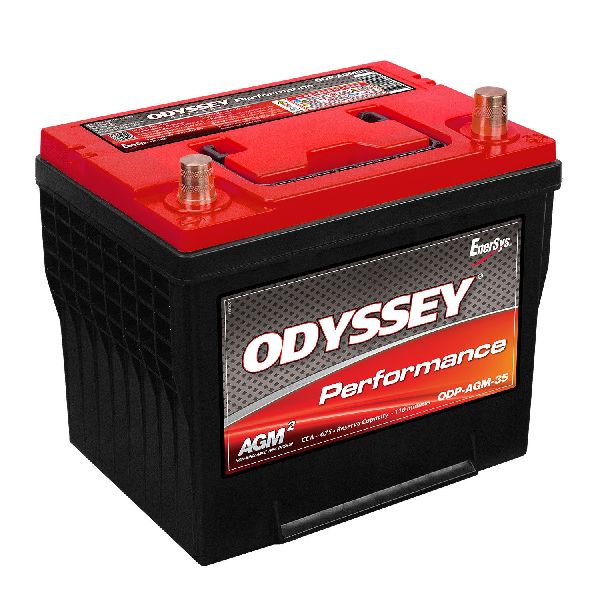
OEM price range: $850-$1200 - Q85 EFB Battery
(OEM #PE1T-18-520-9B)— The required battery type for models with i-Stop or i-ELOOP. Using the wrong type will cause system malfunctions.
Trusted brands: Mazda (OEM), Amaron, Bost
OEM price range: $400-$500
Aftermarket price range: $250-$350
Related Codes That Often Appear With This One
- P1794 — On i-ELOOP equipped models, this code indicates a malfunction in the capacitor system, which can be the root cause of the voltage instability that triggers P0563.
- P0C7A, P0C7B, P0C7C, P0C7D, P0C7E — These are all i-ELOOP specific codes related to the capacitor and its control module, often appearing alongside P0563 on equipped vehicles.
Technical Service Bulletins (TSBs) & Recalls
- TSB 01-011/16: While not directly for P0563, this TSB addresses misfire codes (P0300-P0304) in cold temperatures caused by frozen water in the muffler restricting exhaust flow. This highlights a separate, known issue that could occur on the same vehicle.
Platform-Specific Known Issues
- Failure of the i-ELOOP capacitor is a notable issue on higher-mileage or older (6-7+ years) Mazda 6 models, leading to expensive repairs. Owners in a Singapore-based forum note this is a very common failure in hot climates.
- Using an incorrect battery type (non-EFB) in cars with i-Stop/i-ELOOP is a common owner mistake that can cause dangerous symptoms like the vehicle shutting down while driving or persistent dashboard warnings.
- Some owners have attempted to replace the Q85 EFB battery with a standard AGM battery and encountered persistent 'Battery Management System Malfunction' warnings.
Mechanic-Grade Diagnostic Values
- System Voltage (PCM Detection Threshold) — expected: < 16.0 Volts. Failure: If the PCM monitors battery voltage of more than 16 V, it determines a malfunction and stores P0563.
- i-ELOOP Variable Alternator Output — expected: 12V to 25V. Failure: The alternator's output is controlled by the PCM based on the capacitor's state of charge. A failure in the control circuit or regulator can cause a fixed, high-voltage output.
- Battery Load Test (Q85 EFB) — expected: > 9.6 Volts under load. Failure: A reading below 9.6V during a load test indicates a failing battery that cannot properly support the charging system.
Hidden / Shadow Codes Worth Checking
- CAP_SYS_13 (PID): This is a Mazda-specific Parameter ID (PID), not a DTC. It indicates the status of the capacitor system. A Mazda service bulletin for DTC P1794 uses the value of this PID to determine the diagnostic path. (see via Mazda M-MDS (Mazda Modular Diagnostic System) or an advanced scan tool with manufacturer-specific data streams like FORScan.)
- CAP_SYS_16 (PID): Another Mazda-specific PID used in diagnosing i-ELOOP faults. A service bulletin uses the ON/OFF status of this PID to direct repair procedures for DTC P1794. (see via Mazda M-MDS (Mazda Modular Diagnostic System) or an advanced scan tool with manufacturer-specific data streams.)
Scan Tool Commands That Help
- Mazda M-MDS or equivalent (e.g., FORScan): PCM Reprogramming — A Mazda Technical Service Bulletin (01-001/14) specifies reprogramming the PCM as a fix for certain vehicles experiencing DTC P1794, which is often related to the P0563 fault on i-ELOOP models.
- Mazda M-MDS or equivalent (e.g., FORScan): Battery Adaptation/Reset — After replacing the Q85 EFB battery, this function must be performed to reset the battery monitoring system's learned values and prevent erroneous 'Battery Management System Malfunction' warnings.
Real Owner Repair Stories
- Reddit user in /r/mazda (2017 Mazda 6 GL 2.5L with i-ELOOP) — Engine idle RPM fluctuating up and down when stopped, car vibrates in sync with RPM drop, pulsating interior cabin lights, i-stop green icon flickering above 3k RPM, 'ieloop charging' message appears briefly on startup.
❌ Tried (didn't work) The user was experiencing symptoms but had not yet tried any fixes before taking it to a professional.
✅ What actually fixed it The workshop diagnosed unstable voltage that stabilized once the i-ELOOP capacitor was disconnected. The final fix was replacing the i-ELOOP capacitor with a new one, which resolved all symptoms.
OEM Part Supersession History
GKH8-67-ZC0, GKH8-67-ZC0A, GKH8-67-ZC0B, GKH8-67-ZC0C→GKH8-67-ZC0D— Progressive revisions by the manufacturer to improve reliability or address failure modes.
Heads up: While older versions may be found, it is critical to use the latest available part number (GKH8-67-ZC0D) for replacement to ensure the most updated design.PE01-18-300R-00→PE01-18-300— The 'R00' part number typically denotes a remanufactured unit. PE01-18-300 is the part number for a new OEM alternator for non-i-ELOOP models.
Model Year Variations Within This Range
- 2016-2017: The 2016 model year introduced a major interior refresh, featuring a new dashboard design with a 'tacked-on' tablet-style infotainment screen and an electronic parking brake. The 2014-2015 models had a smaller, integrated screen. The 2017 model further added an updated steering wheel design.
- 2014-2015: Early production 2014-2015 models with i-ELOOP were subject to a TSB (01-001/14) requiring a PCM software update to fix erroneous capacitor-related fault codes (P1794).
Diagnostic Flowchart
Other Known Issues on This Vehicle
Issues unrelated to this code that are worth knowing about as an owner of this generation:
- Intake Valve Carbon Buildup 🟠 Medium — Common on all direct-injection engines, typically requires cleaning every 80,000-120,000 miles. Can cause rough idle and misfires on cold starts.
- Failing Ignition Coils 🟡 Low — A known issue with original YUMEBISHI-produced coils, causing random misfires. Addressed by TSB #01-014-16-3208A. (Ref: TSB #01-014-16-3208A)
- Minor Oil Leaks from Belt Tensioner/Timing Cover 🟡 Low — Seepage from the hydraulic belt tensioner or front timing cover is a common age-related issue but is not typically catastrophic.
- Stuck-Open Thermostat 🟡 Low — Can cause slow engine warm-up and poor heater performance. Mazda offered a warranty extension for this part on some models. (Ref: Warranty Extension)
- Rattling Bose Door Speakers 🟡 Low — Common on Grand Touring models; the speaker diaphragm separates due to corrosion, causing a rattling or distorted sound.
Used vs. New Parts: Buying Guide for This Vehicle
When a used part is the smart pick: A used alternator from a verified low-mileage donor vehicle can be a cost-effective option, as the failure is typically the internal regulator, not the main windings. Other electronic modules like the PCM or DC-DC converter are also candidates for used purchase, as they are not typical wear items.
Donor-vehicle mileage cap: roughly under 70000 miles for the part to have meaningful remaining life.
What to inspect on the donor part:
- For an alternator, check for smooth pulley rotation with no bearing noise or roughness.
- Inspect all electrical connectors for corrosion, melting, or broken plastic.
- Verify the donor vehicle's VIN to ensure it did not have the i-ELOOP system if you need a standard alternator, and vice-versa.
- Ask for a warranty from the salvage yard, even if it's only 30-90 days.
OEM-only on this vehicle (don't cheap out):
- i-ELOOP Capacitor: This is a known wear-and-tear item that degrades with age and cycles. A used capacitor has unknown remaining life and is a significant gamble given the high cost of labor to install it.
- Q85 EFB Battery: The battery management system is calibrated for the specific performance of the OEM-type EFB battery. Using non-specified aftermarket batteries is a well-documented cause of system malfunctions.
Aftermarket brands forum-validated for this vehicle:
- Denso (For standard alternator, as they are often the OEM supplier)
Brands owners have reported issues with on this vehicle:
- No-name, unbranded 'new' alternators from online marketplaces. These often have poor quality voltage regulators that can fail quickly or produce unstable voltage.
Real Owner Stories
Aggregated from forums and TSBs cited above. Mileages and costs reflect what owners reported in those sources.
2014 Mazda 6 Grand Touring 2.5L (w/ Tech Package)
Symptoms: Owner experienced electrical problems after replacing the OEM Q85 EFB battery with a standard AGM battery.
What fixed it: The owner warned that the Q85 EFB battery is required and standard AGM batteries cause continued electrical issues.
Source hint: Reddit: r/mazda - Thread titled '2014 Mazda6 Grand Touring w/ Tech Package Q85 Battery Issue - Do not buy AGM battery instead...'
2014-2017 Mazda 6 2.5L i-ELOOP — ~100000 miles
Symptoms: Fluctuating idle RPM, engine vibrating, and pulsating interior lights.
What fixed it: A mechanic confirmed the i-ELOOP capacitor was the fault by disconnecting it and observing that the voltage stabilized.
Source hint: Reddit: r/mazda6 - Thread titled 'i-ELOOP capacitor failure' (Nov 2024)
2014-2017 Mazda 6 2.5L i-ELOOP
Symptoms: The 'Battery Management System Malfunction' message appeared on the dash after installing an Optima Yellowtop D35 AGM battery.
What fixed it: The message cleared itself after the car was left overnight.
Source hint: Reddit: r/mazda6 - Thread titled 'i-ELOOP Q85 battery replacement with Optima Yellowtop Details' (Oct 2019)
Related OBD-II Codes
Frequently Asked Questions
Can I use a standard AGM battery in my 2014-2017 Mazda 6 with i-ELOOP?
My 2014 Mazda 6 is showing P0563; is the alternator the same for all models?
Does TSB 01-011/16 explain why my charging system light is on?
Why are my headlights pulsating and my idle vibrating when stopped?
What is the specific voltage threshold that triggers P0563 on a Mazda 6?
Is there a TSB for the ignition coils on my 2015 Mazda 6?
Helpful Videos
Used OEM Parts in Stock


New Aftermarket Parts Available


The information in this article is provided for general reference and educational purposes only. Vehicle specifications, procedures, and part compatibility can vary by production date, trim level, and region. Always consult your vehicle's factory service manual and verify part numbers before purchasing or performing repairs. Safety-critical components such as airbags, seat belts, and braking systems should be installed by a qualified professional.
- Mazda 6:
- 🎬 Helpful Videos
- 🛍️ Shop This Part
- What's Unique About the 2014-2017 Mazda 6
- Symptoms You May Notice
- Most Likely Causes
- Rare But Worth Checking
- Diagnosis Steps
- Parts You'll Likely Need
- Related Codes That Often Appear With This One
- Technical Service Bulletins (TSBs) & Recalls
- Platform-Specific Known Issues
- Mechanic-Grade Diagnostic Values
- Hidden / Shadow Codes Worth Checking
- Scan Tool Commands That Help
- Real Owner Repair Stories
- OEM Part Supersession History
- Model Year Variations Within This Range
- Diagnostic Flowchart
- Other Known Issues on This Vehicle
- Used vs. New Parts: Buying Guide for This Vehicle
- Real Owner Stories
- 2014 Mazda 6 Grand Touring 2.5L (w/ Tech Package)
- 2014-2017 Mazda 6 2.5L i-ELOOP — ~100000 miles
- 2014-2017 Mazda 6 2.5L i-ELOOP
- Related OBD-II Codes
- Frequently Asked Questions
- 🎟️ Get 5% Off