

OBD-II Code P1794: Comprehensive Guide to Battery Power Supply Faults
What P1794 means, its multiple manufacturer-specific definitions, and how to diagnose and fix it like a pro
- P1794 has at least 4 vastly different manufacturer definitions, ranging from a generic PCM power loss to a Dodge speed sensor ground fault or a Land Rover auxiliary battery failure.
- On 2014-2018 Mazda models, a weak 12V battery with high internal resistance (e.g., >4.5mΩ) frequently mimics a failed $1,600 i-ELOOP capacitor, making a professional battery health test mandatory before replacing parts.
- For Dodge and Chrysler vehicles, P1794 indicates a 'Speed Sensor Ground Error' that is almost always fixed by cleaning water out of unsealed transmission connectors and applying $5 dielectric grease.
- Driving with an active P1794 code poses a severe safety risk, as sudden PCM power loss causes immediate engine stalling at any speed.
What Does P1794 Mean?

P1794 indicates the Powertrain Control Module (PCM) detected a malfunction in its dedicated, constant power supply circuit. This unswitched 'keep-alive' battery power is crucial for the PCM to retain memory for settings, sensor calibrations, and learned values. When this power feed is interrupted, unstable, or drops below expected voltage, the code triggers. However, the meaning of this code varies dramatically between car manufacturers.
Technical definition: The generic SAE/OBD-II definition for P1794 is "Powertrain Control Module Battery Direct Power Circuit Malfunction". Manufacturer definitions diverge significantly: Mazda defines it as "Capacitor (i-ELOOP) System Malfunction"; Chrysler/Dodge/Jeep as "Speed Sensor Ground Error"; Jaguar/Land Rover as a Transmission Control Module (TCM) "Battery Supply Malfunction"; Honda as a "BARO Sensor Failure"; and BMW as a "TCU Checksum Error".
Can I Drive With P1794?
No — Do Not Drive. Driving is not recommended. The primary risk is the engine stalling unexpectedly at any speed, posing a significant safety hazard. An unstable power supply also causes erratic engine and transmission behavior. Address this code immediately to avoid being stranded or causing an accident.
Common Causes


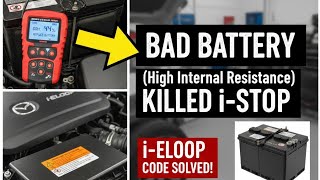
- Weak or Failing Battery (Very Common) — An old battery that cannot hold a proper charge (below 12.4V) or has high internal resistance causes voltage to drop below the PCM's minimum threshold during startup. This is the most frequently misdiagnosed cause for Mazda's i-ELOOP-related P1794. 🎬 Watch: Why a bad battery triggers Mazda i-Stop and P1794 codes.
- Loose, Corroded, or Damaged Battery Terminals/Cables (Very Common) — If the connections at the battery posts are dirty, loose, or rusted, the PCM cannot receive the steady voltage it needs to operate.
- Moisture in Connectors (Dodge/Chrysler Specific) (Common) — On Dodge Rams and Chrysler products where P1794 means 'Speed Sensor Ground Error', water from rain or car washes enters unprotected transmission sensor connectors, shorting the ground circuit.
- Blown Main Fuse or Fusible Link (Common) — A specific fuse or fusible link protects the power circuit going to the PCM. If this blows due to a short or age, the computer loses its direct 'keep-alive' power source.
- Damaged Wiring Harness or Poor Ground Connection (Common) — The wire running from the fuse box to the PCM can fray or short, or the PCM's ground connection to the chassis corrodes, creating high resistance and interrupting the circuit.
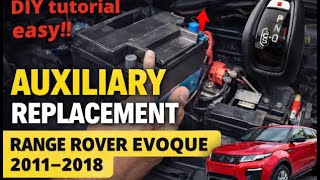
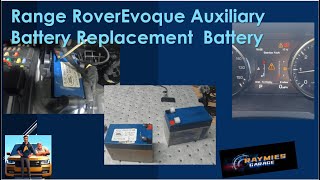
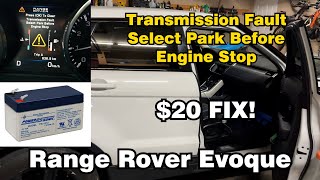
- Failed Auxiliary Battery (Land Rover/Jaguar Specific) (Less Common) — On vehicles like the Range Rover Evoque, a secondary auxiliary battery powers electronics. Failure of this specific battery triggers a P1794 code in the Transmission Control Module (TCM).
- Faulty Alternator or Voltage Regulator (Less Common) — A failing alternator causes undercharging or overcharging conditions (spikes above 15.5V), creating unstable voltage across the entire electrical system that triggers the code, particularly in Jaguars.
- Failed i-ELOOP Capacitor (Mazda Specific) (Rare) — On specific Mazda models with the i-ELOOP system, this code points to a failure of the large capacitor used for regenerative braking. Only consider this after definitively ruling out the 12V battery.
- Faulty Ignition Switch (Rare) — A faulty ignition switch causes intermittent power loss to the PCM and other modules, triggering a P1794 code along with other seemingly unrelated electrical issues.
Symptoms

- Check Engine Light is On — This is the first and only symptom the driver notices for the generic power supply fault.
- Engine Stalls Intermittently or No-Start — The engine shuts off unexpectedly while driving or when coming to a stop because the PCM loses power. It also cranks but refuses to start.
- 'Gearbox Fault' or Transmission Warning Light — On Land Rover and Jaguar vehicles, P1794 is stored in the TCM and illuminates a transmission-specific warning on the dash, even though the root cause is electrical.
- i-ELOOP and i-Stop System Disabled (Mazda) — On affected Mazda vehicles, a warning message like "i-ELOOP Inspection Required" appears, and the auto start-stop system disables itself.
- Erratic Electrical Behavior — Dashboard lights flicker, gauges act strangely, the radio loses presets, and multiple unrelated fault codes appear simultaneously.
- Harsh or Erratic Transmission Shifting — Because the PCM or TCM loses power or receives incorrect sensor data (as in the Dodge case), the transmission shifts harshly, gets stuck in limp mode, or delays engagement.
Diagnostic Flowchart
Tap your situation to follow the diagnostic path that matches what you're seeing on this code.
Common Fixes & Costs
- Replace Battery — Parts: $150-$350, Labor: $50-$100, ~0.5 hr book time (DIY)
- Clean or Replace Battery Terminals/Cables — Parts: $5-$50, Labor: $50-$120, ~0.5 hr book time (DIY)
- Replace Auxiliary Battery (Land Rover) — Parts: $50-$150, Labor: $100-$200, ~1.2 hr book time (Intermediate)
- Repair Transmission Sensor Connector/Wiring (Dodge) — Parts: $10-$95, Labor: $100-$250, ~1.5 hr book time (Intermediate)
- Replace Blown Fuse or Fusible Link — Parts: $5-$30, Labor: $0-$50, ~0.2 hr book time (DIY)
- Reprogram PCM (Mazda per TSB) — Parts: $0, Labor: $100-$200, ~1 hr book time (Professional)
- Replace i-ELOOP Capacitor (Mazda) — Parts: $725-$1600, Labor: $200-$400, ~2.5 hr book time (Professional)
Used vs. New Parts: Buying Guide
When a used part is worth it: For the Mazda i-ELOOP capacitor, a used part from a low-mileage, accident-damaged vehicle is a cost-effective option given the high price of a new OEM unit ($1600+). However, it carries high risk.
Donor-vehicle mileage cap: roughly under 60000 miles for the part to have meaningful remaining life.
Donor quality checklist:
- Verify the donor vehicle was not scrapped due to i-ELOOP or electrical system failure.
- Match the part number exactly (e.g., GKH8-67-ZC0D). Superseded part numbers contain important internal updates.
- Inspect photos of the part and connectors for corrosion or physical damage.
Decision logic:
- If The vehicle is a high-value, long-term keeper. → Buy a new OEM capacitor. The risk of a used part failing is too high.
- If The vehicle is older, has high mileage, and the budget is tight. → A used capacitor is a viable option, but accept the risk that it has a limited remaining lifespan.
- If The part is a main battery or auxiliary battery. → Always buy new. The savings on a used battery are negligible and not worth the risk of being stranded.
Warranty tradeoff: Used parts from salvage yards typically have a 30-90 day warranty covering only the part. A new OEM part installed by a dealer includes a 12-month/12,000-mile warranty on both part and labor.
Worst-case if a used part fails: $400-$600 (Labor to remove the failed used part and install another one, plus the cost of the replacement part.)
What Happens If You Wait — Timeline
- 0-1 month: Check Engine Light is on. For generic faults, the vehicle occasionally hesitates to start. For make-specific faults (Mazda, Land Rover), warning messages like 'i-ELOOP Inspection Required' or 'Gearbox Fault' appear. The risk of stalling is present but infrequent. (MPG impact: 0-5%% · Added cost: $0-$150 (Potential towing cost))
- 1-3 months: Engine stalling becomes frequent and unpredictable, posing a significant safety risk. Electrical gremlins like flickering lights appear. On Mazda, i-ELOOP is disabled, increasing fuel consumption. On Dodge, transmission shifting becomes noticeably harsh. (MPG impact: 5-10%% · Added cost: $100-$400 (Wasted fuel, increased risk of accident))
- 3-6 months: Chronic low or unstable voltage puts significant strain on other components. The alternator is forced to work harder, shortening its lifespan. On Dodge, continued harsh shifting causes premature wear on transmission clutch packs. (MPG impact: 5-15%% · Added cost: $400-$1000 (Potential alternator replacement, increased transmission wear))
- 6+ months: The risk of catastrophic failure of other electronic modules, including the PCM itself, increases significantly due to sustained unstable voltage or voltage spikes. A complete no-start condition becomes highly likely. (MPG impact: 10-20%% · Added cost: $800-$2500+ (Potential replacement of PCM, TCM, or other modules))
Cost of Not Fixing It
- Immediate: High risk of engine stalling in traffic, potentially causing an accident. Vehicle fails to start, leaving you stranded. (Added cost: $100-$250 (Towing))
- 1-6 months: On Mazda, disabled i-ELOOP/i-Stop leads to a 5-10% decrease in fuel economy. On Dodge, continued erratic shifting causes premature wear on transmission components. On Jaguar, an over-voltage fault damages expensive electronic modules. (Added cost: $50-$500 (Fuel, potential module replacement))
- 6+ months: Chronically low or unstable voltage shortens the lifespan of the PCM and other control modules. A weak battery puts extra strain on the alternator. (Added cost: $500-$2000 (Alternator replacement, PCM replacement))
Diagnosis Steps

- Check for Technical Service Bulletins (TSBs)
Search for TSBs related to P1794 for your specific make, model, and year. Manufacturers release bulletins for known issues, such as Mazda's TSBs 01-001/14 and R078/17A, which provide a direct path to the fix.
Tools: Internet access (Beginner) - Test the Battery and Charging System
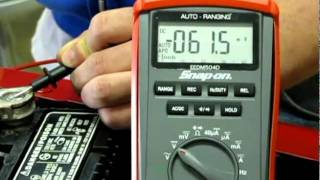
Use a multimeter to check battery voltage with the engine off; a healthy battery reads 12.4-12.8V. Start the engine; charging voltage must be 13.5-14.8V. For a definitive test, use a battery analyzer to check its State of Health (SOH) and internal resistance. High internal resistance is the primary hidden cause on Mazdas.
Tools: Multimeter, Electronic Battery Tester (Beginner) - Visually Inspect Battery and Terminals
Look at the battery terminals for white or greenish corrosion. Check that the cable clamps are tight and do not move. Clean any corrosion and tighten connections.
Tools: Wire brush, battery terminal cleaner, wrench (Beginner) - Inspect Fuses and PCM Power Connector
Check the main fuse box for the PCM/ECU fuse and any related fusible links. Pull the fuse and visually check if it is broken. Locate the PCM and inspect its main electrical connector for corrosion, moisture, or pushed-out pins.
Tools: Fuse puller or pliers, flashlight (Intermediate) - Perform a Voltage Drop Test (Pro Tip)
Place the red lead of your multimeter on the positive battery post and the black lead on the PCM's power input pin. With the key on, the reading must be less than 0.2 volts. A higher reading indicates high resistance in the wiring that requires repair.
Tools: Multimeter, vehicle-specific wiring diagram (Advanced) - Test PCM Ground Circuit Integrity
Perform a ground-side voltage drop test: with the key on, place the red lead on the PCM ground pin and the black lead on the negative battery post. The voltage reading must be less than 0.1 volts. A higher reading indicates a poor ground connection.
Tools: Multimeter, vehicle-specific wiring diagram (Advanced) - Analyze Scan Tool Live Data (Mazda i-ELOOP Pro Tip)
Using a Mazda-specific scan tool, monitor the i-ELOOP PIDs. Check 'CAP_SYS_13' and 'CAP_SYS_16'. If 'CAP_SYS_16' is ON for a 2014 Mazda6/3, TSB 01-001/14 requires a PCM reflash. If 'CAP_SYS_13' is ON, it points to a capacitor capacitance malfunction. The capacitor voltage must vary between 12-25V during operation.
Tools: Mazda-specific scan tool (M-MDS) (Professional) - Test Speed Sensor Ground Circuit (Dodge/Chrysler)
Disconnect the PCM and transmission sensor connectors. Measure the resistance of the (T13) Speed Sensor Ground circuit between the PCM connector and the sensor connectors. Resistance must be below 5.0 Ohms. Measure resistance between the (T13) ground circuit and chassis ground; a reading below 5.0 Ohms indicates a short to ground.
Tools: Multimeter, vehicle-specific wiring diagram (Advanced) - Check BARO Sensor Voltage (Honda)
Connect a diagnostic scanner and monitor the BARO sensor voltage. A normal reading is below 4.5V. A reading stuck high (e.g., 4.95V or higher) confirms a circuit high fault, pointing to a sensor or wiring issue.
Tools: Honda-compatible diagnostic scanner (HDS) (Advanced) - Perform a Harness Wiggle Test
With the engine running, monitor the voltage at the PCM power pin with a multimeter. Gently wiggle the wiring harness leading to the PCM, the fuse box, and the battery. If voltage fluctuates, isolate and repair the intermittent open or short in the harness.
Tools: Multimeter (Intermediate)
When This Code Triggers (Freeze-Frame Conditions)
- Module Voltage: <11.8V or >15.5V (The most critical parameter. For the generic fault, the code sets at key-on or during engine cranking when voltage drops below the PCM's threshold (e.g., 9.5V). For Jaguar, it sets from over-voltage (>15.8V). For Mazda's P1794:16, it sets if voltage drops below 6.5V for 5 seconds.)
- Engine RPM: 0 or <200 RPM (For the generic power supply fault, the code triggers during a key-on, engine-off (KOEO) self-test or during a low-voltage cranking event before the engine starts.)
- Vehicle Speed: Variable (For Dodge/Chrysler's 'Speed Sensor Ground Error', the code sets while driving when the PCM expects a valid speed signal but detects a ground fault instead.)
- Engine Run Time: <10 seconds (The fault is detected shortly after the ignition turns on as the PCM performs its initial power-on self-tests and checks its keep-alive memory circuit.)
Related Codes
- P0562 — Means 'System Voltage Low'. It often appears with P1794. P1794 is specific to the PCM's constant power supply, while P0562 sets when the PCM sees low voltage while the ignition is on. Having both strongly points to a failing battery or alternator.
- U0100 — Means 'Lost Communication With ECM/PCM'. This is a symptom, while P1794 is the cause. If the PCM loses power from the P1794 fault, other modules cannot talk to it and log U0100. Fixing P1794 resolves U0100.
- P2502 — 'Charging System Voltage Low'. On Mazda vehicles, this code frequently stores alongside P1794 when there is a problem with the i-ELOOP system, the alternator, or the battery.
- P1794:00, P1794:13, P1794:16 (Mazda) — Manufacturer-specific sub-codes. P1794:00 is a general i-ELOOP malfunction. P1794:13 indicates an open circuit in the capacitor system. P1794:16 means the start-stop unit has low voltage (below 6.5V), pointing toward a battery or fuse issue.
Climate & Environmental Factors
- High Humidity / Rain: High humidity and rain are significant factors. For Dodge/Chrysler vehicles, moisture ingress into transmission connectors is the primary cause of the 'Speed Sensor Ground Error'. For Mazda, heavy rain causes belt slippage that the PCM misinterprets as a capacitor failure. Humidity accelerates corrosion on battery terminals, increasing resistance.
- Cold Weather: Cold temperatures reduce a battery's efficiency and available cranking amps. A battery with high internal resistance drops below the PCM's minimum voltage threshold during a cold start, triggering a P1794 fault. This is especially true for voltage-sensitive systems like Mazda's i-ELOOP.
- Altitude: For Honda models where P1794 relates to the BARO (barometric pressure) sensor, altitude is a direct factor. A faulty sensor fails to adjust correctly for changes in altitude, making the fault more apparent at higher or lower elevations.
How to Talk to a Mechanic About This Code
Say this: "I have a P1794 code and I'd like to schedule a diagnostic appointment. Based on my vehicle [INSERT MAKE, e.g., Mazda/Dodge/Land Rover], I suspect it's a [INSERT SUSPECTED CAUSE, e.g., 'weak 12V battery', 'wet transmission connector', 'failed auxiliary battery']. Please start by testing that specific component before diagnosing more expensive parts."
This signals you are an informed consumer and directs the technician to the most likely, and often cheapest, cause first. It prevents common misdiagnoses, like a shop quoting an expensive Mazda capacitor replacement before testing the 12V battery, or a transmission rebuild on a Dodge before checking the wiring.
Avoid saying:
- 'My check engine light is on, can you look at it?' (This is too vague and invites a costly, broad diagnosis).
- 'Just fix whatever is wrong.' (This gives the shop a blank check to replace parts without your approval).
- 'My car is acting weird, I think it's the transmission.' (This causes 'diagnosis bias' where the tech only looks at expensive transmission parts, ignoring the more likely electrical cause of P1794).
Questions to ask before authorizing the repair:
- For a Mazda: Can you show me the printout from the professional battery tester showing the State of Health and internal resistance of my 12V battery?
- For a Dodge/Chrysler: Did you inspect the transmission wiring harness connectors for moisture or corrosion before recommending any part replacements?
- For a Land Rover: Did you test the small auxiliary battery in addition to the main battery?
- For any make: Can you explain how you isolated the fault to this specific component and ruled out a wiring or fuse issue?
- What is the warranty on both the parts and the labor for this repair?
Where to Take It: Dealer vs Independent vs Chain
- Dealer:
Recommended for Mazda i-ELOOP, Land Rover, and Jaguar issues to ensure access to specific tools and knowledge. For generic P1794, it is an expensive but reliable option.
Best for: Vehicles under warranty., Manufacturer-specific quirks requiring special tools or TSBs, like a Mazda PCM reflash or i-ELOOP capacitor diagnosis., Complex electrical issues on newer European brands like Land Rover or Jaguar.
Downsides: Highest labor rates., May be quicker to replace a module or assembly rather than perform a more detailed wiring repair. (Typical cost: +50% vs. baseline) - Independent Shop:
Best overall choice for most P1794 scenarios, especially the generic power fault and the Dodge 'wet connector' issue. Ensure the shop has strong electrical diagnostic capabilities.
Best for: Out-of-warranty vehicles., Generic P1794 faults (battery, fuse, wiring)., Make-specific independent shops (e.g., a trusted European car specialist for a Land Rover) are as good as a dealer.
Downsides: Quality and expertise vary widely; look for ASE certifications and good reviews on electrical diagnostics., May not have the expensive, manufacturer-specific scan tools needed for some P1794 variants. (Typical cost: +0% vs. baseline) - Chain Shop:
AVOID for diagnosing P1794. Use them only for a free battery test as a first step, but do not authorize any further diagnostic work for this specific code.
Best for: Free battery testing to start your diagnosis., Selling you a new battery or cleaning terminals.
Downsides: Technicians are often not equipped or trained for complex electrical diagnosis beyond basic parts replacement., High risk of misdiagnosis (e.g., condemning the Mazda capacitor) and upselling unnecessary services. (Typical cost: -10% vs. baseline)
When to Walk Away From the Repair
If the estimated repair cost exceeds 40-50% of the car's current private-party value, pause and seriously consider selling or trading in the vehicle.
- Car worth $7500, fix is $2200: Fix it. A $2,200 repair for a Mazda i-ELOOP capacitor on a 2014 Mazda 6 worth around $7,500 is about 29% of the car's value, which is below the threshold.
- Car worth $3000, fix is $2200: Walk away. The same $2,200 repair on an older, higher-mileage car worth only $3,000 is over 70% of its value. It is not economically sensible to proceed.
- Car worth $4000, fix is $300: Fix it. A $300 repair to replace a Land Rover auxiliary battery or fix a Dodge wiring connector is a small percentage of the vehicle's value and makes perfect sense.
What Scan Tool You Need for This Code
Minimum: A tool that reads and clears codes, and importantly, displays live data, specifically the battery/module voltage. For make-specific faults, you need a scanner that accesses manufacturer-specific codes and modules (TCM, BCM, etc.).
A basic $20 code reader only shows 'P1794' and nothing else. It cannot see the sub-codes on a Mazda (like P1794:16), access the TCM on a Land Rover to confirm the fault, or view the live data needed to see voltage drops.
Budget: BlueDriver Pro Scan Tool (~$99) — Connects to a phone app and reads generic and many manufacturer-specific codes (ABS, SRS, TCM). It provides live data graphing for monitoring battery voltage and repair suggestions based on a large database. A great starting point for any P1794 diagnosis.
Mid-range: Foxwell NT510 Elite (~$170) — This handheld unit comes with one free vehicle manufacturer software package (e.g., Mazda or JLR). It excels at reading manufacturer-specific PIDs, which is essential for diagnosing Mazda's i-ELOOP system by viewing capacitor voltage and status. It performs some bidirectional controls and resets.
Professional: Autel MaxiCOM MK808 (~$500) — A professional-level tablet scanner that accesses all modules on most vehicles. It provides full bidirectional control to activate components, offers advanced functions like battery registration, and performs the PCM reprogramming needed for some Mazda TSBs.
Rent vs buy: Rent for free, but with limitations. Auto parts stores read your codes for free, but their scanners are basic and do not see the specific module or sub-code you need. For a complex, multi-faceted code like P1794, buying at least a budget-level scanner like BlueDriver is highly recommended.
How to Clear the Code After You Fix It
- Reconnect battery if disconnected.
- Use an OBD-II scan tool to clear all Diagnostic Trouble Codes (DTCs).
- Perform a complete drive cycle to allow readiness monitors to run.
Drive cycle (~30 minutes): Start with a cold soak (vehicle off for 8+ hours). Start the engine and idle for 3 minutes. Drive a mix of city and highway speeds, holding a steady 55-60 mph for at least 5 minutes. Allow the vehicle to coast down from highway speed without braking. Total drive time is 20-30 minutes.
Readiness monitors affected: Comprehensive Component Monitor, Misfire Monitor, Catalyst Monitor, EVAP System Monitor
Before emissions retest: drive at least 100 miles to fully set monitors.
Watch out for:
- Disconnecting the battery clears the code but resets all readiness monitors, causing an immediate emissions test failure.
- The code returns immediately if the underlying electrical fault is not properly fixed.
- Skipping the 'cold soak' prevents the EVAP monitor from running.
Will This Fail Emissions / State Inspection?
Yes — this code typically fails an OBD-II emissions inspection.
- California: An active P1794 code with the Check Engine Light on is an automatic failure. After repair, all readiness monitors must be 'Ready'. You must drive 100-200 miles and complete multiple drive cycles before re-testing.
- New York: The NYS inspection includes an OBD-II scan. An illuminated Malfunction Indicator Lamp (MIL) for code P1794 results in an automatic inspection failure.
- Texas: In the 17 Texas counties requiring emissions testing, an active P1794 code causes the vehicle to fail the OBD-II portion of the state inspection.
Most Commonly Affected Vehicles
- Mazda 6, 3, CX-3, MX-5 (2014-2018) — Models with i-ELOOP are highly susceptible. TSB 01-001/14 addresses a PCM software issue on 2014 Mazda3/6 models. Often misdiagnosed as a capacitor failure when the true cause is a weak battery.
- Dodge/Chrysler/Jeep Ram 1500/2500, Neon, models with 45RFE/545RFE/62TE transmissions (1999-2011) — Defines P1794 as 'Speed Sensor Ground Error'. Triggered by moisture in transmission harness connectors after rain or a car wash, requiring cleaning and the application of dielectric grease.
- Land Rover Range Rover Evoque (2012-2018) — P1794 is stored in the TCM, causing a 'Gearbox Fault' message. The fix is frequently replacing the small auxiliary battery, not a major transmission or main battery issue.
- Jaguar XF, XJ, Various (2007-2015) — P1794 is a TCM code for 'Battery Supply Malfunction'. It triggers from either low voltage or an over-voltage condition (>15.8V) from a faulty alternator, causing a 'Gearbox Fault' and limp mode.
- Honda Accord, Odyssey, various V6 models (2003-2012) — Indicates a 'BARO Sensor Failure' within the transmission on V6 models or a communication failure between the body control module and the ECM.
- BMW Various (E60, E90 chassis) (2002-2010) — Defined as a Transmission Control Unit (TCU) checksum error, indicating an internal data verification problem within the transmission's computer.
- Ford Various (2000-2020) — Aligns with the generic 'Battery Voltage Circuit Malfunction' definition. Diagnosis focuses on the battery, terminals, fuses, and wiring to the PCM.
- Chevrolet / GMC Various (2000-2020) — Uses the generic P1794 definition. Troubleshooting involves standard electrical diagnosis of the PCM's power and ground circuits.
Manufacturer-Specific Notes
- Mazda: P1794 is highly specific to the i-ELOOP system. It is frequently misdiagnosed as a failed capacitor ($2000+ repair) when the true cause is a weak 12V battery with high internal resistance. Always perform a professional battery health test first. A safety recall (13V551000) was issued for some 2014 models to reprogram the PCM, as belt slippage in heavy rain was misidentified as a capacitor failure.
- Chrysler/Dodge/Jeep: P1794 means 'Speed Sensor Ground Error'. It is not a battery voltage issue. The most common cause is moisture entering unsealed transmission wiring connectors, especially after rain or car washes. The fix is cleaning the connectors and applying dielectric grease.
- Land Rover/Jaguar: On models like the Evoque and Jaguar XF/XJ, P1794 logs in the Transmission Control Module (TCM) and triggers a 'Gearbox Fault' message. The cause is the failure of the small auxiliary battery (Land Rover) or an over-charging alternator (Jaguar), not a primary transmission fault.
- Honda: P1794 has two distinct meanings. On some V6 models, it points to a fault with the barometric pressure (BARO) sensor located inside the automatic transmission. On others, it indicates a communication breakdown between the body control module and the engine computer (ECM).
- BMW: P1794 translates to a 'TCU Checksum Error'. This indicates an internal self-check failure within the transmission control unit, pointing towards a potential internal TCU fault rather than an external power supply issue.
Real Owner Stories
2014 Mazda 6 with i-ELOOP
Owner saw 'i-ELOOP Inspection Required' and 'Battery Management System Inspection Required' warnings. The i-stop system stopped working. Code P1794 was present.
What they tried:
- A shop initially suspected the expensive i-ELOOP capacitor was faulty.
- A second opinion was sought, and a professional battery test was performed.
Outcome: The 12V battery test revealed a high internal resistance (4.5mΩ) and a low State of Health (44%). The battery was replaced with a new, correctly rated one, and the battery system was reset. This cleared the P1794 code and restored all functions.
Lesson: On a Mazda with P1794, always professionally test the 12V battery's health (internal resistance and SOH), not just its voltage, before considering a capacitor replacement. It is a very common misdiagnosis that saves over $1500.
2004 Dodge Ram 1500 4.7L
For years, the truck shifted hard between 1st and 2nd gear and set a P1794 code, but only when driving in heavy rain or immediately after a car wash.
What they tried:
- A transmission shop couldn't find the issue in dry weather and suggested replacing the controller, which the owner declined.
Outcome: A regular mechanic inspected the transmission's external electrical connectors. He found they were unsealed and lacked dielectric grease. After cleaning the connectors and applying grease to keep moisture out, the problem was completely resolved.
Lesson: For Dodge/Chrysler's P1794 'Speed Sensor Ground Error', the trigger is environmental. If the problem only occurs in wet conditions, the cause is moisture getting into an unsealed wiring connector.
2013 Range Rover Evoque 2.2L SD4
A 'Gearbox Fault' message appeared on the dashboard after starting the engine. A scan tool revealed code P1794 'Battery Supply Malfunction' in the Transmission Control Module (TCM). The vehicle drove and shifted normally.
What they tried:
- The owner first replaced the main 12V battery and registered it, but the fault message immediately returned.
Outcome: Forum advice pointed to the small, secondary auxiliary battery. This battery (Part No. LR024953) is located behind the glove box and powers electronics when the engine is off. The owner replaced this small battery, which resolved the 'Gearbox Fault' message.
Lesson: On a Range Rover Evoque, a 'Gearbox Fault' message combined with P1794 is frequently caused by the failure of the small auxiliary battery, not the main battery or the transmission itself.
How to Prevent This Code From Triggering
- Periodically Clean Battery Terminals (Every 6-12 months or at every oil change) — Corrosion acts as an insulator, increasing resistance and preventing the PCM from getting stable voltage. Cleaning with a wire brush and a baking soda/water solution removes this resistance.
- Apply Protective Coating to Battery Terminals (After every cleaning) — Applying a dedicated battery terminal protectant spray or a thin layer of dielectric grease creates a barrier that seals out moisture and acidic gases, preventing future corrosion.
- Perform a Professional Battery Health Test (Annually after the battery is 3 years old) — A health test measures internal resistance and cold cranking amps. This identifies a weakening battery before it causes voltage-related codes like P1794, preventing you from being stranded.
- Apply Dielectric Grease to At-Risk Connectors (Once, or when connectors are serviced) — On vehicles like Dodge Rams known for P1794 from moisture, applying dielectric grease into the connector's seal waterproofs the connection, preventing the shorts that cause the 'Speed Sensor Ground Error'.
- Ensure Battery is Securely Mounted (Check during every oil change) — A loose battery vibrates excessively, damaging its internal plates and leading to premature failure. Ensuring the hold-down bracket is tight extends battery life.
Frequently Asked Questions
Can I just clear the P1794 code and keep driving?
You can clear it, but it will return. P1794 indicates a persistent fault. Ignoring it is unsafe as it causes the engine to stall at any time, potentially causing an accident.
My Mazda has a P1794 code. Does that automatically mean the expensive capacitor has failed?
No. The i-ELOOP system is extremely sensitive to the health of the 12V battery. Always have the 12V battery professionally tested for high internal resistance before authorizing a $2,000 capacitor replacement.
Why did my Dodge get a P1794 code after a car wash?
On many Dodge, Chrysler, and Jeep vehicles, P1794 means 'Speed Sensor Ground Error'. This is caused by water entering unsealed transmission wiring connectors and shorting the connection. The problem frequently appears in wet weather or after washing the vehicle.
What are the P1794 sub-codes on a Mazda?
Mazda uses sub-codes for specific diagnosis. P1794:00 is a general i-ELOOP malfunction, while P1794:13 points to an open circuit in the capacitor wiring. P1794:16 indicates low voltage at the start-stop unit, suggesting a battery or fuse issue rather than a capacitor failure.
Is P1794 a transmission code?
It depends on the car. For most cars, it is a powertrain (PCM) power supply code. However, on Dodge/Chrysler it points to a transmission speed sensor ground, and on Land Rover/Jaguar it triggers a 'Gearbox Fault' message from the TCM.
The battery is new but the code P1794 came back. What's next?
After confirming the battery is good, inspect the battery cables for corrosion. Next, check the PCM-related fuses. Finally, perform voltage drop and ground resistance tests on the PCM power and ground circuits to locate hidden resistance.
My Range Rover says 'Gearbox Fault' because of P1794. Is my transmission failing?
It is highly unlikely. On a Range Rover Evoque, a 'Gearbox Fault' message with code P1794 is almost always caused by a failing auxiliary battery. Replacing this inexpensive secondary battery usually resolves the issue.
Key Takeaways
- P1794 has at least 4 vastly different manufacturer definitions, ranging from a generic PCM power loss to a Dodge speed sensor ground fault or a Land Rover auxiliary battery failure.
- On 2014-2018 Mazda models, a weak 12V battery with high internal resistance (e.g., >4.5mΩ) frequently mimics a failed $1,600 i-ELOOP capacitor, making a professional battery health test mandatory before replacing parts.
- For Dodge and Chrysler vehicles, P1794 indicates a 'Speed Sensor Ground Error' that is almost always fixed by cleaning water out of unsealed transmission connectors and applying $5 dielectric grease.
- Driving with an active P1794 code poses a severe safety risk, as sudden PCM power loss causes immediate engine stalling at any speed.
Helpful Videos

The information in this article is provided for general reference and educational purposes only. Vehicle specifications, procedures, and part compatibility can vary by production date, trim level, and region. Always consult your vehicle's factory service manual and verify part numbers before purchasing or performing repairs. Safety-critical components such as airbags, seat belts, and braking systems should be installed by a qualified professional.
- 🎬 Helpful Videos
- What Does P1794 Mean?
- Can I Drive With P1794?
- Common Causes
- Symptoms
- Diagnostic Flowchart
- Common Fixes & Costs
- Used vs. New Parts: Buying Guide
- What Happens If You Wait — Timeline
- Cost of Not Fixing It
- Diagnosis Steps
- When This Code Triggers (Freeze-Frame Conditions)
- Related Codes
- Climate & Environmental Factors
- How to Talk to a Mechanic About This Code
- Where to Take It: Dealer vs Independent vs Chain
- When to Walk Away From the Repair
- What Scan Tool You Need for This Code
- How to Clear the Code After You Fix It
- Will This Fail Emissions / State Inspection?
- Most Commonly Affected Vehicles
- Manufacturer-Specific Notes
- Real Owner Stories
- 2014 Mazda 6 with i-ELOOP
- 2004 Dodge Ram 1500 4.7L
- 2013 Range Rover Evoque 2.2L SD4
- How to Prevent This Code From Triggering
- Frequently Asked Questions
- Can I just clear the P1794 code and keep driving?
- My Mazda has a P1794 code. Does that automatically mean the expensive capacitor has failed?
- Why did my Dodge get a P1794 code after a car wash?
- What are the P1794 sub-codes on a Mazda?
- Is P1794 a transmission code?
- The battery is new but the code P1794 came back. What's next?
- My Range Rover says 'Gearbox Fault' because of P1794. Is my transmission failing?
- Key Takeaways
- 🎟️ Get 5% Off