

P0524 on 2011-2023 Chrysler 300 3.6L: Engine Oil Pressure Too Low Causes and Fixes
On a 3.6L Pentastar, code P0524 almost always means a failed oil pressure sensor or a leaking oil filter housing. The original plastic housing cracks from heat, causing a major oil leak in the engine's 'V'. Since the sensor is located under the intake manifold on this housing, it's best to replace the entire housing assembly (upgrading to an aluminum version like Dorman 926-876 or 926-959) and the sensor at the same time. Expect to pay $600-$1200 for a shop to do this.
- P0524 is a critical code. Stop driving immediately to prevent catastrophic engine failure.
- The most likely cause on a Chrysler 300 with the 3.6L engine is a leaking plastic oil filter housing or a failed oil pressure sensor.
- Due to the extensive labor required, it is standard practice to replace the entire oil filter housing assembly (upgrading to aluminum is recommended), the oil pressure sensor, and the intake gaskets all at once.
- Before authorizing expensive repairs, insist that your mechanic verify the true oil pressure with a mechanical gauge to rule out a simple sensor error versus a real, dangerous low-pressure condition.
What's Unique About the 2011-2023 Chrysler 300
On the 3.6L Pentastar V6 engine, the P0524 code is very frequently linked to two specific, well-known failure points. The first is the oil pressure sensor itself, which has a high failure rate. The second, and more significant, issue is the original equipment plastic oil filter housing and cooler assembly. This assembly sits in the hot 'V' of the engine and is notorious for developing cracks and gasket leaks over time. The plastic degrades from constant heat cycles and chemical exposure, causing it to warp and crack, often where it bolts to the aluminum engine block. This leads to oil loss that directly causes low pressure. Because the oil pressure sensor is mounted to this housing and replacing it requires extensive labor (removing intake manifolds), both parts are almost always replaced together.
Generation note: The 2011-2023 Chrysler 300 is part of the second generation (LD). However, the 3.6L Pentastar engine itself has had updates. Notably, the oil filter housing design changed for the 2014 model year. Parts are not interchangeable, so it's crucial to verify the correct part for your specific model year (pre-2014 vs. 2014+). Early Pentastar engines (2011-2013) were also prone to a specific left cylinder head defect and widespread rocker arm/lifter failures ('Pentastar Tick'), which can indirectly lead to oil pressure problems if metal debris clogs oil passages.
Symptoms You May Notice
- Red oil pressure warning light on the dashboard
- Check Engine Light is on
- Engine making unusual noises (ticking, knocking, whining)
- Engine running rough, hesitating, or stalling
- Burning oil smell from the engine bay
- Visible oil leak in the engine valley (top-center of the engine)
- Oil pressure gauge reading zero or an unusually low value
- Replacing only the oil pressure sensor without inspecting or replacing the housing. The high labor cost makes doing the job twice very expensive if the housing fails later.
- Mistaking an oil filter housing leak for a rear main seal leak. Oil from the cracked housing often runs down the back of the engine and drips from the bellhousing, mimicking a rear main seal failure. This is a very common misdiagnosis reported by owners.
Most Likely Causes
- Faulty Oil Filter Housing / Cooler Assembly 🔴 High Probability The original factory part is made of plastic and sits in the hot engine valley. Repeated heat cycles cause it to become brittle, crack, and leak oil. This is a very common failure on the 3.6L Pentastar across all Chrysler, Dodge, and Jeep platforms.
How to confirm: Visually inspect the area under the intake manifold for pooled oil or signs of a significant leak running down the back of the engine toward the transmission bellhousing. This is the most definitive sign.
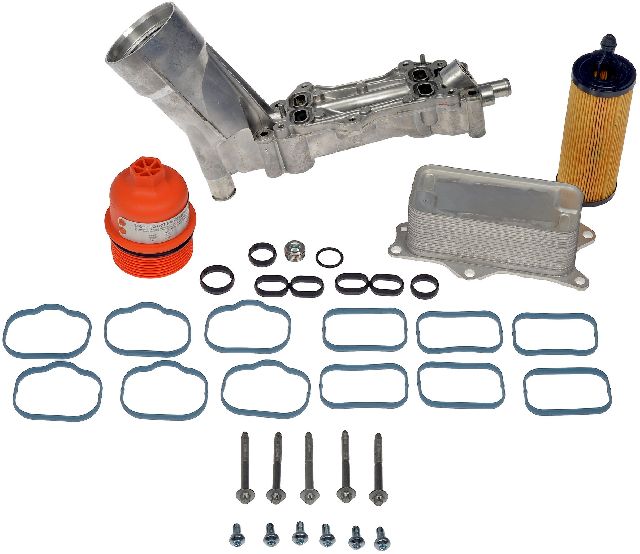
Typical fix: Replace the entire oil filter housing and cooler assembly. It is highly recommended to upgrade to an aftermarket aluminum housing for better durability. The oil pressure sensor and oil temperature sensor should be replaced at the same time due to the shared labor.
Est. part cost: $100-$250 - Faulty Engine Oil Pressure Sensor 🔴 High Probability The sensor is located in a high-heat area on the oil filter housing, leading to a high failure rate. It can fail by sending an incorrect low-pressure signal even when the actual pressure is fine. Sometimes it fails by reading a fixed high value (e.g., 99 PSI) even with the engine off, which can trigger a P0520 code first.
How to confirm: The only way to be certain is to test the engine's oil pressure with a mechanical gauge. If the mechanical gauge shows good pressure but the code is present, the sensor is bad. However, due to its location, it's often replaced preventatively with the housing.
Typical fix: Replace the sensor. This is almost always done during an oil filter housing replacement because the labor to access it is identical and extensive. A revised sensor part was specified in TSB 18-034-14 REV. A.
Est. part cost: $20-$60 - Low Engine Oil Level 🟡 Medium Probability Often a direct result of a leaking oil filter housing. If the oil level drops too low, the oil pump cannot maintain pressure. This is the first and easiest thing to check.
How to confirm: Check the engine oil dipstick. If it is low, top it off and see if the light goes out. However, you must find and fix the source of the leak.
Typical fix: Top off the oil to the correct level and repair the oil leak, which is likely the oil filter housing.
Est. part cost: $20-$40 (for oil) - Incorrect Oil Filter or Viscosity ⚪ Low Probability The Pentastar engine is sensitive to oil flow. Using a cheap or incorrect aftermarket oil filter, or the wrong viscosity oil (manual specifies 5W-20 or 5W-30 depending on year), can restrict flow and trigger a low-pressure code.
How to confirm: Check records to see what oil and filter were used during the last service. If it was not a high-quality Mopar or equivalent OEM-spec filter, this could be the cause.
Typical fix: Perform an oil change using a high-quality Mopar or equivalent OEM-spec filter and the correct 5W-20 or 5W-30 oil (check owner's manual).
Est. part cost: $60-$100
Rare But Worth Checking
- Failing Oil Pump: While less common than sensor or housing issues, the dual-stage oil pump can fail, often getting stuck in the low-pressure stage. This is almost always accompanied by code P06DD ('Engine Oil Pressure Control Stuck Off').
- Worn Internal Engine Components: In very high-mileage engines or engines suffering from rocker arm failure, debris can clog the oil pump pickup tube. Separately, worn crankshaft bearings can increase clearances to the point where the oil pump can no longer maintain pressure. This is a catastrophic failure requiring an engine rebuild or replacement.
Diagnosis Steps
- STOP THE ENGINE IMMEDIATELY. Do not continue to run the engine.
- Check the engine oil level using the dipstick. If it is low, this is a critical clue and the most likely cause is a leak.
- Visually inspect the top of the engine, in the valley between the cylinder heads, for signs of pooled oil. Use a flashlight and mirror. Also check the back of the engine near the transmission bellhousing for drips.
- If the oil level is correct and there are no obvious major leaks, the next step is to verify the actual oil pressure. This MUST be done with a mechanical oil pressure gauge connected to the engine in place of the sensor.
- If mechanical pressure is within spec (typically above 5-6 psi at hot idle and 25-90 psi at 3000 RPM, but check service manual), the problem is electrical (bad sensor, wiring).
- If mechanical pressure is low, the problem is mechanical (low oil level, bad oil pump, clogged pickup tube, or worn engine bearings).
- Given the high failure rate of the oil filter housing and sensor, if any leak is present in the engine valley, it is safe to assume this is the root cause.
- Scan for any other accompanying trouble codes like P0520 or P06DD for more clues.
Parts You'll Likely Need
- Oil Filter Housing and Cooler Assembly
(OEM #2014+: 68105583AF (or newer revisions like AE, AG, AH). 2011-2013: 5184294AE.)— This is the most common failure point leading to oil leaks and the P0524 code. The original plastic part cracks; an aluminum replacement is a recommended upgrade.
Trusted brands: Mopar, Dorman (Aluminum upgrade P/N: 926-959 for 2014+, 926-876 for 2011-2013)
OEM price range: $200-$350
Aftermarket price range: $100-$250 - Engine Oil Pressure Sensor
(OEM #68060337AA, 5149062AA (Verify by VIN, newer revisions exist))— This sensor has a high failure rate and is always replaced during an oil filter housing job due to its inaccessible location. TSB 18-034-14 REV. A called for a revised part.
Trusted brands: Mopar, Standard Motor Products (SMP)
OEM price range: $40-$60
Aftermarket price range: $20-$40 - Intake Manifold Gasket Set (Upper and Lower)
(OEM #Upper: 5184562AC, Lower: 5184331AC)— These gaskets must be replaced when the intake manifolds are removed to access the oil filter housing. They are not reusable.
Trusted brands: Mopar, Fel-Pro
OEM price range: $30-$50
Aftermarket price range: $20-$40
Related Codes That Often Appear With This One
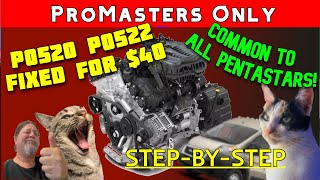
- P0520 — This code for 'Engine Oil Pressure Sensor/Switch Circuit' often appears with P0524 when the sensor itself is failing, as the PCM detects both a general circuit fault and a specific 'too low' condition.
- P06DD — This code means 'Engine Oil Pressure Control Stuck Off' and points to a problem with the Pentastar's dual-stage oil pump failing to switch to high-pressure mode. It can be a direct cause of P0524.
Technical Service Bulletins (TSBs) & Recalls
- TSB 18-034-14 REV. A: Released for 2013-2014 models with the 3.6L engine, this TSB addresses the P0520 code (Engine Oil Pressure Sensor Circuit) by replacing the original sensor with a revised part, acknowledging a known issue with the sensor's reliability.
- TSB 09-002-14 REV. B: Addresses misfires on Bank 2 for 2011-2013 models due to a defective left cylinder head, a separate but major issue for early Pentastar engines.
Platform-Specific Known Issues
- A Technical Service Bulletin (TSB 18-003-08) was issued for earlier model year Chrysler vehicles (including the 2007-2008 300) for a false P0524 code that could be fixed with a PCM software update. While this TSB doesn't cover the 2011+ models, it shows a history of sensor sensitivity on Chrysler products.
Mechanic-Grade Diagnostic Values
- Mechanical Oil Pressure (Engine Warm, at operating temp) — expected: Minimum 5-8 PSI at curb idle; 25-110 PSI at 3,000 RPM.. Failure: Pressure below these minimums confirms a mechanical fault (leak, pump, bearings).
- Oil Pressure Sensor Signal Voltage (Live Data, KOEO) — expected: Approximately 0.5 Volts.. Failure: A static voltage, especially near 5.0V, indicates a failed sensor or a short/open in the signal circuit.
- Oil Pressure Sensor Connector 5V Reference (Key On, Engine Off) — expected: Approximately 4.8V to 5.0V between the 5V reference wire and the ground wire.. Failure: No voltage or significantly lower voltage indicates a wiring or PCM issue.
- Oil Pressure Sensor Circuit Resistance — expected: Below 5.0 Ohms on the signal (G6) and supply (F855) circuits to the PCM. Below 5.0 Ohms on the ground (K900) circuit.. Failure: Resistance higher than 5.0 Ohms indicates a wiring problem like corrosion or a break.
Scan Tool Commands That Help
- wiTECH, Autel, Snap-on (or equivalent): Live Data > PCM > Oil Pressure Sensor Voltage — This is the primary method for observing the sensor's reported electrical value in real-time to see if it correlates with engine RPM or if it is stuck/erratic, which would indicate a sensor or wiring fault.
- wiTECH: Clear Stored DTCs — After replacing the oil pressure sensor as per TSB 18-034-14 REV. A, this function must be used to clear the fault codes from the PCM.
Wiring & Ground Locations
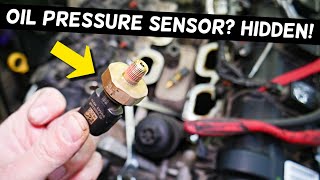
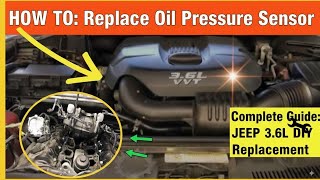
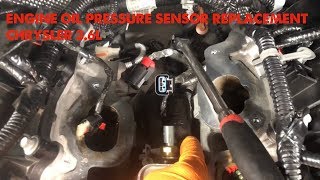
- Oil Pressure Sensor Connector — Deep in the engine valley, mounted on the oil cooler/filter housing assembly, underneath the upper and lower intake manifolds.. This 3-wire connector (5V reference, signal, ground) is in a high-heat area and is prone to oil contamination from a leaking housing, which can cause shorts or high resistance, triggering P0524 or P0520.
- Sensor Ground Circuit (K900) — This is the designation for the ground circuit wire running between the oil pressure sensor connector and the Powertrain Control Module (PCM).. High resistance (over 5.0 Ohms) on this specific circuit can cause incorrect sensor readings, leading to a false P0524 code. It must be tested for continuity if a new sensor doesn't fix the issue.
- Main Engine/Chassis Grounds — A key ground runs from the engine block to the K-member (subframe). Another factory ground runs from the block to the chassis near the intake box. The battery is located in the trunk, under the spare tire compartment.. While not a primary cause, poor engine-to-chassis grounds can create floating voltages and unstable sensor readings. Ensuring these main grounds are clean and tight is a fundamental step in any electrical diagnosis.
Real Owner Repair Stories
- American Muscle customer review (Dodge Challenger with 3.6L Pentastar) — P0520 code, which is often seen with P0524.
❌ Tried (didn't work) Replaced the entire oil filter housing assembly with an aftermarket unit that included a new sensor.
✅ What actually fixed it The P0520 code remained after the housing replacement. The problem was the cheap aftermarket sensor that came with the new housing. The code was only resolved after taking everything apart again and installing a genuine OEM Mopar sensor.
OEM Part Supersession History
68105583AA, 68105583AB, 68105583AC, 68105583AD, 68105583AE→68105583AF (and potentially newer revisions)— Revisions to address the cracking and leaking issues of the original plastic housing for 2014+ models.
Heads up: The 2014+ housing (68105583xx series) is not compatible with 2011-2013 models, which use a different part (e.g., 5184294AE).Unknown (Pre-TSB part)→Revised part specified in TSB 18-034-14 REV. A— To address a high rate of Malfunction Indicator Lamp (MIL) illumination for code P0520, which is directly related to sensor failure.
Heads up: Applies to 2013-2014 models across many Chrysler platforms with the 3.6L engine. Using an old stock sensor may lead to a repeat failure.
Model Year Variations Within This Range
- 2011-2013: Uses a different oil filter housing and cooler assembly (P/N 5184294AE) than later models. The special tool required to mechanically test oil pressure is also different for this year range.
- 2014+: Uses the updated oil filter housing design (P/N 68105583xx series). This part has gone through multiple revisions (AA through AF and beyond) to try and solve the persistent cracking issue.
- 2013-2014: These model years were specifically called out in TSB 18-034-14 REV. A for a high failure rate of the original oil pressure sensor, requiring replacement with a revised part to fix P0520, a common companion code to P0524.
Diagnostic Flowchart
Other Known Issues on This Vehicle
Issues unrelated to this code that are worth knowing about as an owner of this generation:
- Rocker Arm / Lifter Failure ('Pentastar Tick') 🔴 High — Very common across all model years. The needle bearings in the rocker arms fail, causing a distinct ticking noise, misfires (P030x codes), and potential camshaft damage. (Ref: While no universal recall exists, class-action lawsuits have been filed regarding this issue. TSB 09-003-15 addresses ticking on the related 3.2L engine.)
- Left Cylinder Head Defect (2011-2013 models) 🔴 High — Affects early Pentastar engines (typically pre-July 2012 builds). Worn valve guides and seats on the left-side head (Bank 2) cause compression loss, misfires (P0302, P0304, P0306), and rough idle. (Ref: Chrysler issued TSB 09-002-14 Rev. B and an extended warranty (10 years/150,000 miles), which has now expired for most vehicles.)
- Cracked Thermostat Housing 🟠 Medium — The plastic thermostat housing is prone to cracking and leaking coolant, similar to the oil filter housing. This is a common cause of coolant loss and potential overheating.
- Alternator Failure 🟠 Medium — The alternator, particularly on earlier models, has a higher-than-average failure rate, leading to a no-charge condition and battery warning light.
Used vs. New Parts: Buying Guide for This Vehicle
When a used part is the smart pick: For this specific repair, using a used part is NOT recommended for the primary failure components. The oil filter housing and oil pressure sensor are known high-failure items due to material degradation from heat. A used part from a junkyard is likely to have experienced the same heat cycles and will have a very short remaining lifespan, if it hasn't failed already.
What to inspect on the donor part:
- Not applicable, as used versions of the oil filter housing and sensor should be avoided.
OEM-only on this vehicle (don't cheap out):
- Engine Oil Pressure Sensor
Aftermarket brands forum-validated for this vehicle:
- Dorman (specifically their aluminum upgrade versions of the oil filter housing, P/N 926-959 for 2014+ and 926-876 for 2011-2013)
Brands owners have reported issues with on this vehicle:
- Unbranded/no-name oil pressure sensors, especially those included in cheap, complete oil filter housing kits. Forum and user experiences show these have a very high out-of-box failure rate, often requiring the entire labor-intensive job to be redone.
Real Owner Stories
Aggregated from forums and TSBs cited above. Mileages and costs reflect what owners reported in those sources.
2014 Chrysler 300 3.6L Pentastar V6
Symptoms: Oil pressure sensor failing, potentially reading fixed high values or triggering circuit codes.
What fixed it: Replacement of the original sensor with a revised part as specified in TSB 18-034-14 REV. A.
Source hint: TSB 18-034-14 REV. A
2011-2013 Chrysler 300 3.6L Pentastar V6
Symptoms: Engine misfires on Bank 2 and potential ticking noises.
What fixed it: Replacement of the left cylinder head due to a known factory defect.
Source hint: TSB 09-002-14 REV. B
2017 Chrysler 300 3.6L Pentastar V6 — ~85000 miles
Symptoms: Visible oil leak in the engine valley and a burning oil smell from the engine bay.
What fixed it: Replacement of the plastic oil filter housing and cooler assembly with an aluminum version.
Source hint: https://www.reddit.com/r/Chrysler300/comments/17d9x1g/filter_housing_or_oil_cooler_leak/
Related OBD-II Codes
Frequently Asked Questions
Does TSB 18-034-14 REV. A apply to my 2014 Chrysler 300 with the 3.6L engine?
I have a 2012 Chrysler 300 and I'm hearing a ticking noise along with the P0524 code. Is this related?
Should I replace the oil pressure sensor when I fix my leaking oil filter housing?
Is there an upgrade for the plastic oil filter housing that keeps cracking on my Chrysler 300?
Can using the wrong oil filter cause a P0524 code on the 3.6L Pentastar?
Where is the oil leak usually located if it's causing low pressure on this engine?
Helpful Videos
Used OEM Parts in Stock


New Aftermarket Parts Available


The information in this article is provided for general reference and educational purposes only. Vehicle specifications, procedures, and part compatibility can vary by production date, trim level, and region. Always consult your vehicle's factory service manual and verify part numbers before purchasing or performing repairs. Safety-critical components such as airbags, seat belts, and braking systems should be installed by a qualified professional.
- Chrysler 300:
- 🎬 Helpful Videos
- 🛍️ Shop This Part
- What's Unique About the 2011-2023 Chrysler 300
- Symptoms You May Notice
- Most Likely Causes
- Rare But Worth Checking
- Diagnosis Steps
- Parts You'll Likely Need
- Related Codes That Often Appear With This One
- Technical Service Bulletins (TSBs) & Recalls
- Platform-Specific Known Issues
- Mechanic-Grade Diagnostic Values
- Scan Tool Commands That Help
- Wiring & Ground Locations
- Real Owner Repair Stories
- OEM Part Supersession History
- Model Year Variations Within This Range
- Diagnostic Flowchart
- Other Known Issues on This Vehicle
- Used vs. New Parts: Buying Guide for This Vehicle
- Real Owner Stories
- 2014 Chrysler 300 3.6L Pentastar V6
- 2011-2013 Chrysler 300 3.6L Pentastar V6
- 2017 Chrysler 300 3.6L Pentastar V6 — ~85000 miles
- Related OBD-II Codes
- Frequently Asked Questions
- 🎟️ Get 5% Off