

P0456 on 2006-2011 BMW 3-Series: EVAP Very Small Leak Causes and Fixes
For a P0456 code on a 2006-2011 BMW 3-Series, the most likely cause is a worn-out gas cap seal. Start by replacing the gas cap with a genuine BMW part (16117222391) for about $25-$40. If that doesn't work, the next most common failure is the EVAP system's DMTL pump (Bosch 0261222018), a known issue on this platform. A smoke test is the best way to confirm other, less common leaks.
- P0456 means your BMW has detected a very small leak in the fuel vapor system.
- Start your diagnosis by replacing the gas cap with a genuine BMW part; it's the most likely and cheapest fix.
- If a new gas cap doesn't solve it, the DMTL pump is the next most common failure point on an E9x 3-Series.
- Do not guess and replace parts. A professional smoke test is the most accurate way to find the leak if it's not the gas cap.
- This code will not leave you stranded, but it will cause an automatic failure on an emissions test.
What's Unique About the 2006-2011 BMW 3-Series
The 2006-2011 3-Series (E90, E91, E92, E93 generation) uses a specific component called a Diagnostic Module Tank Leakage (DMTL) pump to test the EVAP system. This pump, along with the gas cap, are the most frequent culprits for a P0456 code on this platform. Unlike some other brands where the gas cap is almost always the sole cause, a faulty DMTL pump is a very common issue on these BMWs and should be the second component you investigate if a new gas cap does not resolve the issue. The pump itself can develop internal faults or cracks in its plastic housing, leading to a failed test. The BMW system diagnoses leaks by monitoring the electrical current drawn by the DMTL pump; it knows the current draw associated with a reference leak and triggers a fault if the measured current deviates.
🎬 See how the DMTL system works and how to diagnose itGeneration note: This guide covers the E9x generation of the BMW 3-Series, which includes the E90 (sedan, 2006-2011), E91 (wagon, 2006-2011), E92 (coupe, 2007-2013), and E93 (convertible, 2007-2013). The EVAP system components and common failure points are largely consistent across these models and their various engines (N52, N54, N55, etc.). The location of the purge valve is consistent in the engine bay, while the DMTL pump and charcoal canister are located in the rear wheel well area. However, on 328i/330i models, it's typically on the passenger side, while on 335i models, it's on the driver's side.
Symptoms You May Notice
- Check Engine Light is on
- A faint smell of fuel, particularly around the rear of the car (less common)
- An 'Increased Emissions' warning on the iDrive or instrument cluster display
- Difficulty refueling (gas pump nozzle clicks off repeatedly), which can indicate a blocked charcoal canister.
- Replacing the DMTL pump or other components before replacing the gas cap. The gas cap is the cheapest and most likely fix, and should always be the first step.
- Performing a smoke test without using a scan tool to command the DMTL pump's internal changeover valve to close. This will cause smoke to exit the system's fresh air intake filter, making it appear like there is a large leak when there isn't one.
Most Likely Causes
- Loose or Faulty Gas Cap 🔴 High Probability The rubber O-ring seal on the gas cap degrades, hardens, and cracks over time, preventing a perfect seal. This is the most common and cheapest failure point for any EVAP leak.
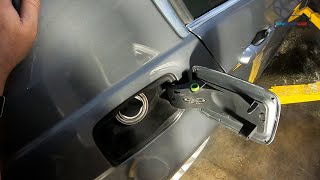
How to confirm: First, ensure the cap is tightened until it clicks. If the code returns, inspect the green or blue rubber seal for cracks or brittleness. The easiest confirmation is to replace it with a new OEM part, as they are inexpensive and aftermarket caps are known to cause issues.
Typical fix: Replace the gas cap. It is highly recommended to use a genuine OEM BMW cap, as some aftermarket caps do not seal correctly.
Est. part cost: $25-$40 - Faulty DMTL Pump 🟡 Medium Probability The Diagnostic Module Tank Leakage (DMTL) pump is a known high-failure item on this platform. The plastic housing can crack, the internal motor can fail, or leaks can even develop through the electrical connector pins. It is also susceptible to wiring breaks near the connector due to its exposed location. It is responsible for pressurizing the system for the leak test, and a fault in the pump will be interpreted by the ECU as a system leak.
How to confirm: This is best confirmed with a smoke test or a BMW-specific scan tool (ISTA/INPA). A mechanic will command the DMTL valve closed and inject smoke into the EVAP system. If the pump is faulty, smoke may be seen leaking from the pump body itself or its connections. The pump is located in the rear wheel well area, attached to the charcoal canister.
Typical fix: Replace the DMTL pump assembly. This involves removing the rear wheel and fender liner to access the component. The pump is typically held to the charcoal canister by three T20 Torx screws.
Est. part cost: $100-$200 - Faulty Fuel Tank Vent Valve (Purge Valve) 🟡 Medium Probability This solenoid valve is located in the engine bay and is subject to constant heat cycles. It can become stuck partially open, creating a leak path from the EVAP system to the intake manifold.
How to confirm: Remove the valve (located near the intake manifold, under the throttle body on N52/N54 engines). With the valve unplugged and removed from the car, try to blow through it. If any air passes through, it is faulty and needs to be replaced.
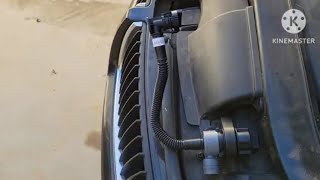
Typical fix: Replace the fuel tank vent valve. Access requires removing the engine air intake boot. 🎬 Watch: Step-by-step guide to replacing the fuel tank vent valve
Est. part cost: $70-$120 - Cracked or Brittle EVAP Hoses ⚪ Low Probability The plastic and rubber hoses throughout the EVAP system become brittle with age and can develop hairline cracks, especially at connection points and where they are exposed to engine heat.
How to confirm: A smoke test is the only reliable way to find a very small leak in a hose. Smoke will be seen escaping from the cracked portion of the line. Pay close attention to the lines connecting to the purge valve in the engine bay and the lines around the DMTL pump/charcoal canister.
Typical fix: Replace the specific section of cracked hose. In some cases, a full hose assembly may need to be replaced.
Est. part cost: $20-$100
Rare But Worth Checking
- Leaking Fuel Pump or Level Sender Seal: The large O-ring seals for the fuel pump and level sender units, located under the rear seat, can degrade and cause a leak. This was identified in a diagnostic video via a smoke test where smoke was seen escaping from under the rear seat access panel. A fuel smell inside the cabin is a strong indicator of this issue. In one documented case, the plastic locking rings for the fuel pump and sending unit caps themselves developed hidden cracks, causing a leak that was found after a smoke test.
- Cracked Charcoal Canister: While less common for a 'very small leak', the plastic body of the charcoal canister (located near the DMTL pump) can develop hairline cracks over time. This is often caused by physical damage or consistently overfilling the fuel tank, which saturates the canister with liquid fuel.
- Cracked Fuel Filler Neck: Corrosion or physical damage can cause small cracks in the fuel filler neck, which is part of the sealed EVAP system. A smoke test will reveal smoke escaping from around the filler neck area, separate from the gas cap seal.
Diagnosis Steps
- Read the code with an OBD-II scanner to confirm P0456.
- Inspect the gas cap. Ensure it is tight. If it has been several years or the seal looks worn, replace it with a new OEM BMW gas cap (Part No. 16117222391). Clear the code and drive for a few days. Note that the EVAP monitor runs only under specific conditions, so it may take several drive cycles for the light to go off or come back on.
- If the code returns, perform a visual inspection of all accessible EVAP hoses in the engine bay, particularly the lines connected to the fuel tank vent/purge valve under the intake manifold. Look for obvious cracks or loose connections.
- Test the fuel tank vent/purge valve. Remove the valve from the engine bay. With the electrical connector unplugged, attempt to blow air through it. If any air passes, the valve is stuck open and must be replaced.
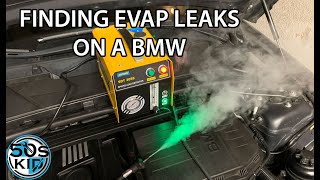
- The next step is a professional smoke test. This is the most effective way to find the leak. 🎬 Watch: Professional smoke test and leak diagnosis walkthrough The test involves injecting low-pressure, UV-dyed smoke into the EVAP system.
- Connect the smoke machine to the EVAP service port. On the E90, this is typically done by disconnecting the line from the purge valve in the engine bay and connecting the smoke machine there.
- Using a BMW-compatible scan tool (like INPA or ISTA), command the DMTL pump's vent valve to the closed position for the test. Failure to do this will result in a misdiagnosis as smoke will simply exit the fresh air filter.
- Observe the system for smoke. Check around the DMTL pump, charcoal canister, all hose connections, the fuel tank vent valve, and the seals for the fuel pump/senders under the rear seat.
- Once the source of the smoke is found, replace the faulty component.
Parts You'll Likely Need
- Gas Cap
(OEM #16117222391)— This is the most common cause of a P0456 code due to the seal wearing out over time.
Trusted brands: BMW (OEM)
OEM price range: $25-$40
Aftermarket price range: $15-$30 - DMTL Pump (Leak Diagnosis Pump)
(OEM #16137193479)— This is a very common failure point on the E9x platform, either from an internal fault or a cracked housing. The OEM part is made by Bosch.
Trusted brands: Bosch (OEM - Part No. 0261222018), BMW (OEM)
OEM price range: $90-$150
Aftermarket price range: $70-$120 - Fuel Tank Vent Valve (Purge Valve)
(OEM #13907618643)— This valve can stick open due to age and heat cycles in the engine bay, creating a constant small leak.
Trusted brands: Bosch (OEM), BMW (OEM)
OEM price range: $70-$120
Aftermarket price range: $40-$80
Related Codes That Often Appear With This One
- P0442 — P0442 indicates a 'small leak' whereas P0456 indicates a 'very small leak'. They point to the same type of problem, just a different leak size detected by the ECU. A leak may start as a P0456 and worsen over time to a P0442.
- 2B3A — This is a BMW-specific fault code that directly points to a DMTL pump system fault. If you see this code alongside P0456, the DMTL pump is almost certainly the culprit.
- 2A17 — A BMW-specific code for 'DMTL, system fault'. This often points to a wiring issue or an internal failure of the DMTL pump module itself.
- 2A15 / 2A16 — These are BMW codes for 'DMTL, fine leakage' and 'DMTL, finest leakage' respectively. They are the manufacturer-specific equivalents that trigger the generic P0456 code.
- 2A18 — This BMW-specific code indicates an open circuit in the DMTL pump's heater element. This points to a wiring problem or a failure within the DMTL unit, as the heater, pump, and valve are integrated.
Platform-Specific Known Issues
- Owner Experience: Chasing P0456, turned out to be DMTL: On the e90post forums, a user described getting a P0456 code. After replacing the gas cap didn't solve the issue, they were advised that the DMTL pump is the next likely culprit. Another user confirmed their issue was also the DMTL pump, which was replaced by the dealer to fix the code.
- Owner Experience: Smoke Test Misdiagnosis: A user on bimmerpost documented their smoke test for a P0456 on their 2010 E91. They introduced smoke via the purge valve line and saw a large amount of smoke exiting the DMTL pump's fresh air filter. Other users pointed out this is normal if the DMTL's internal valve isn't commanded shut with a scan tool, highlighting a common DIY diagnostic error.
Mechanic-Grade Diagnostic Values
- Voltage at DMTL Pump Connector (X17140), Pin 4 (Red/White wire) to ground — expected: 12V+ with ignition on (or shortly after shutdown). Failure: 0V indicates a power supply issue, likely from fuse F17 or the DME main relay (KL87).
- Continuity test on DMTL pump ground wires — expected: Near 0 Ohms of resistance between the DMTL connector pin and its corresponding pin at the DME connector (X60002).. Failure: High resistance or an open circuit (OL) indicates a broken wire in the harness, a common issue.
Hidden / Shadow Codes Worth Checking
- 2A15: DMTL, fine leakage. This is the BMW-specific code for a small leak, equivalent to P0456. (see via BMW-specific scan tools like ISTA, INPA, or advanced aftermarket scanners.)
- 2A16: DMTL, finest leakage. This is the BMW-specific code for a very small leak, equivalent to P0456. (see via BMW-specific scan tools like ISTA, INPA, or advanced aftermarket scanners.)
- 2A17: DMTL, system fault. This code suggests a problem with the DMTL module itself, such as an internal motor or valve failure, or a wiring issue. (see via BMW-specific scan tools like ISTA, INPA, or advanced aftermarket scanners.)
- 2A18: DMTL, heater, activation (Open Circuit). This points specifically to a fault in the DMTL's internal heater circuit or its wiring. (see via BMW-specific scan tools like ISTA, INPA, or advanced aftermarket scanners.)
Scan Tool Commands That Help
- ISTA / INPA: DMTL System Test (or 'Fuel tank leakage diagnostic module DMTL') — This is the primary service function to diagnose the EVAP system. It commands the DMTL pump to run a full test cycle, including a reference measurement, which can confirm if the pump is functioning correctly and if the system can hold pressure.
- ISTA / INPA: DMTL Pump Activation — This command is used to manually activate the DMTL pump and close the changeover valve. It is essential for performing a smoke test, as it seals the system and allows it to be pressurized to find external leaks.
Wiring & Ground Locations
- X17140 — The 4-pin electrical connector at the DMTL pump itself, located in the rear wheel well area.. This is the primary point for testing power and ground signals to the DMTL pump. The wires here are known to break or corrode. Pin 4 (Red/White) is power, Pin 1 (Brown/Blue) is pump motor ground, Pin 2 (Black/Red) is heater ground, and Pin 3 (Black/Green) is valve ground.
- X60002 — A main connector at the DME (engine computer) located in the electronics box (E-box) in the engine bay.. This is the other end of the wiring harness from the DMTL pump. Continuity must be checked between the pins at X17140 and their corresponding pins here (e.g., X17140/1 to X60002/16) to rule out a broken wire.
Real Owner Repair Stories
- E90post forum user 'AggieZig' (2010 BMW E91 w/ N52 engine) — P0456 - Evap leak detected (very small leak)
❌ Tried (didn't work) Replacing the gas cap., Performing a smoke test from the engine bay purge valve line, which showed no leaks.
✅ What actually fixed it The user performed a second smoke test by connecting the smoke machine directly to the DMTL pump's input. This successfully pressurized the system and revealed that both the fuel pump and fuel level sender locking rings (under the rear seat) had hidden cracks. Replacing these cracked rings resolved the leak.
"I Checked Everything" — The Actual Cause
- A common scenario is performing a smoke test without using a scan tool to command the DMTL's internal changeover valve to close. This causes smoke to immediately exit the fresh air filter vent, making it seem like there's a massive leak or that the system cannot be pressurized. The actual cause is often a small leak elsewhere that can only be found once the system is properly sealed via the scan tool command.
- If BMW-specific codes like 2A17 (DMTL system fault) or 2A18 (DMTL heater fault) are present, the DMTL pump itself can be internally faulty without any external smoke leak. The DME detects an incorrect electrical current draw from the pump motor or a break in the heater circuit, interpreting it as a system failure.
OEM Part Supersession History
16136752551, 16136764191→16137193479— Standard part evolution and potential design improvements to address failure rates.
Model Year Variations Within This Range
- 2006-2013: The physical location of the DMTL pump and charcoal canister assembly can vary. On 335i and M3 models, it is typically located on the driver's side (left rear). On other models like the 325i, 328i, and 330i, it is often on the passenger's side (right rear).
Diagnostic Flowchart
Used vs. New Parts: Buying Guide for This Vehicle
When a used part is the smart pick: A used charcoal canister from a low-mileage, non-corrosion-belt donor car can be a cost-effective option if the original is physically cracked. Used EVAP lines or a fuel filler neck can also be viable if they are in excellent physical condition with no signs of brittleness or cracking.
Donor-vehicle mileage cap: roughly under 60000 miles for the part to have meaningful remaining life.
What to inspect on the donor part:
- For charcoal canisters, ensure there are no visible cracks or signs of fuel saturation.
- For hoses, bend them gently to check for any brittleness or cracking; they should still be pliable.
- For electrical components like the purge valve or DMTL pump, verify the donor car did not have EVAP-related fault codes if possible.
OEM-only on this vehicle (don't cheap out):
- Gas Cap: Aftermarket gas caps are notoriously unreliable and often do not seal correctly, leading to a repeat P0456 code. Always use a genuine BMW cap.
- DMTL Pump: While some aftermarket options exist, the OEM Bosch unit is the most reliable choice. Given the labor to access it, using a proven OEM part is recommended to avoid repeat repairs.
Aftermarket brands forum-validated for this vehicle:
- Bosch: Bosch is the Original Equipment Manufacturer (OEM) for the DMTL pump and fuel tank vent (purge) valve. Buying the Bosch-branded part is equivalent to the genuine BMW part but often at a lower cost.
Brands owners have reported issues with on this vehicle:
- Unbranded/generic gas caps.
- While Dorman offers a replacement DMTL pump, owner experiences can be mixed. The OEM Bosch unit is generally preferred for longevity.
Real Owner Stories
Aggregated from forums and TSBs cited above. Mileages and costs reflect what owners reported in those sources.
2008 3-Series
Symptoms: Check Engine Light with code P0456 persisted even after replacing the gas cap.
What fixed it: The dealer replaced the DMTL pump, which resolved the code.
Source hint: Owner Experience: Chasing P0456, turned out to be DMTL
2010 3-Series Wagon
Symptoms: P0456 code was present. During a DIY smoke test, a large amount of smoke was seen exiting the DMTL pump's fresh air filter.
What fixed it: This was a diagnostic issue, not a repair. The owner learned that the DMTL pump's internal valve must be commanded shut with a scan tool for a smoke test to be valid, preventing a misdiagnosis.
Source hint: Owner Experience: Smoke Test Misdiagnosis
Related OBD-II Codes
Frequently Asked Questions
Where is the DMTL pump located on my 2006-2011 3-Series?
I'm doing a smoke test for P0456 and smoke is pouring out of the DMTL pump's filter. Is the pump bad?
What is the official BMW part number for the gas cap to fix a P0456 leak?
How can I test the fuel tank vent valve (purge valve) myself?
I replaced my gas cap and cleared the code, but the Check Engine Light came back on after a day. What's next?
Why did my Check Engine Light not turn off immediately after I replaced the gas cap?
Are other BMWs like the X1 or 1-Series also prone to P0456 from the same parts?
Helpful Videos
Used OEM Parts in Stock


New Aftermarket Parts Available


The information in this article is provided for general reference and educational purposes only. Vehicle specifications, procedures, and part compatibility can vary by production date, trim level, and region. Always consult your vehicle's factory service manual and verify part numbers before purchasing or performing repairs. Safety-critical components such as airbags, seat belts, and braking systems should be installed by a qualified professional.
- BMW 3-Series:
- 🎬 Helpful Videos
- 🛍️ Shop This Part
- What's Unique About the 2006-2011 BMW 3-Series
- Symptoms You May Notice
- Most Likely Causes
- Rare But Worth Checking
- Diagnosis Steps
- Parts You'll Likely Need
- Related Codes That Often Appear With This One
- Platform-Specific Known Issues
- Mechanic-Grade Diagnostic Values
- Hidden / Shadow Codes Worth Checking
- Scan Tool Commands That Help
- Wiring & Ground Locations
- Real Owner Repair Stories
- "I Checked Everything" — The Actual Cause
- OEM Part Supersession History
- Model Year Variations Within This Range
- Diagnostic Flowchart
- Used vs. New Parts: Buying Guide for This Vehicle
- Real Owner Stories
- 2008 3-Series
- 2010 3-Series Wagon
- Related OBD-II Codes
- Frequently Asked Questions
- 🎟️ Get 5% Off