

OBD-II Code P2402: EVAP Leak Detection Pump Control Circuit High
What P2402 means, why it triggers, and how to fix it for good
- P2402 indicates an electrical short to power in the EVAP leak detection pump circuit, meaning a loose gas cap will never cause this code.
- Replacing the EVAP leak detection pump (LDP or DMTL) resolves the P2402 code in over 80% of cases, with parts costing between $80 and $300.
- You can safely drive with a P2402 code, but your vehicle will automatically fail state emissions testing until the electrical fault is repaired.
- Volkswagen, Audi, and BMW owners should check for active Technical Service Bulletins (TSBs) or extended warranties, as pump failures on these models are heavily documented.
What Does P2402 Mean?

P2402 means the Powertrain Control Module (PCM) detects abnormally high voltage in the EVAP leak detection pump's electrical circuit. This pump pressurizes the fuel system to test for vapor leaks, preventing pollution from escaping into the atmosphere.
Technical definition: The official SAE/OBD-II definition is "Evaporative Emission System Leak Detection Pump Control Circuit High." The PCM detects voltage in the EVAP leak detection pump control circuit above the specified range. This typically occurs when the PCM commands the pump off but still reads near battery voltage, indicating a short to power.
Can I Drive With P2402?
Yes, But With Caution. Yes, you can safely drive. This code does not affect engine performance or vehicle safety. However, your vehicle will automatically fail an emissions test. Ignoring it long-term won't cause direct engine damage, but a constantly running pump shortens the charcoal canister's life. On models like the VW Atlas, an active P2402 also disables the remote start feature.
🎬 See why this Passat owner had a P2402 code.Common Causes

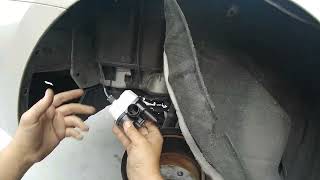
- Faulty EVAP Leak Detection Pump (LDP/DMTL) (Very Common) — The pump itself is the most frequent point of failure. Over time, the internal motor wears out or develops an electrical short, causing it to send a high voltage reading back to the computer. This is a heavily documented issue on Volkswagen, Audi, and BMW models. 🎬 Watch: How to replace the leak detection pump on a Jetta.
- Corroded Wiring or Connectors (Water Intrusion) (Common) — Because the pump is located in a wheel well or near the fuel tank, it is exposed to road spray and salt. Water intrusion causes corrosion and short circuits in the wiring harness or connector, sending a false high-voltage signal to the PCM.
- Stuck EVAP Relay (Less Common) — A relay supplying power to the LDP circuit can get stuck in the closed position. This supplies continuous power to the circuit, resulting in a high voltage reading even when the PCM commands the pump off.
- Clogged or Damaged Charcoal Canister (Less Common) — A blockage in the charcoal canister forces the leak detection pump to work harder or run continuously. This excessive strain eventually causes the pump's internal electrical components to short out and fail.
- PCM Software/Calibration Error (Rare) — An outdated PCM software calibration misinterprets normal voltage fluctuations as a fault, incorrectly triggering the P2402 code. Re-flashing the PCM with the latest manufacturer software resolves this.
- Faulty Powertrain Control Module (PCM) (Rare) — The internal driver circuit within the PCM that controls the pump fails, sending a constant high voltage signal. This is the absolute last item to check after exhaustively ruling out the pump and wiring.
Symptoms

- Check Engine Light is On — The Malfunction Indicator Lamp (MIL) stays illuminated until the electrical fault is repaired and the code is cleared.
- Failed Emissions Test — The EVAP system readiness monitor cannot complete with an active P2402, causing an automatic failure during state emissions inspections.
- Rattling or Buzzing Noise From Under Vehicle — A failing leak detection pump running continuously or struggling to operate produces a distinct rattling or buzzing noise from the rear passenger wheel well, especially on cold starts.
- Remote Start Disabled — Modern vehicles, such as the Volkswagen Atlas, automatically disable the remote start feature when an emissions-related fault like P2402 is active.
- Fuel Odor — You notice a slight smell of gasoline around the rear of the vehicle because the malfunctioning pump prevents the EVAP system from properly containing and purging fuel vapors.
Diagnostic Flowchart

Tap your situation to follow the diagnostic path that matches what you're seeing on this code.
Common Fixes & Costs
- Replace EVAP Leak Detection Pump (LDP/DMTL) — Parts: $80-$300, Labor: $150-$300 (Note: Labor reaches $1200+ on Toyota Tacomas where bed removal is required), ~1.5 hr book time (Intermediate)
- Repair Damaged Wiring or Replace Connector — Parts: $10-$50, Labor: $150-$300, ~2 hr book time (Intermediate)
- Replace Faulty Relay — Parts: $15-$40, Labor: $20-$50, ~0.3 hr book time (DIY)
- Replace Charcoal Canister Assembly — Parts: $250-$500, Labor: $150-$300, ~1.5 hr book time (Intermediate)
- Replace/Reprogram Powertrain Control Module (PCM) — Parts: $600-$1200, Labor: $200-$300, ~1.5 hr book time (Professional)
Used vs. New Parts: Buying Guide
When a used part is worth it: Buying a used leak detection pump is not recommended. The savings are minimal compared to the high risk of the used part failing shortly after installation.
Donor-vehicle mileage cap: roughly under 40000 miles for the part to have meaningful remaining life.
Donor quality checklist:
- Source only from a very low-mileage vehicle.
- Ensure the part number is an exact match, including superseding numbers.
- Avoid parts from regions with heavy road salt use, as corrosion is the primary failure cause.
Decision logic:
- If The part is an electronic pump with a high failure rate (LDP/DMTL). → Buy a new OEM or OEM-supplier (Bosch) part. Reliability outweighs the small cost savings.
- If Budget is the absolute primary concern and the vehicle is old. → A used part is a gamble, but provides a temporary solution. Expect premature failure.
- If A new part is less than $150. → Always buy new. The cost of repeat labor for a failed used part exceeds initial savings.
Warranty tradeoff: Used parts come with a 30-90 day warranty. New aftermarket parts offer a 1-year to limited lifetime warranty. New OEM parts carry a 1-2 year warranty.
Worst-case if a used part fails: $200-$500 if a used pump fails after the warranty period, representing the cost of a new part plus repeat installation labor.
What Happens If You Wait — Timeline
- 0-1 Month: Code P2402 is set, and the Check Engine Light turns on. The vehicle automatically fails an emissions test. There are no noticeable effects on driving performance. (MPG impact: 0%% · Added cost: $0)
- 1-6 Months: The leak detection pump runs continuously instead of only during its test cycle. This causes an audible buzzing from the rear of the vehicle and accelerates wear on the pump's internal motor. (MPG impact: 0-1%% · Added cost: $0)
- 6-12 Months: The continuously running pump motor overheats and burns out completely, blowing the corresponding EVAP fuse. The rattling noise stops because the pump is dead. (MPG impact: 0-1%% · Added cost: $5-$20 for a new fuse, but the pump is definitively destroyed.)
- 12+ Months: A continuously malfunctioning EVAP system places long-term stress on the charcoal canister. Ignoring the Check Engine Light leads to 'diagnostic fatigue,' masking new engine problems. (MPG impact: 1-2%% · Added cost: $250-$500 if the charcoal canister is damaged by the malfunctioning system.)
Cost of Not Fixing It
- Short-Term (0-3 Months): Guaranteed failure of any state emissions inspection. A minor decrease in fuel economy (1-3%) occurs. (Added cost: Negligible, other than the cost of a failed emissions test.)
- Medium-Term (3-12 Months): A shorted, continuously running pump overheats and burns out completely. This places continuous stress on the charcoal canister, shortening its lifespan. (Added cost: $250-$700 if the charcoal canister requires premature replacement.)
- Long-Term (1+ Year): Ignoring the check engine light causes 'diagnostic fatigue,' masking new, severe trouble codes. A persistent electrical fault occasionally damages the PCM driver. (Added cost: Varies. The main cost is the risk of ignoring a more serious future engine problem.)
Diagnosis Steps
- Scan for Codes and Review Freeze Frame Data
Use an OBD-II scanner to confirm P2402 is the active code. Review the freeze frame data to see the exact engine conditions when the fault triggered. Do not clear the code yet, as this erases vital diagnostic data.
Tools: OBD-II Scanner (Beginner) - Visually Inspect Wiring and Connectors
Locate the EVAP leak detection pump near the charcoal canister (often behind the rear passenger-side wheel well liner). Inspect the electrical connector and wiring harness for green corrosion, melted plastic, frayed wires, or water intrusion.
Tools: Flashlight, safety glasses, trim removal tools (Beginner) - Use a Bi-Directional Scan Tool to Command the Pump
If available, use an advanced scan tool to command the LDP ON and OFF. If the pump does not click or change current draw, but power and ground are verified, the pump is dead. If it activates but voltage remains high, suspect a wiring short.
Tools: Bi-directional scan tool (Advanced) - Test the Control Circuit Voltage (Key On, Engine Off)
With the pump connected and ignition on (engine off), backprobe the control circuit wire at the pump's connector. When commanded OFF, it should read near 0 volts. A reading above 11-13V confirms a short to power or a failed pump sending voltage back.
Tools: Multimeter, wiring diagram, backprobe pins (Advanced) - Test the Leak Detection Pump's Internal Resistance
Disconnect the pump. Measure the resistance (Ohms) between the pump's terminals. Infinite resistance means an internal failure. For VW/Audi pumps, measure between pins 1 & 3 (expect 640-720 Ω) and pins 2 & 3 (expect 15-17 Ω). Readings outside this range confirm a bad pump.
Tools: Multimeter, vehicle service manual (Intermediate) - Check EVAP Relays
Locate the EVAP system relay in the fuse box. Test the relay with a multimeter or swap it with a known good relay of the identical type. A stuck-closed relay causes the constant high voltage seen in P2402.
Tools: Owner's manual, multimeter (Intermediate) - Isolate the Circuit to Test for a Short to Power
If the pump and relay test good, disconnect both the PCM and the pump connector. Check for continuity between the control wire and the power wire in the harness. Any continuity confirms the wires are shorted together in the harness.
Tools: Multimeter, wiring diagram (Advanced) - Check the PCM Driver Circuit
Reconnect the pump. Check the voltage signal directly at the PCM's output pin for the LDP control circuit. Command the pump on and off. If the PCM fails to pull the voltage to ground when commanded, the PCM's internal driver has failed.
Tools: Advanced scan tool, oscilloscope/multimeter, wiring diagram (Professional)
When This Code Triggers (Freeze-Frame Conditions)
- Engine Coolant Temp: 170-210°F (77-99°C) (The EVAP monitor test runs when the engine is fully warmed up.)
- Fuel Level: 15-85% (The test requires the fuel tank to be neither full nor empty to ensure proper pressure testing.)
- Vehicle Speed: 40-65 mph (64-105 kph) (The code is set during steady-state cruising on a highway.)
- Ambient Air Temperature: 40-95°F (4-35°C) (The EVAP monitor has a specific temperature window in which it operates.)
Related Codes
- P2401 — Indicates 'EVAP Leak Detection Pump Control Circuit Low.' P2402 is a short to power, while P2401 is a low voltage or open circuit (broken wire). Both point to an electrical fault in the exact same circuit.
- P0442 / P0456 — These 'Small Leak' codes appear alongside P2402 because a faulty pump cannot run its self-test properly, which the PCM misinterprets as a physical leak. Fix the P2402 electrical fault first to resolve these 'ghost' leak codes.
- P04F0 — Indicates 'EVAP System Incorrect Purge Flow.' Often cited in VW TSBs alongside P2402, suggesting the faulty pump is disrupting the system's ability to manage vapor flow.
- P1434 / P1447 — BMW-specific codes translating to 'DMTL Pump Current Too High.' They accompany the generic P2402 and directly point to the failed DMTL pump.
Climate & Environmental Factors
- Road Salt and Moisture: In regions with winter road salting, the leak detection pump and its wiring are highly susceptible to corrosion. This creates unintended electrical paths, leading to short circuits and the 'Circuit High' condition.
- Cold Weather: Moisture freezes within the pump or connector causing a temporary short, or the pump motor struggles to operate in the cold, drawing higher-than-normal current which the PCM interprets as a fault.
How to Talk to a Mechanic About This Code
Say this: "I have a P2402 code, indicating an EVAP Leak Detection Pump Control Circuit High. I need a diagnostic to confirm if the pump has an internal short or if there is a short-to-power in the wiring harness. Please save the freeze frame data before clearing any codes."
This signals you understand it's an electrical fault, not a simple gas cap leak. It directs the technician to the correct diagnostic path (pump, wiring, relay) and prevents unnecessary smoke tests for physical leaks.
Avoid saying:
- 'My check engine light is on, can you look at it?' (Too vague, invites a broad, expensive diagnostic process).
- 'I think I have an EVAP leak.' (Implies a physical leak, leading them down the wrong path of smoke testing).
- 'Just fix whatever is wrong.' (Gives the shop a blank check to replace parts without proper diagnosis).
Questions to ask before authorizing the repair:
- Did you test the voltage on the pump's control circuit to confirm the 'high' condition?
- Did you test the internal resistance of the pump itself?
- If the pump is bad, did you check the relay and fuse to make sure the old one didn't blow it?
- If the pump and fuse are good, how will you test the wiring harness for a short to power?
- Can you provide me with the old parts when the repair is complete?
Where to Take It: Dealer vs Independent vs Chain
- Dealer:
Best for: Vehicles under warranty (VW, Audi, BMW often have extended warranties for this part)., Complex cases where a PCM software update (reflash) is the required fix., Newer vehicles where manufacturer-specific diagnostic tools are essential.
Downsides: Highest labor rates, often 1.5-2x more than an independent shop., Recommends replacing entire assemblies (e.g., canister with pump) when only the pump is needed. (Typical cost: +50% vs. baseline) - Independent Shop:
Best fit for most out-of-warranty vehicles. P2402 is a common code, and a reputable independent shop with good electrical diagnostic skills handles it effectively and affordably.
Best for: Out-of-warranty vehicles where cost is a major factor., Shops specializing in your vehicle's brand (e.g., a German auto specialist for a VW/BMW)., Straightforward part replacements once the diagnosis is clear.
Downsides: Quality and diagnostic capabilities vary widely; vet shops by reviews and ASE certifications., Lacks access to the very latest Technical Service Bulletins (TSBs) or warranty extensions. (Typical cost: +0% vs. baseline) - Chain Shop:
AVOID for this code. Diagnosing a circuit fault requires more expertise than is typically found at a chain shop. High risk of misdiagnosis and paying for unnecessary parts.
Best for: Simple, unrelated maintenance like oil changes or tires.
Downsides: Technicians lack the in-depth electrical diagnostic experience for a 'Circuit High' fault., High pressure to upsell common items; misdiagnoses the electrical fault as a gas cap or purge valve. (Typical cost: -10% vs. baseline)
When to Walk Away From the Repair
If the total estimated repair cost for the P2402 code exceeds 40% of your car's private-party value (from a source like Kelley Blue Book), pause and consider your options.
- Car worth $4000, fix is $1500: Walk away. The repair cost is nearly 40% of the car's value. This is especially true on a high-labor vehicle like a Toyota Tacoma.
- Car worth $15000, fix is $500: Fix it. The repair cost is a very small fraction of the car's value and is necessary to pass emissions.
- Car worth $2500, fix is $400: Fix it. While the car's value is low, the repair cost is relatively low and makes the car legally drivable and sellable.
What Scan Tool You Need for This Code
Minimum: A scanner with live data and bidirectional control to perform an active test on the EVAP leak detection pump.
A basic $20 code reader only shows the P2402 code. To diagnose a 'Circuit High' fault, you must test the components. A bidirectional scanner commands the pump ON and OFF, which is the fastest way to confirm if the pump is dead or if the wiring is the problem.
Budget: BlueDriver Pro (~$100) — Reads and clears the P2402 code, shows freeze frame data, and provides live data streams. It lacks direct bidirectional control for the EVAP pump on all vehicle models.
Mid-range: Foxwell NT510 Elite (~$160) — Provides full system diagnostics and bidirectional control (Active Test) to command the EVAP pump. This is the best-value option for a serious DIYer diagnosing this specific code.
Professional: Autel MaxiCOM MK808S (~$450) — Offers OE-level diagnostics and robust bidirectional controls. It easily commands the EVAP pump, views detailed live data, and performs system tests, making diagnosis fast and accurate.
Rent vs buy: Auto parts stores offer free code reading, but their tools are basic readers and will not perform bidirectional tests. Buying a capable scanner like the Foxwell NT510 Elite is a worthwhile investment that costs less than a single diagnostic hour at a shop.
How to Clear the Code After You Fix It
- Use an OBD-II scan tool to clear the P2402 code from the PCM's memory.
- Ensure the fuel tank is between 1/4 and 3/4 full.
- Perform a complete OBD-II drive cycle to allow the EVAP readiness monitor to run.
Drive cycle (~30 minutes): Cold start the vehicle after sitting for 8+ hours. Idle for 3 minutes. Drive for 20 minutes with a mix of city and highway speeds, including steady cruising between 40-65 mph. Allow the vehicle to cool down. Multiple cycles are often needed.
Readiness monitors affected: Evaporative System, Catalyst, O2 Sensor
Before emissions retest: drive at least 100 miles to fully set monitors.
Watch out for:
- Clearing the code with a scanner erases freeze frame data vital for diagnosis; record it first.
- Disconnecting the battery does not reliably clear the code or reset readiness monitors on modern vehicles.
- The EVAP monitor is the last to become 'Ready'. It takes several days of normal driving if the specific drive cycle isn't performed perfectly.
Will This Fail Emissions / State Inspection?
Yes — this code typically fails an OBD-II emissions inspection.
- California: An active P2402 code results in an automatic smog check failure. The EVAP readiness monitor must be set to 'Ready' to pass.
- New York: The NYS vehicle inspection includes an OBD-II scan. An illuminated Check Engine Light and active P2402 code causes an immediate failure.
- Texas: In the 17 counties requiring emissions testing, a vehicle fails the OBD-II inspection if the Check Engine Light is on. The emissions test requirement remains active in these counties.
Most Commonly Affected Vehicles
- Volkswagen Jetta, Passat, Tiguan, Atlas, Taos (2011-2023) — The leak detection pump (LDP) is a notorious failure item. For 2022+ models, VW issued TSBs (e.g., 01-23-02) and extended warranties. Failure is often preceded by a rattling noise from the rear passenger wheel well.
- Audi A4, Q5, Q7 (2009-2018) — Sharing platforms with Volkswagen, Audi models use the same failure-prone Bosch leak detection pump. Diagnosis and repair are identical to VW counterparts.
- BMW 3-Series (E90, E92), 5-Series (E60, F10), X3, X5 (2002-2016) — BMW calls the LDP a DMTL (Diagnostic Module Tank Leakage) pump. It is a high-failure item, but easily accessible for DIY replacement in the rear wheel well. The OEM Bosch part (#0261222018) has been superseded multiple times.
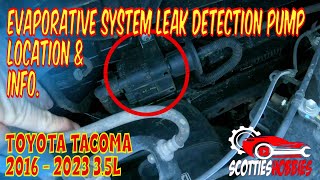
- Toyota Tacoma, Camry, Corolla, RAV4 (2013-2022) — On the Tacoma (2016+), the pump is integrated with the charcoal canister assembly under the truck bed. Accessing it requires lifting the bed, leading to repair costs exceeding $1,200.
- Subaru Outback, Forester, Impreza (2010-2018) — Subaru vehicles set this code due to a failing pump or corrosion in the wiring harness leading to the pump, especially in rust-belt states.
- Ford F-150, Escape, Focus (2012-2019) — Triggered by a faulty pump or shorts in the associated wiring. Diagnosis must include checking the entire circuit for shorts to power.
- Honda CR-V (2017-2022) — Honda's diagnostic procedure requires using the HDS tool to run a module test and check for continuity in the ground line to isolate the high voltage condition.
- Hyundai / Kia Elantra, Sonata, Optima, Sorento (2010-2020) — Typically points to a faulty leak detection pump or a wiring circuit issue near the rear wheel well.
Manufacturer-Specific Notes
- Volkswagen/Audi: Extremely high failure rate for the LDP, accompanied by a rattling sound on cold starts. VW has issued multiple TSBs and extended warranties for the pump.
- Toyota: On 2016+ Tacomas, the leak detection pump is integrated into the charcoal canister. Accessing it requires lifting the entire truck bed, dramatically increasing labor time and repair costs.
- BMW: BMW uses the term DMTL pump. It is a known high-failure part, but relatively accessible in the rear wheel well for a DIY replacement. BMW offered a 10-year/120,000-mile extended warranty on the DMTL pump for specific models.
- Jaguar: P2402 is caused by a design flaw where road spray enters the pump. TSB JTB00436NAS2 details the fix: replacing the pump and canister, and adding a foam shield to prevent water intrusion.
Real Owner Stories
2014 VW Jetta at 125k miles - The Straightforward Fix
Check Engine Light appeared with code P2402. No other symptoms were present.
What they tried:
- Owner researched forums pointing overwhelmingly to the Leak Detection Pump (LDP).
Outcome: Owner replaced the LDP themselves for $235. The part was located in the rear passenger wheel well. After clearing the code, it did not return.
Lesson: For VW models, P2402 is almost always a failed LDP. A DIY replacement is highly feasible and saves significant labor costs.
2014 VW Jetta 1.8T - The Misdiagnosis 'Boomerang'
Car experienced shuddering at idle. Later, the Check Engine Light came on with code P2402.
What they tried:
- Replaced spark plugs and coil packs, which did not solve the shudder.
- Replaced the Leak Detection Pump, fixing the issue for one month.
- The shudder and P2402 code returned.
Outcome: The code returned, proving the replacement LDP was defective or a clogged charcoal canister caused strain on the new pump.
Lesson: If a new part fails quickly, check for underlying issues like a wiring short or a clogged charcoal canister causing the new part to fail.
2017 Toyota Tacoma at 75k miles - The 'Gang of Codes'
Check Engine Light appeared with a cluster of EVAP codes: P2401, P2402, P2419, P043E, and P043F.
What they tried:
- Owner checked fuses and performed a DIY smoke test, finding no leaks.
- Mechanic shops quoted $1,500, citing failure of the pump/canister assembly requiring truck bed removal.
Outcome: The owner replaced the gas cap (OEM Part 77300-07030). After clearing the codes, the Check Engine Light stayed off.
Lesson: Even when a code points to an electrical fault, it appears with general EVAP leak codes. Try the cheapest fixes first before committing to a $1,500 repair.
2022 VW Atlas - The Warranty Win
Newer vehicle threw a P2402 code. Owner heard a rattling noise from the rear of the car.
What they tried:
- Owner confirmed the code and symptoms were common for this model via online forums.
Outcome: The dealer replaced the Leak Detection Pump under an extended warranty VW issued for this known failure.
Lesson: For newer vehicles, check for Technical Service Bulletins (TSBs) or extended warranties before paying for a repair. A call to the dealer saves hundreds of dollars.
How to Prevent This Code From Triggering
- Apply Dielectric Grease to the LDP Connector (During any service near the rear wheel wells) — Dielectric grease is a non-conductive sealant that blocks moisture and road salt from entering the connector, preventing the corrosion that causes short circuits.
- Regularly Wash the Vehicle's Undercarriage (Monthly, especially in winter for regions using road salt) — Road salt is highly corrosive to the LDP housing and wiring harness. Washing the underbody removes corrosive agents before they cause damage.
- Do Not 'Top Off' Your Fuel Tank (Every fill-up) — Overfilling forces liquid gasoline into the charcoal canister. A saturated canister sheds carbon particles that are drawn into and destroy the leak detection pump.
- Inspect and Secure Wheel Well Liners (Annually or after hitting road debris) — The wheel well liner is the primary physical shield protecting the LDP from road spray. A cracked liner allows direct impact from water and salt, accelerating failure.
Frequently Asked Questions
Can a loose gas cap cause code P2402?
No. A loose gas cap triggers codes for physical leaks, like P0456. P2402 is strictly an electrical circuit problem related to the pump's control system.
What is the most common misdiagnosis for P2402?
Replacing purge valves, vent solenoids, or the gas cap before testing the leak detection pump's electrical circuit. Another mistake is replacing the pump without checking if a stuck relay caused the original failure.
Is it safe to drive with code P2402?
Yes, it is safe to drive. The code relates to the emissions system and does not affect performance or safety. However, you will fail state emissions testing.
How much does it cost to fix P2402?
Replacing the leak detection pump costs between $230 and $600 for parts and labor. Diagnostic fees add $100-$150. Costs exceed $1,200 on vehicles like the Toyota Tacoma due to intensive labor requirements.
Where is the leak detection pump located?
The pump is located in the rear of the vehicle, near the fuel tank and charcoal canister. On VWs and BMWs, you must remove a rear wheel and the plastic wheel well liner to access it.
I replaced the pump and the code P2402 came back. What now?
If a new pump fails to clear the code, you have a short-to-power in the wiring harness or a stuck EVAP relay. Use a multimeter to test the control circuit wire for constant battery voltage. If voltage remains high with the pump unplugged, trace the harness to find the short.
What does DMTL pump mean?
DMTL stands for Diagnostic Module Tank Leakage. This is the terminology used by BMW and European manufacturers for the EVAP leak detection pump.
Key Takeaways
- P2402 indicates an electrical short to power in the EVAP leak detection pump circuit, meaning a loose gas cap will never cause this code.
- Replacing the EVAP leak detection pump (LDP or DMTL) resolves the P2402 code in over 80% of cases, with parts costing between $80 and $300.
- You can safely drive with a P2402 code, but your vehicle will automatically fail state emissions testing until the electrical fault is repaired.
- Volkswagen, Audi, and BMW owners should check for active Technical Service Bulletins (TSBs) or extended warranties, as pump failures on these models are heavily documented.
Helpful Videos

The information in this article is provided for general reference and educational purposes only. Vehicle specifications, procedures, and part compatibility can vary by production date, trim level, and region. Always consult your vehicle's factory service manual and verify part numbers before purchasing or performing repairs. Safety-critical components such as airbags, seat belts, and braking systems should be installed by a qualified professional.
- 🎬 Helpful Videos
- What Does P2402 Mean?
- Can I Drive With P2402?
- Common Causes
- Symptoms
- Diagnostic Flowchart
- Common Fixes & Costs
- Used vs. New Parts: Buying Guide
- What Happens If You Wait — Timeline
- Cost of Not Fixing It
- Diagnosis Steps
- When This Code Triggers (Freeze-Frame Conditions)
- Related Codes
- Climate & Environmental Factors
- How to Talk to a Mechanic About This Code
- Where to Take It: Dealer vs Independent vs Chain
- When to Walk Away From the Repair
- What Scan Tool You Need for This Code
- How to Clear the Code After You Fix It
- Will This Fail Emissions / State Inspection?
- Most Commonly Affected Vehicles
- Manufacturer-Specific Notes
- Real Owner Stories
- 2014 VW Jetta at 125k miles - The Straightforward Fix
- 2014 VW Jetta 1.8T - The Misdiagnosis 'Boomerang'
- 2017 Toyota Tacoma at 75k miles - The 'Gang of Codes'
- 2022 VW Atlas - The Warranty Win
- How to Prevent This Code From Triggering
- Frequently Asked Questions
- Can a loose gas cap cause code P2402?
- What is the most common misdiagnosis for P2402?
- Is it safe to drive with code P2402?
- How much does it cost to fix P2402?
- Where is the leak detection pump located?
- I replaced the pump and the code P2402 came back. What now?
- What does DMTL pump mean?
- Key Takeaways
- 🎟️ Get 5% Off