

P0442 on 2010-2014 Subaru Outback: EVAP Small Leak Causes and Fixes
For a 2010-2014 Outback, P0442 is most often a loose or faulty gas cap. If that's not it, the next most likely cause is a rusted fuel filler neck. A new OEM gas cap is about $25-$40, while a filler neck replacement can cost $150-$300+. A smoke test is the best way to find the exact leak source.
- Always check your gas cap first. Make sure it's tight and the seal isn't cracked. This solves the problem a surprising amount of the time.
- If the gas cap isn't the issue, the next most likely culprit on a 2010-2014 Outback is a rusted fuel filler neck, especially if you live in an area with snow and road salt.
- A visual inspection of the filler neck (behind the right rear wheel) and small vacuum hoses in the engine bay can often reveal the source of the leak.
- Driving with P0442 is not dangerous, but it will prevent you from passing an emissions test.
- If you can't find the leak visually, a smoke test performed by a mechanic is the fastest and most accurate way to find the source.
What's Unique About the 2010-2014 Subaru Outback
While P0442 can happen on any car, the 4th generation Outback (2010-2014) and other Subarus of this era are particularly known for two issues beyond the simple gas cap. The first is a fuel filler neck that is highly prone to rusting out, especially in regions that use road salt. The second is the tendency for small rubber EVAP hoses to become brittle and crack, particularly one in the engine bay running from the intake manifold to the fuel pressure regulator.
Symptoms You May Notice
- Check Engine Light is on
- Cruise control is disabled (a side effect of the CEL being active)
- A faint smell of fuel, possibly intermittent, especially after cold starts or while driving
- Vehicle will fail an emissions inspection test
- Immediately replacing the purge valve or other expensive components without first checking the gas cap and inspecting the fuel filler neck.
- Replacing the gas cap but using a cheap aftermarket one that doesn't seal correctly, leading the technician to believe the cap was not the issue.
Most Likely Causes
- Loose or Faulty Gas Cap 🔴 High Probability This is the most common cause on any vehicle. The cap may not have been tightened enough (until it clicks), or the rubber O-ring seal has become old, cracked, or hard.
How to confirm: Remove the gas cap, inspect the rubber seal for any cracks or damage, and reinstall it, tightening until it clicks several times. Clear the code and see if it returns after a few drive cycles.
Typical fix: Replace the gas cap. It is highly recommended to use an OEM (Original Equipment Manufacturer) cap from Subaru, as some aftermarket caps do not seal properly.
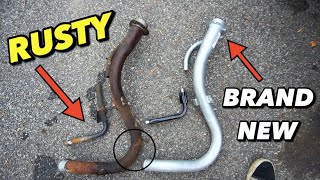
Est. part cost: $25-$40 - Rusted or Cracked Fuel Filler Neck 🔴 High Probability Subarus from this era are known for the metal fuel filler pipe rusting through, especially in the 'rust belt'. The rust creates tiny pinholes that the EVAP system detects as a leak.
How to confirm: A thorough visual inspection is required. This involves removing the right rear wheel and the plastic splash shield in the wheel well to get a clear view of the entire pipe. Look for heavy rust, flaking metal, or wet spots. A smoke test will definitively show smoke billowing from the rusted section.
Typical fix: The rusted filler neck must be replaced. This involves disconnecting the old pipe from the fuel tank and body and installing a new one. Owners on forums confirm this is a very common fix.
Est. part cost: $100-$250 - Cracked or Disconnected EVAP Hoses 🟡 Medium Probability Rubber hoses become brittle with age and exposure to engine heat. A specific hose in the engine bay running from the intake to the fuel regulator is a known failure point, as shown in multiple DIY videos. Other short rubber lines under the intake manifold can also crack.
How to confirm: Visually inspect all accessible EVAP hoses in the engine bay and around the charcoal canister (located near the fuel tank) for cracks, brittleness, or loose connections. A smoke test is the most effective way to find a hard-to-see hose leak.
Typical fix: Replace the cracked section of hose or the entire hose. Ensure new clamps are used for a secure connection.
Est. part cost: $5-$50 - Faulty Purge Control Solenoid/Valve 🟡 Medium Probability This valve controls the flow of fuel vapors to the engine. It can fail electronically or get stuck slightly open, creating a leak path that the system detects.
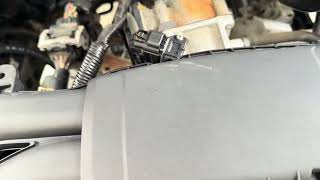
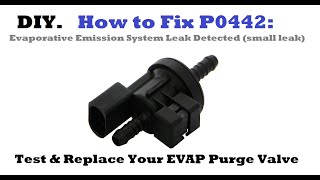
How to confirm: The valve is located in the engine bay, under the air intake ducting. It can be tested by applying 12V power to see if it clicks. When de-energized, you should not be able to blow air through it; if you can, it has failed internally and is stuck open. 🎬 Watch: How to test and replace the EVAP purge valve.
Typical fix: Replace the purge control solenoid. It is typically mounted to the intake manifold area.
Est. part cost: $40-$80
Rare But Worth Checking
- Faulty Vent Valve / Canister Close Valve: This valve is located near the charcoal canister under the car. It can get stuck open due to dirt or debris, or fail electrically. This usually throws other codes (like P0446) but can sometimes cause a P0442.
- Cracked Charcoal Canister: The plastic housing of the canister can crack from physical damage or age. This is less common than other failures but is a possible leak source. Over-filling the gas tank (topping off) can also saturate the canister with liquid fuel, causing it to fail.
- Leaking Fuel Pump Gasket: The gasket sealing the fuel pump assembly to the top of the fuel tank can degrade and leak. This is often difficult to diagnose without a smoke test, as the leak is on top of the tank.
- Rusted Fuel Tank Seams: While more common on other Subaru models like the Forester, NHTSA ODI #11535637 notes that steel tanks can rust at the seam, causing a strong gas smell, fuel leaks when driven on an incline, and a P0442 code.
Diagnosis Steps
- Read the code with an OBD-II scanner to confirm P0442 is present.
- Check the gas cap. Remove it, inspect the seal for cracks, and retighten it until it clicks multiple times. Clear the code and drive for a few days to see if it returns.
- If the code comes back, consider replacing the gas cap with a new OEM part (Part # 42038-AG000) as a cheap and easy potential fix.
- Perform a visual inspection of the fuel filler neck. This requires safely jacking up the vehicle, removing the right rear wheel, and removing the plastic splash shield to view the pipe. Look for significant rust or damage.
- Inspect all visible EVAP hoses in the engine bay, especially the small line running from the intake manifold to the fuel pressure regulator, for cracks or loose connections.
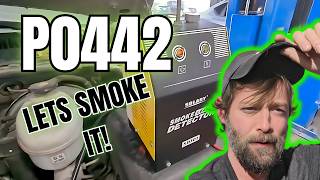
- If no obvious cause is found, the most effective next step is to have a smoke test performed. A machine fills the EVAP system with a visible vapor, which will escape from the location of the leak, making it easy to pinpoint. This is the definitive way 🎬 See how a professional uses a smoke test to find leaks. to find leaks in hoses, the filler neck, canister, or tank gaskets.
- Based on the smoke test results, test or replace the identified leaking component, which could be a hose, valve, or the charcoal canister.
Parts You'll Likely Need
- Fuel Cap
(OEM #42038-AG000)— This is the most frequent cause of P0442. The seal wears out over time, and aftermarket caps can have sealing issues. Using an OEM part is strongly recommended.
Trusted brands: Subaru (OEM)
OEM price range: $25-$40
Aftermarket price range: $15-$30 - Fuel Filler Neck
(OEM #42075AJ090 (Excludes California emissions))— A very common failure point on Subarus of this generation due to rust creating pinhole leaks.
Trusted brands: Subaru (OEM), Spectra Premium, Dorman
OEM price range: $200-$250
Aftermarket price range: $100-$180 - Purge Control Solenoid Valve — This valve is a common failure item that gets stuck open, creating a constant small leak in the system.
Trusted brands: Denso, Bosch, Standard Motor Products
OEM price range: $60-$90
Aftermarket price range: $40-$70
Related Codes That Often Appear With This One
- P0455 — Evaporative Emission System Leak Detected (Large Leak). A large leak can sometimes be flagged as a small leak initially, or vice-versa, depending on the test conditions.
- P0456 — Evaporative Emission System Leak Detected (Very Small Leak). This is a similar code indicating a smaller leak threshold, often caused by the same components.
- P0457 — Evaporative Emission System Leak Detected (Fuel Cap Loose/Off). This code specifically points to the gas cap, but a faulty cap seal or a rusted filler neck can sometimes trigger a P0442 instead.
Technical Service Bulletins (TSBs) & Recalls
- TSB 16-107-17R: Details the CVT warranty extension to 10 years/100,000 miles for 2010-2015 models.
- TSB 02-157-14R: Revises the repair procedure for excessive oil consumption on 2013-2014 2.5L models, mandating a short block replacement instead of just piston rings.
Platform-Specific Known Issues
- The fuel filler neck is highly susceptible to corrosion in areas where road salt is used, making it a primary suspect for P0442 on these vehicles.
- A small rubber hose running from the intake manifold to the fuel pressure regulator in the engine bay is known to become brittle and crack, causing a P0442 code. A YouTube short by 'SoCar Garage' clearly shows this hose and its location.
- Short rubber fuel/vapor lines located under the intake manifold are also a known, though harder to access, failure point that can cause intermittent fuel smells and EVAP codes.
Mechanic-Grade Diagnostic Values
- Purge Control Solenoid Coil Resistance — expected: Approximately 26-36 Ohms. Failure: A reading significantly outside this range, or an open/short circuit, indicates a failed solenoid coil.
- EVAP Vent Valve / Solenoid Coil Resistance — expected: Approximately 30-50 Ohms. Failure: A reading outside this range, especially a low reading or an open circuit, points to a failing solenoid.
- Fuel Tank Pressure (FTP) Sensor Voltage (Key ON, Engine OFF, gas cap off) — expected: Approximately 1.5V (acceptable range 1.3V - 1.7V). Failure: A voltage reading stuck near 0V or 5V indicates a faulty sensor or wiring issue.
Scan Tool Commands That Help
- Subaru Select Monitor (SSMIII / SSM4): On-Board System Test (for ELCM) — For models 2012 and newer with an Evaporative Leak Check Module (ELCM), this forces the system to run its internal self-test. It allows a technician to monitor pressure data to diagnose leaks without a smoke machine, which is crucial as pressurizing or smoking an ELCM system can damage it.
- Subaru Select Monitor (SSM): Green Connector 'Test Mode' — On pre-ELCM models, connecting the green test connectors under the driver's dash puts the car in a test mode that cycles all relays and solenoids, including EVAP valves. This allows a technician to listen for clicks to confirm mechanical actuation without a scan tool.
- Advanced Bidirectional Scanner (e.g., Autel): Vent Valve Close / Activation Test — During a smoke test, the vent valve is normally open. This command forces it closed, sealing the system so the smoke machine can build pressure and reveal leaks. Without this, smoke will just exit through the open vent valve.
Wiring & Ground Locations
- ECM (Engine Control Module) — Located on the right side of the dash.. The ECM is the source of all diagnostic commands and receives data from the Fuel Tank Pressure sensor to determine if a leak is present.
- Fuse & Relay Box (F/B) — Located in the left kick panel area, inside the cabin.. Contains fuses and relays that power the EVAP system components. A blown fuse for a purge or vent valve circuit would cause a circuit code, but could be investigated if a valve is inoperative.
Real Owner Repair Stories
- YouTube channel 'SoCar Garage' (Subaru (model unspecified, but common issue)) — P0442 code for a small EVAP leak.
✅ What actually fixed it The small rubber hose running from the intake manifold to the fuel pressure regulator in the engine bay had become hard, brittle, and developed a small crack. Replacing this short piece of fuel line resolved the code. - Reddit user 'Dmech', Subaru Tech (2006 Subaru Impreza Outback Sport) — Intermittent P0442 code and an occasional whiff of fuel, especially on cold starts.
❌ Tried (didn't work) Replacing the gas cap.
✅ What actually fixed it The user, a Subaru tech, states that three very short rubber fuel/vapor lines under the intake manifold are a common source for this exact issue. They become brittle and leak vapor (before leaking liquid fuel), causing an intermittent P0442 and fuel smell. The fix is to replace these hoses. - YouTube channel 'DIYNORTHCAROLINIAN' (2012 Subaru Outback 2.5L) — P0442 code.
✅ What actually fixed it The previous owner or mechanic had installed the incorrect part for the purge control solenoid. After replacing it with the correct OEM part, the code was resolved. - NHTSA ODI #11535637 (Subaru Forester reference) — An owner reported a strong gas smell and gasoline leaking when driven on an incline. After checking for a P0442 "evap leak small" code, the owner discovered that the steel tank had rusted where the seam of the tank is.
"I Checked Everything" — The Actual Cause
- A user on JustAnswer reported a P0442 and a wet gas cap even after replacing the cap and filler neck with OEM parts. The expert suspected the evaporative canister was malfunctioning and not allowing vapors to purge correctly, causing them to accumulate and condense at the fuel cap.
- A Subaru technician on Reddit noted that spiders' webs can block the EVAP vent hose, creating a restriction that can set a P0442 code. This would not show up as a leak in a smoke test.
OEM Part Supersession History
Unknown→42075AJ090— Standard part for this generation.
Heads up: This part number is specified as 'Exc. Calif.' (Excluding California), meaning PZEV vehicles may require a different part number.Unknown→16131AA060— Purge solenoid for California emissions (PZEV) models 2010-2012, and all 2.5L models 2013-2014.
Heads up: There are different purge valves for PZEV and non-PZEV models in the early years of this generation. Using the wrong one will not fix the issue.
Model Year Variations Within This Range
- 2010-2012: There are different part numbers for the Vapor Canister Purge Solenoid depending on whether the vehicle is a Federal (non-PZEV) or California (PZEV) emissions model. For 2013-2014, it appears they were consolidated to a single part.
- 2012-2014: Later models in this generation are equipped with an Electronic Leak Check Module (ELCM) instead of a traditional pressure/vacuum system. This changes the diagnostic procedure; a smoke machine should NOT be used on an ELCM system. Instead, the Subaru Select Monitor scan tool is used to initiate a system self-test.
Diagnostic Flowchart
Other Known Issues on This Vehicle
Issues unrelated to this code that are worth knowing about as an owner of this generation:
- CVT Transmission Problems 🔴 High — Common enough that Subaru extended the CVT warranty to 10 years/100,000 miles for these models. Problems include shuddering, hesitation, and complete failure. (Ref: TSB 16-107-17R (Warranty Extension))
- Excessive Oil Consumption (FB25 Engine) 🔴 High — Primarily affects the 2.5L FB25 engine in 2013-2014 models. Consumption can exceed 1 quart per 1,200-1,400 miles. A class-action lawsuit was filed over this issue. (Ref: TSB 02-157-14R (revised procedure to replace short block instead of just piston rings))
- Leaking Head Gaskets (EJ253 Engine) 🟠 Medium — More common on the 2.5L EJ253 engine used from 2010-2012. The single-layer gaskets were prone to leaking oil or coolant externally.
- Frequently Burnt-Out Headlight Bulbs 🟡 Low — Many owners report headlight bulbs failing frequently, sometimes every 6-12 months. Accessing the bulbs for replacement is also notoriously difficult.
- Takata Airbag Inflator Recall 🔴 High — Part of the massive global recall, affecting 2010-2014 models. The passenger-side inflator could rupture during deployment. (Ref: NHTSA Recalls 15V323, 16V064, 17V065, etc.)
Used vs. New Parts: Buying Guide for This Vehicle
When a used part is the smart pick: A used fuel filler neck from a donor vehicle in a dry, salt-free climate can be a good value, as the primary failure mode is rust. If the used part is rust-free, it is likely to have a long life. Other electronic components like solenoids are generally not recommended to be purchased used due to unknown remaining lifespan.
Donor-vehicle mileage cap: roughly under 120000 miles for the part to have meaningful remaining life.
What to inspect on the donor part:
- For a fuel filler neck, inspect for any signs of rust, flaking paint, or deep pitting, especially around welds and mounting brackets.
- Ensure all hose connection points are smooth and free of corrosion.
- Verify the donor vehicle is from a state without heavy road salt usage (e.g., Arizona, California, Texas vs. New York, Michigan, Ohio).
OEM-only on this vehicle (don't cheap out):
- Fuel Cap: Aftermarket gas caps are a frequent cause of recurring P0442 codes due to improper sealing. It is strongly recommended to use a genuine Subaru OEM cap.
Aftermarket brands forum-validated for this vehicle:
- Spectra Premium (for Fuel Filler Neck)
- Dorman (for Fuel Filler Neck)
- Denso (for Purge/Vent Solenoids)
- Standard Motor Products (SMP) (for Purge/Vent Solenoids)
Brands owners have reported issues with on this vehicle:
- Unbranded, low-cost aftermarket gas caps are frequently reported as failing to seal properly.
Real Owner Stories
Aggregated from forums and TSBs cited above. Mileages and costs reflect what owners reported in those sources.
2012 Subaru Outback 2.5
Symptoms: Check Engine Light with code P0442.
What fixed it: Replaced an incorrectly installed purge solenoid with the correct part for the vehicle.
Source hint: youtube_comment from DIYNORTHCAROLINIAN
2013 Subaru Outback
Symptoms: P0442 code present; user on Reddit predicted a rusted fuel filler neck.
What fixed it: Replacement of the rusted fuel filler neck as identified via a parts diagram and visual inspection.
Source hint: Reddit r/subaru & r/MechanicAdvice thread titled 'P0442 code' (2023)
2010-2014 Subaru Outback
Symptoms: Intermittent fuel smells and EVAP codes.
What fixed it: Replacement of short rubber fuel/vapor lines located under the intake manifold.
Source hint: vehicle_specific_issues
2011 Subaru Outback 2.5
Symptoms: P0442 code; visual inspection of the engine bay revealed a brittle, cracked hose.
What fixed it: Replacement of the small rubber hose running from the intake manifold to the fuel pressure regulator.
Source hint: YouTube short by 'SoCar Garage'
Related OBD-II Codes
Frequently Asked Questions
Is there a specific gas cap I should buy for my 2010-2014 Outback to fix P0442?
Why does my cruise control stop working when the P0442 code appears?
I live in the 'rust belt'; is there a specific part prone to P0442 on my Subaru?
Does TSB 02-157-14R relate to my P0442 EVAP code?
Is there a common hose failure in the engine bay for this model?
Where is the purge control solenoid located on the 2010-2014 Outback?
Can a rusted fuel tank cause a P0442 code on a Subaru?
Helpful Videos
We Have This Part in Stock


The information in this article is provided for general reference and educational purposes only. Vehicle specifications, procedures, and part compatibility can vary by production date, trim level, and region. Always consult your vehicle's factory service manual and verify part numbers before purchasing or performing repairs. Safety-critical components such as airbags, seat belts, and braking systems should be installed by a qualified professional.
- Subaru Outback:
- 🎬 Helpful Videos
- 🛍️ Shop This Part
- What's Unique About the 2010-2014 Subaru Outback
- Symptoms You May Notice
- Most Likely Causes
- Rare But Worth Checking
- Diagnosis Steps
- Parts You'll Likely Need
- Related Codes That Often Appear With This One
- Technical Service Bulletins (TSBs) & Recalls
- Platform-Specific Known Issues
- Mechanic-Grade Diagnostic Values
- Scan Tool Commands That Help
- Wiring & Ground Locations
- Real Owner Repair Stories
- "I Checked Everything" — The Actual Cause
- OEM Part Supersession History
- Model Year Variations Within This Range
- Diagnostic Flowchart
- Other Known Issues on This Vehicle
- Used vs. New Parts: Buying Guide for This Vehicle
- Real Owner Stories
- 2012 Subaru Outback 2.5
- 2013 Subaru Outback
- 2010-2014 Subaru Outback
- 2011 Subaru Outback 2.5
- Related OBD-II Codes
- Frequently Asked Questions
- 🎟️ Get 5% Off